
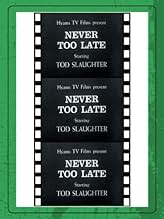
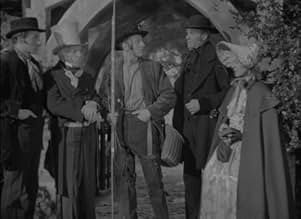
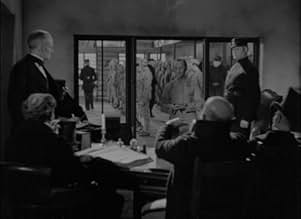
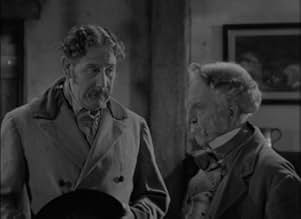
An evil prison administrator cruelly abuses the inmates at his prison, until one day the tables are turned.An evil prison administrator cruelly abuses the inmates at his prison, until one day the tables are turned.An evil prison administrator cruelly abuses the inmates at his prison, until one day the tables are turned.



John Singer
- Matthew Josephs
- (as Johnny Singer)
Cecil Bevan
- Prison Inspector
- (uncredited)

Leonard Sharp
- Henry Bradshaw
- (uncredited)
Douglas Stewart
- Prison Inspector
- (uncredited)

Mavis Villiers
- Betty
- (uncredited)
Jack Vyvyan
- Innkeeper
- (uncredited)
- Director
- Writers
- All cast & crew
- Production, box office & more at IMDbPro
5.9302
1
2
3
4
5
6
7
8
9
10
Featured reviews
"Spare the rod, spoil the child"
A bit heavy on the sentimentality, and laying on the sadism pretty thick, Tod Slaughter plays the grotesquely inhumane Justice who treats the prisoners of his local gaol as his "naughty children", taking pleasure in exacerbating their misery and humiliation. His nemesis played by Jack Livesey pledges to return the favour in spades having come in for some rough treatment after taking the rap for his friend (Ian Colin) with whom Slaughter is competing for the affections of the nubile Susan (Taylor).
There's some moments of the depravity and malevolence with which Slaughter's characters are synonymous (the rough justice meted out to poor little Matty Josephs is primed to tug at the heart strings), but director MacDonald has avoided the sexual deviancy that is present in the George King pictures. As a consequence, Slaughter's character is brutal and morally corrupt as always, but not so dastardly that he would burn at the stake for his crimes.
Livesey is pretty good as the knock-about farmer, willing to take a bullet for his friend as a square-up for having once saved his life, and Taylor is suitably torn in her chastity for her poor boyfriend abroad, and the apparent munificence and adulation poured over her family by the scheming Slaughter; her facial expressions whenever Slaughter makes veiled sexual undertones are perhaps exactly what you'd expect when a creepy, corpulent walrus-like aristocrat seeks to charm the brassiere of a virgin some thirty years his junior. Solid 66 minute citizen, but nothing remarkable.
There's some moments of the depravity and malevolence with which Slaughter's characters are synonymous (the rough justice meted out to poor little Matty Josephs is primed to tug at the heart strings), but director MacDonald has avoided the sexual deviancy that is present in the George King pictures. As a consequence, Slaughter's character is brutal and morally corrupt as always, but not so dastardly that he would burn at the stake for his crimes.
Livesey is pretty good as the knock-about farmer, willing to take a bullet for his friend as a square-up for having once saved his life, and Taylor is suitably torn in her chastity for her poor boyfriend abroad, and the apparent munificence and adulation poured over her family by the scheming Slaughter; her facial expressions whenever Slaughter makes veiled sexual undertones are perhaps exactly what you'd expect when a creepy, corpulent walrus-like aristocrat seeks to charm the brassiere of a virgin some thirty years his junior. Solid 66 minute citizen, but nothing remarkable.
It's never too late to start watching Tod Slaughter films.
In It's Never Too Late to Mend, Tod Slaughter plays yet another despicable villain, Squire John Meadows, who doesn't exactly twirl his moustache, but does stroke it quite a bit. The squire has his beady eyes set on pretty Susan Merton (Slaughter's regular co-star Marjorie Taylor), but she is in love with penniless farmer George Fielding (Ian Colin). Not one to give up, the squire tries to have Fielding (wrongly) arrested for poaching, but the farmer's best friend Tom (Jack Livesey), who George once rescued from a frozen lake, owns up to the crime to repay his debt.
Before the squire can come up with another dastardly scheme, George sets sail to Australia to make his fortune, promising Susan that he will return to marry her in two years. While George is away, the squire, who is justice of the peace and runs the local prison with an iron rod, makes life a misery for poor Tom; he also intercepts and destroys letters between George and Susan, and spreads rumours that George has found a wife in Australia. With Susan's father's approval, the wicked man proposes marriage to Susan, but is shocked to learn that George has returned from Oz and is now a wealthy man...
Once again, it is Slaughter's pantomime performance that makes this film so watchable: he is the epitome of slimy Victorian villainy, rubbing his hands with glee and chuckling with laughter as he treats other humans with utter disdain. In the prison, he delights in punishing 15-year-old Matty Josephs, imprisoned for stealing bread to feed his starving mother, and insists on personally lashing inmates with the 'cat'. Those who complain are thrown in 'the hole', a windowless cell where the occupant slowly loses their mind. If he were alive today, Tod would be perfect to play Dick Dastardly in a live-action Wacky Racers.
Based on a book by Charles Reade, which exposed the dreadful conditions in Victorian prisons and prompted reform, It's Never Too Late to Mend is a condemnation of corporal punishment, and a morality play with religious overtones, Tom helped through his darkest hour by the prison chaplain, and the sadistic squire winding up as an inmate in his own hell-hole (you reap what you sow). Ultimately, though, it's another opportunity to witness one of cinema's greatest unsung actors, the wonderfully wicked Tod Slaughter, at his very best.
6.5/10, rounded up to 7 for IMDb.
Before the squire can come up with another dastardly scheme, George sets sail to Australia to make his fortune, promising Susan that he will return to marry her in two years. While George is away, the squire, who is justice of the peace and runs the local prison with an iron rod, makes life a misery for poor Tom; he also intercepts and destroys letters between George and Susan, and spreads rumours that George has found a wife in Australia. With Susan's father's approval, the wicked man proposes marriage to Susan, but is shocked to learn that George has returned from Oz and is now a wealthy man...
Once again, it is Slaughter's pantomime performance that makes this film so watchable: he is the epitome of slimy Victorian villainy, rubbing his hands with glee and chuckling with laughter as he treats other humans with utter disdain. In the prison, he delights in punishing 15-year-old Matty Josephs, imprisoned for stealing bread to feed his starving mother, and insists on personally lashing inmates with the 'cat'. Those who complain are thrown in 'the hole', a windowless cell where the occupant slowly loses their mind. If he were alive today, Tod would be perfect to play Dick Dastardly in a live-action Wacky Racers.
Based on a book by Charles Reade, which exposed the dreadful conditions in Victorian prisons and prompted reform, It's Never Too Late to Mend is a condemnation of corporal punishment, and a morality play with religious overtones, Tom helped through his darkest hour by the prison chaplain, and the sadistic squire winding up as an inmate in his own hell-hole (you reap what you sow). Ultimately, though, it's another opportunity to witness one of cinema's greatest unsung actors, the wonderfully wicked Tod Slaughter, at his very best.
6.5/10, rounded up to 7 for IMDb.
The Horrors of a Victorian Prison
Not surprisingly, this is a very good Tod Slaughter film. Much better than I anticipated. Slaughter does not disappoint - nor does the rest of the cast, directing and story.
Slaughter plays Squire John Meadows, a cruel man that is head of the prison (justice of the peace)and provides plenty of creative punishments for the inmates: straight-jackets, near starvation, whips and more. What's worse he's found a way to try to imprison an innocent man in order to pursue the man's lady friend.
Lovely use of shadows as only B&W films can capture, wonderful cinematography, a cruel story, excellent performances by the cast. This is a worthwhile drama - it's no masterpiece but it is good.
8/10
Slaughter plays Squire John Meadows, a cruel man that is head of the prison (justice of the peace)and provides plenty of creative punishments for the inmates: straight-jackets, near starvation, whips and more. What's worse he's found a way to try to imprison an innocent man in order to pursue the man's lady friend.
Lovely use of shadows as only B&W films can capture, wonderful cinematography, a cruel story, excellent performances by the cast. This is a worthwhile drama - it's no masterpiece but it is good.
8/10
How Despicable Can You Get!
Watching Tod Slaughter in all kinds of venues, I've come to the conclusion that he is about as bad as a person can get. He expresses this great delight with misfortune of others. He uses people for financial gain, yet at the beginnings of most of his movies, he is portrayed as being loved and respected by all. In this one, he plays a squire who is after a young woman (sound familiar) thirty years his junior. He plants traps for her true love. He also oversees a prison, being a justice of the peace. The prisoners, whom he calls his "chilldren," are abused and starved. He gleams with those big teeth over the misfortunes of these people. One boy, in particular, stole a loaf of bread to feed his dying mother (of course), and he is tortured and force to do work beyond his simple strength. Others are kept in a black hole. How despicable can you get? Of course, his comeuppance is on its way. Eventually those he has used will get there's. This guy is so great. Even though he played the same character over and over.
A more serious-minded Slaughter vehicle
Never Too Late is a typical Tod Slaughter vehicle in some ways but is also certainly the most serious-minded of his films. In it, once again, Slaughter lusts after a woman young enough to be his daughter, while concocting up a dastardly scheme to take her fiancé out of the picture. This kind of specific plot-line underpinned the majority of Slaughter's other Victorian melodramas. Where this one deviates from the norm is that it also incorporates a plot thread that takes a withering look at the prison system in Britain of that time. It shows life in these prisons to be a succession of horrors, with the inmates treated appallingly and the governors acting immorally. It's this social awareness that is a little unusual for a Slaughter melodrama but it does quite effectively make its point about the unpleasantness of the system.
Slaughter himself is once again very much the star draw though, here he plays a character called Squire John Meadows and it's a role that once again allows this great - now pretty obscure – actor to flex his acting chops. His style is the opposite of subtle and is hammy to the max. But it is difficult to play this over-the-top so well and it's a testament to Slaughter's abilities that his fully committed performances are so engaging to watch. In this one, it's perhaps his final moments that stand out the most, where, as he is dragged away by the authorities, he screams insanely at the young woman he has lusted after that her fiancé will leave her! It's a bizarre and manic display and a great way for his unhinged character to bow out of the film. On the whole, this is yet another example of why this great British actor should be rediscovered and reappraised.
Slaughter himself is once again very much the star draw though, here he plays a character called Squire John Meadows and it's a role that once again allows this great - now pretty obscure – actor to flex his acting chops. His style is the opposite of subtle and is hammy to the max. But it is difficult to play this over-the-top so well and it's a testament to Slaughter's abilities that his fully committed performances are so engaging to watch. In this one, it's perhaps his final moments that stand out the most, where, as he is dragged away by the authorities, he screams insanely at the young woman he has lusted after that her fiancé will leave her! It's a bizarre and manic display and a great way for his unhinged character to bow out of the film. On the whole, this is yet another example of why this great British actor should be rediscovered and reappraised.


Did you know
- ConnectionsFeatured in Doom Asylum (1988)
Details
- Runtime
- 1h 10m(70 min)
- Color
- Aspect ratio
- 1.37 : 1
Contribute to this page
Suggest an edit or add missing content