
An evil prison administrator cruelly abuses the inmates at his prison, until one day the tables are turned.An evil prison administrator cruelly abuses the inmates at his prison, until one day the tables are turned.An evil prison administrator cruelly abuses the inmates at his prison, until one day the tables are turned.



John Singer
- Matthew Josephs
- (as Johnny Singer)
Cecil Bevan
- Prison Inspector
- (uncredited)

Leonard Sharp
- Henry Bradshaw
- (uncredited)
Douglas Stewart
- Prison Inspector
- (uncredited)

Mavis Villiers
- Betty
- (uncredited)
Jack Vyvyan
- Innkeeper
- (uncredited)
- Director
- Writers
- All cast & crew
- Production, box office & more at IMDbPro
5.9302
1
2
3
4
5
6
7
8
9
10
Featured reviews
Good 'Ol Slaughter
Never Too Late (1937)
** 1/2 (out of 4)
Insane, over the top and sometimes hilarious Tod Slaughter movie. Slaughter plays a psychotic Justice of the Peace who falls in love with a farmer's daughter but she wants nothing to do with him. She's in love with another guy but Slaughter will go to all ends to make sure they don't marry. Slaughter has the nickname "The British Bela Lugosi" due to his over the top performances but I personally find this an insult to Lugosi and American horror films. Lugosi went over the top quite a bit but never in the way Slaughter does, which makes his films watchable but also hurts them. His over the top style kills the melodrama in the film but it helps the campy horror side. The highlight of the film has to be the prison torture stuff because it's just so damn funny due to Slaughter's wildness.
** 1/2 (out of 4)
Insane, over the top and sometimes hilarious Tod Slaughter movie. Slaughter plays a psychotic Justice of the Peace who falls in love with a farmer's daughter but she wants nothing to do with him. She's in love with another guy but Slaughter will go to all ends to make sure they don't marry. Slaughter has the nickname "The British Bela Lugosi" due to his over the top performances but I personally find this an insult to Lugosi and American horror films. Lugosi went over the top quite a bit but never in the way Slaughter does, which makes his films watchable but also hurts them. His over the top style kills the melodrama in the film but it helps the campy horror side. The highlight of the film has to be the prison torture stuff because it's just so damn funny due to Slaughter's wildness.
Underrated pre-Lean British classic
This is an underrated portrait of the Victorian prison system and the chaplain who tried to change it. An evil squire(Tod Slaughter) sends an innocent man to the British version of Alcatraz in order to get his filthy mitts on a beautiful girl. The cinematography is what makes this film so memorable. The effective use of light and shadow to accentuate the misery and suffering of the inmates, many of which are victims of a corrupt system, foreshadows a style utilized in many venerable products of English postwar cinema such as David Lean's Oliver Twist(1948) Some modern critics have panned this and many other Tod Slaughter films due to the melodramatic, stagey acting. While films like The Demon Barber of Fleet Street(1936) barely hold up today, Never Too Late is the exception because it is well-acted and photographed and is relevant to the global problem of human rights abuses that in these supposedly progressive times has still to be wiped out. After viewing this, I can see why Queen Victoria passed so many prison reform bills after seeing this story done on stage.
Tod has a whip-round
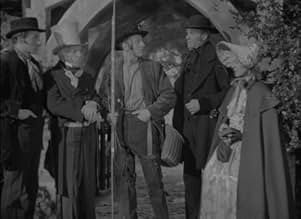
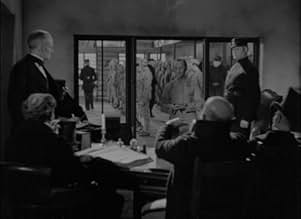
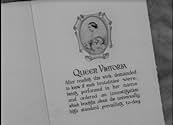
ITS NEVER TO LATE TO MEND is the most traditional of Tod's revived melodramas. It has all the elements and archetypes we expect from the genre. Tod is his usual villainous Squire self. His often comical facial features are better suited to being bewhiskered and having a bushy moustache to twiddle menacingly. As ever, he has his lecherous eye on a virtuous local maiden - Susan, daughter of Farmer Merton. She seeks the penurious local tenant farmer George Fielding (Meadows, Fielding, a slimy solicitor who aid's Tod's schemes called Crawley - the names are not exactly subtle). Tod must be the only wealthy bastard in cinema who never attracts women! But after a failed attempt to convict George for poaching, the young man leaves the country to seek his fortune Down Under. The opening titles reveal Charles Reade's and Queen Victoria's roles in prison reform and it is in the scenes where Tod visits the local gaol in his capacity of Justice of the Peace that we get to enjoy the full magnitude of his hammy villainy. His inspection of the ranks of his "naughty children" and his mocking remarks are a sadistic joy and one can imagine the audience at the Elephant and Castle theatre chuckling along as he speaks. Black comedy is also present in the Uriah Heep-like performance of one convict who makes a great show of demonstrating his penitence but, we see later, has stolen something from the Governor's office. However, the treatment of the 15-year old convict is genuinely disturbing as is John Singer's anguished breakdown.
The tension is diffused by the lack of a strong protagonist for the Squire. George Fielding is sidelined in Australia for the bulk of the narrative - returning only for the climax. The Prison Chaplain provides only token resistance to Tod's reign of terror at the gaol but appears like the 7th cavalry at the end. The main adversary is local poacher Tom Robinson - gallantly taking the blame instead of George for Tod's trumped-up poaching charge. Tom's decline from the jaunty, confident rogue of the opening scenes to a shell of his former self in prison is quite chilling, but the spiritual comfort the Chaplain lends him means a reversion to his old self.
Tom thwarts Meadows' attempts to steal George's newfound fortune. As with MARIA MARTEN, Tod has an alarming tendency to go insane at the inopportune moments - usually while holding his enemies at gunpoint as occurs here at the climax His raving madness as he is led away is genuinely alarming and the closing shot is of him relentlessly repeating the films's title as he works away on the "wheel".
The tension is diffused by the lack of a strong protagonist for the Squire. George Fielding is sidelined in Australia for the bulk of the narrative - returning only for the climax. The Prison Chaplain provides only token resistance to Tod's reign of terror at the gaol but appears like the 7th cavalry at the end. The main adversary is local poacher Tom Robinson - gallantly taking the blame instead of George for Tod's trumped-up poaching charge. Tom's decline from the jaunty, confident rogue of the opening scenes to a shell of his former self in prison is quite chilling, but the spiritual comfort the Chaplain lends him means a reversion to his old self.
Tom thwarts Meadows' attempts to steal George's newfound fortune. As with MARIA MARTEN, Tod has an alarming tendency to go insane at the inopportune moments - usually while holding his enemies at gunpoint as occurs here at the climax His raving madness as he is led away is genuinely alarming and the closing shot is of him relentlessly repeating the films's title as he works away on the "wheel".
How Despicable Can You Get!
Watching Tod Slaughter in all kinds of venues, I've come to the conclusion that he is about as bad as a person can get. He expresses this great delight with misfortune of others. He uses people for financial gain, yet at the beginnings of most of his movies, he is portrayed as being loved and respected by all. In this one, he plays a squire who is after a young woman (sound familiar) thirty years his junior. He plants traps for her true love. He also oversees a prison, being a justice of the peace. The prisoners, whom he calls his "chilldren," are abused and starved. He gleams with those big teeth over the misfortunes of these people. One boy, in particular, stole a loaf of bread to feed his dying mother (of course), and he is tortured and force to do work beyond his simple strength. Others are kept in a black hole. How despicable can you get? Of course, his comeuppance is on its way. Eventually those he has used will get there's. This guy is so great. Even though he played the same character over and over.
It's never too late to start watching Tod Slaughter films.
In It's Never Too Late to Mend, Tod Slaughter plays yet another despicable villain, Squire John Meadows, who doesn't exactly twirl his moustache, but does stroke it quite a bit. The squire has his beady eyes set on pretty Susan Merton (Slaughter's regular co-star Marjorie Taylor), but she is in love with penniless farmer George Fielding (Ian Colin). Not one to give up, the squire tries to have Fielding (wrongly) arrested for poaching, but the farmer's best friend Tom (Jack Livesey), who George once rescued from a frozen lake, owns up to the crime to repay his debt.
Before the squire can come up with another dastardly scheme, George sets sail to Australia to make his fortune, promising Susan that he will return to marry her in two years. While George is away, the squire, who is justice of the peace and runs the local prison with an iron rod, makes life a misery for poor Tom; he also intercepts and destroys letters between George and Susan, and spreads rumours that George has found a wife in Australia. With Susan's father's approval, the wicked man proposes marriage to Susan, but is shocked to learn that George has returned from Oz and is now a wealthy man...
Once again, it is Slaughter's pantomime performance that makes this film so watchable: he is the epitome of slimy Victorian villainy, rubbing his hands with glee and chuckling with laughter as he treats other humans with utter disdain. In the prison, he delights in punishing 15-year-old Matty Josephs, imprisoned for stealing bread to feed his starving mother, and insists on personally lashing inmates with the 'cat'. Those who complain are thrown in 'the hole', a windowless cell where the occupant slowly loses their mind. If he were alive today, Tod would be perfect to play Dick Dastardly in a live-action Wacky Racers.
Based on a book by Charles Reade, which exposed the dreadful conditions in Victorian prisons and prompted reform, It's Never Too Late to Mend is a condemnation of corporal punishment, and a morality play with religious overtones, Tom helped through his darkest hour by the prison chaplain, and the sadistic squire winding up as an inmate in his own hell-hole (you reap what you sow). Ultimately, though, it's another opportunity to witness one of cinema's greatest unsung actors, the wonderfully wicked Tod Slaughter, at his very best.
6.5/10, rounded up to 7 for IMDb.
Before the squire can come up with another dastardly scheme, George sets sail to Australia to make his fortune, promising Susan that he will return to marry her in two years. While George is away, the squire, who is justice of the peace and runs the local prison with an iron rod, makes life a misery for poor Tom; he also intercepts and destroys letters between George and Susan, and spreads rumours that George has found a wife in Australia. With Susan's father's approval, the wicked man proposes marriage to Susan, but is shocked to learn that George has returned from Oz and is now a wealthy man...
Once again, it is Slaughter's pantomime performance that makes this film so watchable: he is the epitome of slimy Victorian villainy, rubbing his hands with glee and chuckling with laughter as he treats other humans with utter disdain. In the prison, he delights in punishing 15-year-old Matty Josephs, imprisoned for stealing bread to feed his starving mother, and insists on personally lashing inmates with the 'cat'. Those who complain are thrown in 'the hole', a windowless cell where the occupant slowly loses their mind. If he were alive today, Tod would be perfect to play Dick Dastardly in a live-action Wacky Racers.
Based on a book by Charles Reade, which exposed the dreadful conditions in Victorian prisons and prompted reform, It's Never Too Late to Mend is a condemnation of corporal punishment, and a morality play with religious overtones, Tom helped through his darkest hour by the prison chaplain, and the sadistic squire winding up as an inmate in his own hell-hole (you reap what you sow). Ultimately, though, it's another opportunity to witness one of cinema's greatest unsung actors, the wonderfully wicked Tod Slaughter, at his very best.
6.5/10, rounded up to 7 for IMDb.


Did you know
- ConnectionsFeatured in Doom Asylum (1988)
Details
- Runtime
- 1h 10m(70 min)
- Color
- Aspect ratio
- 1.37 : 1
Contribute to this page
Suggest an edit or add missing content