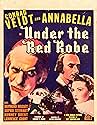
The tale of a swashbuckling soldier of fortune in the days of the power of Cardinal Richelieu in France, and of his swift romance while engaged in a dangerous mission for the ruthless Cardin... Read allThe tale of a swashbuckling soldier of fortune in the days of the power of Cardinal Richelieu in France, and of his swift romance while engaged in a dangerous mission for the ruthless Cardinal.The tale of a swashbuckling soldier of fortune in the days of the power of Cardinal Richelieu in France, and of his swift romance while engaged in a dangerous mission for the ruthless Cardinal.
- Edmond, Duke of Fiox
- (as F. Wyndham Goldie)
- Clon
- (as Balliol Holloway)
- Louis
- (as Shayle Gardner)
- Leval
- (as Ben Soutten)
Featured reviews
The Cardinal sends in a rogue
The Red Robe of the title refers to the vestments of Cardinal Richelieu, minister to King Louis XIII in 17th century France and first statesman of Europe. The man who said on his deathbed that he had no enemies save those of the state is played with a combination of subtlety and fanaticism by Raymond Massey, two qualities normally not compatible.
Massey has a mission and it requires a guy who can think fast on his feet and be both a courtier and a duelist. He's got such a man in Conrad Veidt. But Veidt is under a death sentence for violating the Cardinal's edict against dueling.
But if Veidt brings in the leader of the Huguenot Protestants who hops back and forth over the Pyrenees to Spain stirring up revolt, he can get the sentence commuted. To aid and assist Veidt, Massey assigns his man Romney Brent.
One small complication Veidt falls for Annabella whom he thinks is the Countess. A real mess all around.
The cast does well by the material, but it's ancient and dated and some of the motivations are a bit hard to follow. The play was written in a far more romantic era and was old fashioned when it got to the screen in 1937 let alone seeing it now.
But as a curiosity it might be worth a look.
A disappointing final effort
He's not the only one though with an accent, Annabella with a thick French one, her sister the countess speaks the Queen's English and the men at the inn sounds like peasants from the English countryside. It is all rather confusing.
I don't know why Sjöström accepted the direct this movie, perhaps he was eager to direct again but too many constraints were put on him. The end result looks like any movie that includes musketeers or cardinal Richeliu.
It Was a Dark and Sjöström-y Night
It all starts out very well, given strong compositions and a typically Sjöström-like storm raging as he slips the leash of his watchdog, Romney Brent, recovers the diamonds and offers to duel the soldiers sent to arrest anyone they can. By the end of the movie, alas, the director is overwhelmed by the rigors of dramatic form and having Mr. Brent as his dialogue director. Sjöström retired from directing movies, although he would distinguish them as an actor for the next twenty years.
For the first half, it's a great movie. Too bad it couldn't finish that way.
"I have my honour, madame; and my sword."
An Anglo-American curio from 1937 this third version is primarily of interest to cinéphiles as the final filmic fling of the 'Father of Swedish Cinema' Victor Sjostrom(changed to Seastrom for the benefit of North American viewers)
It is alas in pretty poor shape nowadays both visually and aurally but the cinematography by two masters of their craft Georges Périnal and James Wong Howe still impresses as does the score by Arthur Benjamin.
As one would expect from this director the emphasis is more on character than action and he has the services of some truly fascinating personalities. Delicious French actress Annabella gets first billing and most of the close-ups but who's complaining whilst her leading man is the mesmerising Conrad Veidt, perfectly cast as a gambling, duelling scoundrel who is redeemed by his sense of honour, a virtue which in today's world is dead in the water. The film is weakened alas by a total lack of chemistry between the two whilst the less said about his unfortunate wig the better. Comic relief is supplied by the excellent Romney Brent and gravitas by the powerful presence of Raymond Massey's Cardinal Richelieu. The rest of the cast comprises rather stagey, twee English actors with only Ralph Truman making an impression.
The film is not without its moments but one would ideally have hoped that Sjostrom would finish his distinguished directorial career with material worthy of his talents. He is however in very good company for he is one of a number of great directors who have gone out with a whimper rather than a bang.
Enjoyable Period Drama with Plenty of Intrigue
Conrad Veidt stars as a dreaded duelist under sentence of death, to whom Richelieu offers a pardon if he can bring in a Huguenot duke whose plans for an uprising have the Cardinal in a panic. Raymond Massey is very well cast as the Cardinal, and he does full justice to the role. Veidt is believable as Gil, and his deadpan style works rather well with some of the occasional lines of dry humor.
Veidt's character is accompanied by a slippery servant played with good humor by Romney Brent. The heart of the movie comes in Veidt's interactions with the duke's sister, played by Annabella, who makes her a worthy adversary for the swordsman, both with her beauty and with her brains.
Beyond the basic details of the anticipated conflict, the story relies less on the historical background than on the easily understood human drams among the characters. Veidt finds himself torn between his word, his affection for Annabella, and his fear of death. The servant and the duke's sister likewise have their own dilemmas to face, and these give some depth to the story, which is nothing deep, but is rather entertaining and interesting in its own right.
Did you know
- TriviaThis film received its earliest documented USA telecasts in Chicago Sunday 4 September 1949 on WGN (Channel 9), in Detroit Sunday 11 September 1949 on WWJ (Channel 4), in Atlanta Wednesday 28 September 1949 on WSB (Channel 8), in Boston Sunday 16 October 1949 on WBZ (Channel 4), in Cincinnati Sunday 13 November 1949 on WLW-T (Channel 4), in Philadelphia Sunday 27 November 1949 on WFIL (Channel 6), in New York City Friday 13 January 1950 on WPIX (Channel 11), in Los Angeles Friday 24 February 1950 on KTLA (Channel 5) and in San Francisco Monday 10 April 1950 on KGO (Channel 7).
- Quotes
Cardinal Richelieu: Where did you find your Englishman?
Gil de Berault: I overtook him 50 miles from Calais.
Cardinal Richelieu: What did he say?
Gil de Berault: Nothing, your Eminence.
Cardinal Richelieu: Typically English. What did he do?
Gil de Berault: Fought, your Eminence.
Cardinal Richelieu: Typically English. And then?
Gil de Berault: We had an excellent fight, your Eminence.
Cardinal Richelieu: Did you leave him dead?
Gil de Berault: Oh... not very.
- ConnectionsRemake of Under the Red Robe (1923)
Details
- Runtime
- 1h 20m(80 min)
- Color
- Sound mix
- Aspect ratio
- 1.37 : 1
