
The old west range war story transported to Georgia, with Autry as the hero.The old west range war story transported to Georgia, with Autry as the hero.The old west range war story transported to Georgia, with Autry as the hero.
- Director
- Writers
- Stars


LeRoy Mason
- Len Parker
- (as Le Roy Mason)


The Tennessee Ramblers
- Comic Musicians
- (as Tennessee Ramblers)


Fred 'Snowflake' Toones
- Sam
- (as Snowflake)
Chris Allen
- Rodeo Spectator
- (uncredited)
W.J. Blair
- Member, The Tennessee Ramblers
- (uncredited)

Charles Brinley
- Cattleman
- (uncredited)
Buck Bucko
- Cowhand
- (uncredited)


- Director
- Writers
- All cast & crew
- Production, box office & more at IMDbPro
5.6155
1
2
3
4
5
6
7
8
9
10
Featured reviews
One of Gene Autry's Best!
Excellent storyline. Beautifully upscale sets. Nice direction and marvelous character actors. Plus Autry gets the most interesting girl he's been paired with in his movies! Thank goodness we didn't have to see him in Africa again!!!!
Autry Starts To Hit His Stride
In Georgia or the Florida Panhandle, the ranchers think the turpentiners are stealing their cattle. Only Gene Autry knows better, and is kicked out by his father, Charles Middleton. The turpentiners hate him too, despite Betty Bronson speaking up for him. Her father, Russell Simpson is mad at her. Autry gets a job with Smiley Burnette's Wild West congress and investigates.
It's a nice B western for Autry, with the Tennessee Ramblers providing a far more hillbilly sound than usual for the series. With good performers, a script that offers a handsome variation on a stock western plot, and Joseph Kane directing, there's good music and handsome camerawork by William Nobles proceeding at a good pace thanks to editing by Lester Orleback.
Betty Bronson rose to fame when she was chosen to play the title role in the silent version of Peter Pan. She was a fine actress, but tastes changed, her producers didn't know what to do with her, and she largely abandoned the screen after her marriage in 1933. This would be her last screen appearance for two dozen years. She died in 1971, largely forgotten, at the age of 64.
It's a nice B western for Autry, with the Tennessee Ramblers providing a far more hillbilly sound than usual for the series. With good performers, a script that offers a handsome variation on a stock western plot, and Joseph Kane directing, there's good music and handsome camerawork by William Nobles proceeding at a good pace thanks to editing by Lester Orleback.
Betty Bronson rose to fame when she was chosen to play the title role in the silent version of Peter Pan. She was a fine actress, but tastes changed, her producers didn't know what to do with her, and she largely abandoned the screen after her marriage in 1933. This would be her last screen appearance for two dozen years. She died in 1971, largely forgotten, at the age of 64.
'No yodelin' ? NONSENSE!
One reviewer on here said he "couldn't find a single yodel" in "Yodelin' Kid from Pine Ridge". He must have gone to the popcorn stand, or the restroom, just as the movie started, as Gene yodels the first few bars of the theme song over the credits of the movie. Yes, he did yodel, in a number of his early recordings. And yes, so did Roy Rogers. But my opinion is that Gene's yodeling was superior to Rogers'.
Gene Autry started making records in the late 1920s, and many of his early records were his versions of records made earlier by Jimmy Rodgers, who was famous for his yodeling. That's where Gene learned how to yodel.
Gene Autry started making records in the late 1920s, and many of his early records were his versions of records made earlier by Jimmy Rodgers, who was famous for his yodeling. That's where Gene learned how to yodel.
Even for a Gene Autry film, this one is odd and makes little sense.
The film begins around the Georgia/Florida border. Ranchers and the 'Turpentines' (local hill people) are at odds with each other. In the middle is Gene Autry—who tries to get both sides to see reason and avoid an all out war. Unfortunately, he ends up ticking off both sides and Gene's father disowns him. As for Gene, he lands on his feet—becoming a rodeo champ and singing sensation. When he returns home after a few years, things have NOT improved but have become a lot worse. So, it's up to our star to find out who's behind the fight—who is stirring up BOTH sides as well as why.
The idea of setting a Gene Autry movie in the Georgia/Florida region was very good—a nice change of pace. After all, back in the 1930s (and even today) northern Florida is home to many ranches and horses are very common there. However, and this is a BIG however, the film looked exactly like any other Gene Autry film—with cowboys, dusty trails and even a canyon—yet there are no canyons in Florida or Georgia and they are also not dusty/desert locales. In fact, they have TONS of rain, foliage, palm trees and the like—none of which you see in "Yodelin' Kid from Pine Ridge"! It's obviously just another California back lot production and the filmmakers took no efforts to even try to make it look like the film was set in the East. To me, this was incredibly lazy and brings up a major problem with many B-westerns—they were produced so quickly that shabby mistakes are too common.
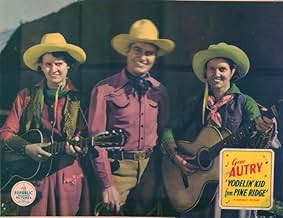
Another problem in the film is the singing. While Autry always had a very nice voice, one of the other singing groups (the ladies who sing at about 34 minutes into the film) are just terrible—and I found myself speeding past their performance. Autry's yodeling, while unpleasant, was at least quite skilled.
All in all, a very disappointing film with little to recommend it. After all, who wants to see a 'western' set in the East Coast where none of this clearly took place?!
The idea of setting a Gene Autry movie in the Georgia/Florida region was very good—a nice change of pace. After all, back in the 1930s (and even today) northern Florida is home to many ranches and horses are very common there. However, and this is a BIG however, the film looked exactly like any other Gene Autry film—with cowboys, dusty trails and even a canyon—yet there are no canyons in Florida or Georgia and they are also not dusty/desert locales. In fact, they have TONS of rain, foliage, palm trees and the like—none of which you see in "Yodelin' Kid from Pine Ridge"! It's obviously just another California back lot production and the filmmakers took no efforts to even try to make it look like the film was set in the East. To me, this was incredibly lazy and brings up a major problem with many B-westerns—they were produced so quickly that shabby mistakes are too common.
Another problem in the film is the singing. While Autry always had a very nice voice, one of the other singing groups (the ladies who sing at about 34 minutes into the film) are just terrible—and I found myself speeding past their performance. Autry's yodeling, while unpleasant, was at least quite skilled.
All in all, a very disappointing film with little to recommend it. After all, who wants to see a 'western' set in the East Coast where none of this clearly took place?!
Very Different In Restored Uncut Version
This Autry film is one of a hand full of his films that for years has been available to the public only in the 53 or 57 minute cut versions. Recently I had the opportunity to see the restored and uncut version on the Starz Westerns channel a few weeks back and what a difference the added 6 or 7 minutes make. The restored version includes a scene of Gene saddling up and singing a nice trail song as he leaves his ranch following his banishment by his father for warning the rival group. Along the way he meets Millie Branum ( Betty Bronson), a young starving girl he befriended earlier by giving her a calf. Millie gives him his rope back and asks him if he will ever return. Gene replies that he doesn't know and Millie blurts out that she will be waiting for him. As Gene rides away continuing his song you see Millie watching him leave as tears stream from her eyes. Also restored are scenes of newspaper headlines superimposed over rodeo footage of Autry's success on the rodeo circuit. Finally an announcement that he is coming back to Pine Ridge with a traveling show. There is more nice restored footage of the show's parade into town with Champion prancing and marching to the music. (The Champion shown in these scenes is not the original screen Champ since he had only three white stockings . The horse used in these scenes has four white stockings.)However, Gene spots his Dad from the parade route and rides over to him, sticks out his had and says " hello Dad". His father turns and walks away. This movie also contains some of Autry's best riding of all his movies. Many closeup chase scenes and running stirrup mounts that clearly show that it is in deed Gene performing these feats. In all a much more enjoyable movie in the restored version.


Did you know
- Quotes
Col. Millhouse: Marvelous, Autry, marvelous! You certainly have that animal trained and I don't see how you do it. What's the secret?
Gene Autry: The secret in training a horse, Colonel, is that, ah, you have to know more than the horse!
- ConnectionsEdited from Annie Oakley (1935)
Details
- Release date
- Country of origin
- Language
- Also known as
- Der Jodeljunge vom Pinienwald
- Filming locations
- Production company
- See more company credits at IMDbPro
- Runtime
- 1h(60 min)
- Color
- Aspect ratio
- 1.37 : 1
Contribute to this page
Suggest an edit or add missing content