
A 100-year-old pioneer woman tells her story in flashbacks.A 100-year-old pioneer woman tells her story in flashbacks.A 100-year-old pioneer woman tells her story in flashbacks.
- Awards
- 2 wins total


K.T. Stevens
- Girl Biographer
- (as Katharine Stevens)


Irving Bacon
- Parson
- (uncredited)

Hank Bell
- Man #1 - Hoyt City
- (uncredited)

Monte Blue
- Man #2 - Hoyt City
- (uncredited)
6.6922
1
2
3
4
5
6
7
8
9
10
Featured reviews
Not as epic as the movie think it is but it's still fine
From the first intro scroll itself, the film shows how dated it is and how stupid it can be with the themes in it. The first half hour went along proving it to me with every character and plot point just fast-forwarding itself to seemingly pointless places. But the rest of the movie, even though doesn't really get out of those aspects gives Barbara Stanwyck a great chance to show her acting prowess and she single-handedly saves the film.
The film can be considered an optimistic look at the tragedy that is any human life. But the privilege of the characters, the lack of feeling any stake even when it is needed and the lacklustre narrative doesn't really help in its philosophy. A lot of the movie, especially the scroll at the beginning and the ending sequence feels like the makers believed it to be something epic when it isn't even remotely close to being that.
Even with all of that and some of the regressive messages, the film believes to be progressive, the film still contains enough to appreciate it for what it is. The movie does portray moments that are representative of how small and yet great life is and Barbara Stanwyck makes it work with her charm and presence. I feel like this same exact story could've been a great film with a better script. I don't know how common this type of story was back then but maybe this film has inspired many other filmmakers afterwards.
The film can be considered an optimistic look at the tragedy that is any human life. But the privilege of the characters, the lack of feeling any stake even when it is needed and the lacklustre narrative doesn't really help in its philosophy. A lot of the movie, especially the scroll at the beginning and the ending sequence feels like the makers believed it to be something epic when it isn't even remotely close to being that.
Even with all of that and some of the regressive messages, the film believes to be progressive, the film still contains enough to appreciate it for what it is. The movie does portray moments that are representative of how small and yet great life is and Barbara Stanwyck makes it work with her charm and presence. I feel like this same exact story could've been a great film with a better script. I don't know how common this type of story was back then but maybe this film has inspired many other filmmakers afterwards.
10SHAWFAN
This film needs defending
Such undeserved condescension on the part of most of your reviewers! I thought it was an absorbing romantic drama in which Stanwyck was at her very best. As she turned from youthful sparkly-eyed amused flirt in her first scenes with McCrea into the mature more gray-haired woman seriously urging him to do his political best for those whom he represented, her virtuosity as an actress of transformations came greatly to the fore. It was a pleasure to respond to her in her various moods of youthful love, a stunned mother's loss of her two babies, her vigorous denunciation of her father in his unconscionable request of her, and finally the resignation of old age in which she at last destroys the long-lived marriage certificate she's been carrying around through most of the story.
McCrea was also very good, especially in the scene in which he confesses himself guilty of the same kind of corruption so rife in the American West at that railroad-building time.
The story seemed to echo the true events of The Ballad of Baby Doe (opera) in its background of silver mining and marital troubles; and it certainly resembled Edna Ferber-Abby Mann's Cimarron in retelling the story of a marriage in which the husband spends years on the road away from his wife.
The 19th-century flooding in Sacramento was certainly up to date given the similar events happening in that city in our own times as well.
A great movie. Pay no attention to those detractors.
McCrea was also very good, especially in the scene in which he confesses himself guilty of the same kind of corruption so rife in the American West at that railroad-building time.
The story seemed to echo the true events of The Ballad of Baby Doe (opera) in its background of silver mining and marital troubles; and it certainly resembled Edna Ferber-Abby Mann's Cimarron in retelling the story of a marriage in which the husband spends years on the road away from his wife.
The 19th-century flooding in Sacramento was certainly up to date given the similar events happening in that city in our own times as well.
A great movie. Pay no attention to those detractors.
Terrific Stanwyck and Charming McCrea in Predictable Story
Saddled with an uninspiring title, "The Great Man's Lady" is less than the sum of its parts. Hoyt City unveils an equine statue of its founder, Ethan Hoyt, which unleashes a bevy of news reporters intent on delving into his life and the mystery of why he returned to die in the home of a local woman, Hannah Semple. While most of the reporters are dismissed, a young biographer manages to win the trust of the elderly Hannah, who proceeds to tell her about Ethan Hoyt in a series of flashbacks. However, Hannah's tale is a routine story of ambition, risk, and tragedy that led to wealth and high political office; a successful man and the woman who aided his rise. Unfortunately, a near-century in the life of a remarkable woman is impossible to squeeze into a 90-minute running time, and decades are omitted between flashbacks; the episodic film has several unseen characters and unexplained events.
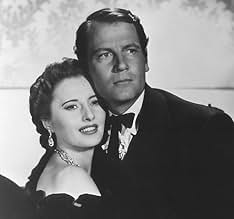
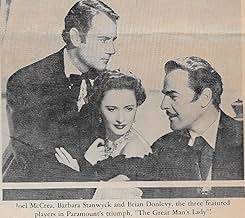
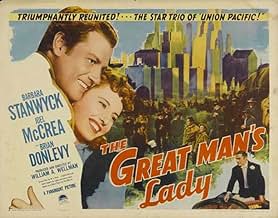
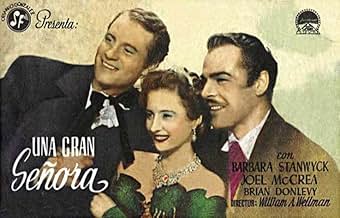
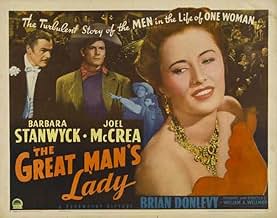
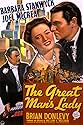
Aided by aging make-up that is remarkably convincing for the period, Barbara Stanwyck plays Hannah Semple from a flirtatious 16-year old to the 109-year-old woman who recalls her life for the biographer. Her tour-de-force performance is the film's prime asset, and Stanwyck has some fine, if occasionally sudsy, moments. In the fifth of their six co-starring features, Joel McCrea as the great man, Ethan Hoyt, plays well opposite Stanwyck, although his role is far less demanding than hers and rests on his considerable charm. Beyond Hoyt's rise to prominence, a romantic triangle is also central to the story, and Brian Donlevy, who often played the villain, is gambler Steely Edwards; Donlevy's part, a heavy with a heart, does demonstrate genuine affection for Hannah and respect for Hoyt.
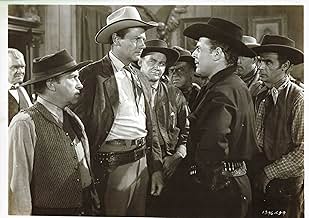
Nearly equal in importance to Stanwyck and McCrea, the third star of the film is cinematographer William C. Mellor, whose shadowy black and white photography is often stunning. Capturing the actors in silhouettes or darkly garbed against light backgrounds, several shots could be framed and hung in a gallery. Mellor also photographs the leads and even extras in sharply delineated close-ups that rival the best studio portraits. The talented cameraman subsequently earned Academy Awards for "A Place in the Sun" and "The Diary of Anne Frank," among other nominations and accolades in his long distinguished career.
Well directed by veteran William Wellman, "The Great Man's Lady" is a predictable story of an important self-made man, who owes much of his success to the woman behind him. However, without Stanwyck's captivating performance, McCrea's charisma, and Mellor's rich cinematography, the film would barely merit attention.
Aided by aging make-up that is remarkably convincing for the period, Barbara Stanwyck plays Hannah Semple from a flirtatious 16-year old to the 109-year-old woman who recalls her life for the biographer. Her tour-de-force performance is the film's prime asset, and Stanwyck has some fine, if occasionally sudsy, moments. In the fifth of their six co-starring features, Joel McCrea as the great man, Ethan Hoyt, plays well opposite Stanwyck, although his role is far less demanding than hers and rests on his considerable charm. Beyond Hoyt's rise to prominence, a romantic triangle is also central to the story, and Brian Donlevy, who often played the villain, is gambler Steely Edwards; Donlevy's part, a heavy with a heart, does demonstrate genuine affection for Hannah and respect for Hoyt.
Nearly equal in importance to Stanwyck and McCrea, the third star of the film is cinematographer William C. Mellor, whose shadowy black and white photography is often stunning. Capturing the actors in silhouettes or darkly garbed against light backgrounds, several shots could be framed and hung in a gallery. Mellor also photographs the leads and even extras in sharply delineated close-ups that rival the best studio portraits. The talented cameraman subsequently earned Academy Awards for "A Place in the Sun" and "The Diary of Anne Frank," among other nominations and accolades in his long distinguished career.
Well directed by veteran William Wellman, "The Great Man's Lady" is a predictable story of an important self-made man, who owes much of his success to the woman behind him. However, without Stanwyck's captivating performance, McCrea's charisma, and Mellor's rich cinematography, the film would barely merit attention.
A Weak Performance by All Hands.
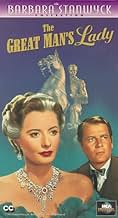
Unfortunately I found this VHS at Video Vault and took it home. All I can say is that even with William A. Wellman directing, Joel McCrea and Barbara Stanwyck acting, Victor Young doing the music and Edith Head the costumes --- each of these people have made pictures ten times better.
Walt Disney's Thumper taught me years ago, "If you can't say nuthin' nice, don't say nuthin' at all." Therefore, I'll note that Great Man's Lady was better than "Shawshank Redemption" which ranks #2 of all time on this website, better than "Order of the Phoenix" whereby Warner's tossed the 750 page story and made a 2 1/2 hour movie with NO story. Please see Wellman's AAA+ "Little Caesar" or McCrea's "4 Faces West" and skip this one.
Walt Disney's Thumper taught me years ago, "If you can't say nuthin' nice, don't say nuthin' at all." Therefore, I'll note that Great Man's Lady was better than "Shawshank Redemption" which ranks #2 of all time on this website, better than "Order of the Phoenix" whereby Warner's tossed the 750 page story and made a 2 1/2 hour movie with NO story. Please see Wellman's AAA+ "Little Caesar" or McCrea's "4 Faces West" and skip this one.
An excellent romantic, historical drama with two of my favorite stars.
~~~Since I was only 12 when I saw this years ago, I was very impressed with everything about the movie-----the stars, the storyline, the costumes, the historical flavor, and the emphasis on the noble character of the leading stars----Barbara Stanwyck and Joel McCrea who were always great in everything in which they ever appeared. It was the only movie I ever returned to see the second time before I started seeing numerous repeats on the TV Movie Channels. The movie starts and ends with Barbara Stanwyck portraying an elderly lady who tells the story of her relationship to Joel McCrea from youth through maturity. Through a series of flashbacks, Stanwyck tells her story to a pretty, young, blonde reporter who is interviewing her in the hope of getting a hot story on the day an imposing statue of McCrea is dedicated.


Did you know
- TriviaFifth of six film collaborations between Barbara Stanwyck and Joel McCrea.
- GoofsWhen the Hoyts stand at the sight of their future city, they're at the foot of a hill, but moments later they're on top of a hill.
- ConnectionsFeatured in Biography: Barbara Stanwyck: Straight Down the Line (1997)
- SoundtracksUnfinished Symphony
("Symphony 8 in B Major") (uncredited)
Composed by Franz Schubert (begun 1822)
Heard on soundtrack during Janet and Ethan's farewell and under end title
- How long is The Great Man's Lady?Powered by Alexa
Details
- Runtime
- 1h 30m(90 min)
- Color
- Aspect ratio
- 1.37 : 1
Contribute to this page
Suggest an edit or add missing content