

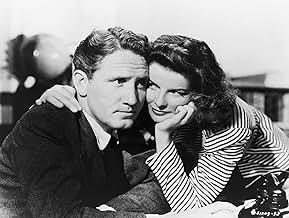
Sportswriter Sam Craig and columnist Tess Harding, with the same New York newspaper, overcome their initial antagonism, fall in love and get married, only to find their relationship strained... Read allSportswriter Sam Craig and columnist Tess Harding, with the same New York newspaper, overcome their initial antagonism, fall in love and get married, only to find their relationship strained when he comes to resent her hectic lifestyle.Sportswriter Sam Craig and columnist Tess Harding, with the same New York newspaper, overcome their initial antagonism, fall in love and get married, only to find their relationship strained when he comes to resent her hectic lifestyle.
- Director
- Writers
- Stars
- Won 1 Oscar
- 5 wins & 2 nominations total



- Dr. Lubbeck
- (as Ludwig Stossel)


- Cab Driver
- (uncredited)

- Stage Doorman
- (uncredited)
- Phone Girl
- (uncredited)

- Baseball Fan
- (uncredited)
- Director
- Writers
- All cast & crew
- Production, box office & more at IMDbPro
Featured reviews
Seminal Tracy-Hepburn Vehicle Teeters Precariously Between Comedy and Melodrama
However, rather than the comic fireworks generated by their later collaboration, 1949's "Adam's Rib", this film treads in unexpectedly sentimental melodrama, especially in the episodes where Tess has to let go of a Greek orphan she wants to adopt and in the climactic scene when she tearfully recognizes her wifely responsibilities as her aunt Ellen marries her father. Still, the pair's familiar bantering occurs when Sam explains the rules of baseball to Tess and in the final feminist reversal as she fails miserably in her attempt at domesticity. George Stevens directed the film, and he displays his sure hand with actors and an acute sense of craftsmanship throughout. Intriguingly, for a Tracy-Hepburn vehicle, it feels much more like her movie than his, and consequently their rapport is not quite up to their normal standard here. The supporting characters also feel more incidental here, even though Fay Bainter shines briefly as Ellen. It's not my favorite of their films together, but it is certainly required viewing for their fans. There are no extras with the 2000 DVD.
Great beginning, awful ending
Hebpurn: Well, we're alone. Talk. You do have something to talk about? Tracy: Yeah, yeah. You. You. I'd like to know what you like and don't like, and how you feel about being you. Hepburn: I feel very good about it. Always have. I like knowing more about what goes on than most people. Tracy: And telling them. Hepburn: Yeah, and telling them.
Last 45 minutes: 5 stars. The film starts unraveling with Hepburn's rash decision to adopt a refugee, not because that's a bad thing (it's a great thing), but because she does so without telling her husband, or without the slightest thought to actually caring for the child. It spirals from there until that horrific prolonged ending scene, where this intelligent, brilliant woman fumbles around in the kitchen, apparently not knowing how to use a toaster. It's, quite frankly, god-awful on every possible level.
The message is loud and clear: if a woman chooses to focus on a career, she will neglect her husband, not have a clue about raising kids, and be incompetent at performing wifely tasks like making breakfast. It's terribly insulting, and undoes a lot of the great things it did in the first 70 minutes. Hepburn's character wins the "Woman of the Year" award, but it's ironically Tracy who is showcased as award-worthy, for having put up with the "difficult case" of his wife, remained level-headed, and taught her a good lesson in what it takes to have a good marriage.
The only small saving grace is that his character suggests she can have both, a career and a family, as long as she doesn't go to extremes in either. It's only too bad the film didn't simply show us how women can do this balancing just as well as men, but it was 1942, and a lot of people - including those in powerful positions - were simply not ready for this message.
Wow
Whatever kind of film George Stevens tried, he did it to perfection. Witness Gunga Din, Swingtime & A Place in the Sun to mention just a few. It was like watching something by Hawks, Lubitch & Sturges all rolled into one.
Hepburn never appeared softer, more vulnerable, less mannered than in Woman of the Year. I fall in love with her all over again every time I watch it, which is surprisingly often, especially in the scene where she carries on about Oswald Spengler while plastered under the table.
Then there's Tracy, the most honest actor who ever lived. But not just that: there was his ability to delve seemingly without effort into an infinite bag of gestures & expressions & tones & just plain old-fashioned but highly manifest wisdom & come up with the most richly nuanced guy ever depicted on-screen. Tracy was a giant, a genius, the Rembrandt of film.
A delightful, dazzlingly perfect grown-up movie.
Undated sexual politics
The point of the script is actually relatively modest. It is not, in fact it is far from, The Taming of the Shrew, or the subjugation of the independent woman. Tracy's character admires Hepburn's character's independence and competence, and he doesn't want her to renounce them to become the "little woman" -- that is the burden of his "kitchen speech" at the end. He simply understands better than she does, at least until the end of the film, that maintaining a relationship and a marriage requires time, work, and attention. That may well be an unwelcome message, but it is not an unwise one.
The comedy of the film comes from their characters' different worlds -- Tracy is a sportswriter and Hepburn an international politics columnist. The drama comes from their different levels of commitment to being a couple. The script delicately and for the most part successfully (with the possible exception of the Greek orphan subplot), balances these two conflicts and the comedy and drama.
Memorable First Tracy-Hepburn Teaming!
The scenario is simple; Beautiful, brilliant Claire Booth Luce-type journalist(Hepburn) and practical, salt-of-the-earth sportswriter (Tracy) clash over whether athletic events should be suspended for the duration of the war (she finds them too frivolous in such serious times, he believes them essential for morale). After she makes some insensitive comments on the radio, he criticizes her in his sports column. Despite the paper-selling feud that results, their editor brings them together to make peace...and the pair, seeing one another in person for the first time, fall in love! Despite their busy schedules, he takes her to a ball game (which she loves) and she introduces him to her international friends (which he doesn't). Nonetheless, they marry, but he quickly discovers she is so busy 'saving the world' that she can't make time for him...and then she 'adopts' a war orphan, without consulting him, or considering how little time for 'motherhood' she's willing to give. He realizes a drastic step must be taken, as she is clueless about what being a 'wife' and 'mother' means...
While the domesticity scene concluding the film seems out of place (the story goes that MGM added it to make Tracy the 'winner' of the 'battle of the sexes', to a much more chauvinistic 40s audience), so many scenes ring true that the film goes beyond simple comedy/drama to a timeless statement about commitment, priorities, and accountability for one's actions. And despite the serious issues raised, it makes you laugh, too! Hepburn's reactions at the ball game, and Tracy, trying to be inconspicuous at the women's club meeting, are among the comic highlights. The star duo are so natural together that it's hard to believe this was their first teaming, and the chemistry carried over into their private lives as well, beginning a romance that lasted 25 years.
WOMAN OF THE YEAR is, deservedly, a classic!


Did you know
- TriviaKatharine Hepburn refused to reveal who wrote the screen play to Louis B. Mayer until after he bought the project from Hepburn. Hepburn was afraid that Mayer would low-ball the two authors (Michael Kanin and Ring Lardner Jr.) because, at the time, they were both relatively unknown.
- GoofsIn the kitchen, Tess uses a vacuum coffee maker (Cona). However, if she had put the coffee in the bottom of the coffee maker and the water in the top, as shown, it wouldn't have made coffee at all.
This is an intended joke as it has been established that Tess does not know how to cook.
- Quotes
Tess Harding: [In the stands at the ballpark, observing the large crowd in attendance] Are all these people unemployed?
Sam Craig: No, they're all attending their grandmother's funeral.
- Alternate versionsThere is an Italian edition of this film on DVD, distributed by DNA Srl: "LA DONNA DEL GIORNO (1942) + INCANTESIMO (1938)" (2 Films on a single DVD, with "Woman of the Year" in double version 1.33:1 and 1.78:1), re-edited with the contribution of film historian Riccardo Cusin. This version is also available for streaming on some platforms.
- ConnectionsFeatured in George Stevens: A Filmmaker's Journey (1984)
- SoundtracksBridal Chorus (Here Comes the Bride)
(1850) (uncredited)
from "Lohengrin"
Written by Richard Wagner
Played on an organ at the wedding
- How long is Woman of the Year?Powered by Alexa
Details
- Release date
- Country of origin
- Languages
- Also known as
- La mujer del año
- Filming locations
- Production company
- See more company credits at IMDbPro
- Runtime
- 1h 54m(114 min)
- Color
- Aspect ratio
- 1.37 : 1