

Three World War Two era pilgrims investigate a bizarre crime in a small UK town while on their way to Canterbury.Three World War Two era pilgrims investigate a bizarre crime in a small UK town while on their way to Canterbury.Three World War Two era pilgrims investigate a bizarre crime in a small UK town while on their way to Canterbury.
- Directors
- Writers
- Stars
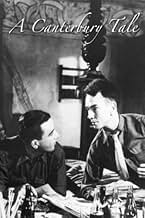
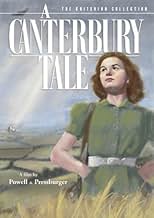

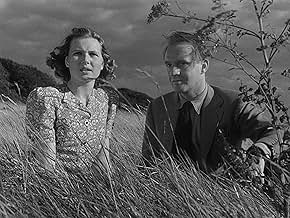
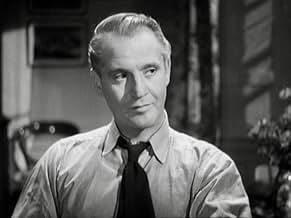


- Sergeant Bob Johnson
- (as Sergt. John Sweet U.S. Army)


- Sergt. Bassett
- (as Antony Holles)
- Directors
- Writers
- All cast & crew
- Production, box office & more at IMDbPro
Featured reviews
A gentle gem that defies description
The only word I can find to give a flavour of this story is that it is above all English - as English as Ealing comedy (without the comedy), as Miss Marple (without the murder), as Elizabeth Goudge (without the magic)... and yet again I find myself defining it by what it *isn't*! It's English in a way that is quietly, deeply antithetical to the frenetic posturing of 'Cool Britannia'. It is as English as the haze over the long grass beneath the trees of a summer meadow; as polished brass and a whiff of steam as the express pulls up at a country halt; as church bells drifting in snatches on a lazy breeze, and the taste of blackberries in the sun.
It's almost impossible now to comprehend that the 1940s countryside in which this film is set was *really there*; that it was not the Second World War but its crippling aftermath that industrialised farms, banished the horse-drawn vehicles from the wheelwright's, and exchanged towering hay-wains for silage towers. Britain was determined never to starve again - and so the world that had once differed so little from that of Chaucer's time was swept away beyond recall. When it was made, this film was no more a rustic period piece than 'Passport to Pimlico', a few years later, was an urban social documentary. Subsequent events have preserved both in mute evidence of contemporary communities that are almost unbelievable today.
It is perhaps fair, therefore, to assume that the type of viewer who will watch 'Battlefield Earth' is unlikely to find this film anything other than silly, parochial and ultimately dull! Very little actually happens. The story is on occasion both humorous and poignant, but what we at first assume to be the central plot turns out not to be the point at all. The triple denouement is set up so gently and skilfully that we, too, are taken by miraculous surprise, with the true shape of the film only evident in retrospect.
It is, ultimately, a story about faith, and miracles, and pilgrimages, even in the then-modern world of shopgirls, lumbermen and cinema organists - and if that idea in itself sounds enough to put you off, as I confess it would have done for me before I watched it myself, then I will gladly add that it is a film about beauty, and hope, and unexpected friendship and laughter; and technically very accomplished to boot. The use of black and white is glorious, ranging from the glimmer in the obscurest of shadows to sun-drenched hillside, and the totally unselfconscious reference to Chaucer in the opening sequence is in these days worth the price of admission alone.
If you like gentle films - sweet-natured films - films with a deep affection for their subject - films that make you laugh and cry, but always smile - then I urge you not on any account to miss this one. If, for the moment, you require thrills, spills, forbidden passions and last-minute rescues, then pass it by and let it go on its tranquil way. When you are old and grey and full of sleep, this unassuming classic will still be there, waiting...
An offbeat British wartime drama...
This is an odd movie. The goofy-sounding Glue Man mystery is an unusual pretext to keep the characters together, but it works. The true aim of the film seems to be reconnecting a war-battered audience with its history and bucolic country landscapes. There's a bit of the mystical, with discussions of centuries past and the lingering ghosts of ancestors. The film also serves as a bit of American-British co-operation propaganda, in the form of Sweet's amiable Oregonian Bob. Sweet was an actual U. S. G. I. loaned to the film, an unprofessional actor, and it shows, but in a good way. His voice and personality may strike some the wrong way, but I found him charming. Both Sheila Sim and Dennis Price were also unknowns, and they both went on to fame, but Sweet became a school teacher. Recommended.
"Happy The Man ..." is me after watching this
ACT is a pleasant inconsequential masterpiece, with no heavy points to labour, no axes to grind and for wartime not too many flags to wave. But it leaves you wishing that Olde England could've been better preserved from the elected savages in charge of us since, and that perhaps it wasn't so surprising that people were ready to defend such a country and its lifestyles to the death. The only thing Chaucer inspired in me in all of his tales was the desire to reach the end of the journey.
The story? Mysterious fetishist keeps pouring glue onto unsuspecting girls heads at night - 3 intrepid souls determine to find and unmask the weirdo, but vacillate when their moment comes. The four main characters weave in and out of the tale, moving it forward gently to the rather grand climax. But what about the Glueman himself - did he go back home to his reprehensible pastime or did he meet a sticky end? Did Bob get his marijuana? Did they manage to get the moths out of Allison's caravan? Did Peter ever stop playing on his organ?
Refreshing: 1/ A platonic relationship between three handsome men and one beautiful woman. 2/ The most violent scene is where the troops burst out clapping the Sgt. who repaired the slide projector. 3/ A basic plot premise so flimsy and yet so captivating.
A most profitable way of spending two hours.
Dennis Price in His First Starring Role
Alison (Sheila Sim) is a London shop girl who ventures to the English countryside to work on a farm as a "land girl" and to revisit the spot where she vacationed with her now dead soldier boyfriend. Bob (John Sweet) is a naive American GI who's girlfriend back in Oregon has stopped writing to him. He told his mother he'd visit Canterbury. Peter (Dennis Price) is a disillusioned organist whose career has been limited to playing in movie theaters and who is soon to ship out overseas.
The three disembark a train together and venture toward the great cathedral city when Alison is attacked in the dark by a strange offender known locally as the "glue man." He's poured nasty glue all over her head. As the three find lodgings and talk to locals they learn that the glue man has struck many other times.
Alison settles into her farm job while Bob discovers the countryside still (in 1944) very much tied to 19th-century ways. Peter tries to find out more about the glue man. They all meet a local eccentric (Eric Portman) who may be the glue man. He lectures locally on the rewards of country life and works as a magistrate in Canterbury. They all meet at the cathedral as they meet their fates.
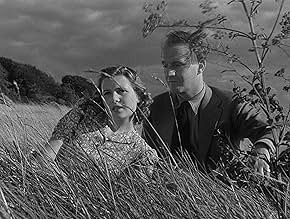
Absolutely gorgeous B&W photography lovingly displays the beautiful countryside with ample shots of wide sky and billowing fields, rustic farms and buildings, and always Canterbury in the background.
The simple story lines are set against the complex allegory of a journey of discovery. Each of the pilgrims finds something in Canterbury, but what happens to them afterwards is left to our imagination. Both Alison and Bob find answers to their private sorrows, and Peter attains a cherished dream. All three are changed in deep and moving ways.
John Sweet was an amateur actor stationed with the US Army in England when he was discovered for this role. His plainspoken American is both naive and deeply wise. His growing love of the countryside and the old ways is infectious. Sheila Sim plays a sturdy and practical girl who deals with her loss while loving her new life in the country. Dennis Price plays the most complicated character, since his loss is more a loss of ambition and opportunity than a loss of human love. His discovery at the cathedral is very moving. Portman is a lonely and aging man who may be attracted to Alison as a kindred spirit, but all paths do not lead to the same destination.
Many notable actors in small parts include Edward Rigby, Charles Hawtrey, Hay Petrie, Freda Jackson, Esma Cannon, Graham Moffatt, Eliot Makeham, Esmond Knight, and Judith Furse.
Powell and Pressburger scored a major success with this moving and seemingly simple story. But the characters will stay with you long after watching this glorious masterpiece.
A deep & entertaining study
The scope of the movie is amazing, and in 2 hours it covers enormous ground. The entire thing is so skillfully and assuredly done that in spite of the absence of any stars and (almost) of a story, and the fact that John Bull is never my companion of choice in any desert island, I was riveted to this movie. Besides the acting, this effect was achieved also by Alfred Junge's brilliant art direction (I couldn't believe the Canterbury church was just a set) and William Hillier's black and white photography. Two scenes stand out - a bird 'turning into' an airplane signifying time going on ahead by a few centuries, and an armoured car breaking through bushes and undergrowth (a very 'Predator'-ish shot).
This is a must see.


Did you know
- TriviaThe Archers (Michael Powell and Emeric Pressburger's production company) weren't given permission to film inside Canterbury Cathedral. In any case, the stained-glass windows had been taken out because of the air raids, the aisles were filled with sandbags and earth to fight fires and to provide a soft landing for any masonry or sculptures that fell there. So the interior of the Cathedral was rebuilt in Denham Studio. They recreated it so well that Cathedral guides have been heard telling people that the film was shot in there.
- GoofsA camera operator's shadow is clearly visible while Alison is riding a horse and buggy along the pilgrim's road.
- Quotes
Thomas Colpeper, JP: Well, there are more ways than one of getting close to your ancestors. Follow the old road, and as you walk, think of them and of the old England. They climbed Chillingbourne Hill, just as you. They sweated and paused for breath just as you did today. And when you see the bluebells in the spring and the wild thyme, and the broom and the heather, you're only seeing what their eyes saw. You ford the same rivers. The same birds are singing. When you lie flat on your back and rest, and watch the clouds sailing, as I often do, you're so close to those other people, that you can hear the thrumming of the hoofs of their horses, and the sound of the wheels on the road, and their laughter and talk, and the music of the instruments they carried. And when I turn the bend in the road, where they too saw the towers of Canterbury, I feel I've only to turn my head, to see them on the road behind me.
- Alternate versionsThe original UK version runs 124 minutes. For the USA release, the film was re-edited to 95-minutes and new footage starring Kim Hunter inserted:
- A scene between Bob (John Sweet) and his new bride Kim Hunter on the Rockefeller Center introduces the story which he then tells in flashback.
- The idyllic scenes with the boys' river battle and much of the hunt for the glue-man is cut with addition scenes or commentary by Bob added to cover the gaps.
- There is an additional epilogue with Bob and his girl at the tea-rooms in Canterbury.
- ConnectionsFeatured in Arena: A Pretty British Affair (1981)
- SoundtracksAngelus ad Virginem
(uncredited)
Traditional
Heard as a peal of bells in the opening titles
- How long is A Canterbury Tale?Powered by Alexa
Details
- Release date
- Country of origin
- Language
- Also known as
- Un cuento de Canterbury
- Filming locations
- Selling, Kent, England, UK(Railway station and signal box)
- Production companies
- See more company credits at IMDbPro
Box office
- Budget
- $650,000 (estimated)
- Gross worldwide
- $15
- Runtime
- 2h 4m(124 min)
- Color
- Aspect ratio
- 1.37 : 1