IMDb RATING
6.2/10
1.1K
YOUR RATING

The biography of Dr. W. T. Morgan, a 19th century Boston dentist, during his quest to have anesthesia, in the form of ether, accepted by the public and the medical and dental establishment.The biography of Dr. W. T. Morgan, a 19th century Boston dentist, during his quest to have anesthesia, in the form of ether, accepted by the public and the medical and dental establishment.The biography of Dr. W. T. Morgan, a 19th century Boston dentist, during his quest to have anesthesia, in the form of ether, accepted by the public and the medical and dental establishment.


Julius Tannen
- Professor Charles T. Jackson
- (as Julian Tannen)


Victor Potel
- First Dental Patient
- (as Vic Potel)


George Anderson
- Frederick T. Johnson
- (uncredited)

6.21.1K
1
2
3
4
5
6
7
8
9
10
Featured reviews
Not the film Preston Sturges envisioned
For those who have enjoyed the brilliant farce comedies made in the early '40s by writer-director Preston Sturges this movie may come as a bewildering disappointment. It's a strangely downbeat biographical film about an obscure Boston dentist, William Morton, who, according to some historians, discovered the anesthetic use of ether for surgery in the mid-nineteenth century. It's said that Morton was falsely accused of plagiarizing his research, ruined his health defending his reputation, and died young, broke and forgotten. Right off the bat you know you're not in traditional Sturges territory.
In the period before this film was made the unexpected popularity of Warner Brothers' biographical dramas such as The Story of Louis Pasteur and Dr. Ehrlich's Magic Bullet inspired the other Hollywood studios to make similar dramas based on the lives of Thomas Edison, Madame Curie, Alexander Graham Bell, etc., but these tales of medical and scientific advance were also upbeat stories of successful and well rewarded endeavor. Sturges, for some reason, was drawn to a story in which the protagonist was wronged and the bad guys won; he also wanted to experiment with chronology and end the film on a high note by circling back in time to Morton's "great moment" of triumph, before his victory slipped away. The director fought pitched battles with his bosses at Paramount to make the film his way, despite the front office's concerns over what wartime audiences preferred to see (not unlike the battle between Orson Welles and RKO over The Magnificent Ambersons, waged at about the same time). Unfortunately, Paramount won. The movie was shelved for two years, and only released in a heavily-altered form after Sturges had quit the studio. The director's cut of the film no longer exists.
So, the movie known as The Great Moment is not the one Sturges made. For starters, he wanted to title his film after the book from which he derived the story, "Triumph Over Pain," and when the studio didn't like that he came up with "Great Without Glory," but eventually they gave it the nondescript title it now bears. Scenes were cut, and the sequence of events was rearranged to fit a more traditional pattern. Those interested in learning what the author actually intended can read his original screenplay in a published collection called Four More Screenplays by Preston Sturges, and you'll find a better piece of work than what's left on screen, but although it's an interesting read I have my doubts about whether the project could've ever been a satisfying film. Still, Sturges' version would have at least been the coherent expression of his vision, instead of fragments rearranged by studio functionaries. As it stands, what's left of The Great Moment is odd and erratic. Some of its problems are inherent in the concept while others rest in Sturges' curious casting choices, which were not imposed on him.
Dr. Morton, the protagonist, is never established as a dimensional character, and although Joel McCrea is as likable as ever he seems to be struggling to breathe life into his role. His (and Morton's) likability is put to a severe test in the scene when the doctor comes home tipsy late one night and attempts to experiment on his own dog. On the plus side, there's a sharp performance by character actor Julius Tannen as Morton's former professor, while veteran Harry Carey is memorable as a surgeon who comes to believe in Morton in a moving, climactic scene. But by that point the tone of the story has undergone several strange shifts: in the interest of lightening the mood, I suppose, Sturges inserted comic interludes with his familiar stock characters, notably William Demarest, but these scenes are more jarring than funny. Demarest offers a spirited turn as a patient named Eben Frost whom Morton uses as a human guinea pig, but when Frost repeats the anecdote again and again ("it was the night of September 30. I was in excruciating pain . . .") the running gag grows wearisome. The central concern here, after all, is the intense pain people experienced during surgery before anesthetics were introduced, and, for me anyway, contemplating this reality undercuts the attempts at humor.
It was bold of Sturges to tackle this project instead of playing it safe by making another crowd-pleasing comedy, but the battle with Paramount damaged his career and ultimately drove him from Hollywood entirely. The film available today is not the one he intended us to see, so he shouldn't be judged too harshly for The Great Moment, but one wishes that he'd been more self-protective, even allowing the front office to talk him out of making this film-- or at least postponing it --perhaps sustaining his winning streak as a master of eccentric, sophisticated comedy just a little longer.
In the period before this film was made the unexpected popularity of Warner Brothers' biographical dramas such as The Story of Louis Pasteur and Dr. Ehrlich's Magic Bullet inspired the other Hollywood studios to make similar dramas based on the lives of Thomas Edison, Madame Curie, Alexander Graham Bell, etc., but these tales of medical and scientific advance were also upbeat stories of successful and well rewarded endeavor. Sturges, for some reason, was drawn to a story in which the protagonist was wronged and the bad guys won; he also wanted to experiment with chronology and end the film on a high note by circling back in time to Morton's "great moment" of triumph, before his victory slipped away. The director fought pitched battles with his bosses at Paramount to make the film his way, despite the front office's concerns over what wartime audiences preferred to see (not unlike the battle between Orson Welles and RKO over The Magnificent Ambersons, waged at about the same time). Unfortunately, Paramount won. The movie was shelved for two years, and only released in a heavily-altered form after Sturges had quit the studio. The director's cut of the film no longer exists.
So, the movie known as The Great Moment is not the one Sturges made. For starters, he wanted to title his film after the book from which he derived the story, "Triumph Over Pain," and when the studio didn't like that he came up with "Great Without Glory," but eventually they gave it the nondescript title it now bears. Scenes were cut, and the sequence of events was rearranged to fit a more traditional pattern. Those interested in learning what the author actually intended can read his original screenplay in a published collection called Four More Screenplays by Preston Sturges, and you'll find a better piece of work than what's left on screen, but although it's an interesting read I have my doubts about whether the project could've ever been a satisfying film. Still, Sturges' version would have at least been the coherent expression of his vision, instead of fragments rearranged by studio functionaries. As it stands, what's left of The Great Moment is odd and erratic. Some of its problems are inherent in the concept while others rest in Sturges' curious casting choices, which were not imposed on him.
Dr. Morton, the protagonist, is never established as a dimensional character, and although Joel McCrea is as likable as ever he seems to be struggling to breathe life into his role. His (and Morton's) likability is put to a severe test in the scene when the doctor comes home tipsy late one night and attempts to experiment on his own dog. On the plus side, there's a sharp performance by character actor Julius Tannen as Morton's former professor, while veteran Harry Carey is memorable as a surgeon who comes to believe in Morton in a moving, climactic scene. But by that point the tone of the story has undergone several strange shifts: in the interest of lightening the mood, I suppose, Sturges inserted comic interludes with his familiar stock characters, notably William Demarest, but these scenes are more jarring than funny. Demarest offers a spirited turn as a patient named Eben Frost whom Morton uses as a human guinea pig, but when Frost repeats the anecdote again and again ("it was the night of September 30. I was in excruciating pain . . .") the running gag grows wearisome. The central concern here, after all, is the intense pain people experienced during surgery before anesthetics were introduced, and, for me anyway, contemplating this reality undercuts the attempts at humor.
It was bold of Sturges to tackle this project instead of playing it safe by making another crowd-pleasing comedy, but the battle with Paramount damaged his career and ultimately drove him from Hollywood entirely. The film available today is not the one he intended us to see, so he shouldn't be judged too harshly for The Great Moment, but one wishes that he'd been more self-protective, even allowing the front office to talk him out of making this film-- or at least postponing it --perhaps sustaining his winning streak as a master of eccentric, sophisticated comedy just a little longer.
Sturges Gives Us The Gas
From The Great McGinty until leaving Paramount at the close of World War II, Preston Sturges created a stream of comedy classics, some of the funniest moments ever put on film. His one failure while he was at Paramount was this film, The Great Moment.
Paramount had Sturges under contract and as such he had to do their bidding and on this occasion the studio required of him to direct this biographical film of the life of William T.G. Morton, the alleged inventor of ether.
From their point of view it was one odd choice to direct a biographical film like The Story of Louis Pasteur or Dr. Ehrlich's Magic Bullet. What possessed the studio brains to select Sturges? On the other hand Sturges did have a lot of creative freedom at Paramount so why didn't he just take one for the team and direct a straight forward biography?
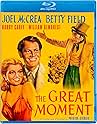
He did neither and the film had stalwart Joel McCrea as the dentist who demonstrated the first public use of ether during surgery. Betty Field was his long suffering wife in an earnest, but rather dull biographical study. It's not even that Morton was that noble because there were other claims by people who were working along the same lines as he. It all amounts to a confusing story.
William Demarest was a player beloved of Preston Sturges and he appeared in all of his Paramount films. He does so here as a man who was willing to be experimented on by McCrea. When McCrea gives him a dose of the wrong stuff the results are hilarious, but oh so out of place in this type of film.
For those who love Preston Sturges's comedies as I do, this is one to stay away from.
Paramount had Sturges under contract and as such he had to do their bidding and on this occasion the studio required of him to direct this biographical film of the life of William T.G. Morton, the alleged inventor of ether.
From their point of view it was one odd choice to direct a biographical film like The Story of Louis Pasteur or Dr. Ehrlich's Magic Bullet. What possessed the studio brains to select Sturges? On the other hand Sturges did have a lot of creative freedom at Paramount so why didn't he just take one for the team and direct a straight forward biography?
He did neither and the film had stalwart Joel McCrea as the dentist who demonstrated the first public use of ether during surgery. Betty Field was his long suffering wife in an earnest, but rather dull biographical study. It's not even that Morton was that noble because there were other claims by people who were working along the same lines as he. It all amounts to a confusing story.
William Demarest was a player beloved of Preston Sturges and he appeared in all of his Paramount films. He does so here as a man who was willing to be experimented on by McCrea. When McCrea gives him a dose of the wrong stuff the results are hilarious, but oh so out of place in this type of film.
For those who love Preston Sturges's comedies as I do, this is one to stay away from.
Dental blandness
A great film 'The Great Moment' could have, and should have, been. Really love Preston Sturges as a director and writer and his golden period ranging from 1940 to 1944 was one of the best prime/golden periods of any director to me. A period that saw 'The Great McGinty', 'Christmas in July', 'The Lady Eve', 'Sullivan's Travels', 'The Palm Beach Story', 'The Miracle of Morgan's Creek' and 'Hail the Conquering Hero', all very good to masterpiece films. 'Unfaithfully Yours' was also great.
Sadly, 'The Great Moment', which didn't turn out the way Sturges intended and was the victim of mis-marketing, delayed release and destructive studio interference, didn't materialise as that great film. It is not a terrible film or unwatchable, it just felt disappointing and bland. Disappointing by Sturges standards, as it often did not feel like a Sturges film in direction or writing, and by that it was released after a string of several hits in a row. Really do appreciate Sturges' obvious good intentions, and it was laudable trying to make something entertaining out of the true story of a forgotten dentist and out of a subject that is really quite serious and potentially not that interesting. It sadly did not turn out that way and after such a consistent streak Sturges had his first failure and it is still one of his lesser films along with 'The Beautiful Blonde from Bashful Bend'.
There are good things with 'The Great Moment'. It's nicely made visually, nothing amateurish here. The music is pleasant and fits well. There are a few sporadically funny moments, that with William Demarest faring most memorably, and the ending while rather abrupt has emotional power and hope.
It is the cast that make 'The Great Moment' watchable. Although the character himself could have been far more interesting, Joel McCrea makes a good sensitive account of himself. Meanwhile Betty Field makes much of little and Harry Carey and Julius Tannon are the supporting cast standouts. William Demarest does his best but he is much better and funnier in other films.
Sturges however, for this point of his career, directs with somewhat of a heavy hand and with the way the film was treated there is the implication that he was at sea of what to do with the material or was not interested in it. All of this not like him at all. The writing also suffers, it lacks sharpness, wit, sophistication and bite and the worst of it is pretty embarrassing. The attempts at comedy are on the most part both over-played and fatigued while feeling at odds with the more dramatic material, which tended to be bland and dull.
Regarding the story, it doesn't ever properly come to life, failing to make what could have been really enlightening if done right rather mundane and so what, and structurally it veers on rushed and disjointed. The characters could have been more engaging and the way they are written comes over as one sided.
Summarising, watchable but for Sturges this was disappointing and too far away from a great moment. Mainly to be seen for completest sake. 5/10 Bethany Cox
Sadly, 'The Great Moment', which didn't turn out the way Sturges intended and was the victim of mis-marketing, delayed release and destructive studio interference, didn't materialise as that great film. It is not a terrible film or unwatchable, it just felt disappointing and bland. Disappointing by Sturges standards, as it often did not feel like a Sturges film in direction or writing, and by that it was released after a string of several hits in a row. Really do appreciate Sturges' obvious good intentions, and it was laudable trying to make something entertaining out of the true story of a forgotten dentist and out of a subject that is really quite serious and potentially not that interesting. It sadly did not turn out that way and after such a consistent streak Sturges had his first failure and it is still one of his lesser films along with 'The Beautiful Blonde from Bashful Bend'.
There are good things with 'The Great Moment'. It's nicely made visually, nothing amateurish here. The music is pleasant and fits well. There are a few sporadically funny moments, that with William Demarest faring most memorably, and the ending while rather abrupt has emotional power and hope.
It is the cast that make 'The Great Moment' watchable. Although the character himself could have been far more interesting, Joel McCrea makes a good sensitive account of himself. Meanwhile Betty Field makes much of little and Harry Carey and Julius Tannon are the supporting cast standouts. William Demarest does his best but he is much better and funnier in other films.
Sturges however, for this point of his career, directs with somewhat of a heavy hand and with the way the film was treated there is the implication that he was at sea of what to do with the material or was not interested in it. All of this not like him at all. The writing also suffers, it lacks sharpness, wit, sophistication and bite and the worst of it is pretty embarrassing. The attempts at comedy are on the most part both over-played and fatigued while feeling at odds with the more dramatic material, which tended to be bland and dull.
Regarding the story, it doesn't ever properly come to life, failing to make what could have been really enlightening if done right rather mundane and so what, and structurally it veers on rushed and disjointed. The characters could have been more engaging and the way they are written comes over as one sided.
Summarising, watchable but for Sturges this was disappointing and too far away from a great moment. Mainly to be seen for completest sake. 5/10 Bethany Cox
THE GREAT MOMENT (Preston Sturges, 1944) ***
This film is notorious for having been butchered by the studio and shelved for two years (the trailer awkwardly tries to pass it off as another Sturges comedy); atypically for him, it’s a medical biopic on the lines of Warner Bros,’ similar films of a few years earlier – and, therefore, more serious than usual (in fact, the few comedy elements here seem like a distraction to the unfolding drama).
I own a volume of Sturges’ scripts – including the original version of this one, called TRIUMPH OVER PAIN (the book from which it derived also inspired the latter-day Boris Karloff vehicle CORRIDORS OF BLOOD [1958]!), which is certainly his most ambitious project; I had read it some years ago and recall it being quite complexly structured: what remains of the film is pretty straightforward, other than adopting a flashback framework (to which it doesn’t even return at the end!). Still, as it stands, it’s hardly a disaster (if undeniably choppy and rushed): fascinating as much for its plot about the inception of anesthesia by a forgotten small-town doctor, W.T.G. Morton, which many a fellow doctor tried to claim as their own invention, as for its handsome and meticulous recreation of an era (recalling Orson Welles’ equally compromised THE MAGNIFICENT AMBERSONS [1942]).
The cast includes a few of Sturges’ renowned stock company: star Joel McCrea (in their third consecutive collaboration) is well-cast in the lead; William Demarest appears as his comic sidekick (the doctor’s first painless client – repeatedly, he starts to recount his experience but each time succeeding in going no further than the first couple of phrases!); Porter Hall (as the somewhat patronizing American President); Franklin Pangborn (in a brief role as secretary to an esteemed doctor whom McCrea wants to test his formula); Jimmy Conlin (the chemist who sells McCrea the ‘miraculous’ ether); Torben Meyer (an irascible doctor who is urgently called in to treat a patient administered an overdose of laughing gas – more on this later).
The remaining actors include: Betty Field as Morton’s long-suffering wife (whose limited role is often relegated to the sidelines, at least in this version); Harry Carey (dignified as the surgeon who regrets the barbaric methods he’s forced to use while operating on his patients); Louis Jean Heydt (as an arrogant young student who uses laughing gas for desensitization, but whose experiment goes comically awry); Grady Sutton (this W.C. Fields regular appears in one of only two overtly slapsticky scenes as the recipient of the laughing gas – the other involves McCrea’s first attempt to extract Demarest’s tooth, which renders him temporarily crazed and sends him crashing through the window into the street below!); Edwin Maxwell (the usual authoritarian role, in this case a colleague of Carey’s who indirectly stoops to blackmail in order to force McCrea to reveal the secret ingredient of his formula – which the latter was concealing, as a means of protection, only so long as the “Letheon” invention was officially patented).
Sturges, obviously, is all for the hero who has to face up to a general wave of both ignorance and prejudice, not to mention centuries of savage medical tradition; in fact, as depicted in the film, the students seem to treat daily grueling operations almost as another form of entertainment! The film rises to a number of good dramatic moments (usually seeing McCrea in confrontation with someone or other) – especially powerful, however, are Carey’s first successful operation with an anesthetized patient (and his surprised but enthusiastic approval of the procedure) and the ending, complete with moody lighting and religious music, as Morton compassionately approaches the next ‘victim’ of established science…when the doors of reason, as it were, are suddenly flung open and the painless method is accepted into its fold.
I own a volume of Sturges’ scripts – including the original version of this one, called TRIUMPH OVER PAIN (the book from which it derived also inspired the latter-day Boris Karloff vehicle CORRIDORS OF BLOOD [1958]!), which is certainly his most ambitious project; I had read it some years ago and recall it being quite complexly structured: what remains of the film is pretty straightforward, other than adopting a flashback framework (to which it doesn’t even return at the end!). Still, as it stands, it’s hardly a disaster (if undeniably choppy and rushed): fascinating as much for its plot about the inception of anesthesia by a forgotten small-town doctor, W.T.G. Morton, which many a fellow doctor tried to claim as their own invention, as for its handsome and meticulous recreation of an era (recalling Orson Welles’ equally compromised THE MAGNIFICENT AMBERSONS [1942]).
The cast includes a few of Sturges’ renowned stock company: star Joel McCrea (in their third consecutive collaboration) is well-cast in the lead; William Demarest appears as his comic sidekick (the doctor’s first painless client – repeatedly, he starts to recount his experience but each time succeeding in going no further than the first couple of phrases!); Porter Hall (as the somewhat patronizing American President); Franklin Pangborn (in a brief role as secretary to an esteemed doctor whom McCrea wants to test his formula); Jimmy Conlin (the chemist who sells McCrea the ‘miraculous’ ether); Torben Meyer (an irascible doctor who is urgently called in to treat a patient administered an overdose of laughing gas – more on this later).
The remaining actors include: Betty Field as Morton’s long-suffering wife (whose limited role is often relegated to the sidelines, at least in this version); Harry Carey (dignified as the surgeon who regrets the barbaric methods he’s forced to use while operating on his patients); Louis Jean Heydt (as an arrogant young student who uses laughing gas for desensitization, but whose experiment goes comically awry); Grady Sutton (this W.C. Fields regular appears in one of only two overtly slapsticky scenes as the recipient of the laughing gas – the other involves McCrea’s first attempt to extract Demarest’s tooth, which renders him temporarily crazed and sends him crashing through the window into the street below!); Edwin Maxwell (the usual authoritarian role, in this case a colleague of Carey’s who indirectly stoops to blackmail in order to force McCrea to reveal the secret ingredient of his formula – which the latter was concealing, as a means of protection, only so long as the “Letheon” invention was officially patented).
Sturges, obviously, is all for the hero who has to face up to a general wave of both ignorance and prejudice, not to mention centuries of savage medical tradition; in fact, as depicted in the film, the students seem to treat daily grueling operations almost as another form of entertainment! The film rises to a number of good dramatic moments (usually seeing McCrea in confrontation with someone or other) – especially powerful, however, are Carey’s first successful operation with an anesthetized patient (and his surprised but enthusiastic approval of the procedure) and the ending, complete with moody lighting and religious music, as Morton compassionately approaches the next ‘victim’ of established science…when the doors of reason, as it were, are suddenly flung open and the painless method is accepted into its fold.
Preston Sturges tackles the Hollywood biopic
Everybody else seems to think there's a lot wrong with this film, but I rather liked it. THE GREAT MOMENT (1944) sees Preston Sturges doing something a little different from the screwy comedies that he's known for. The movie is not a comedy, first of all. It's a more serious Sturges film about a real historical figure. It's the story of the discovery of anesthesia, which would revolutionize medical practice by allowing for painless surgeries. I thought it was very interesting.
Joel McCrea plays W.T.G. Morton, the dentist and amateur scientist who experiments with the use of ether vapor to dull the senses. Ultimately he must share his discovery with the world for the benefit of all mankind, rather than exploit his secret for profit.
The flick breezes by at 81 minutes, so it doesn't delve into the protagonist's personal life as much as other biopics. Sturges puts his own spin on the Hollywood biopic with his flair for comedy still shining through, particularly in William Demarest's scenes. Under Sturges's direction, even the scenes of Morton reading a reference book manage to capture the thrill of scientific discovery and there's some interesting non-linear storytelling early on.
THE GREAT MOMENT may not be a signature Preston Sturges comedy, but that doesn't mean there's anything wrong with it.
Joel McCrea plays W.T.G. Morton, the dentist and amateur scientist who experiments with the use of ether vapor to dull the senses. Ultimately he must share his discovery with the world for the benefit of all mankind, rather than exploit his secret for profit.
The flick breezes by at 81 minutes, so it doesn't delve into the protagonist's personal life as much as other biopics. Sturges puts his own spin on the Hollywood biopic with his flair for comedy still shining through, particularly in William Demarest's scenes. Under Sturges's direction, even the scenes of Morton reading a reference book manage to capture the thrill of scientific discovery and there's some interesting non-linear storytelling early on.
THE GREAT MOMENT may not be a signature Preston Sturges comedy, but that doesn't mean there's anything wrong with it.


Did you know
- TriviaThe movie was filmed in April-June 1942, but not released until 1944. Preview audiences found the film confusing, and Executive Producer Buddy G. De Sylva re-edited it over Preston Sturges's objections.
- Quotes
Elizabeth Morton: He's going to be a dentist!
[weeps on her mother's shoulder]
Mrs. Whitman: Oh, and he seemed such a nice young man.
- SoundtracksAve Maria
Music by Franz Schubert
- How long is The Great Moment?Powered by Alexa
Details
- Runtime
- 1h 23m(83 min)
- Color
- Aspect ratio
- 1.37 : 1
Contribute to this page
Suggest an edit or add missing content