IMDb RATING
6.2/10
1.1K
YOUR RATING

The biography of Dr. W. T. Morgan, a 19th century Boston dentist, during his quest to have anesthesia, in the form of ether, accepted by the public and the medical and dental establishment.The biography of Dr. W. T. Morgan, a 19th century Boston dentist, during his quest to have anesthesia, in the form of ether, accepted by the public and the medical and dental establishment.The biography of Dr. W. T. Morgan, a 19th century Boston dentist, during his quest to have anesthesia, in the form of ether, accepted by the public and the medical and dental establishment.


Julius Tannen
- Professor Charles T. Jackson
- (as Julian Tannen)


Victor Potel
- First Dental Patient
- (as Vic Potel)


George Anderson
- Frederick T. Johnson
- (uncredited)

6.21.1K
1
2
3
4
5
6
7
8
9
10
Featured reviews
Interesting story of Dr. Thomas Morton
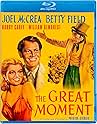
In an unusual move, Preston Sturges decided to film "The Great Moment," a movie that tells the story of Dr. Thomas Morton's struggle to be acknowledged for his work in discovering anesthesia. The Sturges 1944 film (shelved for two years) starring Joel McCrea takes the point of view that Morton was a wronged man. In reading up on it, it seems that he was, and that a good deal of "The Great Moment" is accurate, probably until the very end.
Morton is a dentist seeking a way to practice pain-free dentistry. With the help of his mentor, Dr. Jackson, he eventually tries a form of ether that works, and he gives a name to his product. It was successfully used at the Massachusetts General Hospital for the first time in 1846. The problem comes in that, as with many inventions, other people claimed credit. Dr. Horace Wells, with whom Morton had worked, indeed used anesthesia in the form of laughing gas, but had a colossal public failure and after that, continued experimenting. Jackson, who claimed credit for telling Morton about the ether, later claimed he had invented the telegraph and a form of ammunition and was clearly unbalanced. The man who made anesthesia a practical tool of surgery was Morton, but he was unable to obtain a patent, and the fight about who really invented it raged on for years.
Joel McCrea is very likable as Dr. Morton, and Betty Field is wonderful as his long-suffering wife. Harry Carey turns in one of the best performances as Dr. Warren, the doctor who lets Morton use anesthesia on his patient. William Demarest plays a dental patient who has a pain-free surgery and after that, aligns with Morton. He's actually there more for comic relief.
"The Great Moment" works backwards, starting at the end and working through until Dr. Morton "ruins himself for a servant girl" - you'll be wondering what that's about all through the film. Actually, from my research, that part is pure hooey, and that's not why Dr. Morton lost control of his invention. The film is an uneasy mix of comedy and drama and, unlike other Sturges films, is a downer. Apparently this version isn't his cut. Sturges fans will be disappointed. I have to say, I was intrigued.
Morton is a dentist seeking a way to practice pain-free dentistry. With the help of his mentor, Dr. Jackson, he eventually tries a form of ether that works, and he gives a name to his product. It was successfully used at the Massachusetts General Hospital for the first time in 1846. The problem comes in that, as with many inventions, other people claimed credit. Dr. Horace Wells, with whom Morton had worked, indeed used anesthesia in the form of laughing gas, but had a colossal public failure and after that, continued experimenting. Jackson, who claimed credit for telling Morton about the ether, later claimed he had invented the telegraph and a form of ammunition and was clearly unbalanced. The man who made anesthesia a practical tool of surgery was Morton, but he was unable to obtain a patent, and the fight about who really invented it raged on for years.
Joel McCrea is very likable as Dr. Morton, and Betty Field is wonderful as his long-suffering wife. Harry Carey turns in one of the best performances as Dr. Warren, the doctor who lets Morton use anesthesia on his patient. William Demarest plays a dental patient who has a pain-free surgery and after that, aligns with Morton. He's actually there more for comic relief.
"The Great Moment" works backwards, starting at the end and working through until Dr. Morton "ruins himself for a servant girl" - you'll be wondering what that's about all through the film. Actually, from my research, that part is pure hooey, and that's not why Dr. Morton lost control of his invention. The film is an uneasy mix of comedy and drama and, unlike other Sturges films, is a downer. Apparently this version isn't his cut. Sturges fans will be disappointed. I have to say, I was intrigued.
Dental blandness
A great film 'The Great Moment' could have, and should have, been. Really love Preston Sturges as a director and writer and his golden period ranging from 1940 to 1944 was one of the best prime/golden periods of any director to me. A period that saw 'The Great McGinty', 'Christmas in July', 'The Lady Eve', 'Sullivan's Travels', 'The Palm Beach Story', 'The Miracle of Morgan's Creek' and 'Hail the Conquering Hero', all very good to masterpiece films. 'Unfaithfully Yours' was also great.
Sadly, 'The Great Moment', which didn't turn out the way Sturges intended and was the victim of mis-marketing, delayed release and destructive studio interference, didn't materialise as that great film. It is not a terrible film or unwatchable, it just felt disappointing and bland. Disappointing by Sturges standards, as it often did not feel like a Sturges film in direction or writing, and by that it was released after a string of several hits in a row. Really do appreciate Sturges' obvious good intentions, and it was laudable trying to make something entertaining out of the true story of a forgotten dentist and out of a subject that is really quite serious and potentially not that interesting. It sadly did not turn out that way and after such a consistent streak Sturges had his first failure and it is still one of his lesser films along with 'The Beautiful Blonde from Bashful Bend'.
There are good things with 'The Great Moment'. It's nicely made visually, nothing amateurish here. The music is pleasant and fits well. There are a few sporadically funny moments, that with William Demarest faring most memorably, and the ending while rather abrupt has emotional power and hope.
It is the cast that make 'The Great Moment' watchable. Although the character himself could have been far more interesting, Joel McCrea makes a good sensitive account of himself. Meanwhile Betty Field makes much of little and Harry Carey and Julius Tannon are the supporting cast standouts. William Demarest does his best but he is much better and funnier in other films.
Sturges however, for this point of his career, directs with somewhat of a heavy hand and with the way the film was treated there is the implication that he was at sea of what to do with the material or was not interested in it. All of this not like him at all. The writing also suffers, it lacks sharpness, wit, sophistication and bite and the worst of it is pretty embarrassing. The attempts at comedy are on the most part both over-played and fatigued while feeling at odds with the more dramatic material, which tended to be bland and dull.
Regarding the story, it doesn't ever properly come to life, failing to make what could have been really enlightening if done right rather mundane and so what, and structurally it veers on rushed and disjointed. The characters could have been more engaging and the way they are written comes over as one sided.
Summarising, watchable but for Sturges this was disappointing and too far away from a great moment. Mainly to be seen for completest sake. 5/10 Bethany Cox
Sadly, 'The Great Moment', which didn't turn out the way Sturges intended and was the victim of mis-marketing, delayed release and destructive studio interference, didn't materialise as that great film. It is not a terrible film or unwatchable, it just felt disappointing and bland. Disappointing by Sturges standards, as it often did not feel like a Sturges film in direction or writing, and by that it was released after a string of several hits in a row. Really do appreciate Sturges' obvious good intentions, and it was laudable trying to make something entertaining out of the true story of a forgotten dentist and out of a subject that is really quite serious and potentially not that interesting. It sadly did not turn out that way and after such a consistent streak Sturges had his first failure and it is still one of his lesser films along with 'The Beautiful Blonde from Bashful Bend'.
There are good things with 'The Great Moment'. It's nicely made visually, nothing amateurish here. The music is pleasant and fits well. There are a few sporadically funny moments, that with William Demarest faring most memorably, and the ending while rather abrupt has emotional power and hope.
It is the cast that make 'The Great Moment' watchable. Although the character himself could have been far more interesting, Joel McCrea makes a good sensitive account of himself. Meanwhile Betty Field makes much of little and Harry Carey and Julius Tannon are the supporting cast standouts. William Demarest does his best but he is much better and funnier in other films.
Sturges however, for this point of his career, directs with somewhat of a heavy hand and with the way the film was treated there is the implication that he was at sea of what to do with the material or was not interested in it. All of this not like him at all. The writing also suffers, it lacks sharpness, wit, sophistication and bite and the worst of it is pretty embarrassing. The attempts at comedy are on the most part both over-played and fatigued while feeling at odds with the more dramatic material, which tended to be bland and dull.
Regarding the story, it doesn't ever properly come to life, failing to make what could have been really enlightening if done right rather mundane and so what, and structurally it veers on rushed and disjointed. The characters could have been more engaging and the way they are written comes over as one sided.
Summarising, watchable but for Sturges this was disappointing and too far away from a great moment. Mainly to be seen for completest sake. 5/10 Bethany Cox
A Sturgis Curiosity - and a One Sided View of a Discovery
Every book or play or movie based on history is bound to give only part of the story, and THE GREAT MOMENT is no exception. Preston Sturgis was one of the masters of sound film comedy in the 1940s, which sharp satires like THE GREAT McGINTY, SULLIVAN'S TRAVELS, and THE MIRACLE OF MORGAN'S CREEK. But he wanted to try something more serious - a biography of Dr. William Morton, the dentist who popularized the use of anesthesia (nitrous oxide) in operations. The film was shot in 1942, when Sturgis was reaching the height of his rocket-like career. But the management of Paramount was not satisfied with the film as Sturgis cut it, for he ended the story on a tragic note (that Morton never did benefit by his great discovery, and died impoverished and in disgrace). It was not an up-beat ending, and as Sturgis was known for comedies his film had to be up-beat. They re-cut the film as it remains today, and it ends (illogically) in the middle, with Morton's first triumphant use of nitrous oxide in an operation in 1846. To add to the film's tribulations there was a two year backlog of Hollywood films in 1942, so it was not released until 1944. It did moderate business, and did not aid Sturgis's faltering career at that point.
As it is, the film is not uninteresting, and shows that Sturgis would have had funny sections in the film (William Demerest's reaction to ether, for example). But it is based on a book that paints Morton as the hero of the "Conquest of Pain", relegating Drs. Horace Wells and Charles Jackson to background/villain roles. It's more complex than the surviving film suggests. Nitrous oxide had been known as a gas with odd properties for some time. In 1800 Sir Humphrey Davy, the famous British Chemist, suggested (somewhat inadvertently) it might be used by surgeons. But it was the drug of choice for decades in Europe and American, for a quick, pleasant (but dangerous) high. In THE CIDER HOUSE RULES, Michael Caine's character uses ether to get high when depressed, and it eventually kills him.
Dr. Horace Wells, a dentist from Connecticut, first got the idea of using ether for surgery in the U.S. However, he was not an effective demonstrator, and his attempt to show it before doctors only ended in dismissal and ridicule because the subject (although totally oblivious to pain) moaned while asleep. The audience thought he was hurting. Morton had worked as a dentist with Wells. He continued studying ether, and finally perfected a method of demonstrating it. He was better at demonstrations. But he had to share the secret with Dr. Charles Jackson, who helped him get the supplies of nitrous oxide. An agreement with Jackson was to allow them to share the credit. But Morton (who had an unscrupulous side, not shown in the movie) tried to patent nitrous oxide as "Letheon". It seems that legally one cannot patent natural gases, but Morton added another gas to the nitrous oxide to make the odor less unpleasant. He thought this would create a binding patent. It didn't, and his many attempts to get it patented never succeeded. The film makes it look like Morton did get it finally, when President Franklin Pierce (played by Porter Hall here - who does not look like that handsome weakling) signed a law recognizing Morton's claim. That did not settle the issue in Morton's favor.
None of the three men did well by their joint discovery. Wells became (like Michael Caine in CIDER HOUSE RULES) an addict, and committed suicide in a New York City jail in 1847. Morton actually did have a better career than Wells (in 1849 he gave testimony at the trial of Dr. John Webster for the murder of Dr. George Parkman at Harvard - testimony identifying a jaw as Dr. Parkman's which helped convict Webster). He died in 1868 (also in New York City) still trying to prove title to "Letheon". Jackson made a career of distinction in geology circles, but he kept claiming credit for inventions by other people (Samuel Morse's telegraph, some devices of Professor Joseph Henry of the Smithsonian Institute). He finally died in a madhouse in 1880.
Given the savage results of their fates, one wishes the "downer" version of the film still existed to see how Sturgis might have handled the story. But he still would have made Morton look better than his character fully deserved.
By the way, while Wells, Morton, and Jackson fought for credit for "letheon" in Massachusetts, in Athens, Georgia Dr. Crawford Long had done occasional minor surgery on patients using nitrous oxide. Long, a quiet, honorable country practitioner, wrote about it in some local journals. He never blew his horn about his "great moment". Instead, he lived and died a respected doctor and neighbor. Mark Twain mentioned how "a Northern slicker" (Morton, probably) had stolen the credit from Dr. Long. Oddly enough, the U.S. Postal Service agreed. In 1942, as part of their "Great American Issue" of stamps, among the five scientists was Dr. Long, as the inventor/discover of anesthesia. Apparently no comments by Sturgis about this stamp have ever turned up. One wonders what he thought about it.
As it is, the film is not uninteresting, and shows that Sturgis would have had funny sections in the film (William Demerest's reaction to ether, for example). But it is based on a book that paints Morton as the hero of the "Conquest of Pain", relegating Drs. Horace Wells and Charles Jackson to background/villain roles. It's more complex than the surviving film suggests. Nitrous oxide had been known as a gas with odd properties for some time. In 1800 Sir Humphrey Davy, the famous British Chemist, suggested (somewhat inadvertently) it might be used by surgeons. But it was the drug of choice for decades in Europe and American, for a quick, pleasant (but dangerous) high. In THE CIDER HOUSE RULES, Michael Caine's character uses ether to get high when depressed, and it eventually kills him.
Dr. Horace Wells, a dentist from Connecticut, first got the idea of using ether for surgery in the U.S. However, he was not an effective demonstrator, and his attempt to show it before doctors only ended in dismissal and ridicule because the subject (although totally oblivious to pain) moaned while asleep. The audience thought he was hurting. Morton had worked as a dentist with Wells. He continued studying ether, and finally perfected a method of demonstrating it. He was better at demonstrations. But he had to share the secret with Dr. Charles Jackson, who helped him get the supplies of nitrous oxide. An agreement with Jackson was to allow them to share the credit. But Morton (who had an unscrupulous side, not shown in the movie) tried to patent nitrous oxide as "Letheon". It seems that legally one cannot patent natural gases, but Morton added another gas to the nitrous oxide to make the odor less unpleasant. He thought this would create a binding patent. It didn't, and his many attempts to get it patented never succeeded. The film makes it look like Morton did get it finally, when President Franklin Pierce (played by Porter Hall here - who does not look like that handsome weakling) signed a law recognizing Morton's claim. That did not settle the issue in Morton's favor.
None of the three men did well by their joint discovery. Wells became (like Michael Caine in CIDER HOUSE RULES) an addict, and committed suicide in a New York City jail in 1847. Morton actually did have a better career than Wells (in 1849 he gave testimony at the trial of Dr. John Webster for the murder of Dr. George Parkman at Harvard - testimony identifying a jaw as Dr. Parkman's which helped convict Webster). He died in 1868 (also in New York City) still trying to prove title to "Letheon". Jackson made a career of distinction in geology circles, but he kept claiming credit for inventions by other people (Samuel Morse's telegraph, some devices of Professor Joseph Henry of the Smithsonian Institute). He finally died in a madhouse in 1880.
Given the savage results of their fates, one wishes the "downer" version of the film still existed to see how Sturgis might have handled the story. But he still would have made Morton look better than his character fully deserved.
By the way, while Wells, Morton, and Jackson fought for credit for "letheon" in Massachusetts, in Athens, Georgia Dr. Crawford Long had done occasional minor surgery on patients using nitrous oxide. Long, a quiet, honorable country practitioner, wrote about it in some local journals. He never blew his horn about his "great moment". Instead, he lived and died a respected doctor and neighbor. Mark Twain mentioned how "a Northern slicker" (Morton, probably) had stolen the credit from Dr. Long. Oddly enough, the U.S. Postal Service agreed. In 1942, as part of their "Great American Issue" of stamps, among the five scientists was Dr. Long, as the inventor/discover of anesthesia. Apparently no comments by Sturgis about this stamp have ever turned up. One wonders what he thought about it.
An oddity from a genius
I can't add much to wmorrow59's excellent summary. It caught the strengths and weaknesses of this film and provided excellent historical background. Be sure to read it.
This film is only worth watching if you're a Preston Sturges fanatic (like me) and are willing to sit through his one failure as well as his many triumphs. I have a hunch that the studio meddling accounts for much of the trouble -- the movie's pace and structure are erratic at best -- but I also fear that our man Preston may have wandered too far from his natural path as a filmmaker. This is no buried treasure. Sturges's cut may have been an improvement, but I don't see the makings of a good movie here. The dialogue is weird when it isn't plain awful, the protagonist is a pigheaded dimwit, and the moments of slapstick are wildly misplaced.
If you buy Turner's incredible 7-film Sturges box set, do so for the other six titles -- all of them masterpieces.
This film is only worth watching if you're a Preston Sturges fanatic (like me) and are willing to sit through his one failure as well as his many triumphs. I have a hunch that the studio meddling accounts for much of the trouble -- the movie's pace and structure are erratic at best -- but I also fear that our man Preston may have wandered too far from his natural path as a filmmaker. This is no buried treasure. Sturges's cut may have been an improvement, but I don't see the makings of a good movie here. The dialogue is weird when it isn't plain awful, the protagonist is a pigheaded dimwit, and the moments of slapstick are wildly misplaced.
If you buy Turner's incredible 7-film Sturges box set, do so for the other six titles -- all of them masterpieces.
Far from great
Decidedly odd, you might think, coming from Preston Sturges but then again, perhaps not as the idiosyncratic Sturges seldom stuck to 'conventional' genre pictures; even his screw-ball comedies were more perverse than what was the norm in Hollywood at the time, so this biopic of the man who discovered anesthesia for use in the dental profession is a far cry from the usual Hollywood biopic, (even the subject is obscure and unlikely). Not, of course, is it necessarily any better for that. It's a slight, disingenuous little picture veering uneasily from drama to comedy without making much of an inroad either way.
Joel McCrea, (blander than usual), is the crusading dentist, (sic), and Betty Field, the wife who eggs him on. Some of the Sturges stock company pop up in sundry supporting parts, (noticeably William Demarest), but none make much of an impression. They, like the film, remain largely inoffensive. Not a failure, precisely, but a blip nevertheless.
Joel McCrea, (blander than usual), is the crusading dentist, (sic), and Betty Field, the wife who eggs him on. Some of the Sturges stock company pop up in sundry supporting parts, (noticeably William Demarest), but none make much of an impression. They, like the film, remain largely inoffensive. Not a failure, precisely, but a blip nevertheless.


Did you know
- TriviaThe movie was filmed in April-June 1942, but not released until 1944. Preview audiences found the film confusing, and Executive Producer Buddy G. De Sylva re-edited it over Preston Sturges's objections.
- Quotes
Elizabeth Morton: He's going to be a dentist!
[weeps on her mother's shoulder]
Mrs. Whitman: Oh, and he seemed such a nice young man.
- SoundtracksAve Maria
Music by Franz Schubert
- How long is The Great Moment?Powered by Alexa
Details
- Runtime
- 1h 23m(83 min)
- Color
- Aspect ratio
- 1.37 : 1
Contribute to this page
Suggest an edit or add missing content