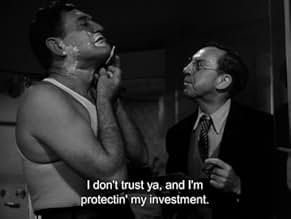
A drifter claims the money in an old bank account by impersonating someone else with the same name. Soon he finds himself the target of a man who turns out to be the son of the old partner o... Read allA drifter claims the money in an old bank account by impersonating someone else with the same name. Soon he finds himself the target of a man who turns out to be the son of the old partner of the impersonated man's father, who caused his partner to do time in prison.A drifter claims the money in an old bank account by impersonating someone else with the same name. Soon he finds himself the target of a man who turns out to be the son of the old partner of the impersonated man's father, who caused his partner to do time in prison.
Frank Baker
- Club Patron
- (uncredited)
Walter Baldwin
- Fireman
- (uncredited)
Willie Best
- Men's Room Attendant
- (uncredited)
Edward Biby
- Club Patron
- (uncredited)
Edgar Dearing
- Bank Guard
- (uncredited)
George Ford
- Clerk
- (uncredited)
Otto Forrest
- The Whistler
- (uncredited)
Howard Freeman
- M.K. Simmons
- (uncredited)
Edna Holland
- Childrens Aid Society Woman
- (uncredited)
Eddie Kane
- Haberdasher at Edwards
- (uncredited)
Donald Kerr
- Newspaper Photographer
- (uncredited)
Matt McHugh
- Tom, Reporter
- (uncredited)
- Director
- Writers
- All cast & crew
- Production, box office & more at IMDbPro
6.5561
1
2
3
4
5
6
7
8
9
10
Featured reviews
It pays at the end!
The mark of the whistler 1944
Film noir, by definition, deals with crime and that too in a stylised way. These films galore in Hollywood in the 40s to 60s period. One such film is this.
The story is narrated by an incognito narrator (the whistler) and is about a stone broke man who gets into the hotseat due to his greed for easy money. The storyline is simple, characters are very few and the filming is seamless. The suspense is kept intact, though it isn't a 'whodunit'. The protagonist gets his share for his part on the day of reckoning and there is one major suprise in the end too. Roughly an hour long, this drama is worth watching and you wouldn't regret it.
Film noir, by definition, deals with crime and that too in a stylised way. These films galore in Hollywood in the 40s to 60s period. One such film is this.
The story is narrated by an incognito narrator (the whistler) and is about a stone broke man who gets into the hotseat due to his greed for easy money. The storyline is simple, characters are very few and the filming is seamless. The suspense is kept intact, though it isn't a 'whodunit'. The protagonist gets his share for his part on the day of reckoning and there is one major suprise in the end too. Roughly an hour long, this drama is worth watching and you wouldn't regret it.
A man impersonates another to commit fraud.
The tangled web we weave strikes again in Mark of the Whistler, starring as usual Richard Dix. This story is by Cornell Woolrich and directed by William Castle, so it has a good pedigree.
The Whistler narrates the story but isn't seen and doesn't interfere. Nice work if you can get it.
Here Dix is a drifter, Lee Nugent, who sees that a bank is seeking owners of old bank accounts that haven't been claimed. He manages to convince a store owner to give him a new suit for a cut of the money. After doing his research and feeling safe that the real man will not come forward, he is ready to approach the bank.
It turns out to be a sizable sum, and he eventually collects. However, he becomes the target of a man whose father was cheated by Lee's father and forced to do time in prison.
I'm never thrilled by Richard Dix, but there are some turns in this story that make it watchable.
The Whistler narrates the story but isn't seen and doesn't interfere. Nice work if you can get it.
Here Dix is a drifter, Lee Nugent, who sees that a bank is seeking owners of old bank accounts that haven't been claimed. He manages to convince a store owner to give him a new suit for a cut of the money. After doing his research and feeling safe that the real man will not come forward, he is ready to approach the bank.
It turns out to be a sizable sum, and he eventually collects. However, he becomes the target of a man whose father was cheated by Lee's father and forced to do time in prison.
I'm never thrilled by Richard Dix, but there are some turns in this story that make it watchable.
What's in a name?
This was the second of the eight self-contained Whistler films starring Richard Dix, still playing a goodie but this time with more bad in him. Also after the first my second favourite entry in the series.
Lee Nugent mark that name is a human derelict who hits upon the idea of impersonating a man whose bank is advertising for him to appear and claim his dormant bank account. He doesn't initially know how much money is involved but when he does get it he gives Porter Hall a fair price for the loan of his suits Things start to get complicated when he bumps into Limpy the match seller and a determined newspaper reporter played by Janis Carter just before she played a determined newspaper reporter in One Mysterious Night! Favourite bits: Signing his name but blotting his middle initial in the bank; Some of the sinister scenes with John Calvert chasing after Dix. The overall moral is Let Your Conscience Be Your Guide, with Dix you can believe it too. With one twist after another the last one is a little twee but still effective.
No cgi cartoonery, swearing, sex or violence, just b&w and an intricate story well acted make for a very pleasant hour.
Lee Nugent mark that name is a human derelict who hits upon the idea of impersonating a man whose bank is advertising for him to appear and claim his dormant bank account. He doesn't initially know how much money is involved but when he does get it he gives Porter Hall a fair price for the loan of his suits Things start to get complicated when he bumps into Limpy the match seller and a determined newspaper reporter played by Janis Carter just before she played a determined newspaper reporter in One Mysterious Night! Favourite bits: Signing his name but blotting his middle initial in the bank; Some of the sinister scenes with John Calvert chasing after Dix. The overall moral is Let Your Conscience Be Your Guide, with Dix you can believe it too. With one twist after another the last one is a little twee but still effective.
No cgi cartoonery, swearing, sex or violence, just b&w and an intricate story well acted make for a very pleasant hour.
Oh the irony!
Lee Selfridge Nugent (Richard Dix) is introduced as someone who once had power and wealth, but has lost that over time, and due to bad health cannot hold a job and has become a homeless hobo. He looks at a newspaper left on a park bench and sees an ad for unclaimed money at a local bank. The accounts are all said to be over a hundred dollars (about 2000 dollars in 2021 money), and one of the people who has a dormant account left it in trust for her son, who is also named Lee Nugent.
So Lee does some reconnaissance and gets enough backstory on Lee Nugent that he feels he can impersonate him and get his mother's money. But nobody seems to know what happened to the actual Lee Nugent past fifteen years of age. Lee does pull it off. A brief investigation by the bank and the money is his. But it is thirty thousand dollars not just one hundred. In 2021 that would be about 600K.
But Lee's conscience bugs him because he KNOWS the money is not his. Before he gets the money he thinks every cop or guard who stares at him must know about his fraud. But after he gets the money he is a bit too confident. And then he starts noticing strangers staring at him who are not cops or guards. Is he imagining things, or are they wanting to rob him, or is it something more? Watch and find out.
Well directed by William Castle, the camera gets good close ups of the people involved, detracting from the somewhat cheap sets that poverty row Columbia could afford, and allowing the viewer to feel the claustrophobia that Lee is feeling.
This Whistler entry has some great plot twists, as do most of them. Plus The Whistler himself narrates more of the story than he does in later entries. I'd highly recommend this one.
So Lee does some reconnaissance and gets enough backstory on Lee Nugent that he feels he can impersonate him and get his mother's money. But nobody seems to know what happened to the actual Lee Nugent past fifteen years of age. Lee does pull it off. A brief investigation by the bank and the money is his. But it is thirty thousand dollars not just one hundred. In 2021 that would be about 600K.
But Lee's conscience bugs him because he KNOWS the money is not his. Before he gets the money he thinks every cop or guard who stares at him must know about his fraud. But after he gets the money he is a bit too confident. And then he starts noticing strangers staring at him who are not cops or guards. Is he imagining things, or are they wanting to rob him, or is it something more? Watch and find out.
Well directed by William Castle, the camera gets good close ups of the people involved, detracting from the somewhat cheap sets that poverty row Columbia could afford, and allowing the viewer to feel the claustrophobia that Lee is feeling.
This Whistler entry has some great plot twists, as do most of them. Plus The Whistler himself narrates more of the story than he does in later entries. I'd highly recommend this one.
William Castle meets Dostoyevsky
This entry is the best in this above-average series from Columbia. All the stories had intriguing premises and clever twists, but this one even more so, since it was based on an original by Cornell Woolrich, that master of gloom, fate and paranoia. You definitely won't see the last curveball coming. There's a nice element of "Crime and Punishment"-like guilt infiltrating the protagonist's shady exploits, although it's not directly responsible for his downfall. The material is the essence of noir, but Castle filmed it straightforwardly for the most part. In his early days before churning out his gimmicky horror pics, he knew how to add telling little touches and include fascinatingly offbeat characters on the margins. All the same, one can't help thinking that this might have been a low-budget noir masterpiece along the lines of "Blind Spot" or "Fear in the Night" if the style had been more doom-laden and shadowy.
Did you know
- TriviaThe film's working title was "Dormant Account."
- ConnectionsFollowed by The Power of the Whistler (1945)
Details
- Release date
- Country of origin
- Language
- Also known as
- Dormant Account
- Production company
- See more company credits at IMDbPro
- Runtime
- 1h 2m(62 min)
- Color
- Aspect ratio
- 1.37 : 1
Contribute to this page
Suggest an edit or add missing content