

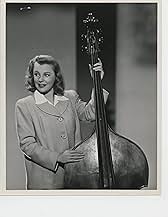
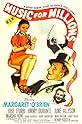
Six year old "Mike" joins her sister Barbara Ainsworth who plays in a classical orchestra during WW II.Six year old "Mike" joins her sister Barbara Ainsworth who plays in a classical orchestra during WW II.Six year old "Mike" joins her sister Barbara Ainsworth who plays in a classical orchestra during WW II.
- Nominated for 1 Oscar
- 4 wins & 2 nominations total


Madeleine Lebeau
- Jane
- (as Madeleine LeBeau)

- Director
- Writer
- All cast & crew
- Production, box office & more at IMDbPro
6.6703
1
2
3
4
5
6
7
8
9
10
Featured reviews
10marshakt
Music for Millions: delightful film for entire family
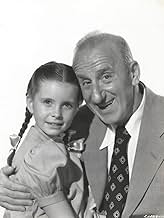
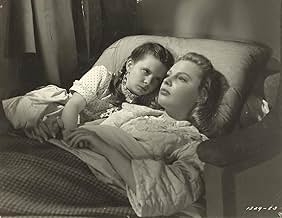
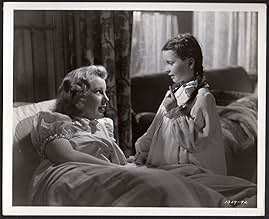
The music is worth the viewing of this WWII film. Jose Iturbi performs some classic pieces as only he could do. This movie gives a slice of life from a different era. Some of the funniest scenes are between Jimmy Durante and Margaret O'Brien. June Allyson's scenes with Marsha Hunt compel even the most cynical person to tears. Seeing tiny June Allyson playing the huge double bass (not the cello) has its own kind of humor, and interestingly, the main character of the movie doesn't appear on screen! But it is the music that makes the film so sweet and memorable. The music is as much a part of the story as the characters. It was a time of innocence and sweetness that June Allyson and Margaret O'Brien capture so perfectly. They don't make movies like this any more.
Better named, "Hope for Millions"!
I saw "Music for Millions" right before Memorial Day. This beautiful WWII movie must have been a wonderful gift of hope to American G.I. wives and sweethearts. It leaves nothing unsaid about the powerlessness and fear many of these women must have felt. Yet it is also an inspiring testimonial about hope. Hope, prayer, and faith as embodied by one tenacious six-year old girl.
Although you'll cry aplenty, this is more than a '4-hankie' drama. Jimmy Durante, with his famous 'snozzoola' and comic skits, provides a wonderfully humorous contrast to the inspiring classical concertos played by the world-renown Jose Iturbi. You'll be left breathless while the famous conductor/pianist fills the air with the incredibly beautiful music of his mostly female orchestra, bringing a different kind of hope and joy to our boys in uniform.
This movie is an absolute MUST!
Although you'll cry aplenty, this is more than a '4-hankie' drama. Jimmy Durante, with his famous 'snozzoola' and comic skits, provides a wonderfully humorous contrast to the inspiring classical concertos played by the world-renown Jose Iturbi. You'll be left breathless while the famous conductor/pianist fills the air with the incredibly beautiful music of his mostly female orchestra, bringing a different kind of hope and joy to our boys in uniform.
This movie is an absolute MUST!
Magical, funny, a perfect feel-good film
This is sheer magic. Margaret O'Brien, aged seven, is the perfect pixie. Unlike Shirley Temple, who could be over-sweet, Margaret O'Brien as a child star was too honest and direct ever to be saccharine, and she never catered to an audience at the expense of her character. Although she could doubtless turn tears on for the camera like a true pro, she never compromised her integrity of genuine childlike innocence, the portrayal of which on the screen borders on the supernatural. Although I met her briefly once before, just to say hello to, I knew her for a few days when she was already a young woman. At that time she was wearing an excessive amount of makeup to try to appear 'grown up' and shed the childlike image which was costing her work as an adult. I saw her once with no makeup at all, and was astounded that even when grown up, underneath her disguise, she had exactly the same child's face. She was very shy and difficult to communicate with because of her apparent introversion. It was evident, however, that her ability to portray innocent adorable waifs on the screen was because it was all true deep inside. Matched here with the childlike June Allyson, the pair are real heart-breakers, and the business of Kleenex must have doubled when this film was released towards the end of the War, especially as there is a husband away fighting in the Pacific, which is a thread throughout the story. This film was directed by Henry Koster, best known for 'My Cousin Rachel' in 1952, who on occasion could tease the very best out of actresses. Larry Adler aged 30 is in the film, in a small speaking part, and plays Debussy's 'Clair de la Lune' beautifully. This is after all a film based round music and a symphony orchestra conducted by real-life conductor and pianist Jose Iturbi, who has a prominent part in the story and does very well. It is fascinating to watch his technique of conducting from the piano, where he leaps up and down with a jack-in-the-box. There are many absolutely hilarious moments in this delightful film, some brought about by Jimmy Durante, whose thick accent however becomes less comprehensible with every passing year that takes us further away from those New York days of Damon Runyon which produced him. (Ethnicity is no longer guaranteed to be funny like it was then, either.) This is one of those films where you will either cry because you are crying or cry because you are laughing, but either way, there is no escape. This film is pure delight, an absolute joy. It is guaranteed to cure any case of depression instantly.
Warm and Wonderful
You'd think that any movie with June Allyson and Margaret O'Brien, Hollywood's two most famous "town criers," would be miserable, but "Music for Millions" is wonderful. Yes, there are tears. But with Jimmy Durante, there's also plenty to laugh about...and with Jose Iturbi there is plenty to sing about, although of course Iturbi plays, and doesn't sing.
Iturbi is the conductor of an orchestra whose male members are being swallowed into the war effort (by the end of the movie, there's only one man left in the orchestra besides Iturbi). Allyson is a bassist (NOT a cellist) who is pining away for her husband, missing in action in the Pacific. O'Brien is Allyson's baby sister "Mike," an eternal optimist and fiercely loyal to her sister. Durante is the manager, a frustrated musician himself and saddled with always making plans for things that you just can't make plans for.
Really, the star of the movie is the music itself, and it's some of the best you'll hear. Iturbi's "Clair de Lune" alone is enough to bring tears, and the first movement of Grieg's piano concerto--most of which we get to hear, when O'Brien isn't interrupting--is majestic. Durante has two numbers of his own, both hilarious reminders of why he was so well-liked.
I figure I'm pretty cynical, but even I was smiling through tears at the end. This is a terrific movie.
By the way, if you're interested in Jose Iturbi, please visit my new website, www.manyfountains.com to learn more about this great pianist and conductor.
Iturbi is the conductor of an orchestra whose male members are being swallowed into the war effort (by the end of the movie, there's only one man left in the orchestra besides Iturbi). Allyson is a bassist (NOT a cellist) who is pining away for her husband, missing in action in the Pacific. O'Brien is Allyson's baby sister "Mike," an eternal optimist and fiercely loyal to her sister. Durante is the manager, a frustrated musician himself and saddled with always making plans for things that you just can't make plans for.
Really, the star of the movie is the music itself, and it's some of the best you'll hear. Iturbi's "Clair de Lune" alone is enough to bring tears, and the first movement of Grieg's piano concerto--most of which we get to hear, when O'Brien isn't interrupting--is majestic. Durante has two numbers of his own, both hilarious reminders of why he was so well-liked.
I figure I'm pretty cynical, but even I was smiling through tears at the end. This is a terrific movie.
By the way, if you're interested in Jose Iturbi, please visit my new website, www.manyfountains.com to learn more about this great pianist and conductor.
They Can't Make'em Like This Anymore
I know we live in a different world than we did in 1944, but its surprising to find a mainstream studio film that has a "power of prayer" theme. A beautifully told, sweet and honest story with (I'll have to admit) lots of overly sentimental scenes, this movie is about hope, and prayer, and belief in a higher power during difficult times. We have forgotten what it feels like to live in a world where most everyone was united against a clearly defined evil, and, I think we have to admit, a country that was much more united in its views of God and faith. I celebrate the diversity of today and am proud of our country because of it, but this ancient world of 1944 did exist. And it is worth celebrating too.


Did you know
- TriviaIn a scene in which June Allyson and Margaret O'Brien were supposed to cry to harmonica player Larry Adler's rendition of "Clair de Lune," the six year-old star asked director Henry Koster, "Shall I let the tears run all the way down my face, or shall I stop then halfway down?"
- Crazy creditsAfter "The End," the following message is seen: "To families and friends of servicemen and women: Pictures exhibited in this theatre are given to the armed forces for showing in combat areas around the world---War Activities Committee, Motion Picture Industry."
- ConnectionsReferenced in Top Secret! (1984)
- SoundtracksClair de Lune
(1890) (uncredited)
Written by Claude Debussy
Performed by Larry Adler on harmonica
Also performed by José Iturbi on piano
Details
- Release date
- Country of origin
- Language
- Also known as
- 100 Girls and a Man
- Filming locations
- Production company
- See more company credits at IMDbPro
Box office
- Budget
- $1,744,000 (estimated)
- Runtime
- 1h 57m(117 min)
- Color
- Aspect ratio
- 1.37 : 1
Contribute to this page
Suggest an edit or add missing content