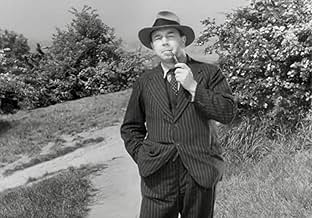
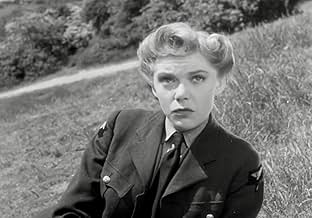
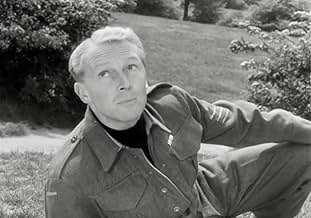
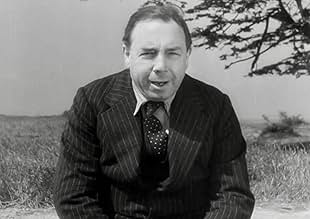
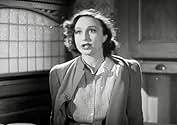
Adapted from a J.B. Priestley play with many of the original actors. The tale of various people who have come to live in an "ideal" city and their hopes and reasons for doing so.Adapted from a J.B. Priestley play with many of the original actors. The tale of various people who have come to live in an "ideal" city and their hopes and reasons for doing so.Adapted from a J.B. Priestley play with many of the original actors. The tale of various people who have come to live in an "ideal" city and their hopes and reasons for doing so.
- Director
- Writers
- Stars
Mabel Terry-Lewis
- Lady Loxfield
- (as Mabel Terry Lewis)
Fanny Rowe
- Philippa Loxfield
- (as Frances Rowe)
Brenda Bruce
- WAAF
- (uncredited)
Ralph Michael
- Sergeant Jimmy
- (uncredited)
J.B. Priestley
- J.B. Priestley
- (uncredited)
Johnnie Schofield
- Bert the Barman
- (uncredited)
- Director
- Writers
- All cast & crew
- Production, box office & more at IMDbPro
6.3462
1
2
3
4
5
6
7
8
9
10
Featured reviews
Inspiring but unconvincing.
Lovely piece about assorted people who discovered a happy land far far away - and some found it happier than others. But as noted elsewhere, the Utopia is portrayed without any explanation of how we got there. As another reviewer says, it captured the mood of the times. That mood produced the Attlee government - and after six years of it, it took another 13 before Labour got in again - and Harold Wilson had the sense not to promise Utopia. Unfortunately, The comparison with Lost Horizon is very apt, but Shangri-La doesn't work without it's supernatural elements - which unfortunately we don't possess.,
How tastes differ!
I usually enjoy malcolmgsw's reviews but this time we have to agree to differ: I consider this, far from being the worst British film, rather amongst the best. Of course, it depends upon what one considers important, how one views our history and the changes in politics. Not long ago, millions of Brits had a vision of a better and more just way of managing things and hopes for a better life for all. This film may have helped the Attlee government gain power the next year, but now all is lost and gone since Clause 4 was thrown out in 1995. The present generation is unhappy but doesn't seem interested in the hopes which this film is concerned with. The acting and the lighting effects are powerful, so it really wouldn't do to sit with one's eyes shut. Of course, if you're hoping for light entertainment and giggles, this film is not for you. It ought to be mentioned that the verse of poetry is taken slightly out of context: 'I dreamed that was the new city of Friends' with a capital 'F', meaning Quakers. It was about the hopes for the founding of Philadelphia in 1681. When a child, Walt Whitman was deeply influenced by a powerful Quaker preacher, and it shows in verses such as this. I can't imagine Whitman would mind his words being applied to this story.
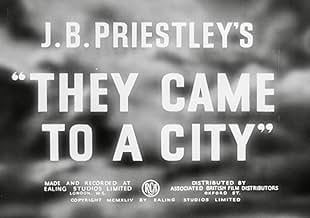
They Came to a City
Based on J. B. Priestley's play, 9 characters from wildly different social backgrounds disappear into the dark one night and arrive at a vast structure which has an entrance to a new, never seen, city. Each of the 9 enter and then decide whether this apparent Utopia is for them or not.
Strange, wordy piece making little attempt to hide its stage origins. This was intended to look at Britain towards the end of the war and how as a society it was to land in its feet. Regrettably, Priestly, who appears briefly, clearly has decided which characters and classes are the good guys and which are the bad. So whilst there are certainly some interesting characters and ideas here, this rather didactic lecture makes it clear that the hard working, poorer and the left wing seeking the searches for Utopia are all right and the right wing are all upper class idiots frightened of change and only interested in money. It's all far too black and white with too many cliched characters and political speeches, particularly by free thinking revolutionary Dinmore played by John Clements who cries for change eloquently whilst the upper classes mumble and moan. It's a pity, because it's a fun idea and with a gentler touch and perhaps more ambiguity it could have been more interesting than it is. An intriguing but not wholly successful cinema oddity.
More of a harangue than a parable
A British drama; A story about how people might live if they were presented with the opportunity to live in a utopia, an "ideal" city, exploring their hopes and reasons for doing so. This is an eloquent, stagy allegory based on a play of the same title by J. B. Priestley. The direction, acting, and photography are all good, apart from occasional fits of overcooked melodrama within its bounds. It is an intelligent screenplay, but the tale within it lacks cinematic dimension with long, static sequences of dialogue; the audience is robbed of the pictorial element of what is hinted at about the mysterious settlement. Tied to this is a quite heavy political slant in the script, which is left for the viewer to accept as a task rather than for them to explore by diversion; the audience is locked out. Though the theme of universal friendship is explored well.
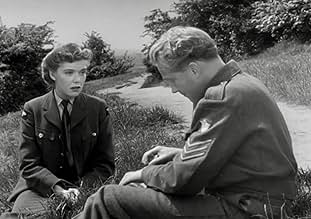
Nine strangers mysteriously transported to a unique city.
Nine disagreeable Britons representing different social/economic classes are mysteriously transported to a place with a door. As they wait for the door to open, we get to know them better. Eventually the door opens, and they go explore a city which the audience never sees. T The idea is that post WW2, England should become a more fair and equitable society with people who treat each other well. When the characters find themselves in such a city they have different reactions. It's interesting how some of the selfish ones try to emotionally drag those who want to live in the city back to their miserable lives. There is an episode involving a mother and daughter that is very similar to an episode in C. S. Lewis' novel "The Great Divorce" written 12 years later. It made me wonder if Mr. Lewis ever saw the film. Note: "They Came To A City" is similar to watching a stage play. At only 66 minutes long it's worth a look.
Did you know
- TriviaFinal film of Mabel Terry-Lewis.
- Quotes
Lady Loxfield: What is it?
Philippa Loxfield: I don't know, but I do know it isn't Bournemouth.
- ConnectionsFeatured in Sosialismi (2014)
- SoundtracksMusic selected from The Divine Poem
Music by Aleksandr Skryabin (as Scriabin)
Played by The London Philharmonic Orchestra
Conducted by Ernest Irving
Details
- Runtime
- 1h 18m(78 min)
- Color
- Aspect ratio
- 1.37 : 1
Contribute to this page
Suggest an edit or add missing content