

An architect, visiting an English country house, realizes the other guests are familiar from his recurring nightmare. When they share their tales of the supernatural, he is filled with a gro... Read allAn architect, visiting an English country house, realizes the other guests are familiar from his recurring nightmare. When they share their tales of the supernatural, he is filled with a growing dread.An architect, visiting an English country house, realizes the other guests are familiar from his recurring nightmare. When they share their tales of the supernatural, he is filled with a growing dread.
- Awards
- 2 wins & 2 nominations total






Anthony Baird
- Hugh Grainger
- (as Antony Baird)


Esme Percy
- Antique Dealer
- (as Esmé Percy)


7.515.5K
1
2
3
4
5
6
7
8
9
10
Featured reviews
A CHERISHED CHILDHOOD MEMORY OF FEAR
I was fortunate enough to see this movie the way it was meant to
be seen: I was about 13 and my brother was 11. We were
supposed to go to bed, but we snuck and watched this movie. We
were also fortunate enough to see it on PBS (of all places!) uncut,
without commercial interruption. Perhaps, the fear of being caught
by our parents added to the experience. We sat by the flickering
light of the TV set (on low volume) in the dark. Needless to say, by
the end of the movie we thought our heads would explode with
fear. I thought my eyes would bulge out of my sockets. It was a
definitive bonding experience for me and my brother. Strange that
fear should be so relished! Up to this day, when posed with the
question, "You wouldn't do that?" Our response is in that devilish
high-pitched voice, "Wouldn't I? WOULDN'T I??" Thanks to Anchor
Bay putting out the dvd double feature of Dead of Night with Queen
of Spades (also excellent!), I have just watched it again and that
old friend fear comes right back. Hugo Fitch lives on!
be seen: I was about 13 and my brother was 11. We were
supposed to go to bed, but we snuck and watched this movie. We
were also fortunate enough to see it on PBS (of all places!) uncut,
without commercial interruption. Perhaps, the fear of being caught
by our parents added to the experience. We sat by the flickering
light of the TV set (on low volume) in the dark. Needless to say, by
the end of the movie we thought our heads would explode with
fear. I thought my eyes would bulge out of my sockets. It was a
definitive bonding experience for me and my brother. Strange that
fear should be so relished! Up to this day, when posed with the
question, "You wouldn't do that?" Our response is in that devilish
high-pitched voice, "Wouldn't I? WOULDN'T I??" Thanks to Anchor
Bay putting out the dvd double feature of Dead of Night with Queen
of Spades (also excellent!), I have just watched it again and that
old friend fear comes right back. Hugo Fitch lives on!
The Original British Horror Omnibus/Anthology
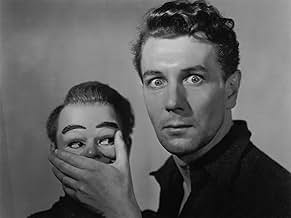
Dead of Night is responsible for so many films made in the horror genre, because it was the first that took a huge gamble and pieced several unconnected stories together within a narrative that loosely keeps them together. Tales From The Crypt, Vault of Horror, Tales That Witness Madness, The House That Dripped Blood, Torture Garden, The Monster Club, Creepshow, Tales From the Darkside: the Movie are just a few of the films that owe part of their existence to this little British film. The frame story details how a man goes to the country for a weekend only to say he has been there before and met the people there before in his recurring dream. He is thrust into a discussion between those that believe in his dream and one lone doctor(psychiatrist) who seems able to explain all phenomena in a scientific way. Each of the guests then in turn tells a story about their brush with the supernatural. Most of the stories are very inventive(although by modern standards cliched as they have been copied many times)and entertaining. Two of the stories really stand-out. The first is about a mirror that shows you a different room as you look into it, and the other about a ventriloquist with a split personality. The other stories are good, and one is humorous(perhaps out of place but fun nonetheless). Acting is solid throughout with Mervyn Johns as the man subjected to the same dream over and over again. Richard Valk excels as the doctor, and Michael Redgrave is outstanding as the man able to give the gift of speech to a "dummy." Also of interest is the pairing of Basil Radford and Naughton Wayne form Hitchcock's The Lady Vanishes. They DO compliment each other so very nicely. A wonderful, eerie film.
Nightmares, recurring dreams, deja vu - something we can all relate to
This is a great horror classic.I think what makes it so great is it contains something that we can all relate to. Many horror films are so far fetched, that we can't imagine anything like that happening to us. Today's horror pictures equate fear with blood, gore and shock value. But I think the things that scare us the most are the things that are subtle, which makes it more believable.
We've all had feelings of deja vu at some point - or had recurring dreams or similar experiences. This movie takes very ordinary objects we all have in our homes, like a mirror, and makes us think twice about them. And what child hasn't played hide and seek and worried that they might not get found by the others. But in this case, the girl gets lost in a secret area of a home only to discover something ghastly.
There is an expected lighthearted touch in the middle with the golfing story. I found the part where the ghost couldn't remember the hand-signal sequence to "disappear" to be absolutely hilarious. Some have commented they felt it was out of place. But I think the comedy relaxes you enough so that when the next scary sequence begins, it really comes as a shock.
I found shadings of Hitchcock, The Twilight Zone, and even Shyamalan ( the circular nature and premonition of SIGNS). I loved the circular nature in this tale especially. I found the cinematography to be intriguing, especially some of the close-ups. I think the "Christmas Party" sequence was especially beautifully filmed. And the creepy music score throughout does quite a good job of adding to and creating tension.
Any fan of classic Horror will love this little gem. This is one that will stick with you for some time (and make you double-check your mirrors). And remember...all it takes is a weekend in the country to cure those recurring nightmares!! HAPPY DREAMS!
We've all had feelings of deja vu at some point - or had recurring dreams or similar experiences. This movie takes very ordinary objects we all have in our homes, like a mirror, and makes us think twice about them. And what child hasn't played hide and seek and worried that they might not get found by the others. But in this case, the girl gets lost in a secret area of a home only to discover something ghastly.
There is an expected lighthearted touch in the middle with the golfing story. I found the part where the ghost couldn't remember the hand-signal sequence to "disappear" to be absolutely hilarious. Some have commented they felt it was out of place. But I think the comedy relaxes you enough so that when the next scary sequence begins, it really comes as a shock.
I found shadings of Hitchcock, The Twilight Zone, and even Shyamalan ( the circular nature and premonition of SIGNS). I loved the circular nature in this tale especially. I found the cinematography to be intriguing, especially some of the close-ups. I think the "Christmas Party" sequence was especially beautifully filmed. And the creepy music score throughout does quite a good job of adding to and creating tension.
Any fan of classic Horror will love this little gem. This is one that will stick with you for some time (and make you double-check your mirrors). And remember...all it takes is a weekend in the country to cure those recurring nightmares!! HAPPY DREAMS!
A prime example of a well-made horror-anthology
Anthology n.: a collection of selected literary pieces or passages of works of art or music.
This classic horror-anthology from Britain's Ealing Studios is composed of four separate stories, composed around a group of strangers that is mysteriously gathered at a country estate where each reveals their chilling tale of the supernatural. But even after these frightening tales are told, does one final nightmare await them all?
The horror-anthology has proved a difficult sub-genre, usually made with only limited success, because it's notoriously difficult to get it right. If only one of the stories fails to deliver, the whole piece is dragged down. But this multi-part horror effort from Britain's Ealing Studios still proves to be very effective and justifiably still is one of the most revered and successful horror anthologies ever made. It features appearances by many of the best British actors of it's day, including Mervyn Johns, Ralph Michael, Basil Radford and Michael Redgrave. With four different directors at the helm, not all four segments are equally effective and are quite different in tone, but they are all good in their own right. The standout for me, not judged in terms of the best, but certainly the most frightening story of the four, is "The Ventriloquist Dummy" by Brazilian born Alberto Cavalcanti (he's simply billed as Cavalcanti), the only non-British director involved in DEAD OF NIGHT. Michael Redgrave plays a renowned ventriloquist who descends into an abyss of madness and murder, when his dummy takes on a life of his own. One of the most unsettling stories I've ever seen.
The somewhat less effective (if only slightly) mirror sequence by Robert Hamer shows something very scary can be achieved with very basic means. When Ralph Michael looks in the mirror, to his horror he keeps seeing the reflection of a dark Gothic room lit with candles, completely different from the room he's standing in and slowly, he begins to loose his mind. Ultimately, it is the extremely unsettling music score that makes it work. Basic but very effective.
As with most anthologies, it's difficult to keep track of the main interwoven storyline, because between the different stories we're told, your mind is still very much trying to grasp what you've just seen. This is probably why the genre became increasingly unpopular over the years. With the exception of "The Ventriloquist Dummy", don't expect anything particularly scary, but it did leave me quietly disturbed. The peerless British cast and the witty, slightly old-fashioned tongue-in-cheek dialog makes this very pleasant and appropriately unsettling viewing.
Camera Obscura --- 8/10 --- 10/10 for "The Ventriloquist Dummy"
This classic horror-anthology from Britain's Ealing Studios is composed of four separate stories, composed around a group of strangers that is mysteriously gathered at a country estate where each reveals their chilling tale of the supernatural. But even after these frightening tales are told, does one final nightmare await them all?
The horror-anthology has proved a difficult sub-genre, usually made with only limited success, because it's notoriously difficult to get it right. If only one of the stories fails to deliver, the whole piece is dragged down. But this multi-part horror effort from Britain's Ealing Studios still proves to be very effective and justifiably still is one of the most revered and successful horror anthologies ever made. It features appearances by many of the best British actors of it's day, including Mervyn Johns, Ralph Michael, Basil Radford and Michael Redgrave. With four different directors at the helm, not all four segments are equally effective and are quite different in tone, but they are all good in their own right. The standout for me, not judged in terms of the best, but certainly the most frightening story of the four, is "The Ventriloquist Dummy" by Brazilian born Alberto Cavalcanti (he's simply billed as Cavalcanti), the only non-British director involved in DEAD OF NIGHT. Michael Redgrave plays a renowned ventriloquist who descends into an abyss of madness and murder, when his dummy takes on a life of his own. One of the most unsettling stories I've ever seen.
The somewhat less effective (if only slightly) mirror sequence by Robert Hamer shows something very scary can be achieved with very basic means. When Ralph Michael looks in the mirror, to his horror he keeps seeing the reflection of a dark Gothic room lit with candles, completely different from the room he's standing in and slowly, he begins to loose his mind. Ultimately, it is the extremely unsettling music score that makes it work. Basic but very effective.
As with most anthologies, it's difficult to keep track of the main interwoven storyline, because between the different stories we're told, your mind is still very much trying to grasp what you've just seen. This is probably why the genre became increasingly unpopular over the years. With the exception of "The Ventriloquist Dummy", don't expect anything particularly scary, but it did leave me quietly disturbed. The peerless British cast and the witty, slightly old-fashioned tongue-in-cheek dialog makes this very pleasant and appropriately unsettling viewing.
Camera Obscura --- 8/10 --- 10/10 for "The Ventriloquist Dummy"
What a wonderful thought provoking creepy film!
I watched this again after a too-long gap of about six years. Were there many anthology films made during this time? "Flesh and Fantasy" (1943) comes to mind but "Dead of Night" is superior. The plot involves an architect who arrives at a country house for work, in a recurring nightmare, and he's terrified because he knows how this nightmare is going to end... At the house there are a number of guests and they soon fall into talking about their own horrifying supernatural tales.
The stories of each of the guests range from semi-comical (the "golfing" episode was my least favorite, although there was one chilling moment even in that one) to the terrifying (the best of the lot, imho, is the 'ventriloquist' episode). Some have speculated that Rod Serling probably drew heavily on "Dead of Night" when writing a number of scripts for "The Twilight Zone" (as just one example, the scene where the dummy bites the hand of the ventriloquist is copied almost exactly in the TZ ep "The Dummy"). I'm not sure if this movie was a blockbuster at the time, but I think it was ahead of its time in terms of depth of concepts, in that there is more than meets the eye.


Did you know
- TriviaThe film's U.S. distributor thought that it was too long, and two of the five segments, "Christmas Party" and "Golfing Story", were both cut. This confused U.S. audiences, who could not understand at all what Michael Allen from "Christmas Party" was doing in the nightmare montage at the end of it. The two segments have since been restored to all U.S. releases of the film.
- GoofsAs Peter Cortland stands looking into the mirror his wife-to-be has bought him, the stripes on his tie run from his left side down to his right. A reverse shot shows the stripes on his tie running in the same direction. Obviously, this is not a mirror image.
- Quotes
Hearse Driver: Just room for one inside, sir.
- Alternate versionsThe original UK version of this film was 105 minutes long and had five segments in it ("Hearse Driver", "Christmas Party", "Haunted Mirror", "Golfing Story" and "Ventriloquist's Dummy"). When it was originally released in the U.S., two of the five segments ("Christmas Party" and "Golfing Story") were cut to shorten it to 77 minutes, because the distributor though that it was too long. Later re-releases of it in the U.S., such as the TV version and all of its home video releases, restored the two missing segments to their proper places in it.
- ConnectionsEdited into Hackers (1995)
- SoundtracksThe Hullalooba
Music by Anna Marly
Lyrics by Anna Marly
Sung by Elisabeth Welch with Frank Weir and his Sextet
Details
Box office
- Gross worldwide
- $35,275
- Runtime
- 1h 17m(77 min)
- Color
- Aspect ratio
- 1.37 : 1
Contribute to this page
Suggest an edit or add missing content