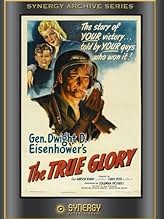
A documentary account of the allied invasion of Europe during World War II compiled from the footage shot by nearly 1400 cameramen.A documentary account of the allied invasion of Europe during World War II compiled from the footage shot by nearly 1400 cameramen.A documentary account of the allied invasion of Europe during World War II compiled from the footage shot by nearly 1400 cameramen.
- Won 1 Oscar
- 5 wins total
Dwight D. Eisenhower
- Self - Supreme Commander Allied Expeditionary Force
- (as General of the Army Dwight D. Eisenhower)
Winston Churchill
- Self
- (archive footage)
Charles de Gaulle
- Self
- (archive footage)
Hermann Göring
- Self
- (archive footage)
Sam Levene
- Self - Commentator
- (voice)
Bernard L. Montgomery
- Self
- (archive footage)
George S. Patton
- Self
- (archive footage)
Franklin D. Roosevelt
- Self
- (archive footage)
Joseph Stalin
- Self
- (archive footage)
- (as Iosif Stalin)
Richard Attenborough
- Self - Commentator
- (voice)
- (uncredited)
Paddy Chayefsky
- Self - Commentator
- (voice)
- (uncredited)
Richard Fallon
- Self
- (uncredited)
Joseph Goebbels
- Self
- (archive footage)
- (uncredited)
Adolf Hitler
- Self
- (archive footage)
- (uncredited)
Erwin Rommel
- Self
- (archive footage)
- (uncredited)
7.0682
1
2
3
4
5
6
7
8
9
10
Featured reviews
THE TRUE GLORY (Garson Kanin and Carol Reed, 1945) ***1/2
This is one of the best-regarded of the classic wartime documentaries – another Academy Award winner, as it happens – and, in retrospect, among those that has stood the test of time reasonably well. Co-incidentally, its viewing followed that of THEY WON'T FORGET (1937) starring Claude Rains, who is featured here as one of several uncredited narrators! With this in mind, while one understands that such films were made as collective efforts for morale-boosting purposes, it feels odd to realize who may or may not have been involved only while watching it
or even after the fact (I was not aware, for instance, that the script was by Paddy Chayefsky)! Anyway, its enduring qualities over more dated similar efforts has much to do with the film's very structure – not only the various nations involved in the Allied cause taking turns to provide 'first-hand' commentary throughout, but its detailing the progress towards the end of WWII (from D-Day to the fall of Berlin).
It was interesting, to be sure, to watch real footage of a number of famed battlegrounds which would later be fictionalized as star-studded spectacles by the commercial cinema – the Normandy invasion itself in THE LONGEST DAY (1962), the BATTLE OF THE BULGE (1965), the entry into Berlin following the capture of THE BRIDGE AT REMAGEN (1968) and the ill-fated Allied maneuver at Arnhem in A BRIDGE TOO FAR (1977). Other points worth mentioning here are the fact that this was 'presented' by U.S. Supreme Commander General Dwight D. Eisenhower (indeed, it is said that the gold statuette on Oscar night was delivered to him personally!), later the 34th American President, and the early harrowing depiction of the realities behind German concentration camps which, as stated in the film itself, removed from one's mind any notion of the futility for such a conflict.
Good documentary but dreadful blank verse commentary
The choice of film was excellent with one exception. They devoted one minute to Belsen with no actual mention of the Holocaust. The documentary though was almost ruined by the dreadful ponderous blank verse commentary.
........." a continuing unto the end until it be thoroughly finished."
Later documentaries and war films have combined to make this piece seem rather outmoded in manner and naively optimistic in tone whilst its powerful images now alas seem all too familiar.
At the time of course it must have packed quite a punch.
The editing of newsreel footage shared among others by co-directors Carol Reed and Garson Kanin, is superlative. Some of the front line cameramen of course would not have lived to see the film receive its Oscar as Best Documentary. Splendid score by William Alwyn.
Lots of familiar and uncredited voices here and the choice of Leslie Banks to declaim the somewhat purple prose is inspired following his role as Chorus in 'Henry V'.
An 'uncredited' name as cinematographer is that of Russ Meyer who went on to film 'action' of an altogether different sort!
The less successful aspects of the campaign are glossed over in keeping with its propogandist nature and the massive casualties are seen as the price to be paid for a job well done.
History has naturally overtaken the film and it is most unsettling now to see Joseph Stalin, who was handed millions of East Europeans on a plate at the Yalta Conference, being described as one of the 'architects of peace'! The following year another of those architects, Winston Churchill, delivered his 'Iron Curtain' speech. Well-intentioned and technically faultless this is a moving testament to human beings 'in extremis'.
Of Historical Interest Only
"The True Glory" was a feature-length documentary, jointly produced by the US Office of War Information and the British Ministry of Information, telling the story of the war on the Western Front, from the D-Day invasion of Normandy up to VE Day. The film was directed by Carol Reed and uses newsreel footage of the actual fighting, with commentary by multiple first-person narrators, including participants in the fighting, and an introduction by no less a personage than General Eisenhower himself. It was advertised with the slogan, "The story of your victory...told by the guys who won it!"
Although the war in the West may have been over when the film was made, some time in mid-1945, it can still be regarded as wartime propaganda; we are reminded that the war in the Far East was still continuing, and one of the film's messages was clearly "we've beaten Germany, now it's Japan's turn!" Another message can be summed up as "And the Krauts had it coming to them!" The view of Germany presented here is equally propagandistic; the Germans are portrayed not just as cruel and sadistic but also arrogant and full of a self-confidence which was eventually to prove unjustified.
This is very much a film of its time; although the emphasis is on the Western front, the Soviets are still "our gallant allies", and Stalin is even described as one of the "architects of freedom", along with Churchill and Roosevelt. These views would start to look outdated only a few years later, when peace had turned to cold war. Today the film is really of historical interest only. If you want to know the story of the Western Front in the years 1944/5, eighty years of historical research and analysis means that we have today documentaries that are far more detailed, informative and objective and less propagandistic and smugly self-congratulatory. 6/10.
Although the war in the West may have been over when the film was made, some time in mid-1945, it can still be regarded as wartime propaganda; we are reminded that the war in the Far East was still continuing, and one of the film's messages was clearly "we've beaten Germany, now it's Japan's turn!" Another message can be summed up as "And the Krauts had it coming to them!" The view of Germany presented here is equally propagandistic; the Germans are portrayed not just as cruel and sadistic but also arrogant and full of a self-confidence which was eventually to prove unjustified.
This is very much a film of its time; although the emphasis is on the Western front, the Soviets are still "our gallant allies", and Stalin is even described as one of the "architects of freedom", along with Churchill and Roosevelt. These views would start to look outdated only a few years later, when peace had turned to cold war. Today the film is really of historical interest only. If you want to know the story of the Western Front in the years 1944/5, eighty years of historical research and analysis means that we have today documentaries that are far more detailed, informative and objective and less propagandistic and smugly self-congratulatory. 6/10.
how quickly things changed
Obviously, "The True Glory" is propaganda in favor of World War II. Walking away from it, one gets the feeling that this was a war that had to get fought (and when you think about it, it WAS the last war declared by congress - as opposed to the president unilaterally launching it - and we paid for it with high taxes). None other than Dwight Eisenhower* introduces it and reminds the viewer that this is firsthand footage of the war. We get narration from all sorts of people: multiple nationalities, and even multiple races.
But something else caught my eye. Towards the end, we get footage of US troops meeting Soviet troops, and both sides hit it off. Any scholar of WWII knows that the USSR was our ally in that war. Well, a mere two years later, the United States and Soviet Union became enemies. A person seeing this documentary just a few years after its release would've gotten left befuddled at the sight of Ivan and GI Joe happily shaking hands, now that the US considered the USSR the world's #1 threat. But as George Orwell depicted in "Nineteen Eighty-Four", alliances shift depending on which war it is, and memories of previous alliances get erased.
Well, one has to understand that the documentary got released right after the war ended. The footage of Roosevelt, Churchill and Stalin holding their conference looked heroic (most people didn't know that Truman had ditched FDR's plans for a future without war). It's understandable that the documentary won Best Documentary Feature at the Academy Awards in 1946. While the propaganda factor may seem over-the-top, I still recommend the documentary as a look at the mindset in late 1945. To think that there was that brief period when it looked as though there would never be another war, and now a nuclear holocaust looks like a real possibility.
Anyway, you should see it (but also watch "The Atomic Cafe").
*It's probably worth noting that as president, Ike taxed the rich at 90% to pay off the war debt and build the Interstate system, defended Social Security, and worked to ease tensions with the Soviet Union. He could never get elected as a conservative nowadays.
But something else caught my eye. Towards the end, we get footage of US troops meeting Soviet troops, and both sides hit it off. Any scholar of WWII knows that the USSR was our ally in that war. Well, a mere two years later, the United States and Soviet Union became enemies. A person seeing this documentary just a few years after its release would've gotten left befuddled at the sight of Ivan and GI Joe happily shaking hands, now that the US considered the USSR the world's #1 threat. But as George Orwell depicted in "Nineteen Eighty-Four", alliances shift depending on which war it is, and memories of previous alliances get erased.
Well, one has to understand that the documentary got released right after the war ended. The footage of Roosevelt, Churchill and Stalin holding their conference looked heroic (most people didn't know that Truman had ditched FDR's plans for a future without war). It's understandable that the documentary won Best Documentary Feature at the Academy Awards in 1946. While the propaganda factor may seem over-the-top, I still recommend the documentary as a look at the mindset in late 1945. To think that there was that brief period when it looked as though there would never be another war, and now a nuclear holocaust looks like a real possibility.
Anyway, you should see it (but also watch "The Atomic Cafe").
*It's probably worth noting that as president, Ike taxed the rich at 90% to pay off the war debt and build the Interstate system, defended Social Security, and worked to ease tensions with the Soviet Union. He could never get elected as a conservative nowadays.
Did you know
- TriviaAccording to director Capt. Garson Kanin, when the movie won the 1945 Academy Award as Best Documentary Feature, the Oscar went to uncredited producer Gen. Dwight D. Eisenhower.
- Quotes
Commentator: This is our people's story, in their words.
- ConnectionsEdited into Dai-ni-ji sekai taisen (1954)
Details
- Release date
- Countries of origin
- Official site
- Language
- Also known as
- Den stora invasionen
- Filming locations
- Production companies
- See more company credits at IMDbPro
- Runtime
- 1h 27m(87 min)
- Color
- Aspect ratio
- 1.37 : 1
Contribute to this page
Suggest an edit or add missing content