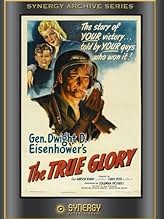
A documentary account of the allied invasion of Europe during World War II compiled from the footage shot by nearly 1400 cameramen.A documentary account of the allied invasion of Europe during World War II compiled from the footage shot by nearly 1400 cameramen.A documentary account of the allied invasion of Europe during World War II compiled from the footage shot by nearly 1400 cameramen.
- Won 1 Oscar
- 5 wins total
Dwight D. Eisenhower
- Self - Supreme Commander Allied Expeditionary Force
- (as General of the Army Dwight D. Eisenhower)
Winston Churchill
- Self
- (archive footage)
Charles de Gaulle
- Self
- (archive footage)
Hermann Göring
- Self
- (archive footage)
Sam Levene
- Self - Commentator
- (voice)
Bernard L. Montgomery
- Self
- (archive footage)
George S. Patton
- Self
- (archive footage)
Franklin D. Roosevelt
- Self
- (archive footage)
Joseph Stalin
- Self
- (archive footage)
- (as Iosif Stalin)
Richard Attenborough
- Self - Commentator
- (voice)
- (uncredited)
Paddy Chayefsky
- Self - Commentator
- (voice)
- (uncredited)
Richard Fallon
- Self
- (uncredited)
Joseph Goebbels
- Self
- (archive footage)
- (uncredited)
Adolf Hitler
- Self
- (archive footage)
- (uncredited)
Erwin Rommel
- Self
- (archive footage)
- (uncredited)
7.0682
1
2
3
4
5
6
7
8
9
10
Featured reviews
First draft of history
This is a documentary of Victory in Europe starting from before D-day to VE day. The Allied military gathered combat and other military footage to put together their version of the fight from Normandy to Berlin. Eisenhower has a foreword introduction. There are lots of combat footage. Some of them are fairly bloody with dead bodies. They are very compelling and many of the footage have been reused over the years. There are two versions of the ending. One ends simply while the other ends mentioning Japan. I can do without the various people (actors?) doing the narration as a stereotype of each nationality and military unit.
The True Glory
This is probably the earliest example of what you could call a "complete" documentary depicting the end of World War II. Starting with the planning for and then the implementation of the D-Day landings, and using hundreds of different pictorial sources, this takes us on a fairly comprehensive and often quite harrowing journey from the beaches of Normandy to the streets of Berlin. It's introduced by Gen. Eisenhower and he occasionally contributes to the soundtrack, but for the most part this is narrated by the ordinary soldiers, sailors, fliers and civilians whose lives were affected by this huge-scale military and logistical operation. It's that commentary that stands out well here, offering us some poignant observations of their travails over the best part of a year in occupied France, the Low Countries and then finally Germany itself. Some of the comments are stoic and witty but never flippant. Each has a story to tell, an episode to describe, an encounter to recount - and for much of this, it's against an enemy that had most certainly not given up. What's also striking here is the collaborative delivery of it's message. Those under the command of The King, Roosevelt and Stalin as well as those fighting for the freedom of those long-occupied territories speak openly and freely of their inter-reliance and abilities to work hand in glove - regardless of language difficulties, cultural or ideological differences and the archive illustrates that co-operation with a remarkable degree of comprehensiveness. Be warned, however, that those images also depict the ghoulish atrocities of not just the war, but of the liberation too. Of Belsen - and these images are not for the squeamish. They are truly appalling, and described by many who arrived there in 1945 with a degree of disgusted incredulity. Then we move on to scenes of ruin in towns and cities in the Fatherland before witnessing scenes of Göring and other staff officers signing documents and surrendering their weapons in defeat - in an altogether more dignified fashion. It doesn't try to be political or analytical, it tells the story from the perspectives of those folks who fought the battles and won the war and is really worth a watch if you are ever looking for a potted, but potent, encapsulation of the end of the war in Europe.
THE TRUE GLORY (Garson Kanin and Carol Reed, 1945) ***1/2
This is one of the best-regarded of the classic wartime documentaries – another Academy Award winner, as it happens – and, in retrospect, among those that has stood the test of time reasonably well. Co-incidentally, its viewing followed that of THEY WON'T FORGET (1937) starring Claude Rains, who is featured here as one of several uncredited narrators! With this in mind, while one understands that such films were made as collective efforts for morale-boosting purposes, it feels odd to realize who may or may not have been involved only while watching it
or even after the fact (I was not aware, for instance, that the script was by Paddy Chayefsky)! Anyway, its enduring qualities over more dated similar efforts has much to do with the film's very structure – not only the various nations involved in the Allied cause taking turns to provide 'first-hand' commentary throughout, but its detailing the progress towards the end of WWII (from D-Day to the fall of Berlin).
It was interesting, to be sure, to watch real footage of a number of famed battlegrounds which would later be fictionalized as star-studded spectacles by the commercial cinema – the Normandy invasion itself in THE LONGEST DAY (1962), the BATTLE OF THE BULGE (1965), the entry into Berlin following the capture of THE BRIDGE AT REMAGEN (1968) and the ill-fated Allied maneuver at Arnhem in A BRIDGE TOO FAR (1977). Other points worth mentioning here are the fact that this was 'presented' by U.S. Supreme Commander General Dwight D. Eisenhower (indeed, it is said that the gold statuette on Oscar night was delivered to him personally!), later the 34th American President, and the early harrowing depiction of the realities behind German concentration camps which, as stated in the film itself, removed from one's mind any notion of the futility for such a conflict.
7sol-
What Price Glory
Not your average World War II documentary, 'The True Glory' avoids static interviews or impersonal narration, instead presenting collated archive footage from the final few months of the war, played out against real war veterans verbally relating their experiences. While some of the stock footage shown feels awfully familiar, there are several excellent, unusual shots throughout, most notably one where the camera is positioned at the wheels of the plane and a sequence where passers-by on the street walk up to the camera from all different directions. The nighttime footage is remarkable too. Not all of the verbal recounts resonate with a lot of flag-waving dialogue, however, several lines linger long in the mind ("I'm not squeamish... but I'm human") and the documentary refreshingly includes recounts from an extensive variety of personnel. Sure, most of the interviewees are soldiers, but we also get the perspective of an army hospital nurse, a war reporter and the list goes on. The documentary also curiously mentions the prospect of World War III some time in (then) foreseeable future with a reminder that war really can be a horrible thing. Indeed, while the film sometimes feels like the Allies patting themselves on the back for a successful victory, 'The True Glory' does not shy away from depicting how grueling war is and it deserves some credit for that.
Good documentary but dreadful blank verse commentary
The choice of film was excellent with one exception. They devoted one minute to Belsen with no actual mention of the Holocaust. The documentary though was almost ruined by the dreadful ponderous blank verse commentary.
Did you know
- TriviaAccording to director Capt. Garson Kanin, when the movie won the 1945 Academy Award as Best Documentary Feature, the Oscar went to uncredited producer Gen. Dwight D. Eisenhower.
- Quotes
Commentator: This is our people's story, in their words.
- ConnectionsEdited into Dai-ni-ji sekai taisen (1954)
Details
- Release date
- Countries of origin
- Official site
- Language
- Also known as
- Den stora invasionen
- Filming locations
- Production companies
- See more company credits at IMDbPro
- Runtime
- 1h 27m(87 min)
- Color
- Aspect ratio
- 1.37 : 1
Contribute to this page
Suggest an edit or add missing content