IMDb RATING
6.4/10
1.7K
YOUR RATING


An ex-dancer and New York radio star narrates his love story for a band singer who loved a self-centered man who was unable to commit to his nightclub business or his family.An ex-dancer and New York radio star narrates his love story for a band singer who loved a self-centered man who was unable to commit to his nightclub business or his family.An ex-dancer and New York radio star narrates his love story for a band singer who loved a self-centered man who was unable to commit to his nightclub business or his family.
- Directors
- Writers
- Stars
- Nominated for 2 Oscars
- 3 wins & 3 nominations total


Jean Aloise
- Dancer
- (uncredited)

Carol Andrews
- Dolly
- (uncredited)
Maxine Ardell
- Dancer
- (uncredited)
Charlene Arnold
- Flapper
- (uncredited)
Gene Ashley
- Dancer
- (uncredited)
Walter Bacon
- Restaurant Patron
- (uncredited)
Valmere Barman
- Dancer
- (uncredited)
Jackie Barnett
- Dancer
- (uncredited)

Dorothy Barrett
- Showgirl
- (uncredited)
- Directors
- Writers
- All cast & crew
- Production, box office & more at IMDbPro
Featured reviews
I had wanted to see this film for years. Despite the talent involved: Astaire; Crosby; Berlin and the best production values that money could buy, I found it to be very disappointing. Part of the problem is, I believe, the lackluster performance of Joan Caulfield who becomes annoying with her vacillating romance between Astaire and Crosby. One wonders why one, much less two, guys would fall for her. Billy DeWolfe and Olga San Juan are very good in supporting roles and,of course, the Irving Berlin score is great, but somehow it all fails to jell.
I believe that this film shows the different "style" of the studios. Had this been made at M-G-M, if probably would have been great, at Paramount it falls flat. "Lady in the Dark" was another Paramount opus which had a similar fault.
I believe that this film shows the different "style" of the studios. Had this been made at M-G-M, if probably would have been great, at Paramount it falls flat. "Lady in the Dark" was another Paramount opus which had a similar fault.
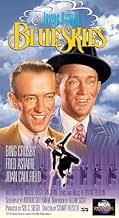
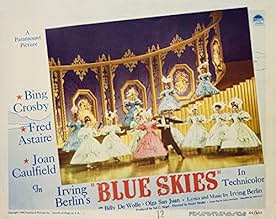
BLUE SKIES (Paramount, 1946), directed by Stuart Heisler, reunites a couple of song and dance men Bing Crosby and Fred Astaire from the ever popular HOLIDAY INN (1942) in a lavish scale musical with songs by the Irving Berlin. While the title BLUE SKIES tends to sound like an aviation movie, it's actually a love triangle story set to music. This could have been an interesting sequel to HOLIDAY INN, where Crosby and Astaire both continue to compete for the same blonde, this time Joan Caulfield instead of Marjorie Reynolds. Overall, it's an original idea credited by Irving Berlin himself with an added touch of Technicolor and larger scale dance routines.
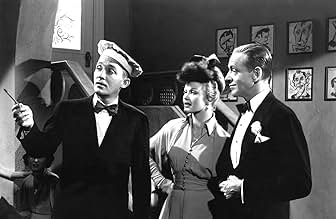
In common tradition to many 1940s movies, most commonly found in the "film noir" genre, BLUE SKIES is told in flashback, starting in modern day setting at a radio station, Broadcast Network of America in New York City's Rockefeller Center, where Jed Potter (Fred Astaire), a former dancer now a radio personality, relates his life story and career to his listeners, a story with a beginning but without a finish. Dating back circa 1919 following World War I finds Jed attracted to Mary O'Hara (Joan Caulfield), a girl, a "very pretty girl," working in the chorus. He invites her to accompany him for dinner at a night club owned by Johnny Aams (Bing Crosby), his Army buddy. Almost immediately, Mary is attracted to Johnny, but in spite of Jed's warning that Johnny is not the marrying kind, she cannot resist him. Johnny and Mary marry, and during their union have a daughter, Mary Elizabeth (Karolyn Grimes). All goes well until Mary finds that Jed is right in his assumption of Johnny being selfish and unstable, buying and selling nightclubs (oneof them called "Top Hat") at a moment's notice, and unable to settle down at in one place they could call home. After their divorce, Mary becomes engaged to Jed. Finding she's unable to marry Jed, Mary disappears, leaving Johnny as well as Jed, through his narration, to wonder whatever became of her.
As Jed Potter relates his "album of Irving Berlin songs" to his radio listeners, movie viewers get to to be treated to see and hear such classic tunes including: "A Pretty Girl is Like a Melody" (sung by chorus, danced by Fred Astaire); "I've Got My Captain Watching for Me Now" (Sung by Bing Crosby); "You'd Be Surprised" (sung by Olga San Juan); "All By Myself" (Crosby); "Serenade to an Old-Fashioned Girl" (sung by Joan Caulfield); "Puttin' on the Ritz" (Astaire); "I'll See You in C.U.B.A." (Crosby); "A Couple of Song and Dance Men" (Astaire and Crosby); "You Keep Coming Back Like a Song" (Crosby); "Always" (chorus); "Blue Skies," "The Little Things in Life," "Not for All the Rice in China" (all sung by Crosby); "Russian Lullaby" (Chorus); "Everybody Step" (Crosby); "How Deep is the Ocean" (chorus); "Running Around in Circles" (Crosby); "Heat Wave" (sung by Olga San Juan/danced by Astaire); "Buy Bonds Today" "This is the Army" "White Christmas" and "You Keep Coming Back Like a Song" (all sung by Crosby). "Mandy" and "Some Sunny Day" are those other songs heard as background music.
Astaire's "Puttin' on the Ritz" number, where he dances to eight images of himself, is one of the great highlights. First introduced by Harry Richman for the 1930 musical, PUTTIN' ON THE RITZ, the original lyrics have been changed to fit the Astaire style as well as the changing of times. Crosby and Astaire also provide fine moments with their joint collaboration as "A Couple of Song and Dance Men." Billy De Wolfe supplies much of the comedy relief as Johnny's partner and assistant. Aside from being the love interest to Olga San Juan, he does a five minute one man comedy routine as Mrs. Murgatroyd.
While the story tends to get corny at times, it does get better with its passage of time and its assortment of fine songs. Aside from Crosby's singing, his sentimental moment where he meets with his little girl (Grimes) again is well done, along with Astaire's dancing, which is always first rate. He briefly breaks away from his traditional character where he becomes a troubled dancer who turns to liquor after being jilted. Legend has it that BLUE SKIES was originally intended to become Astaire's farewell movie. Fortunately, after his two year retirement, he was lured back to the screen for more musicals, dramas and everything else through 1981. Joan Caulfield, then new to the movies, would work again with Crosby in WELCOME STRANGER (1947), an underrated drama with songs. Crosby and Astaire wouldn't work together again until being reunited again for their TV special, "A Couple of Song and Dance Men" (CBS, 1974)
Formerly presented on American Movie Classics (1994-1999) and later Turner Classic Movies (where it premiered February 18, 2007), BLUE SKIES, distributed on video cassette in 1997, is also available on a DVD package double featured with Crosby's other musical, BIRTH OF THE BLUES (1941). Although BLUE SKIES is not as memorable as HOLIDAY INN, they can be summed up as being two different movies with similar storyline as well as the memory of all that. (***1/2)
In common tradition to many 1940s movies, most commonly found in the "film noir" genre, BLUE SKIES is told in flashback, starting in modern day setting at a radio station, Broadcast Network of America in New York City's Rockefeller Center, where Jed Potter (Fred Astaire), a former dancer now a radio personality, relates his life story and career to his listeners, a story with a beginning but without a finish. Dating back circa 1919 following World War I finds Jed attracted to Mary O'Hara (Joan Caulfield), a girl, a "very pretty girl," working in the chorus. He invites her to accompany him for dinner at a night club owned by Johnny Aams (Bing Crosby), his Army buddy. Almost immediately, Mary is attracted to Johnny, but in spite of Jed's warning that Johnny is not the marrying kind, she cannot resist him. Johnny and Mary marry, and during their union have a daughter, Mary Elizabeth (Karolyn Grimes). All goes well until Mary finds that Jed is right in his assumption of Johnny being selfish and unstable, buying and selling nightclubs (oneof them called "Top Hat") at a moment's notice, and unable to settle down at in one place they could call home. After their divorce, Mary becomes engaged to Jed. Finding she's unable to marry Jed, Mary disappears, leaving Johnny as well as Jed, through his narration, to wonder whatever became of her.
As Jed Potter relates his "album of Irving Berlin songs" to his radio listeners, movie viewers get to to be treated to see and hear such classic tunes including: "A Pretty Girl is Like a Melody" (sung by chorus, danced by Fred Astaire); "I've Got My Captain Watching for Me Now" (Sung by Bing Crosby); "You'd Be Surprised" (sung by Olga San Juan); "All By Myself" (Crosby); "Serenade to an Old-Fashioned Girl" (sung by Joan Caulfield); "Puttin' on the Ritz" (Astaire); "I'll See You in C.U.B.A." (Crosby); "A Couple of Song and Dance Men" (Astaire and Crosby); "You Keep Coming Back Like a Song" (Crosby); "Always" (chorus); "Blue Skies," "The Little Things in Life," "Not for All the Rice in China" (all sung by Crosby); "Russian Lullaby" (Chorus); "Everybody Step" (Crosby); "How Deep is the Ocean" (chorus); "Running Around in Circles" (Crosby); "Heat Wave" (sung by Olga San Juan/danced by Astaire); "Buy Bonds Today" "This is the Army" "White Christmas" and "You Keep Coming Back Like a Song" (all sung by Crosby). "Mandy" and "Some Sunny Day" are those other songs heard as background music.
Astaire's "Puttin' on the Ritz" number, where he dances to eight images of himself, is one of the great highlights. First introduced by Harry Richman for the 1930 musical, PUTTIN' ON THE RITZ, the original lyrics have been changed to fit the Astaire style as well as the changing of times. Crosby and Astaire also provide fine moments with their joint collaboration as "A Couple of Song and Dance Men." Billy De Wolfe supplies much of the comedy relief as Johnny's partner and assistant. Aside from being the love interest to Olga San Juan, he does a five minute one man comedy routine as Mrs. Murgatroyd.
While the story tends to get corny at times, it does get better with its passage of time and its assortment of fine songs. Aside from Crosby's singing, his sentimental moment where he meets with his little girl (Grimes) again is well done, along with Astaire's dancing, which is always first rate. He briefly breaks away from his traditional character where he becomes a troubled dancer who turns to liquor after being jilted. Legend has it that BLUE SKIES was originally intended to become Astaire's farewell movie. Fortunately, after his two year retirement, he was lured back to the screen for more musicals, dramas and everything else through 1981. Joan Caulfield, then new to the movies, would work again with Crosby in WELCOME STRANGER (1947), an underrated drama with songs. Crosby and Astaire wouldn't work together again until being reunited again for their TV special, "A Couple of Song and Dance Men" (CBS, 1974)
Formerly presented on American Movie Classics (1994-1999) and later Turner Classic Movies (where it premiered February 18, 2007), BLUE SKIES, distributed on video cassette in 1997, is also available on a DVD package double featured with Crosby's other musical, BIRTH OF THE BLUES (1941). Although BLUE SKIES is not as memorable as HOLIDAY INN, they can be summed up as being two different movies with similar storyline as well as the memory of all that. (***1/2)
Dancing from Fred Astaire. Singing from Bing Crosby. Songs by Irving Berlin. How could one go wrong? Luckily the three main attractions do not disappoint at all, but as an overall film Blue Skies could have been better.
Blue Skies does suffer from a rather tired and over corny story, and it also feels rather thin with a romance that felt like filler and not much else. Joan Caulfield is both incredibly bland and sometimes annoying in a very underwritten part, and the comedy was patchy. In fact, a lot of the comedy falls as flat as a lead balloon and this is not helped by the overplaying of Billy De Wolfe(though he has his moments). And as good as Bing Crosby is, he comes over as rather stiff and clumsy in his acting here, which is a shame as he has shown a lot of natural presence and likability before.
The film looks great however, with some very clever photography in the Puttin' On the Ritz scene and charming costumes and sets. Irving Berlin's songs are marvellous, the Oscar-nominated You Keep Coming Back Like a Song and the unforgettably energetic Puttin' On the Ritz being the standouts, Blue Skies is a beautiful song too. The score is lush and whimsical. Every bit as good as the songs is the characterful and graceful choreography, the truly outstanding number being Puttin' On the Ritz, the whole scene is spectacular and one of Astaire's most classic routines. Crosby sings absolutely beautifully and Olga San Juan brings fire and charm to a rather one-dimensional part with her particularly shining in the Latin rhythm duet I'll See You in Cuba with Crosby, but other than Puttin' On the Ritz, it's the divine dancing and performance of Fred Astaire that makes Blue Skies worth watching.
All in all, decent film but with the likes of Crosby, Astaire and Berlin involved you expect more than just decent. 6/10 Bethany Cox
Blue Skies does suffer from a rather tired and over corny story, and it also feels rather thin with a romance that felt like filler and not much else. Joan Caulfield is both incredibly bland and sometimes annoying in a very underwritten part, and the comedy was patchy. In fact, a lot of the comedy falls as flat as a lead balloon and this is not helped by the overplaying of Billy De Wolfe(though he has his moments). And as good as Bing Crosby is, he comes over as rather stiff and clumsy in his acting here, which is a shame as he has shown a lot of natural presence and likability before.
The film looks great however, with some very clever photography in the Puttin' On the Ritz scene and charming costumes and sets. Irving Berlin's songs are marvellous, the Oscar-nominated You Keep Coming Back Like a Song and the unforgettably energetic Puttin' On the Ritz being the standouts, Blue Skies is a beautiful song too. The score is lush and whimsical. Every bit as good as the songs is the characterful and graceful choreography, the truly outstanding number being Puttin' On the Ritz, the whole scene is spectacular and one of Astaire's most classic routines. Crosby sings absolutely beautifully and Olga San Juan brings fire and charm to a rather one-dimensional part with her particularly shining in the Latin rhythm duet I'll See You in Cuba with Crosby, but other than Puttin' On the Ritz, it's the divine dancing and performance of Fred Astaire that makes Blue Skies worth watching.
All in all, decent film but with the likes of Crosby, Astaire and Berlin involved you expect more than just decent. 6/10 Bethany Cox
Sure it's the same old story of two showbiz guys fighting over the girl, but that's just an excuse to have fun with Fred and Bing. The two dance and sing several fine numbers throughout the film.
And there's the added treat of music by one of the legendary composers. Irving Berlin provides his beautiful songs, including the Oscar-nominee "You Keep Coming Back Like a Song." Fred Astaire does his famous "Puttin on the Ritz" number, while Bing sings the title tune. The duo work well together as they did on "Holiday Inn" four years earlier.
Billy De Wolfe has some funny moments in songs and sketches.
Overall, a colorful and entertaining musical. Don't listen to those who'd turn you away just because the plot is kinda thin.
What more could you want?
And there's the added treat of music by one of the legendary composers. Irving Berlin provides his beautiful songs, including the Oscar-nominee "You Keep Coming Back Like a Song." Fred Astaire does his famous "Puttin on the Ritz" number, while Bing sings the title tune. The duo work well together as they did on "Holiday Inn" four years earlier.
Billy De Wolfe has some funny moments in songs and sketches.
Overall, a colorful and entertaining musical. Don't listen to those who'd turn you away just because the plot is kinda thin.
What more could you want?
This film starts off with Fred Astaire addressing folks over the radio. Oddly, he begins to tell people about his life with his two friends and there is a long flashback scene--where Fred looks EXACTLY the same age as he does when the film begins. It's also odd, as his character seems almost like it was inserted into the film late in the production--as the main story concerns Bing Crosby and Joan Caulfield.
It seems that the three are Vaudeville friends. Fred is head-over-heels for Joan--and Joan is in love with Bing (who is reasonably indifferent for a while). Eventually, Bing and Joan marry--and you see VERY little of Fred through much of the rest of the film. It's a shame, as I really watched this movie for him more than anything else. Eventually, the new marriage goes on the rocks because Bing is too focused on success--much to the detriment of family life. Can these folks somehow make a go of it? Now considering it's a Hollywood film, I'd say the chances are pretty great they will--though if these were real people, you'd advise to Joan to get a divorce and be done with the louse! And what about poor Fred?! What will happen with this really swell guy? Well, what REALLY happens took me aback--as it appears as if she got BOTH of them by the end of the movie! "Blue Skies" is a film weighted very heavily towards singing and Crosby's talents. So, if you love his singing, the film will no doubt be more enjoyable--especially when he sings an abbreviated version of "White Christmas" (who could dislike that?!). However, I do think the film has one or two too many musical numbers and could have used from a bit more plot. As for me, seeing Fred get to play the #3 man and only dance a bit was sad--though his number "Putting on the Ritz" was terrific. One or two more of his numbers might have made the film a bit better. As for the story, it's pretty clichéd but enjoyable. A decent film but it could have been better--particularly if they'd made Bing's character more likable.
It seems that the three are Vaudeville friends. Fred is head-over-heels for Joan--and Joan is in love with Bing (who is reasonably indifferent for a while). Eventually, Bing and Joan marry--and you see VERY little of Fred through much of the rest of the film. It's a shame, as I really watched this movie for him more than anything else. Eventually, the new marriage goes on the rocks because Bing is too focused on success--much to the detriment of family life. Can these folks somehow make a go of it? Now considering it's a Hollywood film, I'd say the chances are pretty great they will--though if these were real people, you'd advise to Joan to get a divorce and be done with the louse! And what about poor Fred?! What will happen with this really swell guy? Well, what REALLY happens took me aback--as it appears as if she got BOTH of them by the end of the movie! "Blue Skies" is a film weighted very heavily towards singing and Crosby's talents. So, if you love his singing, the film will no doubt be more enjoyable--especially when he sings an abbreviated version of "White Christmas" (who could dislike that?!). However, I do think the film has one or two too many musical numbers and could have used from a bit more plot. As for me, seeing Fred get to play the #3 man and only dance a bit was sad--though his number "Putting on the Ritz" was terrific. One or two more of his numbers might have made the film a bit better. As for the story, it's pretty clichéd but enjoyable. A decent film but it could have been better--particularly if they'd made Bing's character more likable.


Did you know
- TriviaAfter Fred Astaire announced his retirement before completing this film, New York's Paramount Theater generated a petition of 10,000 names to persuade him to come out of retirement.
- GoofsAt the beginning of the movie, which is just after World War I, the Crosby character tells the De Wolfe character to do his Frankenstein routine. The Frankenstein character he does is based on Boris Karloff's 1931 version which some ten years or so in the future. At that time in the movie Frankenstein was just a creature in Mary Shelly's book.
- Quotes
Jed Potter: Song and Dance Man.
Johnny Adams: Song and Dance Man, that's right.
Jed Potter: He didn't remember it then, how could he know it now?
Johnny Adams: Oh, get out, I bet I could do it right now, the whole thing.
- ConnectionsFeatured in The Dick Cavett Show: Fred Astaire (1970)
- SoundtracksA Pretty Girl Is Like a Melody
Words and Music by Irving Berlin (1919)
Sung by Fred Astaire
Danced by Fred Astaire, Joan Caulfield, chorus
- How long is Blue Skies?Powered by Alexa
Details
- Release date
- Country of origin
- Languages
- Also known as
- Blau ist der Himmel
- Filming locations
- Production company
- See more company credits at IMDbPro
Box office
- Budget
- $3,000,000 (estimated)
- Runtime
- 1h 39m(99 min)
- Aspect ratio
- 1.37 : 1
Contribute to this page
Suggest an edit or add missing content