Release calendarTop 250 moviesMost popular moviesBrowse movies by genreTop box officeShowtimes & ticketsMovie newsIndia movie spotlight
    What's on TV & streamingTop 250 TV showsMost popular TV showsBrowse TV shows by genreTV news
    What to watchLatest trailersIMDb OriginalsIMDb PicksIMDb SpotlightFamily entertainment guideIMDb Podcasts
    OscarsBest Of 2025Holiday Watch GuideGotham AwardsCelebrity PhotosSTARmeter AwardsAwards CentralFestival CentralAll events
    Born todayMost popular celebsCelebrity news
    Help centerContributor zonePolls
For industry professionals
  • Language
  • Fully supported
  • English (United States)
    Partially supported
  • Français (Canada)
  • Français (France)
  • Deutsch (Deutschland)
  • हिंदी (भारत)
  • Italiano (Italia)
  • Português (Brasil)
  • Español (España)
  • Español (México)
Watchlist
Sign in
  • Fully supported
  • English (United States)
    Partially supported
  • Français (Canada)
  • Français (France)
  • Deutsch (Deutschland)
  • हिंदी (भारत)
  • Italiano (Italia)
  • Português (Brasil)
  • Español (España)
  • Español (México)
Use app
  • Cast & crew
  • User reviews
  • Trivia
  • FAQ
IMDbPro

Murderers Among Us

Original title: Die Mörder sind unter uns
  • 1946
  • Not Rated
  • 1h 25m
IMDb RATING
7.4/10
3.1K
YOUR RATING
Murderers Among Us (1946)
After returning from a concentration camp, Susanne finds an ex-soldier living in her apartment. Together the two try to move past their experiences during WWII.
Play trailer2:37
1 Video
59 Photos
GermanCrimeDramaRomance

Returning to her Berlin apartment after years in a concentration camp, Susanne finds a doctor living there, traumatized by his war service. The two try to move past their experiences, as he ... Read allReturning to her Berlin apartment after years in a concentration camp, Susanne finds a doctor living there, traumatized by his war service. The two try to move past their experiences, as he learns a figure from his past is still living.Returning to her Berlin apartment after years in a concentration camp, Susanne finds a doctor living there, traumatized by his war service. The two try to move past their experiences, as he learns a figure from his past is still living.

  • Director
    • Wolfgang Staudte
  • Writers
    • Wolfgang Staudte
    • Eberhard Keindorff
    • Johanna Sibelius
  • Stars
    • Hildegard Knef
    • Elly Burgmer
    • Erna Sellmer
  • See production info at IMDbPro
  • IMDb RATING
    7.4/10
    3.1K
    YOUR RATING
    • Director
      • Wolfgang Staudte
    • Writers
      • Wolfgang Staudte
      • Eberhard Keindorff
      • Johanna Sibelius
    • Stars
      • Hildegard Knef
      • Elly Burgmer
      • Erna Sellmer
    • 36User reviews
    • 27Critic reviews
  • See production info at IMDbPro
    • Awards
      • 1 nomination total

    Videos1

    Preview Trailer
    Trailer 2:37
    Preview Trailer

    Photos59

    View Poster
    View Poster
    View Poster
    View Poster
    View Poster
    View Poster
    View Poster
    + 52
    View Poster

    Top Cast17

    Edit
    Hildegard Knef
    Hildegard Knef
    • Susanne Wallner
    Elly Burgmer
    • Emily's Mother
    Erna Sellmer
    Erna Sellmer
    • Elise Brückner
    Hilde Adolphi
    • Daisy
    Marlise Ludwig
    • Sonja
    Ursula Krieg
    • Carola Schulz
    Arno Paulsen
    • Ferdinand Brückner
    Wilhelm Borchert
    • Dr. Hans Mertens
    • (as W. Borchert)
    Robert Forsch
    • Herr Mondschein
    Albert Johannes
    • Bartolomaeus Timm
    • (as A. Johannes)
    Wolfgang Dohnberg
    • Fritz Knochenhauer
    Ernst Stahl-Nachbaur
    Ernst Stahl-Nachbaur
    • Arzt
    Christian Blackwood
    • Otto
    • (uncredited)
    Michael Günther
    • Herbert
    • (uncredited)
    Christiane Hanson
    • Dienstmädchen
    • (uncredited)
    Käthe Jöken-König
    • Kundin
    • (uncredited)
    Wanda Peters
    • Schwester
    • (uncredited)
    • Director
      • Wolfgang Staudte
    • Writers
      • Wolfgang Staudte
      • Eberhard Keindorff
      • Johanna Sibelius
    • All cast & crew
    • Production, box office & more at IMDbPro

    User reviews36

    7.43K
    1
    2
    3
    4
    5
    6
    7
    8
    9
    10

    Featured reviews

    theorbys

    Fine German Expressionist / Noir cinematography in the ruins of Berlin

    Murderers Among Us is the first film made, of a vast trove of films, in the Soviet controlled sector of post-war Germany that was to become East Germany. It is deeply and masterfully immersed in the aesthetic traditions of German Expressionism and /or Film Noir: unusual angles and picture planes, extreme lighting effects, twisted stairs, bombed-out buildings that look like jagged fingers against the sky (it was shot in the ruins of Berlin), a haunted, tormented protagonist, stark black and white atmosphere, and, above all, shadows. Shadows and more shadows of every size, shape, and density. In fact this film could serve as a text book on shadow craft: the scene where a man is screaming from within the vast shadow of a pistol wielding attacker is magnificent. I haven't seen The Third Man recently but I am sure Murderers influenced it profoundly. I would recommend the Third Man as a good double feature with this film.

    Murders belongs to a genre called 'rubble films', shot in the rubble of Germany and frequently dealing with issues of German guilt after WW II. Murderers does not seek to deal overmuch with the people who gave the orders, but with the many Germans who followed them with little or no protest. Such as the wounded doctor in this film who stood by while even children were executed as reprisals against resistance fighters in occupied Poland. Plotwise the film works quite nicely, and I liked the atmosphere of renewal, and perhaps relief at the end of a nightmare, amongst all that ruin and rubble as the German people began to pick themselves up.
    8zetes

    Very good immediately post-WWII German film

    Immediately after WWII, Italy and Japan developed strong national cinemas. The same thing didn't happen in Germany. I really didn't know they made any films in the aftermath, but apparently they did. The Murderers Are Among us was made just the year after Germany lost the war. It's quite a strong film, feeling a lot like the film noir style that was all the rage in America at the time (which, in turn, was heavily influenced by German silent cinema). Ernst Wilhelm Borchert plays an alcoholic doctor who is haunted by his participation in the war. He hooks up with his new roommate (Hildegard Knef), which helps him a little, but then he runs into his former commanding officer (Arno Paulsen), which sends him into an angry, murderous downward spiral. The film is actually thinly veiled propaganda, expressing that not all Germans (be they soldiers or civilians) were okay with wiping out entire Polish villages or, you know, the Jews. Eh, maybe I can accept that, but, taking the film as some kind of apology, it all feels a tad too little too late. I do, however, like the appeal for peace and justice, as opposed to revenge. The last thing the world needed at the time was more violence. The filmmaking is very beautiful. Sometimes it feels like a dry run for The Third Man. I don't know if Carol Reed saw this film, but one filmmaker who most certainly did was Lars von Trier. His film Europa cribs from this one pretty liberally at times, most notably the image of a snowfall in a bombed-out church.
    8dbdumonteil

    Berlin after the fall.

    "Die mörder sind unter uns" takes place in Berlin in ruins and features three main characters:Susanne (Hildegarde Knef),a survivor from the concentration camps;a former army medical officer,haunted and tormented by what he did and saw;a former nazi officer who feels no remorse because "he used to obey".

    Susanne ,played by gorgeous Knef,wants to pick up the pieces.She's the strongest character of the movie .She comes back from hell,so what could be worse?To her Xmas means forgiveness and she knows that death breeds death.When he sees her take care of the seedy flat,the doctor first shrugs,but soon he will use his radiographs to replace the panes. Biggest flaw:it's impossible to believe that Susanne is just out of a camp:actually she seems to go out of a beauty parlor.

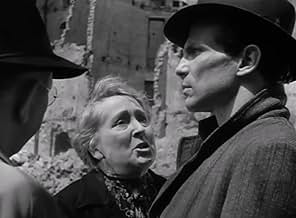
    The doctor is a human wreck who heavily drinks to forget the war horrors.It's only when he meets again his former superior that he rouses himself from his lethargy.Although he feels hatred and thirst of revenge,he is not devoid of compassion:when he takes the man he wants to kill to a desert place among the ruins ,he heeds the call of a desperate mother:it's the most emotional sequence of the movie.

    On the other hand,the officer behaves as if the war had never happened:the parallel between the two Xmas celebrations(past and present) climaxes the movie .The director chose a good-natured actor,nothing like the nazi villain we generally meet.

    The directing shows Fritz Lang's (and expressionism) influence:the huge shadow on the criminal recalls the little girl with the balloon scene in "M".And along with "the third man",the movie had a strong influence on two movies: -"the man between"(1953),another Carol Reed movie :James Mason's character resembles the doctor of this movie.

    -and mainly,mainly, Rosselini's "Germania anno zero"(1948),which dwarves "die mörder sind unter uns".People who enjoyed Staudte's movie should see the Italian genius's masterpiece.
    9mdm-11

    Not all citizens blindly bowed to Nazi Regime's Insanity

    This powerful piece of Historic Fiction shows a realistic look at Post-WWII Germany, and the determination of the shook-up nation to pick up the pieces and survive their darkest chapter in modern history. Many gripping moments include the "return" of a young woman (played by a very young Hildegard Knef) who had spent years in Nazi concentration camps. Her innocence and purity are reflected in the woman's complete willingness to "forgive and forget" the attrocities witnessed and experienced.

    A main character was a commanding officer responsible for horrible acts against innocent civilians, while another had refused to take part in such evil. The final scenes "drive home" the message how some feel no remorse for their evil deeds, while others remain plagued with the images of those mercilessly tortured and murdered.

    Seeing the young woman who had been victimized by the evil regime step in to prevent a altercation between the man she loves and the man responsible for much of the suffering shows that humans are capable of forgiving and thus surviving into a better life, free of hate and vengeance.

    I highly recommend the original German version with or without the subtitles. Many of the effects require the original sound track. This would be a valuable teaching tool for an advanced German class, or a related European History lesson
    10FilmCriticLalitRao

    Landmark first film made in East Germany after World War II by the celebrated DEFA film studios.

    "Die Morder sind unter uns" is a film about guilt,helplessness and incapacity.Its story is told through two main protagonists: Dr.Mertens (Ernst Wilhelm Borchert) and Suzanne Wallner (Hildegard Knef).Mertens is a doctor by profession yet he is an angry man as he hates the fact the war has killed countless innocent people. He is horrified to personally experience that in all wars pawns are always sacrificed to save the king. It is equally hard for the photographer Suzanne Wallner to forget her past. She gets tremendous shock as upon her arrival she finds that her city has turned into a pitiful heap of rubble. Both of them are lonely souls.In this film there is a villain too. He appears in the form of an evil Nazi man Bruckner.Die Morder sind unter uns was the first film made by DEFA (Deutsche Film Aktiengesellschaft). It might appear rather unusual but this film has film noir kind of looks. Expectations were very high with this film. Staudte was triumphant to have created a ground-breaking film. In the original version of the script Bruckner is shot by Mertens.This end was changed on the wishes of the Soviet Cultural officer Dymshitz as he reckoned that a notion of self justice should not be propagated.Staudte was fortunate enough to have Soviet side willing to produce the film as it was rejected by English and American military authorities.Die Morder sind unter uns occupies a unique place in world cinema history as it established the antifascist genre in DEFA film.

    More like this

    SOuthside 1-1000
    6.3
    SOuthside 1-1000
    Blind Spot
    6.6
    Blind Spot
    The Big Street
    6.4
    The Big Street
    New York Confidential
    7.1
    New York Confidential
    The Great Jewel Robber
    6.6
    The Great Jewel Robber
    Berlin Express
    6.8
    Berlin Express
    Police Raid
    6.9
    Police Raid
    Irgendwo in Berlin
    6.8
    Irgendwo in Berlin
    Postmark for Danger
    6.4
    Postmark for Danger
    The Strip
    6.1
    The Strip
    The Affair Blum
    7.7
    The Affair Blum
    Sudden Fear
    7.5
    Sudden Fear

    Related interests

    Peter Lorre in M (1931)
    German
    James Gandolfini, Edie Falco, Sharon Angela, Max Casella, Dan Grimaldi, Joe Perrino, Donna Pescow, Jamie-Lynn Sigler, Tony Sirico, and Michael Drayer in The Sopranos (1999)
    Crime
    Naomie Harris, Mahershala Ali, Janelle Monáe, André Holland, Herman Caheej McGloun, Edson Jean, Alex R. Hibbert, and Tanisha Cidel in Moonlight (2016)
    Drama
    Ingrid Bergman and Humphrey Bogart in Casablanca (1942)
    Romance

    Storyline

    Edit

    Did you know

    Edit
    • Trivia
      This was the first German movie made after World War II.
    • Quotes

      [English subtitled version]

      Herr Mondschein: You are a poor soul, Dr. Mertens.

      Dr. Hans Mertens: We all are, my friend.

    • Connections
      Featured in Century of Cinema: Die Nacht der Regisseure (1995)
    • Soundtracks
      Frühlingsstimmen (Voices of Spring), Op. 410
      (uncredited)

      Written by Johann Strauss

    Top picks

    Sign in to rate and Watchlist for personalized recommendations
    Sign in

    FAQ15

    • How long is Murderers Among Us?Powered by Alexa

    Details

    Edit
    • Release date
      • August 16, 1948 (United States)
    • Country of origin
      • Germany
    • Language
      • German
    • Also known as
      • Ubice su medju nama
    • Filming locations
      • Althoff-Atelier, Babelsberg, Potsdam, Brandenburg, Germany
    • Production company
      • Deutsche Film (DEFA)
    • See more company credits at IMDbPro

    Tech specs

    Edit
    • Runtime
      • 1h 25m(85 min)
    • Color
      • Black and White
    • Sound mix
      • Mono
    • Aspect ratio
      • 1.37 : 1

    Contribute to this page

    Suggest an edit or add missing content
    • Learn more about contributing
    Edit page

    More to explore

    Recently viewed

    Please enable browser cookies to use this feature. Learn more.
    Get the IMDb App
    Sign in for more accessSign in for more access
    Follow IMDb on social
    Get the IMDb App
    For Android and iOS
    Get the IMDb App
    • Help
    • Site Index
    • IMDbPro
    • Box Office Mojo
    • License IMDb Data
    • Press Room
    • Advertising
    • Jobs
    • Conditions of Use
    • Privacy Policy
    • Your Ads Privacy Choices
    IMDb, an Amazon company

    © 1990-2025 by IMDb.com, Inc.