Returning to her Berlin apartment after years in a concentration camp, Susanne finds a doctor living there, traumatized by his war service. The two try to move past their experiences, as he ... Read allReturning to her Berlin apartment after years in a concentration camp, Susanne finds a doctor living there, traumatized by his war service. The two try to move past their experiences, as he learns a figure from his past is still living.Returning to her Berlin apartment after years in a concentration camp, Susanne finds a doctor living there, traumatized by his war service. The two try to move past their experiences, as he learns a figure from his past is still living.
- Awards
- 1 nomination total
- Dr. Hans Mertens
- (as W. Borchert)
- Bartolomaeus Timm
- (as A. Johannes)
- Otto
- (uncredited)
- Herbert
- (uncredited)
- Dienstmädchen
- (uncredited)
- Kundin
- (uncredited)
- Schwester
- (uncredited)
Featured reviews
Fine German Expressionist / Noir cinematography in the ruins of Berlin
Murders belongs to a genre called 'rubble films', shot in the rubble of Germany and frequently dealing with issues of German guilt after WW II. Murderers does not seek to deal overmuch with the people who gave the orders, but with the many Germans who followed them with little or no protest. Such as the wounded doctor in this film who stood by while even children were executed as reprisals against resistance fighters in occupied Poland. Plotwise the film works quite nicely, and I liked the atmosphere of renewal, and perhaps relief at the end of a nightmare, amongst all that ruin and rubble as the German people began to pick themselves up.
The Melancholy of the Film
In this regard, the film acts as a conscience for the people of East Germany, slowly asking themselves about their past and how they are going to live with it. It was a tumultuous period of reconciliation that the Germans were trying to live through. This movie tries to act on those feelings.
Silberman notes that another film of this time, Rotation, "constructs a narration based on identification and emotional catharsis rather than on the cognitive terms of epic distanciation." The Murderers Are Among Us also tries to wipe the slate clean. It comes out and admits that what happened was wrong, hence the horrible feelings that the doctor is going through. They cannot completely distance themselves from these previous events, these earth-shattering events, unless they work through these feelings.
Very good immediately post-WWII German film
A good film bordering on very good
Filmed in the actual ruins of Berlin in 1945/46, this film tells many stories on many levels. Excellent black & white imagery and camera work which really captures the mood and setting.
There is emotional, psychological and physical devastation here. Everything and everyone is ruined, the future wiped away replaced only by recent horrors and appalling choices. "War forces us to choose between greater or lesser evils..."
Hildegard Knef (Suzanne) is beautiful and restrained. She wants a "normal life", whatever that is, in post-apocalyptic Berlin, and will fashion it from what comes to hand. Her past, in a concentration camp, is so bad, that it is not mentioned by her or the film makers, only hinted at. Wilhelm Borchert (Dr Hans Mertens) has also returned from war. He is hopelessly damaged... No spoilers.
Although acted expertly, Knef's story doesn't quite hold up, hence the 7 and not higher. But otherwise this film is limited only by the circumstances and zero resources.
A very interesting and worthwhile film. Watch The Murderers Are Among Us and see what you think. T.
Berlin after the fall.
Susanne ,played by gorgeous Knef,wants to pick up the pieces.She's the strongest character of the movie .She comes back from hell,so what could be worse?To her Xmas means forgiveness and she knows that death breeds death.When he sees her take care of the seedy flat,the doctor first shrugs,but soon he will use his radiographs to replace the panes. Biggest flaw:it's impossible to believe that Susanne is just out of a camp:actually she seems to go out of a beauty parlor.
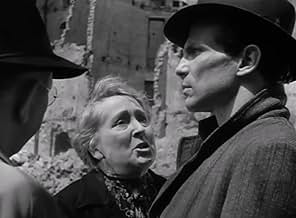
The doctor is a human wreck who heavily drinks to forget the war horrors.It's only when he meets again his former superior that he rouses himself from his lethargy.Although he feels hatred and thirst of revenge,he is not devoid of compassion:when he takes the man he wants to kill to a desert place among the ruins ,he heeds the call of a desperate mother:it's the most emotional sequence of the movie.
On the other hand,the officer behaves as if the war had never happened:the parallel between the two Xmas celebrations(past and present) climaxes the movie .The director chose a good-natured actor,nothing like the nazi villain we generally meet.
The directing shows Fritz Lang's (and expressionism) influence:the huge shadow on the criminal recalls the little girl with the balloon scene in "M".And along with "the third man",the movie had a strong influence on two movies: -"the man between"(1953),another Carol Reed movie :James Mason's character resembles the doctor of this movie.
-and mainly,mainly, Rosselini's "Germania anno zero"(1948),which dwarves "die mörder sind unter uns".People who enjoyed Staudte's movie should see the Italian genius's masterpiece.
Did you know
- TriviaThis was the first German movie made after World War II.
- Quotes
[English subtitled version]
Herr Mondschein: You are a poor soul, Dr. Mertens.
Dr. Hans Mertens: We all are, my friend.
- ConnectionsFeatured in Century of Cinema: Die Nacht der Regisseure (1995)
- How long is Murderers Among Us?Powered by Alexa
Details
- Runtime
- 1h 25m(85 min)
- Color
- Sound mix
- Aspect ratio
- 1.37 : 1