Returning to her Berlin apartment after years in a concentration camp, Susanne finds a doctor living there, traumatized by his war service. The two try to move past their experiences, as he ... Read allReturning to her Berlin apartment after years in a concentration camp, Susanne finds a doctor living there, traumatized by his war service. The two try to move past their experiences, as he learns a figure from his past is still living.Returning to her Berlin apartment after years in a concentration camp, Susanne finds a doctor living there, traumatized by his war service. The two try to move past their experiences, as he learns a figure from his past is still living.
- Awards
- 1 nomination total
- Dr. Hans Mertens
- (as W. Borchert)
- Bartolomaeus Timm
- (as A. Johannes)
- Otto
- (uncredited)
- Herbert
- (uncredited)
- Dienstmädchen
- (uncredited)
- Kundin
- (uncredited)
- Schwester
- (uncredited)
Featured reviews
Not all citizens blindly bowed to Nazi Regime's Insanity
A main character was a commanding officer responsible for horrible acts against innocent civilians, while another had refused to take part in such evil. The final scenes "drive home" the message how some feel no remorse for their evil deeds, while others remain plagued with the images of those mercilessly tortured and murdered.
Seeing the young woman who had been victimized by the evil regime step in to prevent a altercation between the man she loves and the man responsible for much of the suffering shows that humans are capable of forgiving and thus surviving into a better life, free of hate and vengeance.
I highly recommend the original German version with or without the subtitles. Many of the effects require the original sound track. This would be a valuable teaching tool for an advanced German class, or a related European History lesson
Excellent film for fans of mid-20th century movies
But the reason a movie lover wants to watch this film is two-fold. One, the stark B/W cinematography of this film is deeply affecting and very unique for the time period. And two, the wonderful, sublime beauty of a young Hildegard Knef. She is so fragile in this film, it's a real contrast with her later persona of the German song chantreuse of the 60s.
It's hard to find this movie on DVD, but it's out there. If you find it to buy or rent, give it a watch, well worth the time. 8/10 rating.
A good film bordering on very good
Filmed in the actual ruins of Berlin in 1945/46, this film tells many stories on many levels. Excellent black & white imagery and camera work which really captures the mood and setting.
There is emotional, psychological and physical devastation here. Everything and everyone is ruined, the future wiped away replaced only by recent horrors and appalling choices. "War forces us to choose between greater or lesser evils..."
Hildegard Knef (Suzanne) is beautiful and restrained. She wants a "normal life", whatever that is, in post-apocalyptic Berlin, and will fashion it from what comes to hand. Her past, in a concentration camp, is so bad, that it is not mentioned by her or the film makers, only hinted at. Wilhelm Borchert (Dr Hans Mertens) has also returned from war. He is hopelessly damaged... No spoilers.
Although acted expertly, Knef's story doesn't quite hold up, hence the 7 and not higher. But otherwise this film is limited only by the circumstances and zero resources.
A very interesting and worthwhile film. Watch The Murderers Are Among Us and see what you think. T.
Oh How Bleak
Set in Berlin in 1945, the film tells the fictional story of a former surgeon, the man in the opening scene, whose name is Dr. Mertens (Ernst Borchert). He's dispirited and cynical. He meets up with a young woman, played by Hildegard Knef. The two of them share an uninviting apartment, severely damaged in the recently ended war. Knef's character is attracted to the dejected surgeon. But he's too disheartened to care. The deaths of thousands of people in a war render a surgeon's job of saving one life rather meaningless, according to Dr. Mertens. As the plot moves along, he reunites with an older, prosperous industrialist, a man whose attitude about the war is curiously indifferent.
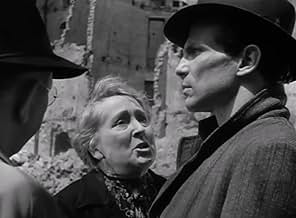
All of the film's photography was done in Berlin, right after the war. The destroyed buildings and brick rubble are a big part of the story, symbolic of human devastation. B&W, expressionistic cinematography is terrific, with stark shadows amid the ruins, human silhouettes against bleak, cracked walls.
Interiors remind me of those in "The Blue Angel" (1930), dilapidated, dirty, cheap, drab, and very depressing. In "The Murderers Are Among Us", background music is minimal. Most scenes lack music, and the story is more potent for it. Sound effects consist of squeaky doors, footsteps on wooden floors, and other realistic sounds. The film's casting and acting are fine.
Historically significant as the first German film made in Germany following the end of WWII, "The Murderers Are Among Us" reminds us of the horrors of war. One scene near the end is unforgettable in its severity. Outside at night, with snow gently falling, arc lights create ghostly shadows. The surgeon stands alone amid the rubble, outside a damaged church where people inside are singing "Silent Night". Faces of the people are grim. What a bleak period in human history.
Berlin after the fall.
Susanne ,played by gorgeous Knef,wants to pick up the pieces.She's the strongest character of the movie .She comes back from hell,so what could be worse?To her Xmas means forgiveness and she knows that death breeds death.When he sees her take care of the seedy flat,the doctor first shrugs,but soon he will use his radiographs to replace the panes. Biggest flaw:it's impossible to believe that Susanne is just out of a camp:actually she seems to go out of a beauty parlor.
The doctor is a human wreck who heavily drinks to forget the war horrors.It's only when he meets again his former superior that he rouses himself from his lethargy.Although he feels hatred and thirst of revenge,he is not devoid of compassion:when he takes the man he wants to kill to a desert place among the ruins ,he heeds the call of a desperate mother:it's the most emotional sequence of the movie.
On the other hand,the officer behaves as if the war had never happened:the parallel between the two Xmas celebrations(past and present) climaxes the movie .The director chose a good-natured actor,nothing like the nazi villain we generally meet.
The directing shows Fritz Lang's (and expressionism) influence:the huge shadow on the criminal recalls the little girl with the balloon scene in "M".And along with "the third man",the movie had a strong influence on two movies: -"the man between"(1953),another Carol Reed movie :James Mason's character resembles the doctor of this movie.
-and mainly,mainly, Rosselini's "Germania anno zero"(1948),which dwarves "die mörder sind unter uns".People who enjoyed Staudte's movie should see the Italian genius's masterpiece.
Did you know
- TriviaThis was the first German movie made after World War II.
- Quotes
[English subtitled version]
Herr Mondschein: You are a poor soul, Dr. Mertens.
Dr. Hans Mertens: We all are, my friend.
- ConnectionsFeatured in Century of Cinema: Die Nacht der Regisseure (1995)
- How long is Murderers Among Us?Powered by Alexa
Details
- Runtime
- 1h 25m(85 min)
- Color
- Sound mix
- Aspect ratio
- 1.37 : 1