
Two guys sharing an apartment meet twin girls (both Bonita Granville). One's sweet, the other a major piece of bad news. The nice one is murdered and her boyfriend is accused of the crime. T... Read allTwo guys sharing an apartment meet twin girls (both Bonita Granville). One's sweet, the other a major piece of bad news. The nice one is murdered and her boyfriend is accused of the crime. The wrong man/wrong victim plot strikes again.Two guys sharing an apartment meet twin girls (both Bonita Granville). One's sweet, the other a major piece of bad news. The nice one is murdered and her boyfriend is accused of the crime. The wrong man/wrong victim plot strikes again.
- Director
- Writers
- Stars






Carol Andrews
- Girl Whistler
- (as Caroline Andrews)
Mike Donovan
- Policeman
- (uncredited)

Franklyn Farnum
- Officer O'Brien
- (uncredited)

Charles Sherlock
- Policeman
- (uncredited)
- Director
- Writers
- All cast & crew
- Production, box office & more at IMDbPro
6.3888
1
2
3
4
5
6
7
8
9
10
Featured reviews
Double Entendre
Don Castle is sharing a cheap room with his ex-lieutenant from the army, Wally Cassell. Castle is studying on the G. I. Bill. Cassell drinks a lot. Each is dating Bonita Granville, but it's all right, since she's twins in this movie. One is nice, the other is nasty. Then the nice one gets murdered, and detective Regis Toomey is on the case.
This being derived from a Cornell Woolrich story, it's surprising the guys aren't twins also; it would have saved on actors' salaries, although the process shots might have eaten up the difference. Miss Granville -- soon to become the wife of Jack Wrather, the producer of this movie -- is doubled by showing the back of another actress, or having her voice come from offscreen.
Of course, many odd possibilities arose in my mind. Did one sister kill the other, and then masquerade as the victim? What is John Litel doing in the cast? I started out confused, and even after the ending, I was still confused, because this was directed by John Reinhardt, who liked to throw in every film noir trope whether it should be there or not. Always watchable for the sake of Woolrich's sick symbolism, it's not one of the best noirs I've seen.
This being derived from a Cornell Woolrich story, it's surprising the guys aren't twins also; it would have saved on actors' salaries, although the process shots might have eaten up the difference. Miss Granville -- soon to become the wife of Jack Wrather, the producer of this movie -- is doubled by showing the back of another actress, or having her voice come from offscreen.
Of course, many odd possibilities arose in my mind. Did one sister kill the other, and then masquerade as the victim? What is John Litel doing in the cast? I started out confused, and even after the ending, I was still confused, because this was directed by John Reinhardt, who liked to throw in every film noir trope whether it should be there or not. Always watchable for the sake of Woolrich's sick symbolism, it's not one of the best noirs I've seen.
Sleazy production enhances Cornell Woolrich tale of twins - one bad, the other dead
In 1946, Olivia De Havilland donned monogram brooches and identity necklaces to take the dual role of good and bad twins Ruth and Terry in Robert Siodmak's The Dark Mirror. The following year Bonita Granville followed suit, as good and bad twins Linda and Estelle, in Monogram's sub-basement adaptation of a Cornell Woolrich story. Of the two, The Guilty is the creepier, more haunting movie, taking a place of dubious honor amid the nether reaches of film noir.
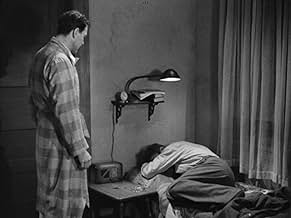
Mustachioed Don Castle shares his walk-up flat with his superior from army days, Wally Cassel, who's a little unstable owing to a head injury sustained in combat. They're involved in a complicated foursome with the twins; when one of the fellows breaks up with one of the girls, the other takes up with the ditched sister. But the insanely jealous Estelle keeps playing one guy off the other; she wants both and her sister to have neither. One night Linda disappears; later her body is found on a rooftop, in a barrel of gravel (she was too big to shove down the incinerator shaft). Police investigator Regis Toomey encounters a baffling maze of alibis and false clues (Castle is on the hunt as well), until the movie ends with climaxes within climaxes.
All this takes place in but three sleazy sets: The men's apartment; that of the twins, their mother and a long-time boarder (John Litel); and a corner bar from which most of the story is narrated in flashback. A few forays into the dark, deserted streets only enhance the claustrophobia, the obsessiveness of Woolrich's nightmare vision. (And his obsessive fiction reuses the same themes and gambits over and over; there are parallels here to the same year's The Fall Guy, which resembles The Black Angel, which...).
Granville, of course, will ever be the screen embodiment of Nancy Drew, from the four programmers she starred in as the teenaged sleuth during the late '30s. Her career started to sputter in the next decade; for one thing her girlish exuberance didn't blossom into womanly glamor. But she developed a tough, no-nonsense, very-'40s face (not unlike Ann Savage's). Her noir appearances were limited to a small (but meaty) role in The Glass Key and a leading one in the low-budget Suspense. It's a shame, because grew up into quite a good bad girl.
Mustachioed Don Castle shares his walk-up flat with his superior from army days, Wally Cassel, who's a little unstable owing to a head injury sustained in combat. They're involved in a complicated foursome with the twins; when one of the fellows breaks up with one of the girls, the other takes up with the ditched sister. But the insanely jealous Estelle keeps playing one guy off the other; she wants both and her sister to have neither. One night Linda disappears; later her body is found on a rooftop, in a barrel of gravel (she was too big to shove down the incinerator shaft). Police investigator Regis Toomey encounters a baffling maze of alibis and false clues (Castle is on the hunt as well), until the movie ends with climaxes within climaxes.
All this takes place in but three sleazy sets: The men's apartment; that of the twins, their mother and a long-time boarder (John Litel); and a corner bar from which most of the story is narrated in flashback. A few forays into the dark, deserted streets only enhance the claustrophobia, the obsessiveness of Woolrich's nightmare vision. (And his obsessive fiction reuses the same themes and gambits over and over; there are parallels here to the same year's The Fall Guy, which resembles The Black Angel, which...).
Granville, of course, will ever be the screen embodiment of Nancy Drew, from the four programmers she starred in as the teenaged sleuth during the late '30s. Her career started to sputter in the next decade; for one thing her girlish exuberance didn't blossom into womanly glamor. But she developed a tough, no-nonsense, very-'40s face (not unlike Ann Savage's). Her noir appearances were limited to a small (but meaty) role in The Glass Key and a leading one in the low-budget Suspense. It's a shame, because grew up into quite a good bad girl.
well executed B-movie noir
Army buddies Mike Carr and Johnny Dixon are roommates after the war. They get involved with twins Linda and Estelle Mitchell (Bonita Granville). When Linda dies, suspicion falls on Johnny who was dating her. Alex Tremholt is the fatherly longtime renter at the Mitchell home. Detective Heller investigates. In the present time, Mike is narrating the story while discussing it with a bartender.
This has classic noir construction. One twin is good and the other is bad. It's a B-movie. It's stripped down. The actors are functional. Bonita Granville is doing both twins. They could differentiate the twins a bit more. I wonder if they should put on a wig for one of them. It's not the best acting nor the worst. There is some big over-acting. It has overwrought noir style although the camera work is mostly perfunctory. The story has plenty of turns which functions well and I like the final twist which is meant to overturn the audience's expectations. The filmmaker is able to execute this classic twist by underplaying him. It's well done.
This has classic noir construction. One twin is good and the other is bad. It's a B-movie. It's stripped down. The actors are functional. Bonita Granville is doing both twins. They could differentiate the twins a bit more. I wonder if they should put on a wig for one of them. It's not the best acting nor the worst. There is some big over-acting. It has overwrought noir style although the camera work is mostly perfunctory. The story has plenty of turns which functions well and I like the final twist which is meant to overturn the audience's expectations. The filmmaker is able to execute this classic twist by underplaying him. It's well done.
good twin/bad twin
From 1947, "The Guilty" is a film noir starring Bonita Granville, Don Castle, Regis Toomey, John Litel, and Wally Cassell.
This is strictly poverty row, Monogram. Bonita Granville plays twins, Linda and Estelle. One is sweet and the other is a vamp. I had a hard time figuring out who was who.
Castle and Cassell play roommates Mike and Johnny. Johnny is the nervous type. When the sweet twin is killed, Johnny is sure he will be blamed and makes himself seem guilty by acting like such a wreck.
This movie is dry as a bone. Castle is one of those stereotypical B movie tough guys who talks out of one side of his mouth. Granville was always a good actress, but the twins' characters aren't well fleshed-out and I'm sure she had no time to work on differences between them. By the way, her husband, Jack Wrather, produced this, and if you're a baby boomer, you know that Bonita Granville Wrather produced the Lassie series.
Regis Toomey plays the detective, and he's pretty one note. He and Castle sounded like they were imitating hard-boiled detectives.
What bothered me is that we knew before we even saw Estelle and Linda that the two were identical twins. So Estelle keeping her back to Linda while she was talking to her in the beginning was a big waste of time.
When she walks out to face her sister, she does it in a grand way, like the audience should be surprised that she looks like Linda. The Castle narration mentions TWICE that they're lookalikes beforehand. Not very well done.
This is strictly poverty row, Monogram. Bonita Granville plays twins, Linda and Estelle. One is sweet and the other is a vamp. I had a hard time figuring out who was who.
Castle and Cassell play roommates Mike and Johnny. Johnny is the nervous type. When the sweet twin is killed, Johnny is sure he will be blamed and makes himself seem guilty by acting like such a wreck.
This movie is dry as a bone. Castle is one of those stereotypical B movie tough guys who talks out of one side of his mouth. Granville was always a good actress, but the twins' characters aren't well fleshed-out and I'm sure she had no time to work on differences between them. By the way, her husband, Jack Wrather, produced this, and if you're a baby boomer, you know that Bonita Granville Wrather produced the Lassie series.
Regis Toomey plays the detective, and he's pretty one note. He and Castle sounded like they were imitating hard-boiled detectives.
What bothered me is that we knew before we even saw Estelle and Linda that the two were identical twins. So Estelle keeping her back to Linda while she was talking to her in the beginning was a big waste of time.
When she walks out to face her sister, she does it in a grand way, like the audience should be surprised that she looks like Linda. The Castle narration mentions TWICE that they're lookalikes beforehand. Not very well done.
LOST CLASSIC FOUND...!
A 1947 film noir. A couple of roommates, Don Castle & Wally Cassell, have the misfortune of dating a pair of identical twins, both played by Bonita Granville. When one of the twins turns up dead, Castle, along w/the police, conduct their own investigations into who did the deed w/the obvious money on Cassell. As the film progresses, we learn not all is what it seems w/several twists leads to a shocking (not really considering the genre) ending. Presented on Noir Alley & a recipient of host Eddie Muller's Noir Restoration Society, this film still looks grimy & lived in (as if dipped in milk) & Castle (dubbed the poor man's Clark Gable during his tenure as an actor) leaves much to be desired as he barely moves his mouth during dialogue delivery but a lost classic is a lost classic so I rather have it than not.


Did you know
- TriviaThe score was written by Rudy Schrager, an immensely talented composer who's been all but forgotten. (His Gunsmoke (1955) scores are required listening for any movie music fan.) When, after WWII, the union representing film composers prohibited them from writing TV music, Schrager and several other composers had some of their film scores re-orchestrated and recorded in Europe. Schrager, et al, could then be paid for their work when this "laundered" music was used in TV shows - one of which was Adventures of Superman (1952).
- GoofsAfter knocking Dixon out, Carr revives him by throwing a glass of water in his face--and completely misses.
- Crazy creditsDon Castle is given "Presenting" credit, which is normally a euphemism for "Introducing," even though he had some 30 credits going back to 1938.
- ConnectionsFeatured in Jack Wrather: A Legacy of Film and Friendship (2022)
- How long is The Guilty?Powered by Alexa
Details
- Release date
- Country of origin
- Official sites
- Language
- Also known as
- Error fatal
- Production companies
- See more company credits at IMDbPro
Box office
- Budget
- $120,000 (estimated)
- Runtime
- 1h 11m(71 min)
- Color
- Sound mix
- Aspect ratio
- 1.37 : 1
Contribute to this page
Suggest an edit or add missing content