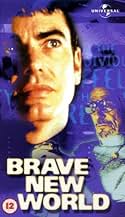
Brave New World
- TV Movie
- 1998
- 1h 27m
IMDb RATING
5.2/10
2.2K
YOUR RATING

In a futuristic totalitarian utopian society, babies are created through genetic engineering, everyone has a predestined place in society, and their minds are conditioned to follow the rules... Read allIn a futuristic totalitarian utopian society, babies are created through genetic engineering, everyone has a predestined place in society, and their minds are conditioned to follow the rules. A tragic outsider jeopardizes the status quo.In a futuristic totalitarian utopian society, babies are created through genetic engineering, everyone has a predestined place in society, and their minds are conditioned to follow the rules. A tragic outsider jeopardizes the status quo.
- Directors
- Writers
- Stars





Wendy Benson-Landes
- Fanny
- (as Wendy Benson)


Nicholas Belgrave
- Alpha Student Boy #1
- (as Nick Belgrave)

- Directors
- Writers
- All cast & crew
- Production, box office & more at IMDbPro
5.22.2K
1
2
3
4
5
6
7
8
9
10
Featured reviews
Isn't it ironic, don't you think?
The book by Aldous Huxley is a classic, not just for its intrigueing plot and characters, but its prediction of the future which seems eerily like our own. And this made for TV movie shows just how our minds have changed, as it completely ignores the moral issues in the novel and falls prey to itself.
For example, the frequent makeup commercials airing between breaks. Beauty is everything. Nobody looks old or gets ugly.
The previews on TV. Sex sells. Sex is good. Sex is harmless. Everybody does it.
The savages being portrayed as white rather than how they are in the book. Don't offend anyone. Avoid racism.
The flashiness. Leonard Nimoy. Ooh-ahh. Everything is happy.
All the themes and slogans that cloud the minds of the common citizen to the point where it becomes human nature to them, seem to have clouded the minds of the people who made this movie. They fall to their own society's entrappings, not seeing themselves for who they are, but falling to spur of the moment emotions, be it passion or extravagance or just trying to make an extra dollar on a TV movie (games must have an economical purpose, afterall). Anyway, read the book. You'll see how you live in a whole new light.
For example, the frequent makeup commercials airing between breaks. Beauty is everything. Nobody looks old or gets ugly.
The previews on TV. Sex sells. Sex is good. Sex is harmless. Everybody does it.
The savages being portrayed as white rather than how they are in the book. Don't offend anyone. Avoid racism.
The flashiness. Leonard Nimoy. Ooh-ahh. Everything is happy.
All the themes and slogans that cloud the minds of the common citizen to the point where it becomes human nature to them, seem to have clouded the minds of the people who made this movie. They fall to their own society's entrappings, not seeing themselves for who they are, but falling to spur of the moment emotions, be it passion or extravagance or just trying to make an extra dollar on a TV movie (games must have an economical purpose, afterall). Anyway, read the book. You'll see how you live in a whole new light.
hugely disappointing
'Brave New World', the 1932 novel by Aldous Huxley, told of a new world where babies were decanted as Alphas, Betas, Deltas, Epsilons, or Gammas, all designed to know their places in society, and in the case of the lower classes, decanted as multiple identical twins to staff entire factories and production lines. Their God is Ford (as in Henry) and their motto is 'history is bunk'.
In the book, Bernard Marx is a fish out of water, an Alpha of stunted growth who has dangerous ideas, who refuses to act like he is expected to, and is generally despised. The film's Bernard is Peter Gallagher, a kind of magnetic Romeo figure, popular with the girls, and a confident success. Already there's been some tampering done with the source.
With Rya Kihlstedt as a colourless Lenina (again nothing like the book's character, who is conventional to a 't') and Leonard Nimoy as the Controller, Mustapha Mond, the film loses impact and goes downhill very quickly.
Nods can be given (grudingly) at the attempts to develop computer generated conditioning forms, and to give some sense of a futuristic world. It just doesn't come off. The savage reservation is simply full of young Americans out to pick a fight, while John (the savage child of Linda, a Beta stranded in the reservation) does speak Shakespeare, but is otherwise of little interest and very unlike the book.
A disappointment and a huge bore, missing both the humour and the science-fiction/faction innovations of Huxley's novel.
In the book, Bernard Marx is a fish out of water, an Alpha of stunted growth who has dangerous ideas, who refuses to act like he is expected to, and is generally despised. The film's Bernard is Peter Gallagher, a kind of magnetic Romeo figure, popular with the girls, and a confident success. Already there's been some tampering done with the source.
With Rya Kihlstedt as a colourless Lenina (again nothing like the book's character, who is conventional to a 't') and Leonard Nimoy as the Controller, Mustapha Mond, the film loses impact and goes downhill very quickly.
Nods can be given (grudingly) at the attempts to develop computer generated conditioning forms, and to give some sense of a futuristic world. It just doesn't come off. The savage reservation is simply full of young Americans out to pick a fight, while John (the savage child of Linda, a Beta stranded in the reservation) does speak Shakespeare, but is otherwise of little interest and very unlike the book.
A disappointment and a huge bore, missing both the humour and the science-fiction/faction innovations of Huxley's novel.
There is NO such thing as "Perfect"...
In spite of the many attempts to maintain perfection, that is one thing that cannot be achieved to its fullest extent in reality. Unfortunately, that is practically the one thing that is misunderstood in the Brave New World.
This TV movie reinterprets a classic novel of how the human soul is compromised to the never-ending quest for perfection. In the story, everybody is born in science labs, and their destiny is determined for them from Day One. They spend their whole lives being conditioned (and reconditioned), their thoughts and emotions suppressed with soma, and all else that virtually eliminates the human soul.
This is all what Aldous Huxley was thinking of human civilization all the way back in 1932, back when communism, socialism, and fascism were still major threats to world societies. While some of these thoughts may seem dated today, there are SOME aspects to modern society, even in a democratic gov't, that brings relevance to this story.
However, because the Brave New World is NOT perfect, there are a few who have their own ways of thinking. One is Bernard Marx, who's persistent in initiating his own forms of human conditioning. Another, Lenina, is one who experiences true happiness, after having spent her entire life deprived of true freedom. Then there's John, a Savage who lives on a Reservation seperated from the World State.
John is one who still has a firm grip on religion, art, literature, and history, all of which are banned in society, but still exists on the Reservation. Bernard and Lenina, both on a temporary holiday, takes John to visit the Brave New World, only for John to discover the horror that had become of the human race.
This was an interesting movie. It retained a lot of what was in the original novel. But there were a few major liberties taken to make the story more accessible to modern tastes. For one thing, the Savages are not Indians (thanks in part to an evil form of liberalism called "political correctness"), but are more like the modern version of Americana, which, 600 years from now, will be considered primitive. Also, the novel did not have a sub-plot about a Delta being reconditioned, and later brainwashed into trying to kill Bernard Marx. It's kinda funny, because that somewhat defies the society's purpose of "no crime, no violence, etc.". Some such things as the worship of Ford, and "orgy-porgy" were eliminated, which makes this movie less intense than the novel. The ending was changed a little, just to present the novel's message in a different light.
I get the impression that the production team wanted more from this movie, but had to work with what came to be the result. It's a wonder why this presentation is an obscure TV movie, rather than a theatrical. I think that some parts of Brave New World would be difficult to reinterpret into a theatrical, because the production team wouldn't be able to reinterpret the story without doing a considerable amount of retooling, as this shows us.
Overall, this was an okay movie. But having read the Brave New World novel not too long ago, I feel as if there are some aspects of our democratic society that I feel make this story more relevant than people realize.
The Brave New World novel is available at your local library.
This TV movie reinterprets a classic novel of how the human soul is compromised to the never-ending quest for perfection. In the story, everybody is born in science labs, and their destiny is determined for them from Day One. They spend their whole lives being conditioned (and reconditioned), their thoughts and emotions suppressed with soma, and all else that virtually eliminates the human soul.
This is all what Aldous Huxley was thinking of human civilization all the way back in 1932, back when communism, socialism, and fascism were still major threats to world societies. While some of these thoughts may seem dated today, there are SOME aspects to modern society, even in a democratic gov't, that brings relevance to this story.
However, because the Brave New World is NOT perfect, there are a few who have their own ways of thinking. One is Bernard Marx, who's persistent in initiating his own forms of human conditioning. Another, Lenina, is one who experiences true happiness, after having spent her entire life deprived of true freedom. Then there's John, a Savage who lives on a Reservation seperated from the World State.
John is one who still has a firm grip on religion, art, literature, and history, all of which are banned in society, but still exists on the Reservation. Bernard and Lenina, both on a temporary holiday, takes John to visit the Brave New World, only for John to discover the horror that had become of the human race.
This was an interesting movie. It retained a lot of what was in the original novel. But there were a few major liberties taken to make the story more accessible to modern tastes. For one thing, the Savages are not Indians (thanks in part to an evil form of liberalism called "political correctness"), but are more like the modern version of Americana, which, 600 years from now, will be considered primitive. Also, the novel did not have a sub-plot about a Delta being reconditioned, and later brainwashed into trying to kill Bernard Marx. It's kinda funny, because that somewhat defies the society's purpose of "no crime, no violence, etc.". Some such things as the worship of Ford, and "orgy-porgy" were eliminated, which makes this movie less intense than the novel. The ending was changed a little, just to present the novel's message in a different light.
I get the impression that the production team wanted more from this movie, but had to work with what came to be the result. It's a wonder why this presentation is an obscure TV movie, rather than a theatrical. I think that some parts of Brave New World would be difficult to reinterpret into a theatrical, because the production team wouldn't be able to reinterpret the story without doing a considerable amount of retooling, as this shows us.
Overall, this was an okay movie. But having read the Brave New World novel not too long ago, I feel as if there are some aspects of our democratic society that I feel make this story more relevant than people realize.
The Brave New World novel is available at your local library.
Not the first to condemn
When I first read "Brave New World" five or six years ago now, I remember thinking about how Huxley was a genius. Whilst not a big fan of his first book "Chrome Yellow", he still always put a point across. In this film though, they lost a lot of the ideas. I always used to wonder what a film adaptation would be like and not long after finishing the book for the third time I realised that deep down there could never be a decent adaptation. Simply put, despite being over 75 years old, the book still talks of ideas which modern society is scared to accept. For one thing, could you really imagine a major Blockbuster movie in which children played erotic games at the start? In a world where a mild swear word is condemned, that sort of imagery would be instantly condemned & banned. With this in mind, a decent adaptation could never be done. Therefore, it's admirable that they make any sort of effort to recreate Huxley's book. However for a book which would influence me in such a powerful way, it's disappointing they didn't realise that it's better to not touch something rather than create a half decent version. Ah well. That's Hollywood for you.
Not a great version or a great film but the modern parallels are worth seeing
In the near future society is managed so that everyone is happy - only a few live on the edges of society as trash. In society, babies are no longer born, they are designed into social categories to decide their future roles. Everyone is happy. However one of the conditioning team, Bernard, can't help but feel if there were any ways of making it better. When a chance helicopter accident brings him into contact with one of the `savages', John Cooper, he brings him back as an experiment. Initially John is taken by the society but gradually he begins to see that the world is not as he wants it.
For a major film to attempt to bring a major novel to the screen is a brave move, but for a cheap TVM to have a stab at it is even more of a risk. This version is kind of interesting in an obvious way, but really is not even worthy of sharing the name of the book (and indeed doesn't really stick to it either). The plot is roughly the same but the film is keen to point out how this future is so very like the current world that many of us in the West now live in. Big deal. This is very obvious and is far too simple a point to make in an attempt to translate Huxley. It is of vague interest on this level and there were certain parallels that made me think - problem was, I didn't leave the film thinking - I ignore the action onscreen and just starting pondering! Films should make you think - but surely not to the point where your thoughts are actually better than what's on the screen!
So yes it says lots of stuff about social classes (which we have - workers and middlemen and top men), consumerism, slogans, media saturation and loss of individualism. But it just doesn't deliver all these in a good package; which it really needed to do in order to get by. As it is, it doesn't manage to really engage and I found myself not really caring.
The cast are pretty low rent to a man - when Nimoy is a surprise big cameo, you know you're in the sh*t! Gallagher is pretty bland and didn't really do anything for me in the lead and support from Kihlstedt is not great either. The supposedly wild and free Cooper is played badly by Guinee; I just didn't care for him or his situation and never really got the feel of a man who is gradually realising that he is in hell. Ferrer was OK and it was nice to see him not playing a sinister creep of one sort or another (although only just!).
Overall this is a passable TVM that makes very obvious comments about our society by exaggerating them slightly in a future setting. This would be well and good but it is certainly never Brave New World. If you are looking for something to wash over you for 90 minutes then this would do, but given the choice again, I'd read the book instead.
For a major film to attempt to bring a major novel to the screen is a brave move, but for a cheap TVM to have a stab at it is even more of a risk. This version is kind of interesting in an obvious way, but really is not even worthy of sharing the name of the book (and indeed doesn't really stick to it either). The plot is roughly the same but the film is keen to point out how this future is so very like the current world that many of us in the West now live in. Big deal. This is very obvious and is far too simple a point to make in an attempt to translate Huxley. It is of vague interest on this level and there were certain parallels that made me think - problem was, I didn't leave the film thinking - I ignore the action onscreen and just starting pondering! Films should make you think - but surely not to the point where your thoughts are actually better than what's on the screen!
So yes it says lots of stuff about social classes (which we have - workers and middlemen and top men), consumerism, slogans, media saturation and loss of individualism. But it just doesn't deliver all these in a good package; which it really needed to do in order to get by. As it is, it doesn't manage to really engage and I found myself not really caring.
The cast are pretty low rent to a man - when Nimoy is a surprise big cameo, you know you're in the sh*t! Gallagher is pretty bland and didn't really do anything for me in the lead and support from Kihlstedt is not great either. The supposedly wild and free Cooper is played badly by Guinee; I just didn't care for him or his situation and never really got the feel of a man who is gradually realising that he is in hell. Ferrer was OK and it was nice to see him not playing a sinister creep of one sort or another (although only just!).
Overall this is a passable TVM that makes very obvious comments about our society by exaggerating them slightly in a future setting. This would be well and good but it is certainly never Brave New World. If you are looking for something to wash over you for 90 minutes then this would do, but given the choice again, I'd read the book instead.


Did you know
- TriviaThe book "Brave New World" that this movie is based on has been banned in many places, including Ireland in 1932. It was Huxley's fifth novel. It was also based on many people, including Freud and Jung, and each character is based on someone. The book also makes many references to Shakespeare and some of his banned works.
- ConnectionsReferenced in Gen RX (2014)
Details
- Release date
- Country of origin
- Language
- Also known as
- Un mundo feliz
- Filming locations
- Barwick Studios - 4585 Electronics Place, Los Angeles, California, USA(closed December 31, 2009, now Quixote Studios - Griffith Park)
- Production companies
- See more company credits at IMDbPro
Contribute to this page
Suggest an edit or add missing content