

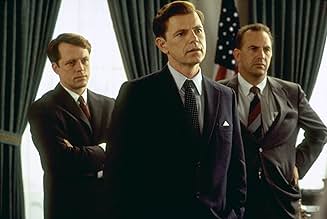
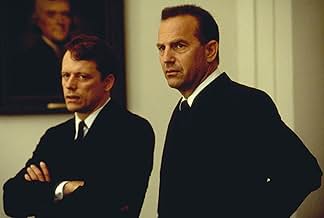
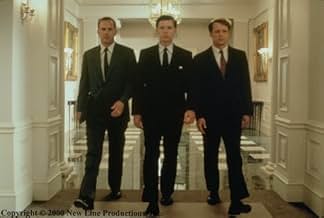
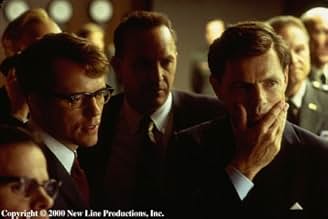
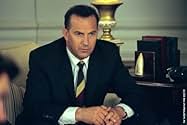
In October 1962, the Kennedy administration struggles to contain the Cuban Missile Crisis.In October 1962, the Kennedy administration struggles to contain the Cuban Missile Crisis.In October 1962, the Kennedy administration struggles to contain the Cuban Missile Crisis.
- Director
- Writers
- Stars
- Awards
- 3 wins & 8 nominations total




- Director
- Writers
- All cast & crew
- Production, box office & more at IMDbPro
7.366K
1
2
3
4
5
6
7
8
9
10
Featured reviews
Gripping but simplistic account
I'm showing the film now to my history seniors so felt obliged to comment on it. Whilst the film is undeniably gripping as a political thriller, it takes considerable liberties with historical facts, thereby compromising its value as an educational resource on this critical period in Cold War history.
One of the most glaring inaccuracies in the film is the exaggerated role of Kenneth O'Donnell, played by Kevin Costner. O'Donnell, who was a special assistant to President Kennedy, is portrayed as an influential figure in the crisis, often present in high-level meetings and even influencing the President's decisions. In reality, O'Donnell was not a key player in the crisis management and was largely uninvolved in the ExComm meetings, which were attended by experts in foreign policy and military strategy. The film's focus on O'Donnell seems to be a deliberate attempt to create a relatable character for the audience, but it distorts the historical record and minimises the roles of pivotal figures like Secretary of Defence Robert McNamara and Secretary of State Dean Rusk.
Another point of contention is the film's portrayal of President Kennedy, played by Bruce Greenwood. While the film does capture Kennedy's calm and rational demeanor, it fails to delve into the complexities of his decision-making process. The President is shown as almost unilaterally steering the United States away from military action, whereas, in reality, he was under immense pressure from his military advisors to authorize an airstrike against Soviet missile sites in Cuba. The film simplifies the intricate discussions and debates that took place among the ExComm members, reducing them to a binary choice between war and peace.
Furthermore, the Soviet perspective is conspicuously absent from the narrative. The film does not delve into the motivations of Soviet Premier Nikita Khrushchev or explore the geopolitical considerations that led the Soviet Union to place missiles in Cuba. This omission perpetuates a one-sided view of the crisis and fails to provide a nuanced understanding of the complex interplay of factors that averted a nuclear catastrophe.
The film also glosses over the role of backchannel communications between the United States and the Soviet Union, which were crucial in resolving the crisis. The secret correspondence between Attorney General Robert Kennedy and Soviet Ambassador Anatoly Dobrynin played a significant role in reaching a peaceful resolution, yet this is scarcely mentioned in the film.
So whilst "Thirteen Days" succeeds as a suspenseful dramatisation of a critical moment in history, it falls short as an accurate representation of the events it depicts. The film takes liberties with historical facts, exaggerates the roles of certain individuals, and omits key aspects of the crisis, thereby providing a skewed understanding of the Cuban Missile Crisis. As such, it should be viewed as a piece of historical fiction rather than a reliable educational resource.
My site- Tracesofevil com.
One of the most glaring inaccuracies in the film is the exaggerated role of Kenneth O'Donnell, played by Kevin Costner. O'Donnell, who was a special assistant to President Kennedy, is portrayed as an influential figure in the crisis, often present in high-level meetings and even influencing the President's decisions. In reality, O'Donnell was not a key player in the crisis management and was largely uninvolved in the ExComm meetings, which were attended by experts in foreign policy and military strategy. The film's focus on O'Donnell seems to be a deliberate attempt to create a relatable character for the audience, but it distorts the historical record and minimises the roles of pivotal figures like Secretary of Defence Robert McNamara and Secretary of State Dean Rusk.
Another point of contention is the film's portrayal of President Kennedy, played by Bruce Greenwood. While the film does capture Kennedy's calm and rational demeanor, it fails to delve into the complexities of his decision-making process. The President is shown as almost unilaterally steering the United States away from military action, whereas, in reality, he was under immense pressure from his military advisors to authorize an airstrike against Soviet missile sites in Cuba. The film simplifies the intricate discussions and debates that took place among the ExComm members, reducing them to a binary choice between war and peace.
Furthermore, the Soviet perspective is conspicuously absent from the narrative. The film does not delve into the motivations of Soviet Premier Nikita Khrushchev or explore the geopolitical considerations that led the Soviet Union to place missiles in Cuba. This omission perpetuates a one-sided view of the crisis and fails to provide a nuanced understanding of the complex interplay of factors that averted a nuclear catastrophe.
The film also glosses over the role of backchannel communications between the United States and the Soviet Union, which were crucial in resolving the crisis. The secret correspondence between Attorney General Robert Kennedy and Soviet Ambassador Anatoly Dobrynin played a significant role in reaching a peaceful resolution, yet this is scarcely mentioned in the film.
So whilst "Thirteen Days" succeeds as a suspenseful dramatisation of a critical moment in history, it falls short as an accurate representation of the events it depicts. The film takes liberties with historical facts, exaggerates the roles of certain individuals, and omits key aspects of the crisis, thereby providing a skewed understanding of the Cuban Missile Crisis. As such, it should be viewed as a piece of historical fiction rather than a reliable educational resource.
My site- Tracesofevil com.
Thrilling Examination Of A Tense Moment In History
The fact of JFK's assassination, and especially the highly mysterious circumstances surrounding it, has resulted in a very distinct historical niche being carved around him. However, the majority of written examinations have concerned his assassination. The man's presidency, short though it was, was fraught with fascinating events and, both in literature and in film, they remain frustratingly under-examined. Which is why "Thirteen Days" is such a treat.
What the film essentially does is offer us a clearly partly-fictionalised but fairly true to the events account of the thirteen days of the Cuban Missile Crisis in 1962. It's a fascinating close-up on a fascinating man, who might have been a truly great president if he had gotten a proper chance. Of course, the filmic portrayal of JFK may be just a tad overly sympathetic, and the treatment of the military a tad overly harsh, and the importance of Kenny O'Donnell, played by Kevin Costner, is probably exaggerated, but these are minor quibbles. What this film really does is show us just how complicated and multi-faceted was the problem of Russian nuclear missiles being installed in Cuba. Not only did the president have to face the dim and distant threat of a faceless Russian bureaucracy, he had to deal with the multiple and conflicting options constantly being advanced to him, the dangers posed by certain special interests in military and intelligence and the popular opinion of the American people. The repercussions of any number of different courses of action were almost unthinkable. Tilting the hand seemingly in the American favour in one place, say in Cuba, would destabilise another danger zone, such as Berlin. Despite the fact that we all know how the events played out in the end, it can't be denied that this film keeps adding to the tension constantly, occasionally letting off a little and then piling on a whole lot more. It's a wonderful portrayal.
At its core, however, the film is an intelligent study of the ultimately paralysing effects of power, and the stark horror of mutual destruction as made possible by the harnessing of atomic power. The discovery of nuclear fission reactions has forever changed the face of warfare, because there now exists an ultimate solution so terrible it is almost beyond contemplation. In the comparatively safer times in which we now live, it is easy to forget how possible, perhaps even likely, the threat of nuclear war. America was then, and remains now, the most powerful nation on the planet, and yet a single wrong move could have ended all that, and at the cost of millions of innocent lives. Bearing the weight of decisions which could cost so much must have been a horrible burden to Kennedy, and, if nothing else, we should thank our lucky stars that he didn't buckle under the multifarious pressures placed on him. This film is a tribute to reason over hotheadedness, and peace over war. We should not forget the lessons that time has to impart, and if this represents a way to remember, then everyone ought to watch it.
What the film essentially does is offer us a clearly partly-fictionalised but fairly true to the events account of the thirteen days of the Cuban Missile Crisis in 1962. It's a fascinating close-up on a fascinating man, who might have been a truly great president if he had gotten a proper chance. Of course, the filmic portrayal of JFK may be just a tad overly sympathetic, and the treatment of the military a tad overly harsh, and the importance of Kenny O'Donnell, played by Kevin Costner, is probably exaggerated, but these are minor quibbles. What this film really does is show us just how complicated and multi-faceted was the problem of Russian nuclear missiles being installed in Cuba. Not only did the president have to face the dim and distant threat of a faceless Russian bureaucracy, he had to deal with the multiple and conflicting options constantly being advanced to him, the dangers posed by certain special interests in military and intelligence and the popular opinion of the American people. The repercussions of any number of different courses of action were almost unthinkable. Tilting the hand seemingly in the American favour in one place, say in Cuba, would destabilise another danger zone, such as Berlin. Despite the fact that we all know how the events played out in the end, it can't be denied that this film keeps adding to the tension constantly, occasionally letting off a little and then piling on a whole lot more. It's a wonderful portrayal.
At its core, however, the film is an intelligent study of the ultimately paralysing effects of power, and the stark horror of mutual destruction as made possible by the harnessing of atomic power. The discovery of nuclear fission reactions has forever changed the face of warfare, because there now exists an ultimate solution so terrible it is almost beyond contemplation. In the comparatively safer times in which we now live, it is easy to forget how possible, perhaps even likely, the threat of nuclear war. America was then, and remains now, the most powerful nation on the planet, and yet a single wrong move could have ended all that, and at the cost of millions of innocent lives. Bearing the weight of decisions which could cost so much must have been a horrible burden to Kennedy, and, if nothing else, we should thank our lucky stars that he didn't buckle under the multifarious pressures placed on him. This film is a tribute to reason over hotheadedness, and peace over war. We should not forget the lessons that time has to impart, and if this represents a way to remember, then everyone ought to watch it.
Almost the end of civilization as we know it.
I watched this movie today with a number of students from my International Politics class, and from the standpoint of a politics professor, this film was absolutely extraordinary. This is a movie about the development of foreign policy in a crisis; it spells out with brilliant detail the decision-making process of JFK's inner circle, the tension between the Executive Office of the President and the Departments of State and Defense, and the attempts by the Military Industrial Complex (namely the Joint Chiefs) to undermine the diplomatic approaches favored by the president. It highlights the conflict between military standard operating procedures ("rules of engagement") and the better judgment/common sense of right-thinking human beings. It hints at conspiracies to (later) depose and otherwise get rid of both Kennedy and Khruschev from within for what turned out to be a very unpopular resolution with the hardliners on both sides. I especially like that the movie acknowledged the humanity of the individual decision-makers without getting too Capra-esquire or preachy.
I can see why this film hasn't been a great commercial success. It is not your standard big studio fare. It's quite cerebral, and although it has some exciting pre-conflict scenes, it's not a "war film". (It reminds me a bit of "Three Kings" in that regard- both films were, in my opinion, mis-marketed. They both seemed to target the younger male action crowd, when both movies are really made for a more intellectual audience.) I liked how the Soviets were not cartoonishly vilified, as is common in a lot of Cold War era films. They were shown to be somewhat calculating and strategic, but not irrational or more importantly, inhuman. In fact, one of the most fascinating parts of the film is the revelation that both sides lack information as to the other side's true intentions. It was this uncertainty that back in October 1962, could have led to the end of civilization as we know it.
The acting was solid (Steven Culp was very, very good as Robert Kennedy- so good, in fact, that I'm afraid he'll have a hard time getting cast in the future. There was audible gasp in the audience when he came on the screen and WAS Bobby). Coaster's accent was actually annoying (as an earlier reviewer noted), but it's forgivable in light of the moving, somewhat understated performance he turns in. It is the directing that takes the cake, however. From the moment the chain of events was set in motion, the tension does NOT let up. It actually feels like you are back in 1962 living through the events of those two weeks- honestly, there was nary a moment to relax until the resolution was wrought. I recommend this film especially strongly to high school and college age students who are too young to have any Cold War memory, as well as to those who lived through the era and may have forgotten what it felt like to come this close.
I can see why this film hasn't been a great commercial success. It is not your standard big studio fare. It's quite cerebral, and although it has some exciting pre-conflict scenes, it's not a "war film". (It reminds me a bit of "Three Kings" in that regard- both films were, in my opinion, mis-marketed. They both seemed to target the younger male action crowd, when both movies are really made for a more intellectual audience.) I liked how the Soviets were not cartoonishly vilified, as is common in a lot of Cold War era films. They were shown to be somewhat calculating and strategic, but not irrational or more importantly, inhuman. In fact, one of the most fascinating parts of the film is the revelation that both sides lack information as to the other side's true intentions. It was this uncertainty that back in October 1962, could have led to the end of civilization as we know it.
The acting was solid (Steven Culp was very, very good as Robert Kennedy- so good, in fact, that I'm afraid he'll have a hard time getting cast in the future. There was audible gasp in the audience when he came on the screen and WAS Bobby). Coaster's accent was actually annoying (as an earlier reviewer noted), but it's forgivable in light of the moving, somewhat understated performance he turns in. It is the directing that takes the cake, however. From the moment the chain of events was set in motion, the tension does NOT let up. It actually feels like you are back in 1962 living through the events of those two weeks- honestly, there was nary a moment to relax until the resolution was wrought. I recommend this film especially strongly to high school and college age students who are too young to have any Cold War memory, as well as to those who lived through the era and may have forgotten what it felt like to come this close.
Good view on possibly the most tense thirteen days of the 20th century.
Basically this movie is a great history lesson. If you want to know more about the cold war and the Cuba missile crisis in particular this is a perfect medium for you to start with. The movie is quite detailed and accurate even though of course some moments and characters have been 'over-dramatized' for the good of the movie and its flow and emotions.
Even though you already know from start till finish how this movie is going to end, it still is a tense movie to watch. The story is build up well and makes the movie really interesting and compelling to follow. It perfectly captures the tension of the whole crisis and really makes you realize how close the world actually came to a WW III. It makes us aware of the fact that those 13 days in history should always be remembered and used as a lesson for the entire world now and forever. It's too bad that the movie becomes a bit too moralistic at times, especially toward the ending.
Bruce Greenwood doesn't really look like JFK but he's a good actor, so he becomes believable enough in his role trough his acting skills. Steven Culp really does look like Robert Kennedy and on top of that he also is a great actor. I wasn't always happy with Kevin Costner performance but overall he did an acceptable job. There are some weaker moments which involves his character but I more blame those moments to the at times too moralistic written script.
A bit of a disappointing aspect of the whole movie is its style. Roger Donaldson at times tries to be over-artistic and mixes the movie with black & white and color images. Perhaps he tried to copy Oliver Stone's style? Who knows. The cinematography was also disappointingly standard but thankfully the good editing saved this a little. Also the musical score by Trevor Jones is surprisingly solid.
Overall it's a very good political movie that has some great tense and important moments in it and also works great as a history lesson.
8/10
http://bobafett1138.blogspot.com/
Even though you already know from start till finish how this movie is going to end, it still is a tense movie to watch. The story is build up well and makes the movie really interesting and compelling to follow. It perfectly captures the tension of the whole crisis and really makes you realize how close the world actually came to a WW III. It makes us aware of the fact that those 13 days in history should always be remembered and used as a lesson for the entire world now and forever. It's too bad that the movie becomes a bit too moralistic at times, especially toward the ending.
Bruce Greenwood doesn't really look like JFK but he's a good actor, so he becomes believable enough in his role trough his acting skills. Steven Culp really does look like Robert Kennedy and on top of that he also is a great actor. I wasn't always happy with Kevin Costner performance but overall he did an acceptable job. There are some weaker moments which involves his character but I more blame those moments to the at times too moralistic written script.
A bit of a disappointing aspect of the whole movie is its style. Roger Donaldson at times tries to be over-artistic and mixes the movie with black & white and color images. Perhaps he tried to copy Oliver Stone's style? Who knows. The cinematography was also disappointingly standard but thankfully the good editing saved this a little. Also the musical score by Trevor Jones is surprisingly solid.
Overall it's a very good political movie that has some great tense and important moments in it and also works great as a history lesson.
8/10
http://bobafett1138.blogspot.com/
Factual??
I served aboard the USS Joseph P. Kennedy which was depicted in the film. The Kennedy was the ship that boarded the Marcula in the waters off the Bahamas. The Kennedy, now part of Battleship cove in Fall River, Ma., actually played herself in the film. The actual boarding was not as quite dramatic as depicted in the movie.
The boarding party for instance did not wear dress white uniforms and the Marcula was more of a "rust bucket" than depicted in the movie. Although the 5 inch guns were aimed at the vessel, I don't recall a shot being fired.
As far as the movie is concerned I though it gave a rather accurate accounting of the circumstances that surrounded this time in history with a few embellishment's that are purely thrown in as theatrical license.
The boarding party for instance did not wear dress white uniforms and the Marcula was more of a "rust bucket" than depicted in the movie. Although the 5 inch guns were aimed at the vessel, I don't recall a shot being fired.
As far as the movie is concerned I though it gave a rather accurate accounting of the circumstances that surrounded this time in history with a few embellishment's that are purely thrown in as theatrical license.


Did you know
- TriviaPresident John F. Kennedy very frequently set up recording machines during meetings at the White House. Much of the dialogue from the movie is taken directly from Kennedy's tapes.
- GoofsPresident Kennedy wanted an eyewitness account so badly that Commander Ecker was ordered to the Pentagon to brief the Joint Chiefs of Staff immediately after landing his RF-8A Crusader, sweaty flight suit and all. This is often thought to be a glaring error in the movie, but his attire is absolutely accurate. Cdr. Ecker was not even allowed to exit his Crusader when he landed at NAS Cecil Field, Jacksonville FL. His film canisters were unloaded from his aircraft, he was refueled and sent immediately to Washington D.C., landing at Andrews AFB and whisked by limousine directly to the Pentagon where he met with the Joint Chiefs of Staff, apologizing right away for appearing at the briefing in his sweat-soaked flight suit. Cdr. Ecker, parched from the Cuba overflight and then the flight north to Washington, asked in a hoarse voice for a drink of water when he arrived. He refuses it in the movie.
- Quotes
Kenny O'Donnell: If the sun comes up tomorrow, it is only because of men of good will. And that's - that's all there is between us and the devil.
- ConnectionsEdited from Trinity and Beyond: The Atomic Bomb Movie (1995)
Details
- Release date
- Country of origin
- Languages
- Also known as
- Trece días
- Filming locations
- Production companies
- See more company credits at IMDbPro
Box office
- Budget
- $80,000,000 (estimated)
- Gross US & Canada
- $34,592,089
- Opening weekend US & Canada
- $46,668
- Dec 25, 2000
- Gross worldwide
- $66,579,890
- Runtime
- 2h 25m(145 min)
- Color
- Sound mix
- Aspect ratio
- 1.85 : 1
Contribute to this page
Suggest an edit or add missing content