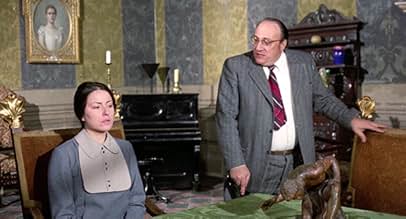
Crazy Desires of a Murderer
Original title: I vizi morbosi di una governante
- 1h 29m
IMDb RATING
5.2/10
652
YOUR RATING
A rich girl invites a few of her friends, including one she befriended during a recent trip to Asia, to her family manor to spend the weekend. Soon, someone gets horribly killed, and secrets... Read allA rich girl invites a few of her friends, including one she befriended during a recent trip to Asia, to her family manor to spend the weekend. Soon, someone gets horribly killed, and secrets and dark desires begin to unravel.A rich girl invites a few of her friends, including one she befriended during a recent trip to Asia, to her family manor to spend the weekend. Soon, someone gets horribly killed, and secrets and dark desires begin to unravel.
- Director
- Writer
- Stars
Roberto Zattini
- Leandro De Chablais
- (as Roberto Zattin)
Isabelle Marchall
- Ileana De Chablais
- (as Isabelle Marchal)
Annie Carol Edel
- Berta
- (as Anie Edel)
Giuseppe Colombo
- Frank Hoffman
- (as Beppe Colombo)
Stuart Brisbane Colin
- Baron De Chablais
- (uncredited)
Sergio Silveri
- Agent Moretti
- (uncredited)
- Director
- Writer
- All cast & crew
- Production, box office & more at IMDbPro
5.2652
1
2
3
4
5
6
7
8
9
10
Featured reviews
Eyeball violence.
"The Morbid Habits of the Governess" is one of the most obscure gialli I have seen.A group of men and their women is invited to a villa and then stalked and murdered by a mysterious killer who collects their eyeballs.Slow-moving and melancholic giallo with several macabre set-pieces and plenty of delicious sleaze.Corrado Gaipa's police inspector is especially memorable as are two sexy ladies Isabelle Marchall and Patrizia Gori.The film was released in 1995 on VHS by Redemption and after selling very poorly faded into complete obscurity.The moody score helps to create some suspenseful moments and the acting is solid.If you are a fan of Eurotrash you can't miss "Crazy Desires of a Murderer".7 out of 10.
taking out their eyes
It's a rather silly idea but it just about holds together with several lovely girls stripping off while somebody is killing and taking out their eyes. It is a rather nasty and bloody business but doesn't really get what is happening. There are a lot of footsteps and people going down to the cellar although it is the inspector who is trying to find out what is going on and he seems to have an amusing time.
A decent gothic giallo with highs and lows
I am not kidding, I had this movie for almost two decades and I began watching it at least five times but the first 20 minutes or so never really caught my interest enough to keep watching for some reason. Now, finally I watched it to the end and can conclude that if you get past the opening 25-30 minutes you are in for a quite entertaining and good looking little giallo with quite some eerie atmosphere. Corrado Gaipa is the most memorable in the role of the inspector, along with Isabelle Marchall as the young countess. The opening and ending theme, which I believe is by Piero Piccioni (he is the credited composer here) is an incredibly atmospheric piece, but the rest of the soundtrack is a mystery to me. I hear themes from at least two other earlier giallo movies not scored by Piccioni. It would be nice to see these themes accurately credited.
🔪🏰Decadent Castle, Hollow Shock 💃
The film opens with a cinematic indulgence in early 1970s European glamour, a cascade of metallic fabrics, flowing blonde hair, and glittering chandeliers that reflect both wealth and superficiality. The initial sequences offer a polished visual feast: champagne bubbles rising in crystal glasses, mirrored corridors doubling the opulence, and disco lights casting fractured colors across dancing bodies. Yet, beneath this glittering veneer, the narrative soon reveals a murky moral landscape.
Performances are uneven, with Isabelle Marchall's Ileana carrying moments of fragile charm, but the supporting ensemble lacks depth, often reduced to archetypes of sleazy playboys or self-indulgent socialites. Patrizia Gori and Adler Gray contribute fleeting sparks of charisma, yet their characters' interactions feel perfunctory, undermining emotional investment. Giuseppe Colombo and Roberto Zattin embody melodramatic villainy, but the writing provides them little room for nuance.
Pacing is inconsistent, with the story drifting through tepid social scenes before sporadically punctuating tension with shocking violence. Dialogue occasionally flirts with wit, yet most exchanges fall flat, failing to sustain intrigue. The plot's momentum collapses in a midsection weighed down by indulgent leisure sequences, only to regain momentary energy when a gruesome murder jolts the narrative back into motion.
Cinematography captures the castle's labyrinthine interiors with occasional flair, contrasting ornate rooms against shadowy passageways, yet most suspenseful moments lack the tension or framing needed to terrify. Musical cues swing between lively disco rhythms and sudden ominous chords, but their deployment feels haphazard, underscoring tonal inconsistencies rather than heightening dread. Two sequences linger: the sudden, shocking murder that blends sex and violence, and the chaotic tomb raid that fuses greed, desperation, and panic, reminiscent of later giallo set pieces like Mario Bava's Blood and Black Lace.
Despite its flaws, the film offers a time capsule of fashion and aesthetic sensibilities, particularly in the early 1970s European social milieu, and provides glimpses of the era's fascination with East-meets-West exotica. For viewers interested in vintage costume design, stylized set pieces, or the evolution of giallo tropes, the movie offers sporadic rewards. Conversely, audiences seeking coherent suspense, richly drawn characters, or sustained terror may find the experience tedious, as the plot's excessive meandering and uneven violence dilute its intended impact.
In sum, Crazy Desires of a Murderer sparkles with superficial glamour and occasional shock, yet falters under convoluted plotting and flat characterizations. Its pleasures lie in visual flair and audacious, if poorly executed, moments of horror rather than narrative mastery or emotional resonance. Those with patience for stylistic indulgence may enjoy glimpses of twisted fun, while viewers prioritizing suspenseful storytelling will likely be frustrated.
Performances are uneven, with Isabelle Marchall's Ileana carrying moments of fragile charm, but the supporting ensemble lacks depth, often reduced to archetypes of sleazy playboys or self-indulgent socialites. Patrizia Gori and Adler Gray contribute fleeting sparks of charisma, yet their characters' interactions feel perfunctory, undermining emotional investment. Giuseppe Colombo and Roberto Zattin embody melodramatic villainy, but the writing provides them little room for nuance.
Pacing is inconsistent, with the story drifting through tepid social scenes before sporadically punctuating tension with shocking violence. Dialogue occasionally flirts with wit, yet most exchanges fall flat, failing to sustain intrigue. The plot's momentum collapses in a midsection weighed down by indulgent leisure sequences, only to regain momentary energy when a gruesome murder jolts the narrative back into motion.
Cinematography captures the castle's labyrinthine interiors with occasional flair, contrasting ornate rooms against shadowy passageways, yet most suspenseful moments lack the tension or framing needed to terrify. Musical cues swing between lively disco rhythms and sudden ominous chords, but their deployment feels haphazard, underscoring tonal inconsistencies rather than heightening dread. Two sequences linger: the sudden, shocking murder that blends sex and violence, and the chaotic tomb raid that fuses greed, desperation, and panic, reminiscent of later giallo set pieces like Mario Bava's Blood and Black Lace.
Despite its flaws, the film offers a time capsule of fashion and aesthetic sensibilities, particularly in the early 1970s European social milieu, and provides glimpses of the era's fascination with East-meets-West exotica. For viewers interested in vintage costume design, stylized set pieces, or the evolution of giallo tropes, the movie offers sporadic rewards. Conversely, audiences seeking coherent suspense, richly drawn characters, or sustained terror may find the experience tedious, as the plot's excessive meandering and uneven violence dilute its intended impact.
In sum, Crazy Desires of a Murderer sparkles with superficial glamour and occasional shock, yet falters under convoluted plotting and flat characterizations. Its pleasures lie in visual flair and audacious, if poorly executed, moments of horror rather than narrative mastery or emotional resonance. Those with patience for stylistic indulgence may enjoy glimpses of twisted fun, while viewers prioritizing suspenseful storytelling will likely be frustrated.
It is not exactly scary as much as it is a little gross
(1977) Crazy Desires of a Murderer/ I vizi morbosi di una governante
(In Italian with English subtitles)
HORROR THRILLER
It has one of those odd introductions with someone viewers are unable make out other than his already bloody hands coming straight toward someone. A phone rings with the baron, De Chablais (Stuart Brisbane Colin) displeasure speaking with his teenage daughter, Ileana De Chablais (Isabelle Marchal) informing her dad ahead of time she has invited a few friends of hers. Meanwhile, Pierluigi La Rocca (Claudio Peticchio) is trying to make a drug deal with two goons on his case, and they are giving him a week to pay up. And it is during then we get to see Illeana's friends she has invited to stay with them who are Frank Hoffman (Giuseppe Colombo) who is a doctor to which the baron knows his dad; Elsa Leiter (Patrizia Gori), Gretel Schanz (Adler Gray); the drug dealer, Pierluigi La Rocca (Claudio Peticchio) with his friend, Bobby Jelson (Gaetano Russo). Living with the baron in the castle are housemaid, Berta (Anie Edel) and servant, Hans (Hugh Denis) . And it was not until the movie is progressing we find out there is a third person, a young man who became a mute, Leonardo (Roberto Zattin) who appear to be already been scarred as a result of the death of his mother. Leonardo loves down below them near the wine cellar that was supposed to staying in a room all to himself. He appears to be the character viewers saw at the opening with the bloody hand as it turns out he is a taxidermist, the reason why his hands are bloody at all times. When one of the guest's are killed after making out with one of the other friends, the detectives are then called and they cross examine each resident staying with them, including Leonardo. At this point all fingers point to him because when the victim was killed, her eyeballs were plucked out, and those same eyeballs eventually showed up in his dungeon room to which they could be planted there to make it appear like he did it.
Anyways, at first I was unable to get involve with watching it because the movie did some abnormal things, such as at the opening when the daughter, Illeana was speaking with his daughter on the phone. It appears that someone with bloody hands was going to attack the baron, because the way it ended their abrupt conversation was ambiguous. Illeana just kept calling out for her dad with no answer. She neither calls for authorities or anything. And then, it is like as soon as they do finally meet each other, it is as if nothing had ever happened. We find out much later that it was the brother. Viewers are also oblivious the connection between the killer and it's victims, for the drug scenario between Pierluigi and what happened has no relation with one another. Anyways, the eyeball sequence is more gross than it is scary. The poster is misleading as there are only two nude scenes throughout the entire movie of one of the guests and the maid, anyone who presume to see a ton of nudity would be disappointed.
It has one of those odd introductions with someone viewers are unable make out other than his already bloody hands coming straight toward someone. A phone rings with the baron, De Chablais (Stuart Brisbane Colin) displeasure speaking with his teenage daughter, Ileana De Chablais (Isabelle Marchal) informing her dad ahead of time she has invited a few friends of hers. Meanwhile, Pierluigi La Rocca (Claudio Peticchio) is trying to make a drug deal with two goons on his case, and they are giving him a week to pay up. And it is during then we get to see Illeana's friends she has invited to stay with them who are Frank Hoffman (Giuseppe Colombo) who is a doctor to which the baron knows his dad; Elsa Leiter (Patrizia Gori), Gretel Schanz (Adler Gray); the drug dealer, Pierluigi La Rocca (Claudio Peticchio) with his friend, Bobby Jelson (Gaetano Russo). Living with the baron in the castle are housemaid, Berta (Anie Edel) and servant, Hans (Hugh Denis) . And it was not until the movie is progressing we find out there is a third person, a young man who became a mute, Leonardo (Roberto Zattin) who appear to be already been scarred as a result of the death of his mother. Leonardo loves down below them near the wine cellar that was supposed to staying in a room all to himself. He appears to be the character viewers saw at the opening with the bloody hand as it turns out he is a taxidermist, the reason why his hands are bloody at all times. When one of the guest's are killed after making out with one of the other friends, the detectives are then called and they cross examine each resident staying with them, including Leonardo. At this point all fingers point to him because when the victim was killed, her eyeballs were plucked out, and those same eyeballs eventually showed up in his dungeon room to which they could be planted there to make it appear like he did it.
Anyways, at first I was unable to get involve with watching it because the movie did some abnormal things, such as at the opening when the daughter, Illeana was speaking with his daughter on the phone. It appears that someone with bloody hands was going to attack the baron, because the way it ended their abrupt conversation was ambiguous. Illeana just kept calling out for her dad with no answer. She neither calls for authorities or anything. And then, it is like as soon as they do finally meet each other, it is as if nothing had ever happened. We find out much later that it was the brother. Viewers are also oblivious the connection between the killer and it's victims, for the drug scenario between Pierluigi and what happened has no relation with one another. Anyways, the eyeball sequence is more gross than it is scary. The poster is misleading as there are only two nude scenes throughout the entire movie of one of the guests and the maid, anyone who presume to see a ton of nudity would be disappointed.
Did you know
- TriviaMost likely filmed around 1972-73, but not released until 1977.
- GoofsThe poster shows Ileana's hair as jet black. In the movie it is platinum blonde.
- Alternate versionsThe UK video on the Redemption label is cut by 5 seconds in the scene where the killer removes a victim's eyeball.
- ConnectionsReferences Le salamandre (1969)
- How long is Crazy Desires of a Murderer?Powered by Alexa
Details
- Release date
- Country of origin
- Language
- Also known as
- The Morbid Habits of the Governess
- Filming locations
- Production company
- See more company credits at IMDbPro
- Runtime
- 1h 29m(89 min)
- Sound mix
- Aspect ratio
- 1.85 : 1
Contribute to this page
Suggest an edit or add missing content