

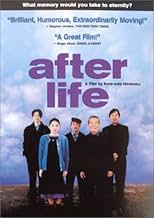
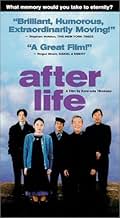
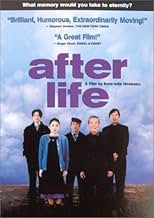
After death, people have a week to choose only one memory to keep for eternity.After death, people have a week to choose only one memory to keep for eternity.After death, people have a week to choose only one memory to keep for eternity.
- Awards
- 7 wins & 8 nominations total



Arata Iura
- Takashi Mochizuki, counselor
- (as Arata)


- Director
- Writer
- All cast & crew
- Production, box office & more at IMDbPro
7.615.2K
1
2
3
4
5
6
7
8
9
10
Featured reviews
Can you pick your best memory?
This was a perfect film for watching on a quiet Sunday morning. It made me reflect on my own life, and realize that I would probably be one of the counselors in the afterlife.
It was brilliantly written and directed and one of the most innovative stories I have seen on screen. After death, you spend a week in a way-station to reflect on your life and take one memory with you. It is not an easy process as I discovered.
I was interested in the fact that some people can remember all the way back to the womb. Picking a happy memory before I was an adult is almost impossible for me, so I cannot imagine going back that far. Most people remember only to age three or four.
I was fascinated with the man who wanted to leave behind some evidence of his existence. One man could not remember any happy memories in his 70+ years, so he had to sit through video tapes, one for each year of his life, to help him. It seems that there was a connection with one of the counselors and this played out in an unusual way at the end. Choosing your best memory as the fact that you were someone else's best memory and that you made one person happy.
Most of us fall into the category expressed by one man. "I had a so-so education, a so-so job, a so-so marriage, and a so-so retirement." How do you pick a happy or important memory from that? I also liked one man's response when he picked his memory after lamenting that most of the memories of his life were bad. After being told he would forget all the bad memories, he exclaimed, "That truly is heaven." An unusual film that will be in my memory for a long time.
It was brilliantly written and directed and one of the most innovative stories I have seen on screen. After death, you spend a week in a way-station to reflect on your life and take one memory with you. It is not an easy process as I discovered.
I was interested in the fact that some people can remember all the way back to the womb. Picking a happy memory before I was an adult is almost impossible for me, so I cannot imagine going back that far. Most people remember only to age three or four.
I was fascinated with the man who wanted to leave behind some evidence of his existence. One man could not remember any happy memories in his 70+ years, so he had to sit through video tapes, one for each year of his life, to help him. It seems that there was a connection with one of the counselors and this played out in an unusual way at the end. Choosing your best memory as the fact that you were someone else's best memory and that you made one person happy.
Most of us fall into the category expressed by one man. "I had a so-so education, a so-so job, a so-so marriage, and a so-so retirement." How do you pick a happy or important memory from that? I also liked one man's response when he picked his memory after lamenting that most of the memories of his life were bad. After being told he would forget all the bad memories, he exclaimed, "That truly is heaven." An unusual film that will be in my memory for a long time.
Good movie, definitely worth watching, but I would have liked more philosophy
The underlying premise and theme of this film is extremely thought-provoking. Within the first 20 minutes, your brain will light up like a Christmas tree as you think of the implications and how you would react in a similar situation. It has the magical ability to awaken nostalgic memories of your own, and several times I had to pause the film so that I could indulge my own private thoughts for a while. Hats off to the director/writer for achieving the necessary balance between fantasy and realism (i.e., taking you to a surreal place whilst not destroying the human perspective).
But the downside... I feel that the director failed to cultivate some of the excellent philosophies which were barely touched upon. This could have been accomplished with more dialogue. Don't get me wrong, there's plenty of *talking* in the movie, but it's mostly anecdotal (people wistfully reminiscing about the past). There wasn't enough analysis and barely any *dialogue* (people communicating with each other).
Without ruining anything, I'll give you one example. The premise is, of course, "if you had to pick one memory to relive forever, which would you choose?" One character simply refuses to pick. This is brilliant. As soon as he takes his position, which he does in the first 10 minutes of the film, it woke me up and made me wonder why he would choose this unconventional act of defiance.
But much to my disappointment, this central theme is abandoned. The character is hardly seen again. He does deliver an interesting monologue towards the end which is encapsulated in a single powerful statement he says (I won't tell you what it is). But I couldn't help feeling as if the director didn't really follow through with his philosophy.
Perhaps that was the intent of the director: to present us only with fragments so that we may ponder the philosophy ourselves. But that approach somewhat betrays the nature of art. Art, I believe, should do its best to communicate a complete idea, and *then* open up the floor for discussion. Anything less is a mere Rorshach test. Or whatever you call those inkblot thingees that psychologists use to probe your mind.
As you can probably guess, I'm not a big fan of the Minimalist movement.
Another gripe... Some of the interesting philosophical points were shoved aside to make room for the romantic sub-plot, which I found to be a bit forced and unbelievable. I would have preferred to see the director stick to the heavier issues. If this is truly a film about deep spirituality, why dedicate so much time to a teenage girl's crush on a guy?
So my overall criticism is that there wasn't enough substance presented. I admit there IS the possibility that the dialogue/philosophy I craved was lost in translation. It is possible that the English subtitles didn't convey the philosophy inherent in the original Japanese. That's been known to happen.
But still, I think this film could have truly benefited by a good old fashioned Shakespearian soliloquy, like Hamlet Act III Sc 1, to help clarify the director's message.
Well, here I've wasted my whole review babbling about philosophy, and I haven't touched upon the technical merits of this film. Let me just wrap up by reiterating that THIS IS A GOOD FILM despite my criticism. I love the way the director achieved a surreal feeling without using gimmicky, schlocky clichés like pearly gates and angels and pixie dust. Everything about the production is firmly rooted in reality despite the very unrealistic nature, and that achieves a very bizarre and clever paradox. Also there's no music at all. It's an original, I'll definitely give it that! Give it a whirl. I'll probably watch it a 2nd time myself.
But the downside... I feel that the director failed to cultivate some of the excellent philosophies which were barely touched upon. This could have been accomplished with more dialogue. Don't get me wrong, there's plenty of *talking* in the movie, but it's mostly anecdotal (people wistfully reminiscing about the past). There wasn't enough analysis and barely any *dialogue* (people communicating with each other).
Without ruining anything, I'll give you one example. The premise is, of course, "if you had to pick one memory to relive forever, which would you choose?" One character simply refuses to pick. This is brilliant. As soon as he takes his position, which he does in the first 10 minutes of the film, it woke me up and made me wonder why he would choose this unconventional act of defiance.
But much to my disappointment, this central theme is abandoned. The character is hardly seen again. He does deliver an interesting monologue towards the end which is encapsulated in a single powerful statement he says (I won't tell you what it is). But I couldn't help feeling as if the director didn't really follow through with his philosophy.
Perhaps that was the intent of the director: to present us only with fragments so that we may ponder the philosophy ourselves. But that approach somewhat betrays the nature of art. Art, I believe, should do its best to communicate a complete idea, and *then* open up the floor for discussion. Anything less is a mere Rorshach test. Or whatever you call those inkblot thingees that psychologists use to probe your mind.
As you can probably guess, I'm not a big fan of the Minimalist movement.
Another gripe... Some of the interesting philosophical points were shoved aside to make room for the romantic sub-plot, which I found to be a bit forced and unbelievable. I would have preferred to see the director stick to the heavier issues. If this is truly a film about deep spirituality, why dedicate so much time to a teenage girl's crush on a guy?
So my overall criticism is that there wasn't enough substance presented. I admit there IS the possibility that the dialogue/philosophy I craved was lost in translation. It is possible that the English subtitles didn't convey the philosophy inherent in the original Japanese. That's been known to happen.
But still, I think this film could have truly benefited by a good old fashioned Shakespearian soliloquy, like Hamlet Act III Sc 1, to help clarify the director's message.
Well, here I've wasted my whole review babbling about philosophy, and I haven't touched upon the technical merits of this film. Let me just wrap up by reiterating that THIS IS A GOOD FILM despite my criticism. I love the way the director achieved a surreal feeling without using gimmicky, schlocky clichés like pearly gates and angels and pixie dust. Everything about the production is firmly rooted in reality despite the very unrealistic nature, and that achieves a very bizarre and clever paradox. Also there's no music at all. It's an original, I'll definitely give it that! Give it a whirl. I'll probably watch it a 2nd time myself.
One of my all time favourites
I saw this movie in the theatre. It is always a pleasure to be at a viewing where there is spontaneous applause at the end. This is one of those movies. It speaks to your very soul. I understand that quite a few of the cast were not professional actors, but spoke from their own lifetime experiences. There is a very simple premise: you get to choose the most favourite moment of your life after you are dead and then help to recreate it, staging, cast of characters, scene - and the total non-professional manufacturing of this moment I found very touching - so that it can be savoured for all eternity. The perfect heaven. Of course some recently dead people can't think of anything, some remember very simple things, some are given assistance, like the record of their entire life in video form to review and extract a memory, if they can. The cast and direction is brilliant. I shudder to think of what modern Hollywood would do with this ("What dreams may come" being a case in point). It was all extremely simple and believable and has certainly had me talking about it for quite a while since I have seen it. 8 out of 10.
Beautiful.
Afterlife is another film offering an answer to the unanswerable question "What happens after you die? ". Although this has been asked many times through cinema in the past, few films have answered as elegantly as Afterlife.
Directly after dying the departed are received by a group of counsellors who assist them in finding what was, for them, the most beautiful and perfect, single experience of their lives. For some the choice is easy and they are instantly able to provide the moment, which, once recreated by technicians, they remain in forever but the majority of the film concentrates upon those who are unable to find their perfect moment, and need extra help to recall past loves and lost days of their youth. The institution has the perfect means to assist this choice, with the complete life of everyone on grainy home-video, perhaps a comment on the tehcnology and recording-obsessed Japanese.
Many of the scenes are visually exceptional, especially those in the snow and everything seems very real, and, ironically, down-to-earth, especially the school building being used throughout the film giving an institutional feeling, but the interaction between the staff is where the film holds its true strength. Especially interesting is the relationship between Shiori, a newly employed worker, and Mochizuki, her mentor, which develops throughout. The film is slow to start due to the documentary style often used, but proceeds in an enveloping manner holding your attention to the end. Along with "Heaven can wait" and "Beetlejuice" this film offers another novel look at life, death and the hereafter.
The Japanese title was "Wandafuru raifu" (wonderful life, after Frank Capra) and, even though the film is dealing with death, it is a statement of how wonderful life is.
I loved this film and it stuck me stunningly and reminded me of how good films can be when they try.
Directly after dying the departed are received by a group of counsellors who assist them in finding what was, for them, the most beautiful and perfect, single experience of their lives. For some the choice is easy and they are instantly able to provide the moment, which, once recreated by technicians, they remain in forever but the majority of the film concentrates upon those who are unable to find their perfect moment, and need extra help to recall past loves and lost days of their youth. The institution has the perfect means to assist this choice, with the complete life of everyone on grainy home-video, perhaps a comment on the tehcnology and recording-obsessed Japanese.
Many of the scenes are visually exceptional, especially those in the snow and everything seems very real, and, ironically, down-to-earth, especially the school building being used throughout the film giving an institutional feeling, but the interaction between the staff is where the film holds its true strength. Especially interesting is the relationship between Shiori, a newly employed worker, and Mochizuki, her mentor, which develops throughout. The film is slow to start due to the documentary style often used, but proceeds in an enveloping manner holding your attention to the end. Along with "Heaven can wait" and "Beetlejuice" this film offers another novel look at life, death and the hereafter.
The Japanese title was "Wandafuru raifu" (wonderful life, after Frank Capra) and, even though the film is dealing with death, it is a statement of how wonderful life is.
I loved this film and it stuck me stunningly and reminded me of how good films can be when they try.
why does my life suck
this movie was lovely. i could relate to the people and what they chose as their memories. i wanted to find a memory but i couldn't find one i would want to spend eternity with. so this movie has actually made me want to create beautiful memories before it is too late. see this movie, it might make you evaluate your own life.


Did you know
- TriviaMuch of the action in After Life is shown as interviews conducted with the recently deceased regarding their lives. Some of these interviews were scripted, but many were done impromptu, with real people (not actors) reminiscing about their own lives.
- Quotes
Kenji Yamamoto, who wants to forget his past: Say I choose a memory, from when I was eight or ten years old. Then I'll only remember how I felt back then? I'll be able to forget everything else? Really? You can forget? Well, then that really is heaven.
- How long is After Life?Powered by Alexa
Details
Box office
- Gross US & Canada
- $801,985
- Opening weekend US & Canada
- $11,791
- May 16, 1999
- Gross worldwide
- $801,985
Contribute to this page
Suggest an edit or add missing content