
Episodes from entire military history of Portugal are told through flashbacks as a professorish soldier recounts them while marching through a Portuguese African colony in 1973. He easily dr... Read allEpisodes from entire military history of Portugal are told through flashbacks as a professorish soldier recounts them while marching through a Portuguese African colony in 1973. He easily draws his comrades into philosophical musings, and the little contingent suffers badly at th... Read allEpisodes from entire military history of Portugal are told through flashbacks as a professorish soldier recounts them while marching through a Portuguese African colony in 1973. He easily draws his comrades into philosophical musings, and the little contingent suffers badly at the hands of the local military opposition.
- Director
- Writers
- Stars
- Awards
- 1 nomination total



- Soldier
- (as António Sequeira Lopes)
- …


- Preacher at Funeral
- (as Rui de Carvalho)
- …
- Venus
- (as Teresa Meneses)


- Baron of Alvito
- (as Duarte de Almeida)


- Director
- Writers
- All cast & crew
- Production, box office & more at IMDbPro
Featured reviews
Another miss by Oliveira
Dull, boring, a regular Oliveira's film - GO SEE IT!
What I think about the movie...
THE PORTUGUESE WAR IN AFRICA 5: MANOEL DE OLIVEIRA'S NO, OR THE VAIN GLORY OF COMMAND
The camera's positioning is both precise and baffling: it stands opposite the soldiers, who seem to look straight at it. However, the gaze, attitudes and impact are more subtle and less systematic than this casual impression suggests. It is as if the camera is creating a strange space in which it does not fully relate to the actors, and the performance appears to be taking place in another dimension. The trucks keep riding and the arguments keep being exchanged. Other, totally different images are incorporated into the montage: reconstructions of key historical events that enter the present-day narrative without transition. The war adventure becomes an exploration of ideas, visions, and a revered past; the road trip becomes a journey down memory lane and a meandering of the mind.
This is made possible by careful characterization. There is the embodiment of antagonistic swagger in Private Salvador, who is eager to brag about his own and Portugal's patriotism, challenging those who doubt him with the simplest and most blunt reasoning. Then there is the far more cautious, inquisitive and fatalistic Private Manuel. The perfect antagonist to Salvador is Corporal Brito, who is ready to express doubt and anger. Finally, the key figure of the film is Lieutenant Cabrita, who patiently replies to the others and extends the conversation into ever more philosophical and scholarly territories. He used to study history at university back home.
The actors playing these men of war are used cleverly in the period set pieces displayed in the film: faces move through the centuries as easily as the minds of the present-day characters become engrossed in their thoughts. It is as if men cannot help but relate to and identify with figures from the past, unable or unwilling to move on from the past, as if history were to be experienced again and again, a pattern that is hard to escape.
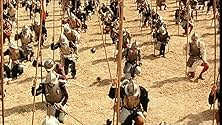
Four moments from Portugal's long history are highlighted. First, there is the struggle against the Roman troops led by Viriato, chief of the local Celtic population, the Lusitanians. This ends with his defeat in 139 BC. Next is the battle won by King João I, founder of the Avis dynasty, against the King of Spain in 1385. This battle enabled Portugal to remain independent, while simultaneously thwarting the project of unifying the political entities of the Iberian Peninsula. Next, the film moves on to Portugal's geographical explorations and discoveries during the 15^(th) and 16^(th) centuries. These are depicted in a more symbolic way, rather than through vivid cinematic realism, which would recreate the past in a manner similar to the poetic, mythical and fantastical views written by Luís Vaz de Camões, the 16th-century soldier and poet who wrote the "Lusiads", one of the most important works in Portuguese literature. This epic poem meditates on Portugal's achievements through world exploration. Finally, there is the tragic death of the moody and dreamy King Sebastian in a battle in Alcácer, Morocco, in 1578, which sparked a succession crisis and the end of the Avis dynasty. This dynasty had turned a small corner of Europe into an efficient and solid monarchy and a bold world power present on four continents.
Even after they reach their camp, the soldiers continue to talk. It doesn't last long, though, as the lieutenant receives a message ordering his platoon to venture into the savannah. The operation is a disaster, with the Portuguese troops coming under attack. The scene is full of sound and smoke, but it is more basic shooting of a war event than a truly elaborate, dramatic and thrilling display of cinematic skill. The only moment in this war film that truly reflects the genre's visual tropes and expectations feels perfunctory rather than thoughtful. To be fair, this underwhelming result is not entirely unexpected, as the reconstructions of past events are also less than impressive or detailed. They do not quite live up to the flourishes and daring that the audience might expect. The big surprise and real embarrassment comes with the segment inspired by Camões' discoveries, which is unconvincing and clumsy. It is a bizarre attempt at eroticism and poetry that is contrived and ridiculous. The purpose of this scene is to alter the lieutenant's narrative arc: badly wounded, Cabrita is evacuated. The final scenes of the film take place in a military hospital in the colony, where a doctor struggles to save Cabrita's life while his stream of consciousness wanders through his memories and thoughts about national history. He dies on the same day, 25 April 1974, that fellow soldiers in Portugal bring down the authoritarian, far-right Estado Novo government, which had been in power since 1928 under António de Oliveira Salazar.
This war film consciously breaks the rules of the genre. It cleverly refuses to be what it purports to be and compels a bemused audience to engage with battles other than the one promised, driving them through centuries and complex debates. It is a sad meditation whose point of view is hard to define.
Incidentally, this fits with a wider pattern: Manoel de Oliveira has already demonstrated his ability to tweak and transcend film forms to offer fresh perspectives and challenge the purpose of projects, questioning the filmmaking act and the notion of representation. In his 1963 feature O Acto da Primavera - Rite of Spring, de Oliveira worked with material he had discovered by chance: a folk tradition dealing with the Passion of Christ. He used this to create his own vision, straying from the documentary he had intended to make, and producing unique storytelling that magnifies and colours an original performance.
It is not obvious that the film reflects the director's political views: he may be more interested in Cabrita's specific, personal experience, while keeping the man and his ideas at a distance. De Oliveira captures a state of mind, but he may not adhere to what it expresses. The quest for meaning, specifically the idea of national grandeur that never reached its full potential, may be futile, even though the Portuguese are eager to justify their actions and define their identity.
From the opening quote to the final chaotic and bleak vision of Lieutenant Cabrita conflating the battlegrounds of 1385 and 1578, the film is imbued with the influence of António Vieira. A 17th-century Jesuit missionary, preacher and writer, he spent most of his life in Brazil but travelled often to his native Portugal. He fiercely defended the rights of the Indians, especially against their enslavement and the encroachment of colonial settlers, but failed to condemn African slavery. He also criticised the Inquisition while developing a personal millenarian interpretation of Portuguese history. He is still regarded as one of the greatest writers in Portuguese literature and a significant religious figure.
One of his comments gives the film its title. What meaning does it have in the film? How can it be interpreted, even when it is screamed onscreen in the final, chaotic battleground? Does it represent the tragic denial of Portugal's ambitions, offering a disheartening perspective of inevitable yet unjust failure, despite Portugal's commendable expansion of Europe's cultural and geographical horizons? Or does it show that commanding history and men is truly a vain effort? Does the lieutenant get it right, or does the director have a more relevant attitude, showing how men have failed and letting the audience judge for themselves? While the film may not be a sweeping, strongly articulated meditation on political and human disasters, it does explore the malaise and thoughts of individuals caught up in political and human dramas. Ultimately, it suggests that history is merely the catalyst for profound, unshakable melancholy, which is considered a defining aspect of the Portuguese state of mind and identity. Battles are lost, significance and fate are cryptic and absurdity prevails. What men can still hold on to is the pensive sadness that gives life meaning.
One of Oliveira's best... but weak, fragile, boring and a little unpatriotic.
However, although I recognize Oliveira's intelligence, attentive eye, perfectionism, stubbornness and passion, this does not blind my discernment to another issue: his films are not commercially viable. As I have already said on other occasions, Portuguese filmmakers and directors tend to opt for unpalatable films, intellectual to the point of hermeticism, or cheesy, idiotic films, without any cultural value. And if some are the delight of festivals and that pseudo-intellectual bourgeoisie (mainly those who want to appear to understand cinema when in fact they know nothing about the subject), the others sell well, but are a national disgrace. We still haven't found that middle ground where art marries healthy entertainment.
Of all Oliveira's films I've seen, this one manages to be probably the least silly and the most enjoyable. Maybe because I'm a historian, and the film is essentially about the country's past and, mainly, the lost battles of history. Using these themes, Oliveira attempts an essay on the great military defeats suffered by the country, and the way in which this affected the course of the nation: the murder of Viriato (he was not Portuguese, not even in dreams, but is traditionally associated with Portuguese history), the Portuguese defeat at the Battle of Toro and the disastrous Battle of Alcácer-Quibir, not to mention the Colonial War, a fourteen-year conflict that Portugal won militarily until it was betrayed, in Lisbon, by the captains who wanted to make Portugal a Marxist-Leninist republic, on April 25, 1974. To say that it was all in vain, or that they were meaningless conflicts, would perhaps be the ultimate insult to those who died in these wars.
The film features several well-known actors, with Luís Miguel Cintra, Diogo Dória and Miguel Guilherme certainly being the best and those who develop the most interesting work. Both the scenes in the Overseas, and each of the historical recreations, are very well done, taking into account that, at the time of this film, we didn't have much practice with period reconstitutions. Cinematography is once again, as it happens in Oliveira's films, the filmmaker's signature feature, with impeccable framing, good camera work, the actors breaking the "fourth wall" (as if we were also part of the film). The worst part of this film turns out to be the mythological scene on Love Island. It just doesn't fit, plus a lot of the child nudity should have been cut. And the almost virtual absence of a soundtrack is also annoying (but not as annoying as the synthesizer that, in the mythological scenes, tried to emulate a piece of baroque music).


Did you know
- ConnectionsFeatured in O Velho do Restelo (2014)
- How long is No, or the Vain Glory of Command?Powered by Alexa
Details
- Release date
- Countries of origin
- Official site
- Languages
- Also known as
- No, or The Vain Glory of Command
- Filming locations
- Production companies
- See more company credits at IMDbPro