IMDb RATING
6.5/10
3.8K
YOUR RATING


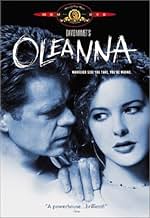
When a student visits her professor to discuss how she failed his course, the discussion takes an awkward turn.When a student visits her professor to discuss how she failed his course, the discussion takes an awkward turn.When a student visits her professor to discuss how she failed his course, the discussion takes an awkward turn.
- Awards
- 1 nomination total






Diego Pineda
- Quarterback
- (uncredited)
Scott Zigler
- Clerk in Copy Shop
- (uncredited)
- Director
- Writer
- All cast & crew
- Production, box office & more at IMDbPro
6.53.8K
1
2
3
4
5
6
7
8
9
10
Featured reviews
10oowawa
Oleanna: the sham promised land behind Academia?
One writer perceptively suggests that the term "Oleanna" was used to describe swampland being sold as prime real estate.
I think the primary context in which the title "Oleanna" is to be understood appears in a "folk" stanza preceding Mamet's published edition of the play:
"Oh to be in 'Oleanna,'/ That's where I would rather be,/ Than be bound in Norway/ And drag the chains of slavery."
And so, Oleanna is a version of a Utopian promised land, and in the context of the play, the gateway to this better tomorrow is through the halls of Academia. Susan, the victim of her own false expectations of how the university is to transform her existence, repeatedly mentions the struggle she had to endure in order to get into college. For her, academic success is central to her vision of a better life. John, the pedantic professor, also sees Academia as the means to a comfortable, upper middle class existence with his new house, wife, and son. All he needs to do is make tenure, and his future is secured.
However, John presents himself as an academic bad-boy who debunks the very Academia with which he is trying to secure his comfortable future. This ridicule of the academic process strikes at the heart of Carol's dreams of a better future through education. She quite rightly sees that the professor is trying to have it both ways--playing the academic outsider while trying to kiss-up to the tenure committee in order to ensure his cushy new home in the suburbs. When someone's dreams are threatened, they become angry and strike out, however they can.
This is a brilliant movie. Anyone working in a high school or university, and anyone contemplating an academic career, needs to watch it, and allow it to soak deep into the structure of the brain. Perhaps that academic career isn't such a good idea, after all. Maybe that utopian real estate is really swampland. At any rate, one needs to be very, very careful when dealing with students.
I think the primary context in which the title "Oleanna" is to be understood appears in a "folk" stanza preceding Mamet's published edition of the play:
"Oh to be in 'Oleanna,'/ That's where I would rather be,/ Than be bound in Norway/ And drag the chains of slavery."
And so, Oleanna is a version of a Utopian promised land, and in the context of the play, the gateway to this better tomorrow is through the halls of Academia. Susan, the victim of her own false expectations of how the university is to transform her existence, repeatedly mentions the struggle she had to endure in order to get into college. For her, academic success is central to her vision of a better life. John, the pedantic professor, also sees Academia as the means to a comfortable, upper middle class existence with his new house, wife, and son. All he needs to do is make tenure, and his future is secured.
However, John presents himself as an academic bad-boy who debunks the very Academia with which he is trying to secure his comfortable future. This ridicule of the academic process strikes at the heart of Carol's dreams of a better future through education. She quite rightly sees that the professor is trying to have it both ways--playing the academic outsider while trying to kiss-up to the tenure committee in order to ensure his cushy new home in the suburbs. When someone's dreams are threatened, they become angry and strike out, however they can.
This is a brilliant movie. Anyone working in a high school or university, and anyone contemplating an academic career, needs to watch it, and allow it to soak deep into the structure of the brain. Perhaps that academic career isn't such a good idea, after all. Maybe that utopian real estate is really swampland. At any rate, one needs to be very, very careful when dealing with students.
Mamet does a masterful job. I'd watch it again.
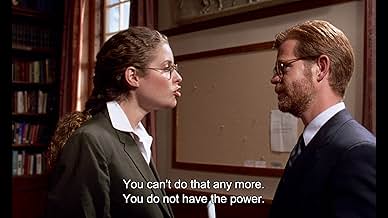
William H. Macy plays a professor, and Debra Eisenstadt plays a student who needs an A in the class she is taking from him. They argue as to why she should or shouldn't get an A. In the course of their arguing, the student finds cause to charge the professor, who is up for tenure, with sexual harassment and takes her case to the tenure committee.
The movie runs about an hour and a half. It was slow going, but as I was about to flip away from it (watching it on cable), I checked how long it had to go, and it was about half-way through. I figured, oh well, there's still some Canadian Club I need to get rid of, and tomorrow's a holiday, so I stuck with it. And I'm glad I did.
It is not a good movie, and maybe not even a very good play. Mamet's direction is ultra-stagy, even more declamatory than live theater would normally allow for, let alone a movie. For about an hour and a half, the actors hurl complete sentences and big chunks of paragraphs at one another.
Are Mamet and the actors really that insensitive to the conventions of film? Not likely. I think he chose that artificial manner in order to distance the audience from the characters and bring the ideas to the foreperhaps in the same vein as Bertolt Brecht's notion of "epic theater".
This is not so much a movie or a play as it is a staged philosophical dialogue. It examines the power relationships between man and woman, teacher and student. When the student comes to the professor to reveal the case she has built against him, it shows how words and deeds in one context can be given a whole different thrust and meaning when used to "build a case". Or are they really that different? Perhaps her case focuses and explicates the real underlying relationship of those words and deeds. Those are the kinds of questions Mamet raises, and I think it is a masterful exploration.
But is it a movie? Well, it is certainly dramatic, if stilted, and the dénoument is devastating. It may not be a good movie, but Mamet knew exactly what he was doing, and I'd watch it again.
The movie runs about an hour and a half. It was slow going, but as I was about to flip away from it (watching it on cable), I checked how long it had to go, and it was about half-way through. I figured, oh well, there's still some Canadian Club I need to get rid of, and tomorrow's a holiday, so I stuck with it. And I'm glad I did.
It is not a good movie, and maybe not even a very good play. Mamet's direction is ultra-stagy, even more declamatory than live theater would normally allow for, let alone a movie. For about an hour and a half, the actors hurl complete sentences and big chunks of paragraphs at one another.
Are Mamet and the actors really that insensitive to the conventions of film? Not likely. I think he chose that artificial manner in order to distance the audience from the characters and bring the ideas to the foreperhaps in the same vein as Bertolt Brecht's notion of "epic theater".
This is not so much a movie or a play as it is a staged philosophical dialogue. It examines the power relationships between man and woman, teacher and student. When the student comes to the professor to reveal the case she has built against him, it shows how words and deeds in one context can be given a whole different thrust and meaning when used to "build a case". Or are they really that different? Perhaps her case focuses and explicates the real underlying relationship of those words and deeds. Those are the kinds of questions Mamet raises, and I think it is a masterful exploration.
But is it a movie? Well, it is certainly dramatic, if stilted, and the dénoument is devastating. It may not be a good movie, but Mamet knew exactly what he was doing, and I'd watch it again.
Under appreciated Mamet film/play.
One general misunderstanding (in my opinion) of Mamet is that he tries to write realistic dialog. In Oleanna, Mamet seems to want to speak directly through each character in a very academic verse which is well suited to the film/play. The issues of sexual misconduct and the way perspectives differ between men and women make this an interesting journey. And if you are a Bill Macy fan, you will like the movie.
Prepare yourself for discussions and dissensions.
This is a movie not without faults -- the dialog at the beginning is stilted, William H. Macy's performance is not without its weak spots -- but in spite of those quibbles, is a compelling, intriguing film.
The movie centers on the relationship between a student and a professor at an unnamed university. She goes to him for extra help in his class (but she may be just trying to set him up for a sexual harrassment lawsuit). He tries to help her with her studies (but may be trying to dominate and have innappropriate relations with her at the same time). As the relationship turns into a struggle, the viewer finds him/herself switching sides early and often. The tension in the film becomes the viewer's tension; during the final scenes you'll barely breathe.
The tagline is right -- whatever side you choose, you're wrong. I've seen this movie lambasted as being anti-feminist, lauded for being pro-feminist, hated for being anti-establishment, pro-establishment, racist, sexist, etc. In reality, it is all and none of these things. Oleanna is a mirror that forces us to examine and discuss our own convictions. That it accomplishes this while still being an exciting film makes it worth seeing more than once.
The movie centers on the relationship between a student and a professor at an unnamed university. She goes to him for extra help in his class (but she may be just trying to set him up for a sexual harrassment lawsuit). He tries to help her with her studies (but may be trying to dominate and have innappropriate relations with her at the same time). As the relationship turns into a struggle, the viewer finds him/herself switching sides early and often. The tension in the film becomes the viewer's tension; during the final scenes you'll barely breathe.
The tagline is right -- whatever side you choose, you're wrong. I've seen this movie lambasted as being anti-feminist, lauded for being pro-feminist, hated for being anti-establishment, pro-establishment, racist, sexist, etc. In reality, it is all and none of these things. Oleanna is a mirror that forces us to examine and discuss our own convictions. That it accomplishes this while still being an exciting film makes it worth seeing more than once.
Quirky, full of irony, not a film for everyone
The dialogue is difficult to get past -- you want to grab the characters one at a time by the throat so the other one can at least finish a sentence or thought without interruption. But if you stick with it, the characters do deliver on what had to be a difficult script. And I found the irony of the story line to be the reward. It is a mind game -- not for the casual viewer.


Did you know
- TriviaDavid Mamet's script was heavily criticized as sexist. He defended himself against this allegation in (Guardian supplement) (UK) 8 April 2004, pg. 8-9, "'Why can't I show a woman telling lies?'"
- GoofsWhen Carol's tea cup falls to the carpeted floor and shatters, the sound is of porcelain crashing against a hard surface.
- Alternate versionsThere is a version of the movie circulating in Australia, in a series of videos along with other David Mamet films including "A Life in the Theater". This particular copy of the film is timecoded. In that version, after Carol tells John not to call his wife "baby," (thus sending him into a torrent of rage), and he slaps her arm and grabs her, screaming a sexual expletive and raising a chair above her head, the door to the hallway swings open and a number of people stand in the hallway, observing the fight and thus hopelessly damning John. In the version now appearing on The Sundance Channel (10/05), the expletive is unchanged but he never lifts the chair and the door never opens; aside from a final exterior shot of the school, the film ends with Carol (Eisenstadt) having collapsed on the floor of John's office, and John sitting in his chair, his head buried in his hands.
- SoundtracksLong Ago And Far Away
Words by David Mamet
Music by Rebecca Pidgeon
Soloist: Steve Goldstein (as Steven Goldstein)
© Copyright 1994 Dwight Street Music
- How long is Oleanna?Powered by Alexa
Details
- Release date
- Countries of origin
- Official sites
- Language
- Also known as
- David Mamet's Oleanna
- Filming locations
- Production companies
- See more company credits at IMDbPro
Box office
- Gross US & Canada
- $124,693
- Opening weekend US & Canada
- $25,316
- Nov 6, 1994
- Gross worldwide
- $124,693
Contribute to this page
Suggest an edit or add missing content