
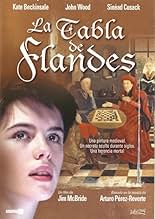
A woman finds a hidden message in a restored painting questioning a knight's death. When her friend is murdered investigating it, a chess game's moves in the painting link to killings from t... Read allA woman finds a hidden message in a restored painting questioning a knight's death. When her friend is murdered investigating it, a chess game's moves in the painting link to killings from the past that she must solve.A woman finds a hidden message in a restored painting questioning a knight's death. When her friend is murdered investigating it, a chess game's moves in the painting link to killings from the past that she must solve.




Sinéad Cusack
- Menchu
- (as Sinead Cusack)


Julian Martínez
- Duke Ferdinand
- (as Julián Martínez)
Isabel van Unen
- Beatrix of Burgundy
- (as Isabel Van Unen)
Josuè Guasch
- Messenger
- (as Josue Guasch)
5.73K
1
2
3
4
5
6
7
8
9
10
Featured reviews
a lovely actress, an interesting story
The story behind this movie is quite interesting. Perhaps for some the real mystery was obvious all along, but for me, it held my attention for the whole duration, and it took a second viewing to fully unravel the threads.
The real gem in this movie is Ms. Beckinsale. She is radiantly lovely throughout, and there is a strong sensuality about her that pervades the entire movie. And yes, those who long to see her unclothed will not be disappointed. Even with clothes on, though, she manages to exude this alluring aura that is irresistible.
The supporting cast is mixed. Perhaps the best is the investigating police detective, who is a classic. The gigolo guy is rather over the top.
I also wish they had not inserted those brief historical re-enactments, as they neither fit well into the narrative thread, nor are they in any way convincingly real.
The real gem in this movie is Ms. Beckinsale. She is radiantly lovely throughout, and there is a strong sensuality about her that pervades the entire movie. And yes, those who long to see her unclothed will not be disappointed. Even with clothes on, though, she manages to exude this alluring aura that is irresistible.
The supporting cast is mixed. Perhaps the best is the investigating police detective, who is a classic. The gigolo guy is rather over the top.
I also wish they had not inserted those brief historical re-enactments, as they neither fit well into the narrative thread, nor are they in any way convincingly real.
Quis Necavit Equitem?
"Uncovered" is based on Arturo Pérez-Reverte's novel "The Flanders Panel". Julia Darro, a young art historian and restorer from Barcelona, is working on a fifteenth-century Flemish painting called "The Game of Chess", when she discovers a painted-over message reading "Quis Necavit Equitem?" (Latin for "Who killed the knight?") Julia begins to research the painting's background to discover the meaning of this inscription, and discovers that it relates to a 500-year-old murder mystery. She realises that the solution to the mystery is connected to the chess game being played in the picture, and knowing little of the game herself recruits Domenec, a talented local chess player, to assist her. Julia and Domenec, however, realise that they are in danger, as several people connected with their research are also murdered.
The central mystery is an intriguing and ingenious one, and well developed, although I could spot the identity of the murderer well before this was announced on screen. There are no really outstanding acting performances, but the lovely Kate Beckinsale makes a charming heroine (although I could never work out why she sneezes so much). Kate is one of the few actresses who can get away with wearing her hair boyishly short and still look strikingly beautiful.
One criticism I have heard is that although the main characters are all supposed to be Spanish they all speak English without foreign accents. This, however, is not something which has ever worried me. The use of native British or American accents to represent foreigners' use of their own native languages is something I find perfectly acceptable. Charlton Heston's El Cid, for example, was also a Spaniard, and nobody complains that he speaks English like an American rather than like Manuel in "Fawlty Towers".
This is one of the few films to take an interest in chess and art history, two rather intellectual pursuits, and it does so in such a way as to make both those subjects seem interesting, even glamorous, featuring a romance between a beautiful young art historian and a handsome chess genius. It makes good use of its setting, with some wonderful views of the city of Barcelona, especially the architecture of Antoni Gaudi. (One of the characters lives in an apartment in Casa Batlló, and Julia and Domenec first meet in Park Güell).
Although this film was an Anglo-Spanish co-production, and stars a well-known English actress, it is curiously unknown in Britain. Although it is nearly twenty years since it was made, I have never seen it on television here, and it is available on DVD in the US but not in the UK. Yet it is, I think, a film which deserves to be better-known. 7/10
The central mystery is an intriguing and ingenious one, and well developed, although I could spot the identity of the murderer well before this was announced on screen. There are no really outstanding acting performances, but the lovely Kate Beckinsale makes a charming heroine (although I could never work out why she sneezes so much). Kate is one of the few actresses who can get away with wearing her hair boyishly short and still look strikingly beautiful.
One criticism I have heard is that although the main characters are all supposed to be Spanish they all speak English without foreign accents. This, however, is not something which has ever worried me. The use of native British or American accents to represent foreigners' use of their own native languages is something I find perfectly acceptable. Charlton Heston's El Cid, for example, was also a Spaniard, and nobody complains that he speaks English like an American rather than like Manuel in "Fawlty Towers".
This is one of the few films to take an interest in chess and art history, two rather intellectual pursuits, and it does so in such a way as to make both those subjects seem interesting, even glamorous, featuring a romance between a beautiful young art historian and a handsome chess genius. It makes good use of its setting, with some wonderful views of the city of Barcelona, especially the architecture of Antoni Gaudi. (One of the characters lives in an apartment in Casa Batlló, and Julia and Domenec first meet in Park Güell).
Although this film was an Anglo-Spanish co-production, and stars a well-known English actress, it is curiously unknown in Britain. Although it is nearly twenty years since it was made, I have never seen it on television here, and it is available on DVD in the US but not in the UK. Yet it is, I think, a film which deserves to be better-known. 7/10
Bad, Bad
A truly bad movie, from a generally good director like Jim McBride (I loved "Great Balls of Fire"). Based on a novel from Perez Reverte, this film is dull and uninteresting, and the only thing you can recommend from it is a nude scene from Kate Beckinsale (48 minutes after the start, so press your fast forward button in your video).
Light murder mystery with hairy armpits, doubles as Barcelona tourist advert
A young Kate Beckinsale barely 20 years old during principal photography (which began one week after her 20th birthday, 2 august 1993), stars as the ingenue protagonist in this light murder mystery. We immediately and easily glean that this is indeed inténded to be a light hearted lowbrow movie, from the cheery musical score which is incessant and at times quite annoying.
Beckinsale plays Julia Darro, a restorer of paintings in Barcelona, who gets a job to restore a 500 year old painting, by the fictitious painter Van Huys (sounds like Van Nuys .... from the boulevard ... get it?) from Flanders, so, not a true Dutch Master but something close to it. She discovers that the painting contains a hidden, painted over message in Latin: "Quis Necavit Equitem" or "Who Killed the Knight?". What unfolds is a who-dunnit with some plot twists, but since they eventually kill off all possible suspects, when we get near the end, it's pretty clear who is the culprit.
Now, miss Beckinsale bravely shows some skin in this movie but, there have been numerous women who done that before her and at a younger age at that. Of the 260+ actresses in this 18-21 age group, Amber Heard, Barbara Capell, Charlotte Alexandra, Charlotte Walior, Clémence Poésy, Donna Wilkes, Georgina Cates, Hayley Mills, Heather Langenkamp, Helena Bonham Carter, Jacqueline Byers, Katie Holmes, Lizzie Brocheré, Mathilda May, Melanie Griffith, Odile Michel, Romane Bohringer, Tamara Mello come to mind, and those are just the ones that were of legal, non-Brooke Shields age, so to speak. But what makes her truly braver than her younger collegueas, are two things that stand out: She has the lips of Art Malik touching her breasts and ... she shows some truly hairy armpits somewhat later .... I found that last one to be especially shocking, since "even" French actressess haven't done that since the 70s. And they dó get a bad rep on the whole hairy armpits thing anyway.
The lightness of the movie is fully intentional, so much of the whining that it doesn't do the book justice is wholly irrelevant. And I get the feeling that much of the negative reviews come from .... let's call them ... the "Cesar Belvedere"-side of the spectrum. Which is odd, because John Wood (what's in a name) is actually one of the excellent aspects of this movie. Even.
Oh well. This movie is like Back to the Future, and all JCVD movies: they are excellent in their respective genres. So, don't go comparing this to "They shoot horses, don't they?" That's nonsensical. If you think this movie hurts the book, get the funding and make one yourself.
7/10.
The Melancholic Alcholic.
Beckinsale plays Julia Darro, a restorer of paintings in Barcelona, who gets a job to restore a 500 year old painting, by the fictitious painter Van Huys (sounds like Van Nuys .... from the boulevard ... get it?) from Flanders, so, not a true Dutch Master but something close to it. She discovers that the painting contains a hidden, painted over message in Latin: "Quis Necavit Equitem" or "Who Killed the Knight?". What unfolds is a who-dunnit with some plot twists, but since they eventually kill off all possible suspects, when we get near the end, it's pretty clear who is the culprit.
Now, miss Beckinsale bravely shows some skin in this movie but, there have been numerous women who done that before her and at a younger age at that. Of the 260+ actresses in this 18-21 age group, Amber Heard, Barbara Capell, Charlotte Alexandra, Charlotte Walior, Clémence Poésy, Donna Wilkes, Georgina Cates, Hayley Mills, Heather Langenkamp, Helena Bonham Carter, Jacqueline Byers, Katie Holmes, Lizzie Brocheré, Mathilda May, Melanie Griffith, Odile Michel, Romane Bohringer, Tamara Mello come to mind, and those are just the ones that were of legal, non-Brooke Shields age, so to speak. But what makes her truly braver than her younger collegueas, are two things that stand out: She has the lips of Art Malik touching her breasts and ... she shows some truly hairy armpits somewhat later .... I found that last one to be especially shocking, since "even" French actressess haven't done that since the 70s. And they dó get a bad rep on the whole hairy armpits thing anyway.
The lightness of the movie is fully intentional, so much of the whining that it doesn't do the book justice is wholly irrelevant. And I get the feeling that much of the negative reviews come from .... let's call them ... the "Cesar Belvedere"-side of the spectrum. Which is odd, because John Wood (what's in a name) is actually one of the excellent aspects of this movie. Even.
Oh well. This movie is like Back to the Future, and all JCVD movies: they are excellent in their respective genres. So, don't go comparing this to "They shoot horses, don't they?" That's nonsensical. If you think this movie hurts the book, get the funding and make one yourself.
7/10.
The Melancholic Alcholic.
An Incredible and Complex Story, With Kate Beckinsale in the Beginning of Career
Julia (Kate Beckinsale) is a restorer working in a five hundred years old painting, which theme is a chess game: there are two men playing chess and a woman watching them. This painting will be sold in an auction after the restoration, and the amount will be split among the owner, an old man who lost his wealthy, Julia's best friend Menchu (Sinéad Cusack) and her partner. Max and Lola, relatives of the owner, are very interested in the selling. Julia has no family and was raised by Cesar (John Wood), who has a fraternal love for her. Cesar is also homosexual. Julia finds a hidden message in Latin in the paint, an after some investigation, she finds out that the translation would be `Who killed the knight?' Soon, many characters are associated to the pieces of the chess and are killed, following the movements of the game in the painting. This incredible and complex plot is a great disappointment. One of the attraction is Kate Beckinsale in the beginning of her career, with a beautiful body and breasts, but with a rough and common face. Presently, nine years older than in this movie, she is very gorgeous, very well produced in her films, with a delicate face, thin nose, beautiful and long hair and wonderful costumes. My vote is five.


Did you know
- TriviaHelen McCrory's debut.
- How long is Uncovered?Powered by Alexa
Details
- Runtime
- 1h 43m(103 min)
- Color
- Sound mix
- Aspect ratio
- 1.66 : 1
Contribute to this page
Suggest an edit or add missing content