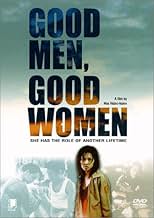
Intended as the concluding film in the trilogy on the modern history of Taiwan began with Beiqing Chengshi (1989), this film reveals the story through three levels: a film within a film as w... Read allIntended as the concluding film in the trilogy on the modern history of Taiwan began with Beiqing Chengshi (1989), this film reveals the story through three levels: a film within a film as well as the past and present as linked by a young woman, Liang Ching. She is being persecut... Read allIntended as the concluding film in the trilogy on the modern history of Taiwan began with Beiqing Chengshi (1989), this film reveals the story through three levels: a film within a film as well as the past and present as linked by a young woman, Liang Ching. She is being persecuted by an anonymous man who calls her repeatedly but does not speak. He has stolen her diar... Read all
- Director
- Writers
- Stars
- Awards
- 11 wins & 5 nominations total
- Director
- Writers
- All cast & crew
- Production, box office & more at IMDbPro
Featured reviews
nope
It takes the viewer some time to realize that during the scenes depicting Bi-Ya's life, we are not, in fact, watching a film- within-a- film, but rather Ching's fantasies of Bi-Ya as she prepares for the role. Ching imagines Bi-Ya's life and struggle, a young idealist who joins the initially Nationalist-led resistance to the Japanese only to later be attacked by those same nationalists, in ways that both reflect and contrast with her own experiences. Consciously or not, Ching constructs a narrative of the founding of modern Taiwan as a US garrison state that forgrounds and to a degree excuses her own moral and emotional compromise to the modern Taiwanese mafia, who buy and sell human lives and loyalties.
It is of course a truism that one cannot understand the present without understanding the past. But, Hou Hsiao-hsien's film suggests, neither can we look to the past without trying to understand it through the lens of the present and the personal. We never see any of the scenes from the "objective biopic" that Ching will star in, and the film suggests that such a work cannot be put on screen. It cannot exist. History and memory are inextricably intertwined. The personal and the universal cannot ultimately be distinguished.
Good Men, Good Women displays the painterly beauty characteristic of Hou's films. The point of its narrative is much less allusive than in many of his movies, making it easier to digest, yet also less seductively enigmatic than Hou's very best work. Still, a very worthwhile piece of filmmaking.
Deliberate minimalism from an uncompromising master
So Zhang can do intense drama, and Wong can direct spontaneous acting. Hou Hsiou Hsien (or his colleagues Tsai Ming Liang and Edward Yang), however, is of a different breed. His films (that I've seen anyway) are casual but deliberately never ever strive to be interesting. For example, there's no moody music, showy cinematography, or thought-provoking dialogue to spice things up while you watch a 2-minute long take of people walking. Everything is just as indifferent as it is and nothing more; then it's up to us to give it a meaning -- that is the essence of MINIMALISM which define Hou's body of work. Minimalist cinema is by far the most difficult to grasp and sit through (since "nothing happens," some will understandably accuse), and many viewers detest it with a passion. Whether this style is actually effective I do not know, "all I know is this: once I was blind and now I can see." Good Men Good Women is an eye opener for me.
In recent years, several well-noted Chinese art house filmmakers have upgraded to generously budgeted blockbusters: Ang Lee with Crouching Tiger, Zhang Yimou with Hero and Flying Dagger, He Ping with Warriors of Heaven & Earth, Fruit Chan with Three Extremes: Dumpling, not to forget Cheng Kaige's special effects fantasy extravaganza The Promise on the way, followed by Wong Kar Wai reportedly to film an American feature The Lady from Shanghai with Nicole Kidman, and words of Hou's Taiwanese colleague Edward Yang to direct an animation produced by Jackie Chan. In such a relaxing trend, will Hou Hsiou Hsien have any surprises for us, or will he continue to explore Taiwan in minimalist glory?
One of Hou's greatest achievements
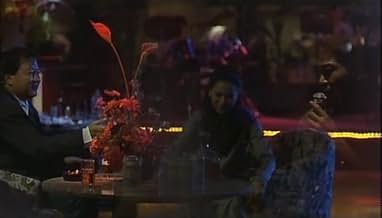
Good Men, Good Women takes place in three different time sequences: the contemporary world of actress Liang Ching (Annie Shizuka Inoh), her recollection of her recent past as a drug-addicted barmaid, and the world of a yet to be made film about resistance fighters in the 1940s. Hou suggests a contrast between the sterile, corrupt lives of the present generation and the young people of the past who acted with a social conscience. While it is a complex and elliptical film, it is one of Hou's greatest, filled with tenderness and sensuality and an aching melancholy for a world whose promise has remained unfulfilled.
The film opens with a parade of young people dressed as peasants who march toward the camera singing a joyous song: "When yesterday's sadness is about to die. When tomorrow's good cheer is marching towards us. Then people say, don't cry. So why don't we sing." The camera then cuts to present day Taipei where an unidentified caller telephones Liang Chang but refuses to speak. The caller has stolen her diaries, and faxes her the pages daily prompting her to recall her tragic relationship with Ah Wei (Jack Kao), a gangster who died in a shootout. The film intersperses scenes of intimacy between the two lovers with the world of the 1940s where Chiang Bi-Yu and Hao-Tung, have left Taiwan for the Chinese mainland to support the anti-Japanese resistance. The "film within a film" shows how Chiang and Hao are forced to put their children in foster care and Liang identifies with Chiang, drawing parallels from her own experience of having to give up the things she loved the most.
Hou shows that events buried in a nation's past can have far reaching consequences and that history may be indistinguishable from personal memory. Yet the film is not one of ideas but of images and Hou has provided some memorable ones; for example, when Liang sits before a mirror putting on her makeup as Ah Wei sits closely beside her talking about the possibility of her being pregnant. It is a mundane event, yet Hou imparts it with a mysterious and timeless quality. In many ways, Good Men, Good Women is typical of Hou's films with its static camera, long takes, and rhythms of everyday life, yet it is also his most political, a searing indictment of the squandering of a nation's heritage, allowing us to see that a country, like its people, cannot redeem its future until it tells the truth about its past.
Brave movie
Hou's critique of old and new Taiwan.
This is a movie that bravely confronts issues in a country that is too preoccupied with trying to juggle for positions in the global market. A reminder to everyone that a country's history does not consist of only the valiant highlights, but also of shameful past that should not be discarded.
Did you know
- ConnectionsFeatures Late Spring (1949)
Details
- Runtime
- 1h 48m(108 min)
- Color
- Sound mix
- Aspect ratio
- 1.78 : 1