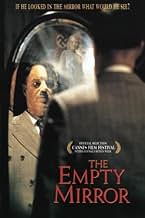
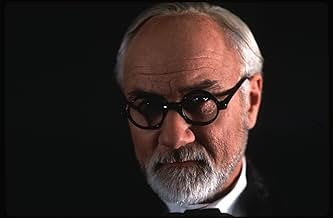
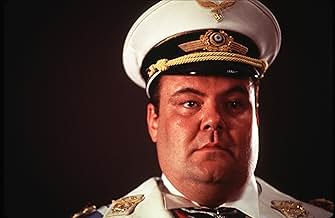
Adolf Hitler faces himself and must come to terms with his infamous career in an imaginary post-war subterranean bunker where he reviews historical films, dictates his memoirs and encounters... Read allAdolf Hitler faces himself and must come to terms with his infamous career in an imaginary post-war subterranean bunker where he reviews historical films, dictates his memoirs and encounters Eva Braun, Josef Göbbels, Hermann Göring, and Sigmund Freud.Adolf Hitler faces himself and must come to terms with his infamous career in an imaginary post-war subterranean bunker where he reviews historical films, dictates his memoirs and encounters Eva Braun, Josef Göbbels, Hermann Göring, and Sigmund Freud.
- Director
- Writers
- Stars
- Awards
- 7 wins & 1 nomination total
- Hitler Youth
- (as Christopher Levitus)
- Director
- Writers
- All cast & crew
- Production, box office & more at IMDbPro
Featured reviews
highly intelligent?
Perhaps what needs to be understood is that they weren't any more intelligent than he was. This explains why they could be 'mesmerized' by him.
The fact is that Hitler WAS exactly the same as all the people around him. He represented the realization of their deepest desires, promised to deliver, was applauded for the early result then, as an escape from their own culpability, blamed for the entire 12 year debacle. Every murder, every despicable act by every person who either directly or tacitly supported him, was laid off on a single momentarily charismatic human being.
They weren't in any way unlike him, they were just like him; and he; just like them.
The real question that remains is — are we?
Good writing but mediocre casting
The story illuminates the power of illusions and how someone could delude themselves into believing almost anything. It humanizes Hitler a bit, examining how he destroyed himself in his lust for power, and how the same thing could happen again.
Psychologically and historically faithful for those who understand Hitler
While I doubt this movie appeals to the majority of people, it is never-the-less accurate both historically and psychologically. Many of the ideas expressed (by the character Hitler and his cohorts), facts referenced, and behavior exhibited are realistic. I have studied Hitler to a some extent, particularly his psychology and neuroses (read Robert G .L. Waite), and I feel that this movie shows the man as he was, a facade of power covering thinly doubt and pain. Hitler is not, after all, simply the worst monster in history, he had reasons and beliefs that motivated his actions. While the depiction of him may seem to inappropriate to some, it shows Hitler as a vulnerable, conflicted person who uses power and cruelty to attempt to hide his own debilitating lack of self confidence. Hitler needed to be accepted, loved, and to belong. He tried to use power and fear as a surrogate for all these things that make a healthy happy person, but it gave him no rest. He did indeed stare into an empty mirror. Hitler was a victim of his own twisted mind and lonely, hollow existence.
Hitler deserves not to be forgiven, but understood. The empty mirror shows Hitler as human, and a weak one. This is not a tribute: Hitler wanted to be remembered as a great destructive prophet, to see him as the vulnerable victim of himself (while not pardoning what he did) is not what Hitler wanted. Watch, and understand Hitler the victim.
Devastating
"The Empty Mirror" parallels the Third Reich in that it shows Hitler, dictating his memoirs in Hell, gradually disintegrating both emotionally and physically as he confronts the enormity of his horrific actions.
Yes, this movie would be considered politically incorrect by some for not portraying Hitler as a two-dimensional monster, all fire and brimstone, but showing that he had actual human emotions, had fallen in love with a facade of his own (and Dr. Goebbels) creation, and learning that once the facade was demolished, what lived behind it was a puny, cowardly man.
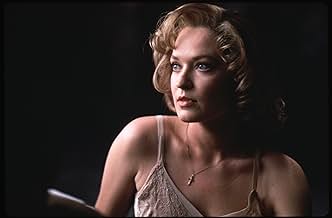
Acting was terrific on all counts. Rodway, although physically far more imposing than the Fuhrer, did an excellent job as his character alternated between lucidity and madness. Joel Grey was a splendid Dr. Josef Goebbels, a sarcastic smart-ass who was perhaps the world's first spin doctor. The Eva Braun character was both sweet and pathetic as Hitler's airheaded mistress, then wife, who wanted nothing more than attention from him. But most frightening were the little blond Deutsche Kinder who were mesmerized by Onkel Adolf, in the same way that 70 million Germans were during the 12 years of the Thousand Year Reich.
In one of the more revealing moments of the film, Hitler belittles Stalin, saying the latter will be simply a blip on the radar screen of life (I'm paraphrasing). He, of course, was right. Stalin may have killed more, and the KGB certainly matched the Gestapo in cruelty, but Russia was and is a nation where human life is cheap. Germany was not and is not, except for those 12 years.
While this isn't easy viewing, and requires some knowledge of history, it should be required viewing in high school Modern European History courses, along with "Schindler's List" and "Judgment at Nuremberg." If we understand Hitler, and how he was able to mesmerize 70 million otherwise highly intelligent people, then history will be far less likely to repeat itself.
An Interesting Foray Into a Fascinating Character
Did you know
- GoofsWhen Hitler wears his uniform with the brown coat and white shirt he wears a black tie. The real Hitler, when wearing this uniform, would wear a brown tie with a tie pin of an eagle astride a swastika.
- Quotes
[first lines]
Adolf Hitler: Before us lies Germany, within us marches Germany, and after us comes Germany!
- ConnectionsEdited into A. Hitler (2010)
Details
Box office
- Gross US & Canada
- $4,688
- Opening weekend US & Canada
- $4,688
- May 9, 1999
- Gross worldwide
- $4,688