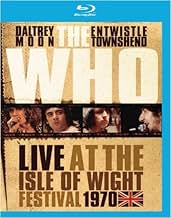
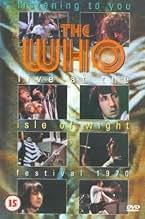
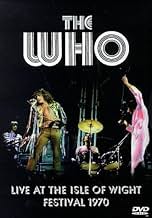
Listening to You: The Who at the Isle of Wight 1970
- TV Special
- 1998
- 1h 25m
IMDb RATING
8.3/10
539
YOUR RATING

This is the film of The Who's appearance at the third (and final) Isle of Wight festival in 1970. This is regarded as the band's finest performance.This is the film of The Who's appearance at the third (and final) Isle of Wight festival in 1970. This is regarded as the band's finest performance.This is the film of The Who's appearance at the third (and final) Isle of Wight festival in 1970. This is regarded as the band's finest performance.






8.3539
1
2
3
4
5
6
7
8
9
10
Featured reviews
Better, the Best
I feel that this is the best Who concert film that I have seen yet. The original Who are all in check, doing various classics like Summertime Blues, I Can't Explain, The Magic Bus and My Generation, each a little different for the good. And, there is a majority of the original Rock opera Tommy, performed soley by the Who in a rare sight (unlike the one in 1989, where it was 3 out of 4 and with guests). Beautiful rock on the small screen by one of the best groups ever. By the way, there is even some unintentional comedy from Keith Moon! A+
The Who at Their Finest
In 1970, The Who were pretty much at their peak and this film captures them during what is considered their greatest concert ever. The chemistry that Pete Townhsend, Roger Daltry, John Entwistle and of course the legendary Keith Moon display on stage is a far cry from the acrimony that would plague The Who in later years. This film can also be seen as the end of an era as this was the last time that their classic rock opera "Tommy" would be played in it's full glory on stage (not unless you count the god awful film version) for 19 years until they played it again on their 25th anniversary tour in 1989.
Maximum R&B, Live and at its Peak
The Isle of Wight festival in 1970 is often regarded as one of The Who's finest performances: after almost two years of steady touring behind 'Tommy,' the group was in peak shape, so well-rehearsed and in tune with each other as performers that not even their reckless antics and often bitter interpersonal animosity could undermine their virtuosity as a live act. 'Tommy' made superstars of The Who, but their identity as the inventors of 'rock opera' often obscures the fact that they were also essentially the inventors of punk, and were, at heart, always the thinking man's hard rock band.
'Listening to You' catches The Who at their best, warts and all. The sound mix is typically bass-heavy: guitarist/songwriter Pete Townshend and bassist John Entwistle were perennially at odds over the latter's tendency to play too loud, and though Entwistle was perhaps the group's most inventive and virtuosic instrumentalist, the guitar work is frequently inaudible beneath the bass, which tends to undermine the recording's overall quality. The editing is questionable, particularly for Who purists: director Murray Lerner falls into the typical tendency to place the 'Tommy' sequence at the end of the film, when in actuality it took up the mid-section of the performance. This editorial decision is particularly glaring and nonsensical on the DVD, as it includes an interview with Townshend in which he explains how the group intentionally placed 'Tommy' in the middle of the set so as to capitalize on the mesmerizing effect of its climax to unite the band with the audience for the final act. The camera work is limited to three angles--center-stage, stage-left, and stage-right--and thus lacks the scope of the Woodstock film and other premier rock films of the era such as Martin Scorsese's and The Band's 'The Last Waltz.' In some ways this limits the film, but it also allows for a more direct and authentic impression of what it might have been like to be there.
This is not a 'great concert film' in the same sense as 'Woodstock' or 'The Last Waltz,' but it catches the group at what most of its members considered to be their peak as artists and performers. Murray Lerner wisely includes a great deal of the group's on-stage banter, though a little knowledge of the chaotic nature of the festival--where over half a million fans crowded onto the island and perpetuated the pseudo-revolutionary nonsense of the era by gate-crashing and harassing the performers for the great sin of expecting people to pay for tickets and behave with civility--is necessary to understand the tone of the commentary. Townshend gets in a few good digs at the crowd--introducing live staple 'Young Man Blues,' he remarks 'blues, for the people who paid to get in!'--reminding the contemporary viewer that the Who's irreverence and cynicism extended to idiotic followers of the zeitgeist as well as to the uptight, bourgeois establishment.
There are some glaring omissions--'A Quick One' and 'Amazing Journey/Sparks' most notably--but the disc includes less frequently filmed gems such as 'Water' and 'I Don't Even Know Myself' to make up for the absences somewhat.
For Who neophytes, 'The Kids Are Alright' is probably a better introduction to the group as live performers, but, even given its deficiencies, 'Listening to You' will not likely disappoint anyone interested in the music of the era or the art of live rock performance.
'Listening to You' catches The Who at their best, warts and all. The sound mix is typically bass-heavy: guitarist/songwriter Pete Townshend and bassist John Entwistle were perennially at odds over the latter's tendency to play too loud, and though Entwistle was perhaps the group's most inventive and virtuosic instrumentalist, the guitar work is frequently inaudible beneath the bass, which tends to undermine the recording's overall quality. The editing is questionable, particularly for Who purists: director Murray Lerner falls into the typical tendency to place the 'Tommy' sequence at the end of the film, when in actuality it took up the mid-section of the performance. This editorial decision is particularly glaring and nonsensical on the DVD, as it includes an interview with Townshend in which he explains how the group intentionally placed 'Tommy' in the middle of the set so as to capitalize on the mesmerizing effect of its climax to unite the band with the audience for the final act. The camera work is limited to three angles--center-stage, stage-left, and stage-right--and thus lacks the scope of the Woodstock film and other premier rock films of the era such as Martin Scorsese's and The Band's 'The Last Waltz.' In some ways this limits the film, but it also allows for a more direct and authentic impression of what it might have been like to be there.
This is not a 'great concert film' in the same sense as 'Woodstock' or 'The Last Waltz,' but it catches the group at what most of its members considered to be their peak as artists and performers. Murray Lerner wisely includes a great deal of the group's on-stage banter, though a little knowledge of the chaotic nature of the festival--where over half a million fans crowded onto the island and perpetuated the pseudo-revolutionary nonsense of the era by gate-crashing and harassing the performers for the great sin of expecting people to pay for tickets and behave with civility--is necessary to understand the tone of the commentary. Townshend gets in a few good digs at the crowd--introducing live staple 'Young Man Blues,' he remarks 'blues, for the people who paid to get in!'--reminding the contemporary viewer that the Who's irreverence and cynicism extended to idiotic followers of the zeitgeist as well as to the uptight, bourgeois establishment.
There are some glaring omissions--'A Quick One' and 'Amazing Journey/Sparks' most notably--but the disc includes less frequently filmed gems such as 'Water' and 'I Don't Even Know Myself' to make up for the absences somewhat.
For Who neophytes, 'The Kids Are Alright' is probably a better introduction to the group as live performers, but, even given its deficiencies, 'Listening to You' will not likely disappoint anyone interested in the music of the era or the art of live rock performance.
the heart of rock and roll is still beating
I saw The Who when the 1982 version of their "final tour" passed through Toronto. While enjoying them immensely, what most sticks in my mind the 20 years and more since is the visual of Roger Daltrey running on the spot a few times, suggesting more than a few ideas that must have been in mind at that time. Here, however, taken from 1970, is a singer and a band musically and visually connected to the music. I doubt that anything of that music and time would have inspired him to be running on the spot. As Huey Lewis would later note and i find it applicable here, judging by a performance like this it would be easy to say that "the heart of rock and roll is still beating." An inspiring performance worth seeing.
The Who at their peak
The Who at the Isle of Wight festival in 1970. This concert and movie captures The Who at their peak.
The band had just released Tommy, their classic, and seminal, rock opera and at the concert they reproduce it, note for note.
It's not all Tommy, however, there's a few other classics of theirs, eg My Generation, Magic Bus, I Can't Explain, plus covers, which were a staple of their show. Here they cover Summertime Blues, Shaking' All Over, Spoonful, Twist and Shout and Young Man's Blues.
Great performance by the band, with Pete Townshend to the fore, but with Keith Moon the undoubtable and unforgettable court jester. Plus, he sure knows how to play the drums...
Ultimately, however, it feels like there is something missing, something that was needed to push this concert into the pantheon of recorded concerts. Maybe it was that some of the songs just feel lacking, and not worthy of a The Who's "best of to that point". Heaven and Hell, I Don't Even Know Myself and Water seem out of place with all the great songs. I could have done without Young Man's Blues too.
Maybe it is the restrictive nature of playing a rock opera from start to finish - there's very little room for detours and jams.
Overall, still a good concert, but needed something more to make it great.
The band had just released Tommy, their classic, and seminal, rock opera and at the concert they reproduce it, note for note.
It's not all Tommy, however, there's a few other classics of theirs, eg My Generation, Magic Bus, I Can't Explain, plus covers, which were a staple of their show. Here they cover Summertime Blues, Shaking' All Over, Spoonful, Twist and Shout and Young Man's Blues.
Great performance by the band, with Pete Townshend to the fore, but with Keith Moon the undoubtable and unforgettable court jester. Plus, he sure knows how to play the drums...
Ultimately, however, it feels like there is something missing, something that was needed to push this concert into the pantheon of recorded concerts. Maybe it was that some of the songs just feel lacking, and not worthy of a The Who's "best of to that point". Heaven and Hell, I Don't Even Know Myself and Water seem out of place with all the great songs. I could have done without Young Man's Blues too.
Maybe it is the restrictive nature of playing a rock opera from start to finish - there's very little room for detours and jams.
Overall, still a good concert, but needed something more to make it great.


Did you know
- TriviaDuring The Who's performance, Pete Townshend makes a comment about "foreigners" coming in and causing problems. Earlier that weekend, a group of French anarchists tried to storm the festival and tear down the iron fence that surrounded the stage area.
- Quotes
Pete Townshend: Smile, you buggers! Pretend it's Christmas.
Details
Contribute to this page
Suggest an edit or add missing content