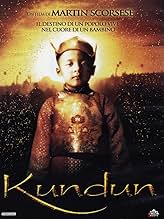
From childhood to adulthood, Tibet's fourteenth Dalai Lama deals with Chinese oppression and other problems.From childhood to adulthood, Tibet's fourteenth Dalai Lama deals with Chinese oppression and other problems.From childhood to adulthood, Tibet's fourteenth Dalai Lama deals with Chinese oppression and other problems.
- Director
- Writer
- Stars
- Nominated for 4 Oscars
- 7 wins & 13 nominations total
Losang Gyatso
- The Messenger
- (as Lobsang Gyatso)
Jigme Tsarong
- Taktra Rimpoche
- (as Tsewang Jigme Tsarong)
Namgay Dorjee
- Kashag
- (as Ngawang Dorjee)
- …
- Director
- Writer
- All cast & crew
- Production, box office & more at IMDbPro
7.031.7K
1
2
3
4
5
6
7
8
9
10
Featured reviews
unbearably spiritual movie
I live in South Korea, so I didn't think I would get some insights about buddhism from a Western movie. But this movie shocked me a lot. Very beautiful and meaningful visuals, quiet but spiritually forceful atmosphere every single moments are in the movie, I could hardly breath during playing. This movie is not just about one man, but about the pain of all mankind and the way to transcend the pain and sin of ours in a very buddhist direction. China in this movie got a bad part. Ironically they were also victims of imperialism but learned the exact way to extort, destroy the property and beliefs of others by the power of machines. It was just sad to watch. But as Kundun implied, those violence's are in the shadow of our minds which should be overcame by the power of spirit. For me, this movie tells that.
Beautiful and eye-opening...
Kundun was beautifully done, adding true portrayals of the practices of the Tibetan Buddhists - their chants, artwork, dances and costumes. Also, Philip Glass did a wonderful job with the soundtrack- combining the sound of damarus, ghantas, conch-shells and mantras with his own unique sound. Unlike Seven Years in Tibet, Kundun concentrates on the plight of Tibet through the life of the Dalai Lama. This perspective allows for the audience to realize the ideals and morals that define the people of Tibet, through the eyes and life experiences of their own chosen leader. Focusing on a character other than the Dalai Lama allows for too many distractions within the plot of the movie, especially when the script for Kundun was taken from a biography of His Holiness. This film employs most of the senses in order to allow the audience a fuller understanding of the Dalai Lama, his people, and their struggle against the Chinese. Kundun may be lengthy, but it is well worth the time.
Scorsese's most under-appreciated film?
I was rendered speechless by KUNDUN when I first saw it, and subsequent viewing have only confirmed my impression that this is one of Scorsese's finest films. Yeah - it's slow and elegant. So what.
I've long held an admittedly superficial interest in Buddhism, and also been a fan of Scorsese, liking most of his films quite a bit, so I went into this with some biases, but with every viewing this seems like a richer film. I also think that Scorsese was in some ways far more at home with this material than he was given credit for being. The cinematography and performances are excellent - the cast of mostly non-actors is surprisingly good, and much of KUNDUN is staggeringly beautiful to watch.
It has also struck me that this film isn't as much of a departure for Scorsese as it first may seem - this film works well as something of a companion to LAST TEMPTATION OF Christ in that both pictures examine great faiths through spiritual figures in a way that personalizes the divine. This simply literalizes undercurrents running through a number of Scorsese's other films, which often turn on themes of loyalty, conviction and ethics (like the self-assurance, against massive obstacles, shown by Alice Hyatt in ALICE DOESN'T LIVE HERE ANYMORE). All evidence a worldview where some form of redemption or transcendance is possible. In their own ways, several memorable Scorsese characters - Sam Rothstein (CASINO), Henry Hill (GOODFELLAS), Rupert Pupkin (KING OF COMEDY), Paul Hackett (AFTER HOURS) and Alice Hyatt attempt this, some in ways that are desperate, comically misguided or just plain wrong, but they're all human, driven by some redemptive impulse nonetheless.
The Catholicism of Scorsese's youth places great value on the importance of ritual, which is also true of Buddhism, which is depicted in a detailed and respectful fashion here, and the rhythm of KUNDUN - where the chronology of events isn't (or at least doesn't seem) forced, but are instead allowed to unfold in a more naturalistic and lifelike fashion also seems to mirror Buddhist ideas admirably.
This is a far more complex film than it first might appear to be - far from being a simple biopic, KUNDUN is much much more. Definitely one of Martin Scorsese's least appreciated films.
I've long held an admittedly superficial interest in Buddhism, and also been a fan of Scorsese, liking most of his films quite a bit, so I went into this with some biases, but with every viewing this seems like a richer film. I also think that Scorsese was in some ways far more at home with this material than he was given credit for being. The cinematography and performances are excellent - the cast of mostly non-actors is surprisingly good, and much of KUNDUN is staggeringly beautiful to watch.
It has also struck me that this film isn't as much of a departure for Scorsese as it first may seem - this film works well as something of a companion to LAST TEMPTATION OF Christ in that both pictures examine great faiths through spiritual figures in a way that personalizes the divine. This simply literalizes undercurrents running through a number of Scorsese's other films, which often turn on themes of loyalty, conviction and ethics (like the self-assurance, against massive obstacles, shown by Alice Hyatt in ALICE DOESN'T LIVE HERE ANYMORE). All evidence a worldview where some form of redemption or transcendance is possible. In their own ways, several memorable Scorsese characters - Sam Rothstein (CASINO), Henry Hill (GOODFELLAS), Rupert Pupkin (KING OF COMEDY), Paul Hackett (AFTER HOURS) and Alice Hyatt attempt this, some in ways that are desperate, comically misguided or just plain wrong, but they're all human, driven by some redemptive impulse nonetheless.
The Catholicism of Scorsese's youth places great value on the importance of ritual, which is also true of Buddhism, which is depicted in a detailed and respectful fashion here, and the rhythm of KUNDUN - where the chronology of events isn't (or at least doesn't seem) forced, but are instead allowed to unfold in a more naturalistic and lifelike fashion also seems to mirror Buddhist ideas admirably.
This is a far more complex film than it first might appear to be - far from being a simple biopic, KUNDUN is much much more. Definitely one of Martin Scorsese's least appreciated films.
10joelally
incredibly beautiful movie
I rented Kundun to further my quest to see all the Scorsese movies I can. I never expected such an incredible movie. I didn't want this movie to end. It's really difficult to describe how I feel about this movie since I have only viewed it once and was completely blown away, it left me in complete awe.
Like most when I first started watching Scorsese I thought that he did brilliant gangster films and that was his thing, but I have recently discovered that this couldn't be further from the truth. Fist seeing The Last Temptation of Christ and now Kundun I wouldn't care if Scorsese ever made another gangster film. It is easy to see that he is an artistic genius, the acting in the film was great, but I could have watched it on mute and still have been amazed.
If, like I was, you are unfamiliar with the Buddhist religion and the Chinese takeover of Tibet this film has even more to offer. Scorsese's risk of using real Buddhists to do all of the acting payed off better than I ever expected it would, the fact that we are hearing the story through the people it affected adds another level to this movie.
I cannot believe that this film only has a rating of 7 on this site. If you are a fan of Scorsese and are not sure you are going to like this just give it a chance, it deserves at least one viewing, if you give it that I am sure you will be amazed as I was. Scorsese's vision's in this movie are unlike any of his films, not to mention a great score by Phillip Glass.
Like most when I first started watching Scorsese I thought that he did brilliant gangster films and that was his thing, but I have recently discovered that this couldn't be further from the truth. Fist seeing The Last Temptation of Christ and now Kundun I wouldn't care if Scorsese ever made another gangster film. It is easy to see that he is an artistic genius, the acting in the film was great, but I could have watched it on mute and still have been amazed.
If, like I was, you are unfamiliar with the Buddhist religion and the Chinese takeover of Tibet this film has even more to offer. Scorsese's risk of using real Buddhists to do all of the acting payed off better than I ever expected it would, the fact that we are hearing the story through the people it affected adds another level to this movie.
I cannot believe that this film only has a rating of 7 on this site. If you are a fan of Scorsese and are not sure you are going to like this just give it a chance, it deserves at least one viewing, if you give it that I am sure you will be amazed as I was. Scorsese's vision's in this movie are unlike any of his films, not to mention a great score by Phillip Glass.
Emotional Transportation
Though I see a lot of films (usually 100+ in theaters per year), I can't say that I'm much of a student of films. I go to be entertained and/or moved. And Kundun moved me in a way I don't think has ever happened before.
I saw the film in the multiplex in Phipps Plaza, probably Atlanta's most upscale shopping mall. At the end of the film, when I walked out the theater exit into the mall, I was emotionally stunned. Scorsese had hypnotized me into the world of Bhuddist simplicity and wonder. Seeing the activity and commercialism (which I normally love) of the mall was a shock.
Peter Weir once said: "The true test of it is when you come out of a picture and you can't remember whether it was day or night when you came in." I think that barely remembering what country I was in shows that for me, this film passes that "true test".
I saw the film in the multiplex in Phipps Plaza, probably Atlanta's most upscale shopping mall. At the end of the film, when I walked out the theater exit into the mall, I was emotionally stunned. Scorsese had hypnotized me into the world of Bhuddist simplicity and wonder. Seeing the activity and commercialism (which I normally love) of the mall was a shock.
Peter Weir once said: "The true test of it is when you come out of a picture and you can't remember whether it was day or night when you came in." I think that barely remembering what country I was in shows that for me, this film passes that "true test".
What Scorsese Film Ranks Highest on IMDb?
Cinema legend Martin Scorsese has directed some of the most acclaimed films of all time. See how IMDb users rank all of his feature films as director.
Did you know
- TriviaThe Dalai Lama and his family were portrayed by his real-life relatives, now living in exile. Tenzin Thuthob Tsarong, who played the adult Dalai Lama, is his grand nephew.
- GoofsFor narrative purposes, the timeline is compressed; the Chinese invaded in 1950, the Dalai Lama visited Chairman Mao in Beijing in 1954, and he fled Tibet in 1959.
- Quotes
Indian: Are you the Lord Buddha?
Dalai Lama: I believe I am a reflection, like the moon on water. When you see me, and I try to be a good man, you see yourself.
- Crazy creditsThe Touchstone Pictures logo shown after the end credits is red.
- How long is Kundun?Powered by Alexa
Details
Box office
- Budget
- $28,000,000 (estimated)
- Gross US & Canada
- $5,684,789
- Opening weekend US & Canada
- $72,095
- Dec 28, 1997
- Gross worldwide
- $5,684,960
- Runtime
- 2h 14m(134 min)
- Color
- Sound mix
- Aspect ratio
- 2.35 : 1
Contribute to this page
Suggest an edit or add missing content