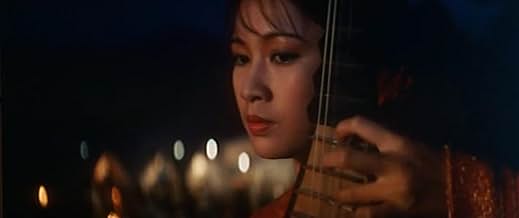
Qing official Lin Zexu burns the opium of British traders in a bid to end the opium trade. Incensed by his actions, the British traders appeal to their government, leading to the First Opium... Read allQing official Lin Zexu burns the opium of British traders in a bid to end the opium trade. Incensed by his actions, the British traders appeal to their government, leading to the First Opium War and the eventual cessation of Hong Kong.Qing official Lin Zexu burns the opium of British traders in a bid to end the opium trade. Incensed by his actions, the British traders appeal to their government, leading to the First Opium War and the eventual cessation of Hong Kong.
- Awards
- 8 wins & 7 nominations total
Sihung Lung
- He Jingrong
- (as Xiong Lang)
6.5626
1
2
3
4
5
6
7
8
9
10
Featured reviews
Grandiose
Never heard of this until today! Grandiose, fabulous, perfect depiction of supremacist mentality of Western culture which is alive and well today in Europe no matter what political conviction. Most excellently filmed, grandiose scenes terrific actors, superbly conveyed emotions. China will get it's rightful place back in the world, the sufferings of their ancestors were not invane. Question that arises though is: if the 400 million chinese would have done nationwide uprising against the invaders, they surely would have carried the day. But the mentality wasn't in place yet like under communist China today where people gather as one knowing what they are sacrificing for. Definitely terrible turn of events for China, it should never have happened but we Westerners jyst cannot get rid of our supremacist psychopathy, it just won't go away.
nationalistic anti-western propaganda
Using thousands of extras, great vistas, panoramic view-scopes of harbors filled with ships, lavish costumes, the motion picture describes the Opium War events that led to the british occupation of what is now Honk Kong. Ironic how exactly those lavish emperors and lifestyles that were once the target from Communist China are now used by the same Communist China to instill nationalistic feelings. While the motion picture is a big budget endeavor, it is not artistic. Some of the text captions are too educative, as if the audience were in kindergarden (for example, a slow view of an opium smoking den was indeed capioned with bright while lettering "Opium Den" as if the audience couldn't figure that out). That is what I meant as not being artistic: stating too evidently what is already too obvious. Everything is spelled out. But to its credit, I really appreciated its authenticity in regards of languages spoken, where two languages were spoken. The english tongues were precise, including an american tongue. Couldn't verify wether the chinese characters in the movie spoke Mandarin or Cantonese, nor can I comment on wether at the time (1839) which one was spoken in the regions where the story takes place.
10zzmale
It would be extremely racist and foolish to label the film as...
...nationlistic anti-western propaganda.
This is a subject that BBC would not have guts to face, at least not in the near future. Before labeling this film as anti-western communist propaganda, one must first bravely face the ugly past of colonialism and the racism of today: Not only UK has yet to face acknowledge its crime in the colonial era openly and without any reservation, what taught and belived in UK, and as in many in the west, are still represented by obvious racism:
For example, many in the west still believe in the racist lie of Opium being used in China as medicine for thousands of years. The reality is that marijuana was used in China for thousand of years, not opium, which was introduced by British by force. Next time when you visit Washington, DC, make sure you visit the museum of DEA, where this part of the true history is honestly told. This is one area Brits has to learn from USA.
Another example of current day racism is that when describing the ugly past of colonial era, the British still calls the Opium War as Trade War, when everywhere else it is honestly called as Opium War, as it really was. This is the equivalent of a drug dealer forcing to sell drugs to people, and assaulted people when they refused, and then simply called the assault was a trade disagreement. Imagine what would happen if the drug dealer was white and the people were black in the current world, and the public reaction.
Enough said about British side, now about the Chinese side: unlike the previous nationalistic propaganda, which glorified the victimization by demonizing west, this film factually told the cause of the war in a sympathetic way, and for the first time, correctly criticized the corrupted Imperial Chinese political system and its corrupted officials, which lead to the backwardness of China.
The example would be the lavish living style of emperor and his court officials in comparison to the impoverished life style of ordinary Chinese citizens, which is the reflection of corrupted feudalistic system being defeated by much more advanced modern industrial capitalism. One must see the typical nationalistic propaganda made decades earlier and compare to this movie in order to appreciate the giant steps made here, which may not be something big for west, but it is something considerable for workers in the movie industry in a totalitarian regime.
This is a subject that BBC would not have guts to face, at least not in the near future. Before labeling this film as anti-western communist propaganda, one must first bravely face the ugly past of colonialism and the racism of today: Not only UK has yet to face acknowledge its crime in the colonial era openly and without any reservation, what taught and belived in UK, and as in many in the west, are still represented by obvious racism:
For example, many in the west still believe in the racist lie of Opium being used in China as medicine for thousands of years. The reality is that marijuana was used in China for thousand of years, not opium, which was introduced by British by force. Next time when you visit Washington, DC, make sure you visit the museum of DEA, where this part of the true history is honestly told. This is one area Brits has to learn from USA.
Another example of current day racism is that when describing the ugly past of colonial era, the British still calls the Opium War as Trade War, when everywhere else it is honestly called as Opium War, as it really was. This is the equivalent of a drug dealer forcing to sell drugs to people, and assaulted people when they refused, and then simply called the assault was a trade disagreement. Imagine what would happen if the drug dealer was white and the people were black in the current world, and the public reaction.
Enough said about British side, now about the Chinese side: unlike the previous nationalistic propaganda, which glorified the victimization by demonizing west, this film factually told the cause of the war in a sympathetic way, and for the first time, correctly criticized the corrupted Imperial Chinese political system and its corrupted officials, which lead to the backwardness of China.
The example would be the lavish living style of emperor and his court officials in comparison to the impoverished life style of ordinary Chinese citizens, which is the reflection of corrupted feudalistic system being defeated by much more advanced modern industrial capitalism. One must see the typical nationalistic propaganda made decades earlier and compare to this movie in order to appreciate the giant steps made here, which may not be something big for west, but it is something considerable for workers in the movie industry in a totalitarian regime.
Surprisingly good with impressive acting
I stumbled upon this film by accident and decided to give it a go as I was interested in learning the history. Knowing it was a Chinese film sponsored by the government I was surprised to see that it had a lot of prominent British actors (at the time) playing the British characters. This is unusual for a Chinese film as they usually would employ Russians or Polish as cheaper fill ins. It's clear that the British actors and the British assistant director had a degree of artistic flexibility with the script, as the way the characters talk and the mannerisms are quite clearly written by an English native speaker. There are scenes in London with the queen, in parliament as the prospect of war is debated and voted on. I wanted to see more from the British side. Particularly the Opium dealer played by Bob Peck, his story arc finishes halfway. It left me wanting more to be honest. There is a big battle at the end, which is a little underwhelming by today's standards. Some modern CGI and grander battles would make this an amazing film. The Chinese parts are the main focus of the film of course, a lot of politics and dilemmas faced by the officials. I watched it in Chinese without subtitles, so it was hard to follow everything they were saying but I think there is a version online with English subtitles. Would be great to see a remake of this! Or even a TV show that explores the war in greater detail.
A fairly accurate depiction of the origins of the Opium War
The Opium War is an historical event that heralded the beginning of the end for the Qing Dynasty and the Chinese Empire as a whole. However, despite its name, the roots of Opium War do not only lie in the drug or its addiction. Opium, corruption, mismanagement, and a gross underestimate of the West's projection power are only some of the many complex reasons that led to the First Opium War.
In Yapian Zhanzheng (Opium War), historical events are depicted in a fairly accurate manner, concentrating on the main facts and events. Different aspects of the situation are presented: the Emperor's dilemmas, British/Western interests, Commissioner Lin's character, the opium merchant, the corrupt officials, etc... The film however lacks depth and emotion. The viewer is kept on the outside, and cannot identify with any character, bar young He who is forced into the story so as to add a human dimension to the story.
From a historical perspective, the film also tends to simplify certain aspects of the situation. One would think that there only were half a dozen merchants in Canton, and that the whole war was caused by Captain Elliott. The power of merchants and their trade is briefly mentioned, but only incidentally, as are power politics at the Imperial Court and at Parliament, internal turmoil, national and international political strategy, and many other factors that led to the War.
Overall, viewing of this film is recommended to gain a overview of major events; certain scenes are also quite spectacular. But do not watch for an in-depth historical analysis or representation of the Opium War.
In Yapian Zhanzheng (Opium War), historical events are depicted in a fairly accurate manner, concentrating on the main facts and events. Different aspects of the situation are presented: the Emperor's dilemmas, British/Western interests, Commissioner Lin's character, the opium merchant, the corrupt officials, etc... The film however lacks depth and emotion. The viewer is kept on the outside, and cannot identify with any character, bar young He who is forced into the story so as to add a human dimension to the story.
From a historical perspective, the film also tends to simplify certain aspects of the situation. One would think that there only were half a dozen merchants in Canton, and that the whole war was caused by Captain Elliott. The power of merchants and their trade is briefly mentioned, but only incidentally, as are power politics at the Imperial Court and at Parliament, internal turmoil, national and international political strategy, and many other factors that led to the War.
Overall, viewing of this film is recommended to gain a overview of major events; certain scenes are also quite spectacular. But do not watch for an in-depth historical analysis or representation of the Opium War.
Did you know
- TriviaThe movie was released at the same year Hong Kong was restored to China by the United Kingdom. The annexation of Hong Kong to the British Empire was one of the main consequences of the war depicted in the film.
- How long is The Opium War?Powered by Alexa
Details
Box office
- Budget
- $15,000,000 (estimated)
Contribute to this page
Suggest an edit or add missing content