IMDb RATING
7.2/10
1.3K
YOUR RATING

A love triangle develops between a benevolent student, his innocent girlfriend, and a cruel petty criminal, all as a point of diagnosis of a social disease that had Japan slowly succumbing t... Read allA love triangle develops between a benevolent student, his innocent girlfriend, and a cruel petty criminal, all as a point of diagnosis of a social disease that had Japan slowly succumbing to lawlessness during the post-War era.A love triangle develops between a benevolent student, his innocent girlfriend, and a cruel petty criminal, all as a point of diagnosis of a social disease that had Japan slowly succumbing to lawlessness during the post-War era.
- Director
- Writers
- Stars




- Director
- Writers
- All cast & crew
- Production, box office & more at IMDbPro
7.21.3K
1
2
3
4
5
6
7
8
9
10
Featured reviews
I Prefer My Rivers Black
No one is innocent in the post-war Japan depicted in Masaki Kobayashi's Black River. The film focuses on a love triangle: the straight-laced bookseller Nishida and Yakuza gangbanger Joe compete for the affections of the bourgeois local girl Shizuko. The American military base looms large in the film but the action takes place outside of it, mostly in a nearby shantytown. Although he regards the American presence as pernicious, Kobayashi is clear as to where responsibility rests for immoral behaviour and deficiencies in character, namely, the individual and society as a whole.
Kobayashi challenges preconceived notions as to whether people of a certain class are virtuous or vicious. Appearances may reinforce the moral decay of a character, such as the rotten teeth of the unscrupulous landlord, or conceal it in the case of the beautiful and virginal Shizuko. In a disturbing scene, not one tenant is willing to donate blood to a man who is critically ill--not even his own wife. Nishida at least deigns to admit that, in spite of having the correct blood type, he does not want to donate his blood. He may feel that the man, apparently less educated and of a lower class than him, is unworthy of his blood. However, his refusal is as callous and cowardly as that of the other tenants, exposing his apparent nobility as a mere façade.
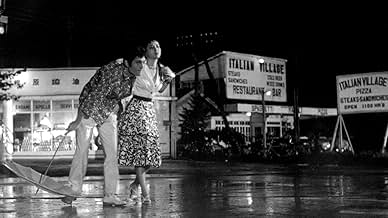
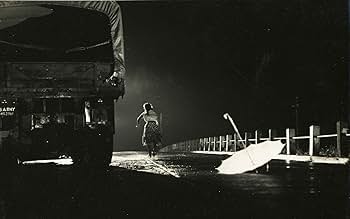
Black River exhibits the characteristic influence of film noir whose origin is American popular culture. Just as the presence of the American military corrupts Japanese society in the film, American culture has, as it were, corrupted Black River. Kobayashi paints in black and white a quasi-dystopian picture of a society that, having abandoned its principles, has descended into paranoia and mutual sabotage. The stylized and disinterested depictions of characters betray a moral ambivalence to their actions. Sultry jazz music, a distinctly American genre, provides the score of the film. Like the cinematography, its expression suggests that sordid deeds, places, and people are at hand.
In general, Kobayashi juggles the large cast of characters skillfully. However, their number can distract from the film's main plot about the love triangle, leading to a loss of focus and making it difficult to identify with any one character. Humour often shines through the dark subject matter, notably in a quarrel about emptying outhouses and the use of communal space. Like most film noir, Black River occasionally wavers into campiness and mannerism.
Kobayashi crafts a powerful ending to commit the metaphorical assassination of Shizuko's character. Once again, the Americans act as an accomplice but crucially not as the malefactor, the person ultimately responsible. Perhaps for the first time in the film, a character reflects on her own behaviour and is profoundly disgusted. Contemporary viewers will likely, as I did, have more sympathy for some characters and forgive them in light of the ordeals they have experienced or the circumstances in which they live. Nonetheless, Kobayashi makes a powerful argument, not to mention an excellent film that will appeal to fans of post-war cinema, film noir, and Japanese culture.
Kobayashi challenges preconceived notions as to whether people of a certain class are virtuous or vicious. Appearances may reinforce the moral decay of a character, such as the rotten teeth of the unscrupulous landlord, or conceal it in the case of the beautiful and virginal Shizuko. In a disturbing scene, not one tenant is willing to donate blood to a man who is critically ill--not even his own wife. Nishida at least deigns to admit that, in spite of having the correct blood type, he does not want to donate his blood. He may feel that the man, apparently less educated and of a lower class than him, is unworthy of his blood. However, his refusal is as callous and cowardly as that of the other tenants, exposing his apparent nobility as a mere façade.
Black River exhibits the characteristic influence of film noir whose origin is American popular culture. Just as the presence of the American military corrupts Japanese society in the film, American culture has, as it were, corrupted Black River. Kobayashi paints in black and white a quasi-dystopian picture of a society that, having abandoned its principles, has descended into paranoia and mutual sabotage. The stylized and disinterested depictions of characters betray a moral ambivalence to their actions. Sultry jazz music, a distinctly American genre, provides the score of the film. Like the cinematography, its expression suggests that sordid deeds, places, and people are at hand.
In general, Kobayashi juggles the large cast of characters skillfully. However, their number can distract from the film's main plot about the love triangle, leading to a loss of focus and making it difficult to identify with any one character. Humour often shines through the dark subject matter, notably in a quarrel about emptying outhouses and the use of communal space. Like most film noir, Black River occasionally wavers into campiness and mannerism.
Kobayashi crafts a powerful ending to commit the metaphorical assassination of Shizuko's character. Once again, the Americans act as an accomplice but crucially not as the malefactor, the person ultimately responsible. Perhaps for the first time in the film, a character reflects on her own behaviour and is profoundly disgusted. Contemporary viewers will likely, as I did, have more sympathy for some characters and forgive them in light of the ordeals they have experienced or the circumstances in which they live. Nonetheless, Kobayashi makes a powerful argument, not to mention an excellent film that will appeal to fans of post-war cinema, film noir, and Japanese culture.
Film noirish look at post war Japanese squalor
The story is set around an American Air Force base which has attracted bars and brothels and the native Japanese who need this sordid world to scape by and make money to just barely survive. A love triangle develops among the dwellers of a falling down apartment building and a local gangster called Killer Joe.
It's a fascinating slice of life with engaging vivid seedy characters, these type of shanty towns always develop around military bases, I can't think of any other films I've seen that take place there. It's a rare look into the postwar lower middle class and lower end criminal element in Japan. Fast moving and convincing well worth watching if you can find it. Memorable ending and last image to a memorable film.
It's a fascinating slice of life with engaging vivid seedy characters, these type of shanty towns always develop around military bases, I can't think of any other films I've seen that take place there. It's a rare look into the postwar lower middle class and lower end criminal element in Japan. Fast moving and convincing well worth watching if you can find it. Memorable ending and last image to a memorable film.
Disturbing in many ways, but gets better as it goes along
I hated the first half of this film so much that I thought it would almost certainly get a scathing review and one of the lowest possible review scores from me. It's unpleasant to say the least, and problematic in several ways, the biggest of which is its treatment of women. You see, amidst the squalor of a slum near a U. S. Army base, a young woman is raped by a sleazeball posing as her rescuer, and she wants to marry him instead of going to the police. Obviously a big part of that relates to the culture and time period, and the (disgusting) reality that as a "ruined" woman she may not be able to get another man to marry her. However, it builds on this. In a second encounter, he slaps her around, and she embraces him tenderly anyway. We soon see her placated, demurely eating a watermelon, and aside from fear over the man's cruelty to another woman, we don't really see signs of her trauma. When she says "I saw it as fate and resigned myself to forgiving Joe. It seemed like one way to find a mate," it's beyond nauseating.
Meanwhile, Kobayashi gives us the various doings of Les Misérables in the slum, the subplots of which are unpleasant to watch and don't develop into anything much. In one scene, they argue with a woman about their excrement being used to help fertilize a garden. In another, they refuse to give blood to help a man who desperately needs a transfusion. In yet another, a woman tries to seduce the virtuous young man, but her husband catches her and physically assaults her. Later, when she turns to prostitution, he threatens to tie her up and beat her. All is selfishness, and there is no honor to be found anywhere.
The undercurrent to all of this moral decay is that it's due to the American occupiers, something signaled without nuance or reference to the Japanese militarism that brought on the war. We see the base and English signs for bars and brothels prominently in the background. When the lone virtuous man in the film asserts in indignation that "Japan is an independent nation," he's hit with the reality that the denizens of the slum have to pay for the utilities of the American base. We also see what is almost certainly the racist use of African American servicemen to heighten the sense of depravity.
Despite these issues, the film turned itself around in its second half. While the film is never full free of misogyny, the woman's motivations become a little clearer, and when the story begins focusing on the love triangle coming to a head, it's at its strongest. One guy (Fumio Watanabe) is a student, the other (wonderfully sinister Tatsuya Nakadai) is a violent game leader, and in their struggle for the woman (Ineko Arima), there is a fight for the soul of Japan, an old trope. The woman taking control of her own destiny and how the conflict was resolved was satisfying and cathartic.
The story about the slum being sold so that it can be demolished and turned into a "love hotel" doesn't end quite as strongly or as happily, but perhaps in that it balanced out the main story line. The residents must all agree to leave before it can be sold, and we see some of them bribed, and others who have their signature stamps forged. A "communist" tries to get them to stand together but fails, lamenting "Workers minds never seem to advance. This is hopeless. The military and the authorities always exert control over the workers." There is a sense of capitalist greed and corruption triumphing because the common man is uneducated and disorganized, a dark truism.
It's a tough one to rate because of how unpleasant the first half was, but in the end, I found that I was glad I had seen it for the little window it provided. The cinematography and cool jazz soundtrack helped as well. Not one I'd recommend necessarily though.
Meanwhile, Kobayashi gives us the various doings of Les Misérables in the slum, the subplots of which are unpleasant to watch and don't develop into anything much. In one scene, they argue with a woman about their excrement being used to help fertilize a garden. In another, they refuse to give blood to help a man who desperately needs a transfusion. In yet another, a woman tries to seduce the virtuous young man, but her husband catches her and physically assaults her. Later, when she turns to prostitution, he threatens to tie her up and beat her. All is selfishness, and there is no honor to be found anywhere.
The undercurrent to all of this moral decay is that it's due to the American occupiers, something signaled without nuance or reference to the Japanese militarism that brought on the war. We see the base and English signs for bars and brothels prominently in the background. When the lone virtuous man in the film asserts in indignation that "Japan is an independent nation," he's hit with the reality that the denizens of the slum have to pay for the utilities of the American base. We also see what is almost certainly the racist use of African American servicemen to heighten the sense of depravity.
Despite these issues, the film turned itself around in its second half. While the film is never full free of misogyny, the woman's motivations become a little clearer, and when the story begins focusing on the love triangle coming to a head, it's at its strongest. One guy (Fumio Watanabe) is a student, the other (wonderfully sinister Tatsuya Nakadai) is a violent game leader, and in their struggle for the woman (Ineko Arima), there is a fight for the soul of Japan, an old trope. The woman taking control of her own destiny and how the conflict was resolved was satisfying and cathartic.
The story about the slum being sold so that it can be demolished and turned into a "love hotel" doesn't end quite as strongly or as happily, but perhaps in that it balanced out the main story line. The residents must all agree to leave before it can be sold, and we see some of them bribed, and others who have their signature stamps forged. A "communist" tries to get them to stand together but fails, lamenting "Workers minds never seem to advance. This is hopeless. The military and the authorities always exert control over the workers." There is a sense of capitalist greed and corruption triumphing because the common man is uneducated and disorganized, a dark truism.
It's a tough one to rate because of how unpleasant the first half was, but in the end, I found that I was glad I had seen it for the little window it provided. The cinematography and cool jazz soundtrack helped as well. Not one I'd recommend necessarily though.
Potent and electrifying, a tense and exciting classic that deserves far more recognition
Whether or not and to what specific degree it's true I don't know, but I recognize a definite kinship in this with films out of Hollywood, whether contemporaries of the 50s or snaking back into the 40s and late 30s. The story gives us a sleazy gangster ruling over a den of no-good hooligans, the innocent woman he abuses, the wicked landlady he conspires with who mistreats her tenants, and a well-meaning university student who enters the fray and finds himself sucked into the mire. There are unmistakable touches of film-noir here, and the crime flick, in a drama that by its plot alone we can easily envisage with famous American stars. Those echoes are firmly cemented with Kinoshita Chuji's flavorful music, placing emphasis on jazz and big band and readily invoking similar fare from across the Pacific. Of course, maybe this is part and parcel of the underlying intent; after all, 'Black River' takes place in Japan in the years following soon after World War II, when the United States occupied the land. With a military base operating right next door to all these goings-on, one may even deduce a narrative correlation between the presence of the Americans, the introduction of and insistence on Western values, and the corruption and iniquity we see infecting the town. Whatever connections we may make as viewers, though, the fact is that this is a fantastic movie, and it definitely continues to stand tall almost seventy years later.
Master filmmaker Kobayashi Masaki gives us a peek at a nation in flux, and it comes with a severity of tone that doesn't flinch away from the violence and sexuality like comparable Hollywood titles did under restrictive production codes. Where all the credit belongs between Kobayashi, author Tomishima Takeo, and screenwriter Matsuyama Zenzo I don't know, but the tale is raptly engaging and compelling as the tableau shows us the poor conditions of a country in transition, the ramshackle dwellings in which all variety of people lived, the rampant exploitation in which the seedy and dubious took advantage of those in no position to fend for themselves, and the struggles everyone had just to get by. From the outside looking in it doesn't sound like anything super special, but it takes no time at all after we press play" that we're fully absorbed in the saga. The characters are interesting and complicated, written with stark personalities, and the dialogue carries its own measure of spunk befitting the tenor of the picture. The scene writing is marvelously strong in fueling the storytelling - and everyone who helped to bring 'Black River' to life turned in consistently fantastic work.
The cast give vibrant performances commensurate with the charged pitch of the proceedings and the bent of their roles, and even those in smaller supporting parts like Awaji Keiko and Katsuragi Yoko have a moment to shine. Watanabe Fumio and Arima Ineko, starring as Nishida and Shizuko, have the most opportunity to demonstrate their skills given the intense, complex emotions of their characters; would that it were as reliably easy to find the credits of international players as those of domestic ones, for as the length draws on and events escalate they only impress more. Moreover, in that they quite match Nakadai Tatsuya, with the unyielding forcefulness and ferocity he bears in his portrayal of Joe. And as if the actors needed any help, Kobayashi's direction buzzes with a revitalizing energy that allows every detail, nuance, feeling, and thought in the feature pop off like sharp firecrackers of vigor. Accentuating the point: "party scenes" in the third act, reduced to a handful of actors, bristle with a fierce current of tension that is as potent as any scene of violence here, or any we'd get elsewhere, cementing a phenomenal finish for a film that grabbed us from the beginning as characters have changed over the course of the plot.
Outstanding production design and art direction lend substantial verisimilitude as they define the visual aesthetics with stupendous minutiae, making this fictional story all the more vivid and real; much the same goes for the attentive costume design, hair, and makeup. Smart editing and cinematography are boons nearly equal to Kobayashi's direction in facilitating the electricity herein while spotlighting every subtlety; sharp audio boosts every sound effect and line of dialogue, let alone Kinoshita's superb score as it reflects the sordid undercurrents and harsh atmosphere. Those stunts and effects that are employed are excellent; even the use of lighting is fetching at some times. The result of all this careful craftsmanship, rich writing, shrewd direction, and terrific acting is an engrossing, low-key brilliant drama that is far more, and more worthwhile, than it may seem at first blush. Even as I've loved anything I've seen to date from Kobayashi I admit I entered with mixed expectations, but when all is said and done I believe it stands shoulder to shoulder alongside his most celebrated pictures. Just as much to the point, I wouldn't hesitate to pit this against its Hollywood counterparts, and considering the space it plays in, that's a very high compliment indeed. Given the subject matter it may not appeal to all, yet I'd have no qualms in suggesting it to just about anyone. Whether you're a fan of someone involved, a connoisseur of the relevant genres, or just looking for something good watch, I'm thrilled with how tremendous 'Black River' is, and I'm happy to give it my very high, hearty, and enthusiastic recommendation!
Master filmmaker Kobayashi Masaki gives us a peek at a nation in flux, and it comes with a severity of tone that doesn't flinch away from the violence and sexuality like comparable Hollywood titles did under restrictive production codes. Where all the credit belongs between Kobayashi, author Tomishima Takeo, and screenwriter Matsuyama Zenzo I don't know, but the tale is raptly engaging and compelling as the tableau shows us the poor conditions of a country in transition, the ramshackle dwellings in which all variety of people lived, the rampant exploitation in which the seedy and dubious took advantage of those in no position to fend for themselves, and the struggles everyone had just to get by. From the outside looking in it doesn't sound like anything super special, but it takes no time at all after we press play" that we're fully absorbed in the saga. The characters are interesting and complicated, written with stark personalities, and the dialogue carries its own measure of spunk befitting the tenor of the picture. The scene writing is marvelously strong in fueling the storytelling - and everyone who helped to bring 'Black River' to life turned in consistently fantastic work.
The cast give vibrant performances commensurate with the charged pitch of the proceedings and the bent of their roles, and even those in smaller supporting parts like Awaji Keiko and Katsuragi Yoko have a moment to shine. Watanabe Fumio and Arima Ineko, starring as Nishida and Shizuko, have the most opportunity to demonstrate their skills given the intense, complex emotions of their characters; would that it were as reliably easy to find the credits of international players as those of domestic ones, for as the length draws on and events escalate they only impress more. Moreover, in that they quite match Nakadai Tatsuya, with the unyielding forcefulness and ferocity he bears in his portrayal of Joe. And as if the actors needed any help, Kobayashi's direction buzzes with a revitalizing energy that allows every detail, nuance, feeling, and thought in the feature pop off like sharp firecrackers of vigor. Accentuating the point: "party scenes" in the third act, reduced to a handful of actors, bristle with a fierce current of tension that is as potent as any scene of violence here, or any we'd get elsewhere, cementing a phenomenal finish for a film that grabbed us from the beginning as characters have changed over the course of the plot.
Outstanding production design and art direction lend substantial verisimilitude as they define the visual aesthetics with stupendous minutiae, making this fictional story all the more vivid and real; much the same goes for the attentive costume design, hair, and makeup. Smart editing and cinematography are boons nearly equal to Kobayashi's direction in facilitating the electricity herein while spotlighting every subtlety; sharp audio boosts every sound effect and line of dialogue, let alone Kinoshita's superb score as it reflects the sordid undercurrents and harsh atmosphere. Those stunts and effects that are employed are excellent; even the use of lighting is fetching at some times. The result of all this careful craftsmanship, rich writing, shrewd direction, and terrific acting is an engrossing, low-key brilliant drama that is far more, and more worthwhile, than it may seem at first blush. Even as I've loved anything I've seen to date from Kobayashi I admit I entered with mixed expectations, but when all is said and done I believe it stands shoulder to shoulder alongside his most celebrated pictures. Just as much to the point, I wouldn't hesitate to pit this against its Hollywood counterparts, and considering the space it plays in, that's a very high compliment indeed. Given the subject matter it may not appeal to all, yet I'd have no qualms in suggesting it to just about anyone. Whether you're a fan of someone involved, a connoisseur of the relevant genres, or just looking for something good watch, I'm thrilled with how tremendous 'Black River' is, and I'm happy to give it my very high, hearty, and enthusiastic recommendation!
Epitome of Noir
From that beautiful classic rumble like music they blare frequently, to the cast sporting unique bright clothing in high contrast to the dark or black backgrounds that often inhabit the screen, the look and feel of this film is true noir, fantastic cinematography, and a dark themed plot.
Complete with romance, gang violence, a slumbers handing out evictions, and a love triangle. . Id call the plot original. And enthralling, in plain terms.
I put this up against classics like M, Chinatown, the Crimson Kimono.
Complete with romance, gang violence, a slumbers handing out evictions, and a love triangle. . Id call the plot original. And enthralling, in plain terms.
I put this up against classics like M, Chinatown, the Crimson Kimono.


Did you know
- TriviaTatsuya Nakadai's first major role for director Kobayashi, starting a partnership that lasted over 15 years and 10 films.
- ConnectionsReferences Neptune's Daughter (1949)
- How long is Black River?Powered by Alexa
Details
- Runtime
- 1h 54m(114 min)
- Color
- Sound mix
- Aspect ratio
- 1.37 : 1
Contribute to this page
Suggest an edit or add missing content