IMDb RATING
5.8/10
2.9K
YOUR RATING


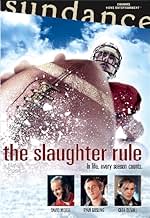
A young man finds solace with a young woman, his mother, and a high-school football coach who recruits him to quarterback a six-man team.A young man finds solace with a young woman, his mother, and a high-school football coach who recruits him to quarterback a six-man team.A young man finds solace with a young woman, his mother, and a high-school football coach who recruits him to quarterback a six-man team.
- Directors
- Writers
- Stars
- Awards
- 2 wins & 2 nominations total






John Henry Marshall
- Matt Kibbs
- (as John Henry Marshall III)
- Directors
- Writers
- All cast & crew
- Production, box office & more at IMDbPro
5.82.8K
1
2
3
4
5
6
7
8
9
10
Featured reviews
An interesting study of relationships
"The Slaughter Rule" is an interesting, moving study of male relationships, with the movie portraying how the limits of male bonding are tested through past and natural emotion. Ryan Gosling is deep and effective as a teenage jock who's life has seen it's rocky roads, and then he meets a quiet, mystifying older man who wants to recruit him for a six man football team. What Gosling doesn't know is about the Man's past, which turns out to test their growing relationship. It's an often slow but alluring tale, absorbing you in to the story of characters that are both familiar and alien, and ending up with an odd but truthful ending that pulls out all the raw, closeted emotions that the two men have for each other, and it's home-movie-style video shoot and beautiful country scenery brings it to life.
Football as Male Life in Cold Montana
I don't usually find movies first by their soundtrack, but I first heard of "The Slaughter Rule" because Jay Farrar, of the late Uncle Tupelo, did the score and song selections, including by Vic Chestnutt, the Flatlanders, and the Pernice Brothers. So I was intrigued when I saw it was on Sundance Channel as it hadn't appeared on screens in New York.
The debut jointly written/directed feature of twin brothers Andrew and Alex Smith, the film has a lot of similarity to Tom Cruise's early "All the Right Moves," even down to charismatic young star Ryan Gosling clearly being a movie star hunk of the future.
Set in the brothers' home area of rugged (and very desolate) Montana in the fall, this film takes its working class football frame of athlete seeking father figure and coach conflict much further in examining maleness and the implications of the homo-eroticism of such sports much further.
It bravely (particularly by David Morse in a touchingly agonized performance) goes into the breach of what much discussion of current scandals has avoided, at the confused nexus of pedophilia and sexual identity, particularly for teen-age boys.
There's also a dollop of racial issues via the very realistically portrayed poverty of the Native Americans.
The women are mostly helpless within this overwhelmingly male environment, and their best choice for survival is just to leave, as unromantically satisfying as that is.
This ranks in the gritty tradition of sports movies as a setting to demonstrate social tensions like "Loneliness of the Long Distance Runner" than more popular fare.
The debut jointly written/directed feature of twin brothers Andrew and Alex Smith, the film has a lot of similarity to Tom Cruise's early "All the Right Moves," even down to charismatic young star Ryan Gosling clearly being a movie star hunk of the future.
Set in the brothers' home area of rugged (and very desolate) Montana in the fall, this film takes its working class football frame of athlete seeking father figure and coach conflict much further in examining maleness and the implications of the homo-eroticism of such sports much further.
It bravely (particularly by David Morse in a touchingly agonized performance) goes into the breach of what much discussion of current scandals has avoided, at the confused nexus of pedophilia and sexual identity, particularly for teen-age boys.
There's also a dollop of racial issues via the very realistically portrayed poverty of the Native Americans.
The women are mostly helpless within this overwhelmingly male environment, and their best choice for survival is just to leave, as unromantically satisfying as that is.
This ranks in the gritty tradition of sports movies as a setting to demonstrate social tensions like "Loneliness of the Long Distance Runner" than more popular fare.
a few good elements but weak overall
Despite the novelty of its setting, 'The Slaughter Rule' is a fairly conventional coming-of-age tale about a boy who grows into manhood by becoming a member of a ragtag six-man football team. Roy is a teenager trapped in a small Montana town whose life has not been going any too well of late. His father, with whom he had only the most casual of relationships, has been discovered dead on a railroad track, a possible suicide victim. His mother, embittered by their divorce, sleeps around with countless men and has no real inclination to provide her son with any but the most cursory form of maternal affection. On top of all this, Roy has just been rejected for the school's varsity football team because the coach finds him lacking in the kind of 'anger' he feels a player needs to be a success on the gridiron. When Roy is asked by Gid, a somewhat eccentric older man in the town, to come join his six-man football team, the youth only reluctantly acquiesces (six-man football is a near rule-less poor relation to the real game, one ostensibly only played by farm boys). It is at this point that Roy's growth into manhood begins, since it turns out that the enigmatic Gid, who one assumes will be merely a father figure for the affection-starved youth, may be seeking more than just a father/son, athlete/coach relationship with the boy.
This latent-homosexual subtext, in fact, is just about the only element that separates 'The Slaughter Rule' from countless other films in this genre. Most everything else about the film feels derivative and stale: the emotionally distant parents, the promiscuous, psychologically detached mother, the abusive stepdad, the sweet girl who wants to flee this hicksville town as fast and as far as a bus ticket can take her. Towards the end, especially, the filmmakers start to pile up the heartbreaks and tragedies, one on top of the other, almost to epic proportions. One wonders how so much can happen in so short a time to so small a group of people. In the almost two hour running time of the film, only the ambiguity of the Roy/Gid relationship arouses any real interest in the viewer.
Ryan Gosling is tremendously appealing as the troubled Roy, and David Morse (the father in 'Contact') turns Gid into a nicely sympathetic figure. The starkness of the Montana landscape also provides an appropriate backdrop for the bleak melodrama that is playing itself out in the foreground. Apart from these few quality elements, however, there isn't a whole lot else to commend in 'The Slaughter Rule.'
This latent-homosexual subtext, in fact, is just about the only element that separates 'The Slaughter Rule' from countless other films in this genre. Most everything else about the film feels derivative and stale: the emotionally distant parents, the promiscuous, psychologically detached mother, the abusive stepdad, the sweet girl who wants to flee this hicksville town as fast and as far as a bus ticket can take her. Towards the end, especially, the filmmakers start to pile up the heartbreaks and tragedies, one on top of the other, almost to epic proportions. One wonders how so much can happen in so short a time to so small a group of people. In the almost two hour running time of the film, only the ambiguity of the Roy/Gid relationship arouses any real interest in the viewer.
Ryan Gosling is tremendously appealing as the troubled Roy, and David Morse (the father in 'Contact') turns Gid into a nicely sympathetic figure. The starkness of the Montana landscape also provides an appropriate backdrop for the bleak melodrama that is playing itself out in the foreground. Apart from these few quality elements, however, there isn't a whole lot else to commend in 'The Slaughter Rule.'
A Poignant display of loss, recovery, and redemption.
The Slaughter Rule is one of the few unique films that captivates the viewer straight from the opening sequence. The film opens with a haunting shot, as twin brothers Alex and Andrew Smith take there camera through a barb-wire fence to reveal a helpless dying deer, literally struggling for its every last breath of life. Enter Roy Chutney, a high school student who is cut from the varsity football team just three days prior to losing his estranged father. Much like the deer, Roy never gives up in his struggle to live his life in wake of tragedy, even after losing just about everything that held meaning in his young adulthood. Roy is eventually approached by the local paper distributor Gideon (played with remarkable passion and sustain by the brilliant David Morse). Gideon asks Roy to join his roughneck 6-man football team. Upon joining, Roy is taken under Gideon's wing and must eventually confront the small-town rumors that linger regarding Gideons sexuality, and turbulent past. The Slaughter Rule is unlike any high school football movie ever made. First of all, the film omits any of the standard hallway and classroom scenes that frequent every other film of the genre, It also discards the glorified high school football stadiums that almost give the impression they could be home to the next super bowl. Instead the scenes in this film are mainly set in country bars, private bedrooms, and cold icy fields, where the viewer can almost feel themselves being slammed into the frozen tundra alongside the players themselves. Where most football movies feature strong, good-looking, "prom king" type players, The Slaughter Rule uses gritty, "normal-looking" kids, that could easily be seen tossing the pigskin around in any small middle American town. Eric Edwards stunning cinematography, and alt/country musician Jay Farrar's folk influenced score, help make The Slaughter Rule one of the most promising directorial debuts in recent years, and was by far the best film I saw at the 2002 Lake Placid Film Festival. I strongly urge anyone who has ever experienced loss from death or rejection, to watch this film. For those of you who have not, pull that letterman jacket out of the closet and rent Varsity Blues.
Jesse Haven is a 19 year old film student from Burlington, Vermont Questions or comments?? Email me
Jesse Haven is a 19 year old film student from Burlington, Vermont Questions or comments?? Email me
Quirky, interesting
Needs to be subtitled sometimes, t'was either the accent or the poor sound system. Unfortunately I'm not into any kind of sport so that does not help but now know a little bit more about American football. A good first time effort.


Did you know
- TriviaScreenplay was developed in the Sundance Lab.
- GoofsThe microphone that the yodeling band gather round is a Sennheiser MD441, which has a tight, end-on pickup pattern. Singing into it sideways as they are, the would hardly have been picked up.
- Quotes
Roy Chutney: My father told me if I was hard enough, I wouldn't break. He lied. Everything breaks.
- ConnectionsFeatured in The 2003 IFP Independent Spirit Awards (2003)
- How long is The Slaughter Rule?Powered by Alexa
Details
Box office
- Budget
- $500,000 (estimated)
- Gross US & Canada
- $13,411
- Opening weekend US & Canada
- $1,461
- Jan 12, 2003
- Gross worldwide
- $13,411
- Runtime
- 1h 52m(112 min)
- Color
- Sound mix
- Aspect ratio
- 2.35 : 1
Contribute to this page
Suggest an edit or add missing content