IMDb RATING
7.3/10
5.2K
YOUR RATING


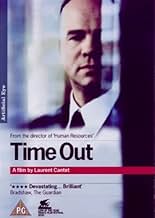
An unemployed man finds his life sinking more and more into trouble as he hides his situation from his family and friends.An unemployed man finds his life sinking more and more into trouble as he hides his situation from his family and friends.An unemployed man finds his life sinking more and more into trouble as he hides his situation from his family and friends.
- Director
- Writers
- Stars
- Awards
- 3 wins & 8 nominations total


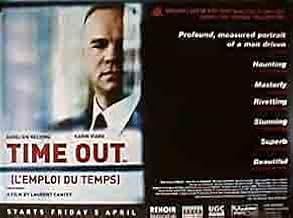
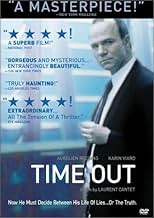





Didier Reyes
- Philippe
- (as Didier Perez)
- Director
- Writers
- All cast & crew
- Production, box office & more at IMDbPro
7.35.2K
1
2
3
4
5
6
7
8
9
10
Featured reviews
10jotix100
Killing time
"Time Out" seems to be the wrong translation for "L'emploi du temps". Laurent Cantet, the brilliant French director has given us a film that has a hypnotic quality and makes the viewer thinks. M. Cantet also wrote the material for the movie with Robin Campillo. This is, without a doubt, one of the most satisfying films coming from France in recent memory. As he proved with his "Human Resources", M. Cantet loves to present us stories in which characters are at the crossroads of their lives facing dilemmas related to things in the work environment.
If you haven't watched the film, perhaps you should like to stop reading now.
Vincent, the main character of "Time Out", is seen at the beginning of the film driving aimlessly through rural France, stopping at rest stops to sleep, buying things at roadside shops, or just idling around. When he calls his wife Muriel in his cell phone, we hear banal conversation between a married couple where the husband is calling home to check on his family. The only trouble is that Vincent is unemployed and he is reluctant to break the news to the family.
This man has a lovely wife, three normal children. His parents seem to have a good relationship with him. We see no sight of conflict. That is why so hard to understand what makes Vincent tick. Is it shame? Is it an ego thing? Is it his pride? Nothing seems to answer our questions because for all appearances, he is a normal person.
When Vincent hints about the possibility of a job in Geneva with the UN, his father, as well as the rest of the family believes him. Vincent witnesses a meeting in the UN building about the investment opportunities in Africa and how is that body going to be instrumental in helping the emerging economies. Suddenly, Vincent makes a plan to get some of his friends part with their savings by inventing a sure plan with incredible returns. In a way, it seems that people will be reluctant of schemes such as this one, but obviously, greed play a great deal in their minds and they give money to any charlatan. I know it first hand since I have a close friend that lost a lot of money this way, even though he understood about the risks involved.
Jean Michel, the mysterious man that happens to overhear Vincent pitching the idea to prospective investors, realizes the impossibility of the scheme. Vincent tells him about his plight and Jean Michel offers him a job helping him smuggle the counterfeit merchandise that makes a lot of money.
Unfortunately for liars, discovery is only a phone call away. Muriel finds out the truth and confronts Vincent about it. She tells her father in law, who has given an obscene amount of money to Vincent. When the father arrives at the house, Vincent flees into the night to the comforting highways that have become his best friends because they don't ask anything of him. Eventually, Vincent is seen calling Muriel from a roadside. She pleads with him to come home, but he refuses. The turmoil within his soul will not let him see the end of the tunnel. In his own mind, there is no solution for the problem he created.
The director hints to an easy solution for Vincent with an imminent suicide, but no. In the last sequence that ends the picture, we watch a Vincent dressed all in black being interviewed for a job that his father has been instrumental in securing for him. Are we seeing the truth, or are we seeing what the director has brilliantly done in order to get take us to a possibility that will register as the solution in our minds. The only thing is M. Cantet has left us clues about what really becomes of Vincent.
Aurelien Recoing, is a terrific actor. As times he reminds us of Kevin Spacey, and at times, he resembles a more ethereal James Gandolfini, but make no mistake, M. Recoing is an actor who captured the essence of the troubled Vincent. As Muriel, Karin Viard, is perfect. She gives a restrained performance. Also, Serge Livrozet, the kind Jean Michel, makes a wonderful appearance.
We await for the next work by the amazing Laurent Cantet.
If you haven't watched the film, perhaps you should like to stop reading now.
Vincent, the main character of "Time Out", is seen at the beginning of the film driving aimlessly through rural France, stopping at rest stops to sleep, buying things at roadside shops, or just idling around. When he calls his wife Muriel in his cell phone, we hear banal conversation between a married couple where the husband is calling home to check on his family. The only trouble is that Vincent is unemployed and he is reluctant to break the news to the family.
This man has a lovely wife, three normal children. His parents seem to have a good relationship with him. We see no sight of conflict. That is why so hard to understand what makes Vincent tick. Is it shame? Is it an ego thing? Is it his pride? Nothing seems to answer our questions because for all appearances, he is a normal person.
When Vincent hints about the possibility of a job in Geneva with the UN, his father, as well as the rest of the family believes him. Vincent witnesses a meeting in the UN building about the investment opportunities in Africa and how is that body going to be instrumental in helping the emerging economies. Suddenly, Vincent makes a plan to get some of his friends part with their savings by inventing a sure plan with incredible returns. In a way, it seems that people will be reluctant of schemes such as this one, but obviously, greed play a great deal in their minds and they give money to any charlatan. I know it first hand since I have a close friend that lost a lot of money this way, even though he understood about the risks involved.
Jean Michel, the mysterious man that happens to overhear Vincent pitching the idea to prospective investors, realizes the impossibility of the scheme. Vincent tells him about his plight and Jean Michel offers him a job helping him smuggle the counterfeit merchandise that makes a lot of money.
Unfortunately for liars, discovery is only a phone call away. Muriel finds out the truth and confronts Vincent about it. She tells her father in law, who has given an obscene amount of money to Vincent. When the father arrives at the house, Vincent flees into the night to the comforting highways that have become his best friends because they don't ask anything of him. Eventually, Vincent is seen calling Muriel from a roadside. She pleads with him to come home, but he refuses. The turmoil within his soul will not let him see the end of the tunnel. In his own mind, there is no solution for the problem he created.
The director hints to an easy solution for Vincent with an imminent suicide, but no. In the last sequence that ends the picture, we watch a Vincent dressed all in black being interviewed for a job that his father has been instrumental in securing for him. Are we seeing the truth, or are we seeing what the director has brilliantly done in order to get take us to a possibility that will register as the solution in our minds. The only thing is M. Cantet has left us clues about what really becomes of Vincent.
Aurelien Recoing, is a terrific actor. As times he reminds us of Kevin Spacey, and at times, he resembles a more ethereal James Gandolfini, but make no mistake, M. Recoing is an actor who captured the essence of the troubled Vincent. As Muriel, Karin Viard, is perfect. She gives a restrained performance. Also, Serge Livrozet, the kind Jean Michel, makes a wonderful appearance.
We await for the next work by the amazing Laurent Cantet.
But not a loss of time for the audience
This is a purely awesome film, the best of Laurent Cantet, the movie that reavealed him, and the best role ever from Aurélien Recoing. This is inspired from actual events,a nd this very same story was remade one year later with Daniel Auteuil: L'ADVERSAIRE. Both are terrific but not sjown in the same manner. The 2002 film from Nicole Garcia was more criminal oriented. Here, you are glued, stuck to this riveting tale. You always wonder what will happen in the next scene. An outstanding drama, involving normal folks to whom happens something really terrible. Top of the top. One of the best dramas ever. Serge Livrozet, this non professional actor, gives here a jaw dropping short but unique performance. The amazing story of a man more and more prisoner of his own lies.
Vinny Liar
People may lie for the thrill of being appreciated, or out of the fear of not being so; but while a fantasy world may initially seem liberating, it can become a prison as well. These themes are explored in 'Time Out', the story of Vincent, a man who loses his job and pretends he hasn't, rather than face up to the truth. There's a nice absence of didacticism in the way this film is assembled, a rich picture is assembled but without any attempt to ram a single interpretation down the audience's throat; it adds up to a fine portrait of depression, and a loneliness that oddly can exist only within a relationship. But there's also a creativeness in Vincent's behaviour which is necessary to generate the plot but which doesn't quite square with the rest of the movie: the film is more convincing once Vincent is deeply trapped in the web of his own lies, rather than when he is spinning it. At the heart of 'Time Out', Vincent remains an enigma unclarified: it is this that is both the film's strength and weakness. It's not a perfect film, and the start is quite dull, but the longer it lasts, the deeper it feels.
Highly nuanced psychological thriller
TIME OUT (Laurent Cantet - France 2001).
The English language title Time Out is not entirely fitting. Perhaps Time Running Out would be a more appropriate title, since this is exactly what Vincent, the main character, is going through.
Vincent (Aurélien Recoing) is a highly motivated financial consultant. Or, at least, that's what he used to be. Fact of the matter is, he lost his job three months ago and now concocts an elaborate facade to cover up the fact he is now unemployed. While his wife, Muriel (Karin Viard), thinks he's at work, Vincent is aimlessly roaming the highways, hanging out at rest stops, and sleeping in his car, regularly calling his wife to give her an update about his next meeting and apologizing for coming home late, before turning in for his overnight stay in his car. Vincent lives like a ghost, increasingly detached from his wife, children and former colleagues, he doesn't seem to realize the truth is closing in. One day, they will find out. But Vincent has gotten to a point where he's constructed his own dream world. He resorts to reading all kinds of economic pamphlets about his apparent line of business, studying and memorizing them like he really is active in this line of work. As Vincent needs money, he makes up a plan to defraud old friends and his parents out of their savings by letting them in on some bogus investment scheme. He conducts his business out of a hotel lounge, where he catches the eye of Jean-Michel (Serge Livrozet, a brilliant role), a "real" , experienced operator who immediately recognizes Vincent is a fraud. He offers Vincent a job in his own operation, meaning some extra pocket money and perhaps even a way out of his increasingly sticky situation.
Director Cantet's style is distinctly unflashy. Set against the wintry landscapes of Rhône-Alpes around Grenoble and Annecy, the film makes very good use of its locations. Whether it's the bland office complexes in the "zones commerciales" at the outskirts of anonymous towns, or the snow-clad mountains surrounding them, it seems to blend perfectly with the film's tone. Accompanied by a beautiful classical score, Cantet shows himself a remarkably sharp and observant storyteller. Although the film maintains interest throughout, the running time of 132 minutes did seem a tad long, and Vincent's lengthy economic arguments when conning his friends and relatives (some of them business men themselves) out of their money weren't terribly convincing. His arguments range from unconvincing to downright nonsense. At least he would'n have convinced me, but even my 91 year old grandmother wouldn't have bought any of this for a moment. But, some of these inconsistencies aside, this is a skilfully constructed film and an engrossing psychological drama that slowly unfolds like a thriller with a brilliant performance by Aurélien Recoing to top it off.
Camera Obscura --- 8/10
The English language title Time Out is not entirely fitting. Perhaps Time Running Out would be a more appropriate title, since this is exactly what Vincent, the main character, is going through.
Vincent (Aurélien Recoing) is a highly motivated financial consultant. Or, at least, that's what he used to be. Fact of the matter is, he lost his job three months ago and now concocts an elaborate facade to cover up the fact he is now unemployed. While his wife, Muriel (Karin Viard), thinks he's at work, Vincent is aimlessly roaming the highways, hanging out at rest stops, and sleeping in his car, regularly calling his wife to give her an update about his next meeting and apologizing for coming home late, before turning in for his overnight stay in his car. Vincent lives like a ghost, increasingly detached from his wife, children and former colleagues, he doesn't seem to realize the truth is closing in. One day, they will find out. But Vincent has gotten to a point where he's constructed his own dream world. He resorts to reading all kinds of economic pamphlets about his apparent line of business, studying and memorizing them like he really is active in this line of work. As Vincent needs money, he makes up a plan to defraud old friends and his parents out of their savings by letting them in on some bogus investment scheme. He conducts his business out of a hotel lounge, where he catches the eye of Jean-Michel (Serge Livrozet, a brilliant role), a "real" , experienced operator who immediately recognizes Vincent is a fraud. He offers Vincent a job in his own operation, meaning some extra pocket money and perhaps even a way out of his increasingly sticky situation.
Director Cantet's style is distinctly unflashy. Set against the wintry landscapes of Rhône-Alpes around Grenoble and Annecy, the film makes very good use of its locations. Whether it's the bland office complexes in the "zones commerciales" at the outskirts of anonymous towns, or the snow-clad mountains surrounding them, it seems to blend perfectly with the film's tone. Accompanied by a beautiful classical score, Cantet shows himself a remarkably sharp and observant storyteller. Although the film maintains interest throughout, the running time of 132 minutes did seem a tad long, and Vincent's lengthy economic arguments when conning his friends and relatives (some of them business men themselves) out of their money weren't terribly convincing. His arguments range from unconvincing to downright nonsense. At least he would'n have convinced me, but even my 91 year old grandmother wouldn't have bought any of this for a moment. But, some of these inconsistencies aside, this is a skilfully constructed film and an engrossing psychological drama that slowly unfolds like a thriller with a brilliant performance by Aurélien Recoing to top it off.
Camera Obscura --- 8/10
To be my own person, who sets the rules?
Shakespeare spoke of the tangled web of deceit suggesting it was a terrible trap. Laurent Cantet presents us with another view. His hero in this film, Vincent (played to perfection by Aurelien Recoing) appears to revel in the freedom his dissembling brings...at least for a time. A middle-aged, middle class man who has lost his job keeps this information from his family and sets out on a complex journey of survival, both existentially and financially, involving schemes that he eventually has ambivalent feelings about. We also see another side to this complex man...the loving husband, father and son. Are we to judge and dislike this man? Should we cast the first stone?
I was particularly impressed by the subtle way Cantet depicted Muriel, Vincent's wife (performed with sensitivity and grace by Karin Viard). Her suspicions and uncertainties are written only on her lovely face...very little is ever said. And yet she's not seen as the long-suffering little woman...not at all. She appears independent and strong.
And then there's the affecting scenes in the snow-filled mountains... in that place of isolation (so representative of...well...of us all). There's majestic beauty and danger.
The mystery, the thought=provoking qualities of this film have made it for me a haunting and moving experience...One that I'd certainly recommend!
I was particularly impressed by the subtle way Cantet depicted Muriel, Vincent's wife (performed with sensitivity and grace by Karin Viard). Her suspicions and uncertainties are written only on her lovely face...very little is ever said. And yet she's not seen as the long-suffering little woman...not at all. She appears independent and strong.
And then there's the affecting scenes in the snow-filled mountains... in that place of isolation (so representative of...well...of us all). There's majestic beauty and danger.
The mystery, the thought=provoking qualities of this film have made it for me a haunting and moving experience...One that I'd certainly recommend!


Did you know
- TriviaInspired by a true story, that of Jean-Claude Romand. In reality, Romand went on to kill, on January 9, 1993, his wife, two children and both his parents. It is the first of three films in two years inspired by the case, followed by The Adversary (2002) and La vida de nadie (2002), of which the former is the closest to the real events. Phantom (2002) was also inspired by the same incident.
- ConnectionsFeatured in The 2003 IFP Independent Spirit Awards (2003)
- SoundtracksL'Emploi Du Temps - Musique Originale
Composed by/ Arranged By Jocelyn Pook
Performed by 'Electra Strings' Ensemble
Cello Solo performed by Sophie Harris
Viola Solo performed by Clive Howard
Violin solo performed by Jacqueline Norrie
Phonographic Copyright (p) Jocelyn Pook / Haut et Court
Under Exclusive License To Virgin France
Published By Chester Music Ltd.
© 2001 Virgin France
- How long is Time Out?Powered by Alexa
Details
- Release date
- Country of origin
- Official sites
- Language
- Also known as
- El empleo del tiempo
- Filming locations
- Production companies
- See more company credits at IMDbPro
Box office
- Gross US & Canada
- $448,542
- Gross worldwide
- $1,213,913
- Runtime
- 2h 14m(134 min)
- Color
- Sound mix
- Aspect ratio
- 1.85 : 1
Contribute to this page
Suggest an edit or add missing content