

Senator Laine Hanson is a contender for U.S. Vice President, but information and disinformation about her past surfaces that threatens to derail her confirmation.Senator Laine Hanson is a contender for U.S. Vice President, but information and disinformation about her past surfaces that threatens to derail her confirmation.Senator Laine Hanson is a contender for U.S. Vice President, but information and disinformation about her past surfaces that threatens to derail her confirmation.
- Director
- Writer
- Stars
- Nominated for 2 Oscars
- 1 win & 22 nominations total


Angelica Page
- Dierdra
- (as Angelica Torn)

Joseph Lyle Taylor
- Paul Smith
- (as Joe Taylor)

- Director
- Writer
- All cast & crew
- Production, box office & more at IMDbPro
6.925.9K
1
2
3
4
5
6
7
8
9
10
Featured reviews
So many acting Pros, so few twists
Greetings again from the darkness. Director Rod Lurie is living my fantasy. After a career as a movie critic, he is now directing some of Hollywood's best (and under-utilized) actors and actresses. This little thriller is fun to watch thanks mostly to the skills of those on the screen. All of these actors should work more ... SHARE your talent. Jeff Bridges is a very pompous, yet charming, smooth talking president. I assume the list to play the president was short, thanks to a couple of script lines about Clinton. Joan Allen is excellent as the cool senator with the lurid past (?) who is nominated for the VP slot. Gary Oldman, who continues to reinvent the role of CREEP, steals every scene he is in. Of course, this happens in all of his movies! It is always nice to see Sam Elliott and William Petersen on screen. And I guess Christian Slater is trying to salvage a career after the disastrous "Very Bad Things". He has lost some smugness and tempered his Jack Nicholson dialect. My only disappointment with the movie was in the script. Although I love the subject matter and the issues raised, I kept waiting for the shoe to drop on Gary Oldman's charater's deep, dark secret. Jeff Bridges stifling his political career seem quite the letdown. Would have really enjoyed a few more plot twists to really test the audience and cast. My tidbit for this one comes from the career of Sam Elliott. Next time you are watching "Butch Cassidy and the Sundance Kid", check out a young Sam Elliott in the early card playing scene. Also, William Petersen's power-hungry wife in "The Contender" is played by Kristen Shaw, a carry-over from Rod Lurie's film, "Deterrence".
Riveting performances and a thought-provoking story. One of the best movies of the year. **** (out of four)
THE CONTENDER / (2000) **** (out of four)
After our recent presidential conflicts, Rod Lurie's political drama, "The Contender" is of the most timely and uncommonly absorbing movies this year, even though we may be sick and tired of politics. The film examines political figures and their stand of such controversial issues like abortion, infidelities, and even Clinton's impeachment trial, making this production feel real, as if a behind the scenes look at a sex scandal in Washington DC because it is so well written and portrayed. Interlaced with much thought-provoking material and Academy Award worthy performances, "The Contender" is one of the best pictures of the year.
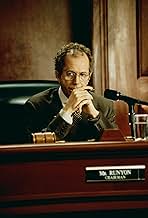
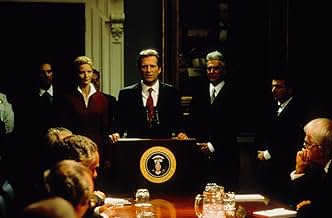
As the film opens, the country's vice president has recently died, leaving Democratic President Jackson Evans (Jeff Bridges), who is near the end of his final term, choosing a vice president for replacement. Although he recently bared his courage in a failed attempt to save a woman from drowning, Governor Jack Hathaway (William L. Peterson) is turned down by President Evens. Instead, Evens wants to leave a legacy by selecting a woman as vice president, thus chooses a Senator who currently shifted from the Republican party to the Democratic party, Laine Hanson (Joan Allen). The Republican confirmation committee chairman, Shelly Runyon (Gary Oldman), thinks Evans' choice to be self-dignified and inaccurate, and desires Hathaway to take the place of the vice president.
"The Contender" begins on a strong note, only displaying the necessary events. We do not witness the death of the original vice-president because it is not important. We do get to see the heroic action of Governor Hathaway, however, squarely because this event, concluding with a shocking twist, plays a vital role in the movie at a later time. Through brilliant directing and editing, the story provides an increasing amount of tension within the characters, especially the Joan Allen and Jeff Bridges characters.
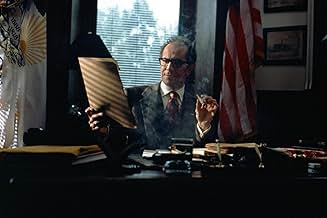
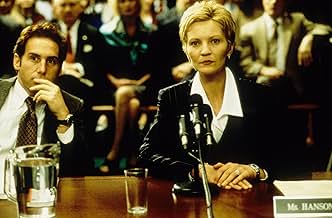
In a cruel attempt to prove the insecurities of the vice-presidential candidate, Runyon uncovers information that places Hanson's morality in question. The situation is whether or not she participated in public sex with two men (at the same time) while 19 years of age in college. The information is leaked to the press, while Runyon uses the discussion to bring the subject in the hearings. "What I say the American people will believe. And do you know why? Because I will have a very big microphone in front of me," states Runyon. The democrats are extremely weary over this case because 1) they know Runyon's statement is true and 2) Hanson refuses to acknowledge anything regarding her alleged sexual adventures. Even so, the president supports his candidate.
The movie succeeds with its accurate and involving performances. Joan Allen is Award material in a performance that is tense, taut, and engaging. Christian Slater is frantic and energetic as a novice reporter. Jeff Bridges is entirely convincing as the President of the United States. His prestige is convincing and he exhibits a powerful, detailed attitude, resulting in a superb performance. Gary Oldman is perfect with a sly, cunningly cocky and self-confident performance that fits his character extremely well; there is a very real possbility his work will be remembered come Academy Award time.
"The Contender" succeeds to a high degree because it makes us to examine our own beliefs and possible reactions to such a pragmatic issue; would we, as individuals, want a vice-president who is a sleaze ball, or as a character puts it "with a mouth full of c*ck." What makes the film even more extraordinarily enthralling is that it never until the end reveals whether Laine actually did participate in the immoral acts. This is a very thought-provoking story, full of surprising twists and a meaningful message.
After our recent presidential conflicts, Rod Lurie's political drama, "The Contender" is of the most timely and uncommonly absorbing movies this year, even though we may be sick and tired of politics. The film examines political figures and their stand of such controversial issues like abortion, infidelities, and even Clinton's impeachment trial, making this production feel real, as if a behind the scenes look at a sex scandal in Washington DC because it is so well written and portrayed. Interlaced with much thought-provoking material and Academy Award worthy performances, "The Contender" is one of the best pictures of the year.
As the film opens, the country's vice president has recently died, leaving Democratic President Jackson Evans (Jeff Bridges), who is near the end of his final term, choosing a vice president for replacement. Although he recently bared his courage in a failed attempt to save a woman from drowning, Governor Jack Hathaway (William L. Peterson) is turned down by President Evens. Instead, Evens wants to leave a legacy by selecting a woman as vice president, thus chooses a Senator who currently shifted from the Republican party to the Democratic party, Laine Hanson (Joan Allen). The Republican confirmation committee chairman, Shelly Runyon (Gary Oldman), thinks Evans' choice to be self-dignified and inaccurate, and desires Hathaway to take the place of the vice president.
"The Contender" begins on a strong note, only displaying the necessary events. We do not witness the death of the original vice-president because it is not important. We do get to see the heroic action of Governor Hathaway, however, squarely because this event, concluding with a shocking twist, plays a vital role in the movie at a later time. Through brilliant directing and editing, the story provides an increasing amount of tension within the characters, especially the Joan Allen and Jeff Bridges characters.
In a cruel attempt to prove the insecurities of the vice-presidential candidate, Runyon uncovers information that places Hanson's morality in question. The situation is whether or not she participated in public sex with two men (at the same time) while 19 years of age in college. The information is leaked to the press, while Runyon uses the discussion to bring the subject in the hearings. "What I say the American people will believe. And do you know why? Because I will have a very big microphone in front of me," states Runyon. The democrats are extremely weary over this case because 1) they know Runyon's statement is true and 2) Hanson refuses to acknowledge anything regarding her alleged sexual adventures. Even so, the president supports his candidate.
The movie succeeds with its accurate and involving performances. Joan Allen is Award material in a performance that is tense, taut, and engaging. Christian Slater is frantic and energetic as a novice reporter. Jeff Bridges is entirely convincing as the President of the United States. His prestige is convincing and he exhibits a powerful, detailed attitude, resulting in a superb performance. Gary Oldman is perfect with a sly, cunningly cocky and self-confident performance that fits his character extremely well; there is a very real possbility his work will be remembered come Academy Award time.
"The Contender" succeeds to a high degree because it makes us to examine our own beliefs and possible reactions to such a pragmatic issue; would we, as individuals, want a vice-president who is a sleaze ball, or as a character puts it "with a mouth full of c*ck." What makes the film even more extraordinarily enthralling is that it never until the end reveals whether Laine actually did participate in the immoral acts. This is a very thought-provoking story, full of surprising twists and a meaningful message.
crackling political drama
Writer/director Rod Lurie's `The Contender' marks a significant advance in both technique and storytelling ability for this fledgling filmmaker over his sole previous cinematic effort, `Deterrence.' This former L.A. film critic-turned-filmmaker has created a crackerjack political thriller attuned to the temper of its times. In this era in which one politician after another has fallen victim to the cutthroat `politics of personal destruction' as practiced in the media, in the committee hearing room and in the backrooms of campaign headquarters around the nation, `The Contender' emerges as a timely, astute and politically savvy drama.
Like most contemporary films that deal with political issues, `The Contender' demonstrates an obvious left leaning bias. As usual, it is the Democrats who are portrayed as the righteous speakers of truth and the Republicans who are shown as the scheming, unctuous and conniving dispensers of hatred and rumormongering. Jeff Bridges stars as President Jackson Evans, a well-meaning, seemingly moral man who, upon the sudden death of his vice president, nominates a woman, Senator Laine Hanson, to be his replacement. Gary Oldman plays the Republican chairman who will stop at nothing in his efforts to torpedo the nomination, even if that means exposing her rather torrid sexual past for all the world to see (although, in many ways, his obsession with ruining the chances of a candidate he feels to be less qualified in favor of one who is more beloved as a national figure makes little practical sense because wouldn't he, as a member of the rival party, be MORE inclined to support someone he thought would bring trouble to the present administration?)
If you can see past the partisan propaganda, you will find `The Contender' to be one of the most riveting films of the past several years. In many ways, it reminds one of those Biblical spectaculars that moviemakers like Cecil B. DeMille used to churn out in the 1950's, the ones that would allow us to wallow in the depiction of all sorts of `sinful' activities, yet when the divine judgments began to fall on the perpetrators, permit us to feel morally superior to it all at the same time. In a similar way, `The Contender,' may come out foursquare against the obsession we seem to have concerning the sex lives of our elected officials but it sure has a fun time devoting two solid hours to the topic. And its fun is ours.
One of the reasons that `The Contender' succeeds so well is because Laine Hanson, as portrayed by the brilliant Joan Allen, is an endlessly fascinating and enigmatic character. We never know quite what to make of her and it is this sense of moral imbalance that draws us in to her plight. Had she been made an innocent victim or a goody-two-shoes, she would quickly lose our interest. As the President, seemingly more concerned with ordering up spectacular dishes from the White House kitchen than with the pressing concerns of affairs of state, Jeff Bridges cuts just as believable and compelling a figure.
As with virtually all films of a political nature, the characters' actions are occasionally inexplicable within the context of practical politics. For example, President Evans rejects one of his top candidates for the VP position for ludicrous reasons. When Governor Jack Hathaway attempts but fails to rescue a woman from her vehicle that has crashed to the bottom of a river, Evans tells Hathaway that he believes the Republicans will try to bring up parallels to Chappaquiddick in an attempt to sink his nomination. Not only is that a patently absurd possibility, but Evans seems blithely unconcerned about the much worse drubbing he and his eventual nominee end up undergoing. Which leads us to the next implausibility Evans' sticking by Hanson far past the point where any real president would have asked for the candidate to withdraw her name. Oh well, `The Contender' may not always ring true in its plotting, but it definitely gets the job done as a piece of titillating pulp drama.
My only serious complaint with the film comes in its closing stretches. Perhaps it is too much, in these days of mandatory happy endings and feel-good emotionalism, to expect the type of clear-eyed cynical conclusions we were treated to in movies like `The Candidate' or `The Best Man,' but the upbeat, fairy tale resolution here is unworthy of all the good stuff that has gone before it. By climbing onto a soapbox and deigning to lecture to us all, Lurie cops out on both Hanson and the audience - striving for the type of phony inspirationalism that went out with `Mr. Smith Goes to Washington' way back in the 1930's. Such an obvious sop to the box office leaves us with a bit of a sour aftertaste after all is said and done. (Also, Lurie needs to shed himself of the gimmick he seems to have latched onto in both his films thus far that of the melodramatic `surprise' turnabout ending. It didn't work in `Deterrence' and it doesn't work here).
Yet, despite its sundry flaws, `The Contender' emerges as one of the most compelling and fast-moving two hours you are likely to see in a long time. You may feel like taking a shower when it's all over (maybe that explains the need Lurie may have had in providing a `moral bath' in the last 15 minutes or so), but you will at least have had a great time getting dirty.
Like most contemporary films that deal with political issues, `The Contender' demonstrates an obvious left leaning bias. As usual, it is the Democrats who are portrayed as the righteous speakers of truth and the Republicans who are shown as the scheming, unctuous and conniving dispensers of hatred and rumormongering. Jeff Bridges stars as President Jackson Evans, a well-meaning, seemingly moral man who, upon the sudden death of his vice president, nominates a woman, Senator Laine Hanson, to be his replacement. Gary Oldman plays the Republican chairman who will stop at nothing in his efforts to torpedo the nomination, even if that means exposing her rather torrid sexual past for all the world to see (although, in many ways, his obsession with ruining the chances of a candidate he feels to be less qualified in favor of one who is more beloved as a national figure makes little practical sense because wouldn't he, as a member of the rival party, be MORE inclined to support someone he thought would bring trouble to the present administration?)
If you can see past the partisan propaganda, you will find `The Contender' to be one of the most riveting films of the past several years. In many ways, it reminds one of those Biblical spectaculars that moviemakers like Cecil B. DeMille used to churn out in the 1950's, the ones that would allow us to wallow in the depiction of all sorts of `sinful' activities, yet when the divine judgments began to fall on the perpetrators, permit us to feel morally superior to it all at the same time. In a similar way, `The Contender,' may come out foursquare against the obsession we seem to have concerning the sex lives of our elected officials but it sure has a fun time devoting two solid hours to the topic. And its fun is ours.
One of the reasons that `The Contender' succeeds so well is because Laine Hanson, as portrayed by the brilliant Joan Allen, is an endlessly fascinating and enigmatic character. We never know quite what to make of her and it is this sense of moral imbalance that draws us in to her plight. Had she been made an innocent victim or a goody-two-shoes, she would quickly lose our interest. As the President, seemingly more concerned with ordering up spectacular dishes from the White House kitchen than with the pressing concerns of affairs of state, Jeff Bridges cuts just as believable and compelling a figure.
As with virtually all films of a political nature, the characters' actions are occasionally inexplicable within the context of practical politics. For example, President Evans rejects one of his top candidates for the VP position for ludicrous reasons. When Governor Jack Hathaway attempts but fails to rescue a woman from her vehicle that has crashed to the bottom of a river, Evans tells Hathaway that he believes the Republicans will try to bring up parallels to Chappaquiddick in an attempt to sink his nomination. Not only is that a patently absurd possibility, but Evans seems blithely unconcerned about the much worse drubbing he and his eventual nominee end up undergoing. Which leads us to the next implausibility Evans' sticking by Hanson far past the point where any real president would have asked for the candidate to withdraw her name. Oh well, `The Contender' may not always ring true in its plotting, but it definitely gets the job done as a piece of titillating pulp drama.
My only serious complaint with the film comes in its closing stretches. Perhaps it is too much, in these days of mandatory happy endings and feel-good emotionalism, to expect the type of clear-eyed cynical conclusions we were treated to in movies like `The Candidate' or `The Best Man,' but the upbeat, fairy tale resolution here is unworthy of all the good stuff that has gone before it. By climbing onto a soapbox and deigning to lecture to us all, Lurie cops out on both Hanson and the audience - striving for the type of phony inspirationalism that went out with `Mr. Smith Goes to Washington' way back in the 1930's. Such an obvious sop to the box office leaves us with a bit of a sour aftertaste after all is said and done. (Also, Lurie needs to shed himself of the gimmick he seems to have latched onto in both his films thus far that of the melodramatic `surprise' turnabout ending. It didn't work in `Deterrence' and it doesn't work here).
Yet, despite its sundry flaws, `The Contender' emerges as one of the most compelling and fast-moving two hours you are likely to see in a long time. You may feel like taking a shower when it's all over (maybe that explains the need Lurie may have had in providing a `moral bath' in the last 15 minutes or so), but you will at least have had a great time getting dirty.
Important, Dynamic Film
Unless you sleep through your days or live with your head buried in the sand, you know that, without a doubt, politics is a dirty business. But do we need to be reminded of that fact? The answer to that is, inarguably, yes; just as we must be reminded of the Holocaust lest we forget and allow history to repeat itself, we have to at least keep somewhat abreast of anything which so significantly affects our lives. And unfortunately (some would say), politics is one of those things, and whether we approach it actively or view it all with passive ambiguity, the fact remains that what happens in government affects us all in one way or another on a daily basis. `The Contender,' written and directed by Rod Lurie, is a serious and sensitive examination of the political machinations employed to effect power and control within a democracy. In Lurie's scenario, the position of Vice President of The United States has been open for three weeks and must be filled. President Jackson Evans (Jeff Bridges) makes his choice: Senator Laine Hanson (Joan Allen), who would be the first woman in history to hold the position. First, however, she must be confirmed. And at this point, the real story begins to unfold as the beast rears it's head: Enter partisanism, personal agendas, media manipulation and, somewhere near the bottom of the list, Truth. To illustrate this dirtiest of all businesses, Lurie references a specific episode from the not-too-distant past, and draws a number of parallels to more recent political events, all of which are used purposefully and effect the desired results. It becomes not so much a case of good against evil so much as simply a question of what is right and what is wrong, who draws the line and who decides when and where that line should be crossed. To his credit, Lurie objectively presents both sides of the story without delving so deep as to mire the proceedings down with any unnecessary baggage merely to introduce any subjective leanings or to manipulate the audience one way or another. It's like a political campaign; viewers are left to decide for themselves and cast their vote as they may. The theme of the story itself is not virgin territory, but the way it's handled and delivered, including some exceptionally strong performances (there should be some Oscar nominations here), makes it unique. Joan Allen adds another exemplary performance to her resume, further demonstrating her great prowess as an actress. She imbues Laine Hanson with a strength and character that makes her entirely believable and credible. And Gary Oldman (in what is an uncharacteristic role for him) is absolutely dynamic as the ultra-conservative Shelly Runyon, who proves to be a most formidable opponent to Hanson and Evans. Bridges also comports himself well, creating a strong, insightful character in President Evans, exhibiting the very private, human qualities behind the public figure. The excellent supporting cast includes Christian Slater (Reginald Webster), Sam Elliott (Kermit), William Petersen (Hathaway), Philip Baker Hall (Oscar), Mike Binder (Lewis), Robin Thomas (William Hanson) and Saul Rubinek (Jerry). Lurie allows only a single lapse into melodrama (patriotic music begins to swell about half-way through Hanson's final speech), but the closing speech by President Evans is impeccably delivered with force and strength, and his words are exhilarating; how satisfying it is to hear things said that must and should be said, if only in the movies. Using the political arena to address subjects that concern all of us morality, ethics, principles, truth and honesty `The Contender' is riveting drama that invokes the conscience of a nation by examining the moral fiber and motives of those who would aspire to greatness. It's gripping entertainment with a message about Truth, Decency and the necessity of bipartisanism in politics; it's a statement well made, and one that should be taken to heart by all. I rate this one 9/10.
Where Lewinsky meets Lebowski
This may not be the greatest White House movie thriller ever - as its makers claim - but it is probably the most politically explicit. Gone are the days of Advise and Consent, when the opposing parties were simply referred to as the "majority" and "minority", and the movie aimed at non-partisan neutrality . Here, the administration is Democrat, and the film proudly wears its liberal heart on its sleeve. And the movie is all the better for this clarity and honesty.
Jeff Bridges is well cast as Jackson Evans, a President every bit as charismatic and opportunistic as Bill Clinton. Indeed, the whole movie can be seen as a take on the Monica Lewinsky saga, highlighting the manipulation and hypocrisy displayed on all sides at that time. (One mistake in the script is a direct reference to the Clinton impeachment vote; it is dangerous for parodies or satires to refer to the true stories on which they are based - it leads to a dislocation in the audience's point of view, and in this case to the awkward question - if this is a post-Clinton Democrat President, and he's coming to the end of his second term, in just what year is the action supposed to be taking place?!)
Given the White House shenanigans in recent years, it is surprising that some IMDb commenters should question the plausibility of the plot, which I feel stretches our credulity no further than most Hollywood thrillers. Joan Allen as vice-Presidential nominee Laine Hanson, and Gary Oldman as Shelly Runyon, her would-be character assassin, have strong parts and make the most of them - though personally I think it is Bridges' movie - but there is perhaps a little too much of Christian Slater in a curious role as Reginald Webster, a young, liberal, but seemingly anti-feminist, Democrat Congressman. The director, Rod Lurie, seems unable to make up his mind whether Webster should be portrayed as an overly-naive idealist, or an ambitious cynic with his eye on the main chance.
Overall, this is a fast-moving, enjoyable film, making the points that petty personal indiscretions should have little influence when it comes to power politics, and that it's about time the USA had a woman as President or at least a heart beat away.
Jeff Bridges is well cast as Jackson Evans, a President every bit as charismatic and opportunistic as Bill Clinton. Indeed, the whole movie can be seen as a take on the Monica Lewinsky saga, highlighting the manipulation and hypocrisy displayed on all sides at that time. (One mistake in the script is a direct reference to the Clinton impeachment vote; it is dangerous for parodies or satires to refer to the true stories on which they are based - it leads to a dislocation in the audience's point of view, and in this case to the awkward question - if this is a post-Clinton Democrat President, and he's coming to the end of his second term, in just what year is the action supposed to be taking place?!)
Given the White House shenanigans in recent years, it is surprising that some IMDb commenters should question the plausibility of the plot, which I feel stretches our credulity no further than most Hollywood thrillers. Joan Allen as vice-Presidential nominee Laine Hanson, and Gary Oldman as Shelly Runyon, her would-be character assassin, have strong parts and make the most of them - though personally I think it is Bridges' movie - but there is perhaps a little too much of Christian Slater in a curious role as Reginald Webster, a young, liberal, but seemingly anti-feminist, Democrat Congressman. The director, Rod Lurie, seems unable to make up his mind whether Webster should be portrayed as an overly-naive idealist, or an ambitious cynic with his eye on the main chance.
Overall, this is a fast-moving, enjoyable film, making the points that petty personal indiscretions should have little influence when it comes to power politics, and that it's about time the USA had a woman as President or at least a heart beat away.


Did you know
- TriviaSir Gary Oldman and co-producer Douglas Urbanski complained after the film was released that the film was changed from the more balanced script by DreamWorks Pictures to reflect the liberal politics of the studios head at DreamWorks (Steven Spielberg, Jeffrey Katzenberg, and David Geffen). The English Oldman, who according to long-time business partner Urbanski is "the least political person I know", was simply contending this since he didn't enjoy how negatively his character was portrayed. DreamWorks vehemently denied tampering with the film.
- GoofsSenator Hanson is seen jogging in what is undoubtedly meant to be Arlington National Cemetery. Jogging is not permitted in Arlington National Cemetery, and presumably a U.S. Senator would know better than to be seen disrespecting American veterans in such a way.
- Quotes
Laine Hanson: But principles only mean something if you stick by them when they're inconvenient.
- Crazy creditsFor our daughters
- ConnectionsEdited into The Contender: From the Cutting Room Floor (2001)
- SoundtracksRing Of Fire
Written by June Carter Cash (as June Carter) and Merle Kilgore
Performed by Jeff Bridges and Kim Carnes
Courtesy Of Ramp Records, LLC.
- How long is The Contender?Powered by Alexa
Details
- Release date
- Countries of origin
- Language
- Also known as
- La conspiración
- Filming locations
- Production companies
- See more company credits at IMDbPro
Box office
- Budget
- $20,000,000 (estimated)
- Gross US & Canada
- $17,872,723
- Opening weekend US & Canada
- $5,363,900
- Oct 15, 2000
- Gross worldwide
- $22,428,990
- Runtime
- 2h 6m(126 min)
- Color
- Sound mix
- Aspect ratio
- 1.85 : 1
Contribute to this page
Suggest an edit or add missing content