
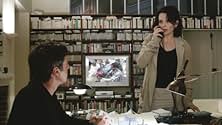
A married couple is terrorized by a series of surveillance videotapes left on their front porch.A married couple is terrorized by a series of surveillance videotapes left on their front porch.A married couple is terrorized by a series of surveillance videotapes left on their front porch.
- Awards
- 29 wins & 37 nominations total


- Director
- Writer
- All cast & crew
- Production, box office & more at IMDbPro
7.389.3K
1
2
3
4
5
6
7
8
9
10
Featured reviews
Guilty and Paranoia
In Paris, Georges Laurent (Daniel Auteuil) is a famous host of a literary talk show on TV, who lives in a comfortable house with his wife Anne (Juliette Binoche) and their teenager son Pierrot (Lester Makedonsky). When Georges and Anne receives videotapes of surveillance of their private life and weird and gore childlike drawings, they go to the police, but they do not get any protection since there is not a clear menace to the Laurent family. When Georges follows a clue in one of the tapes that shows his childhood home, he meets his former adopted brother, the Algerian Majid (Maurice Bénichou) and accuses him of sending the tapes. Meanwhile, through glimpses of Georges' nightmares, his lies due to his jealous relationship with his foster brother are disclosed.
"Caché" is definitely an inconclusive movie, open to the most different interpretations, and this obvious based on the number of very intelligent and helpful discussions in IMDb Message Board. I am a fan of Michael Haneke, and I believe this is his intention, to promote a wide discussion about his movie at the same time he uses the historical moment in 1961 of the war between France and Alger. The last scene with Majid's son at Pierrot's school indicating that the may know each other just increases the possibilities. Anyway, the tense and realistic story of guilty and paranoia is very original and without the usual clichés of Hollywood movies. My vote is seven.
Title (Brazil): "Caché"
"Caché" is definitely an inconclusive movie, open to the most different interpretations, and this obvious based on the number of very intelligent and helpful discussions in IMDb Message Board. I am a fan of Michael Haneke, and I believe this is his intention, to promote a wide discussion about his movie at the same time he uses the historical moment in 1961 of the war between France and Alger. The last scene with Majid's son at Pierrot's school indicating that the may know each other just increases the possibilities. Anyway, the tense and realistic story of guilty and paranoia is very original and without the usual clichés of Hollywood movies. My vote is seven.
Title (Brazil): "Caché"
When hiding can be revealing -- one of the top films of the 2000s
If you've just seen "Cachê" and are still (understandably) in shock, not knowing whether you really liked it or not, let me ask you a few questions. Now, when was the last time a film:
a) had you glued to your seat as in "Caché", your eyes and neurones required to work in full gear from beginning to end, making it impossible to erase it out of your mind (instead of the instantly forgettable films you see every week), and actually making a second viewing almost compulsory?
b) posed such complex, multi-layered questions -- socio-political ones (the shameful, violent legacy of past and present imperialist nations, the manipulation of "reality" by the State and the media), existential ones (the racial, class and social prejudices that we all carry and have to fight within ourselves), and more prosaic ones, like trying to solve a complicated thriller? When were they so masterly interwoven?
c) made you aware that your explanation for the movie's most immediate, "practical" question (who's sending the tapes to Georges) will be influenced by your own background and prejudices?
d) had such a controversial and rich ending? (I could think of at least five possible denouements, even considering that I DID see the two boys -- q.v. the multiple theories about the ending in "Caché"'s message boards here in IMDb).
"Caché" is one of the few real masterpieces of the 2000s. The mix of socio-political comment with the thriller genre is not new, of course (you can go back at least to great German silent films by Lang, Murnau, Dieterle, Pabst). In 2005 alone, Cronenberg made the half-successful "A History of Violence", Spielberg the underachieved "Munich", Stephen Gaghan the overwrought "Syriana", Paul Haggis the soap-operatic "Crash". But Haneke asks us and gives us much more: he demands our ability to fill in the many important historical and political gaps, messes with our prejudices but respects our intelligence, and knows that a good part of us viewers are bored to death of being spoon-fed with one-digit I.Q. plots in mechanical thrillers inhabited by tired, phony "archetypes" of good x evil characters.
"Caché" is a monumental proof of Haneke's COMPLETE command of his craft. Artistic achievements like this are now SO rare in films that "Caché" feels like a happening -- a work of art that is mind-boggling, hypnotic and physically unnerving, ethically and esthetically disturbing, combining the sense of revelation and discomfort you get with the best political films with the braincells workout you get with the best thrillers.
As I left the theater, three masterpieces immediately came to my mind: Clouzot's "Le Corbeau" (a political statement disguised as a thriller and a probable inspiration for "Caché"), Antonioni's "The Passenger" (ditto, and also for the long, breathtaking, "open-meaning" last shot) and Resnais' "Marienbad" (the seminal film of multi-layered possible interpretations of "reality"). "Caché" stands tall on its own, reaffirming Haneke as one the top-5 working directors of the 2000s. Can't wait for his next film -- but while I do, I'll watch "Caché" one more time, and understand that hiding (Georges hiding his past and his feelings, nations hiding shameful parts of their history, Haneke hiding evidence, explanations and conclusions) can be a form of powerful revelation...and self-revelation.
a) had you glued to your seat as in "Caché", your eyes and neurones required to work in full gear from beginning to end, making it impossible to erase it out of your mind (instead of the instantly forgettable films you see every week), and actually making a second viewing almost compulsory?
b) posed such complex, multi-layered questions -- socio-political ones (the shameful, violent legacy of past and present imperialist nations, the manipulation of "reality" by the State and the media), existential ones (the racial, class and social prejudices that we all carry and have to fight within ourselves), and more prosaic ones, like trying to solve a complicated thriller? When were they so masterly interwoven?
c) made you aware that your explanation for the movie's most immediate, "practical" question (who's sending the tapes to Georges) will be influenced by your own background and prejudices?
d) had such a controversial and rich ending? (I could think of at least five possible denouements, even considering that I DID see the two boys -- q.v. the multiple theories about the ending in "Caché"'s message boards here in IMDb).
"Caché" is one of the few real masterpieces of the 2000s. The mix of socio-political comment with the thriller genre is not new, of course (you can go back at least to great German silent films by Lang, Murnau, Dieterle, Pabst). In 2005 alone, Cronenberg made the half-successful "A History of Violence", Spielberg the underachieved "Munich", Stephen Gaghan the overwrought "Syriana", Paul Haggis the soap-operatic "Crash". But Haneke asks us and gives us much more: he demands our ability to fill in the many important historical and political gaps, messes with our prejudices but respects our intelligence, and knows that a good part of us viewers are bored to death of being spoon-fed with one-digit I.Q. plots in mechanical thrillers inhabited by tired, phony "archetypes" of good x evil characters.
"Caché" is a monumental proof of Haneke's COMPLETE command of his craft. Artistic achievements like this are now SO rare in films that "Caché" feels like a happening -- a work of art that is mind-boggling, hypnotic and physically unnerving, ethically and esthetically disturbing, combining the sense of revelation and discomfort you get with the best political films with the braincells workout you get with the best thrillers.
As I left the theater, three masterpieces immediately came to my mind: Clouzot's "Le Corbeau" (a political statement disguised as a thriller and a probable inspiration for "Caché"), Antonioni's "The Passenger" (ditto, and also for the long, breathtaking, "open-meaning" last shot) and Resnais' "Marienbad" (the seminal film of multi-layered possible interpretations of "reality"). "Caché" stands tall on its own, reaffirming Haneke as one the top-5 working directors of the 2000s. Can't wait for his next film -- but while I do, I'll watch "Caché" one more time, and understand that hiding (Georges hiding his past and his feelings, nations hiding shameful parts of their history, Haneke hiding evidence, explanations and conclusions) can be a form of powerful revelation...and self-revelation.
Global Paranoia and Responsibility Made Very Personal
"Caché (Hidden)" uses the visual power of film to create an escalating examination of contemporary paranoia and personal global responsibility the way Francis Ford Coppola's 1974 film "The Conversation" did with sound and fictional criminals.
Writer/director Michael Haneke plays visual tricks on the audience as voyeurs from the opening shot, much as he did with "Code Inconnu," as he coyly plays with technology, building on the pervasive surveillance potential of our times.
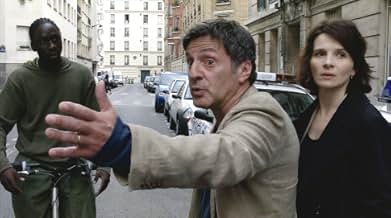
The comfortable upper middle class life of married intellectuals Daniel Auteuil and Juliette Binoche is more and more disrupted by spooky video and drawings from some kind of stalker. With a bit heavy-handed constant background TV news coverage about terrorism and other violence in the MidEast, as well as too much irony that Auteuil works on TV (evidently in yet another book discussion show like the central narcissist in "Look At Me (Comme une image)"), race is quickly introduced as a flash point in contemporary Paris from a brief street confrontation and reinforced with Auteuil's flashback dreams of his youth.
While the political angles are obvious, the Hitchcockian tension is very effectively built up (though not narratively resolved even as some secrets are revealed that lead to other inscrutabilities), not just as we see Auteuil repeatedly lie and Binoche practically disintegrate from nerves, but through sudden violence.
While we never understand who all is lying and who isn't, the film further plays on the truth that visual images don't in fact communicate the reality of a situation and can be misleading about relationships, particularly once paranoia has destroyed trust. The film also raises the question if people change their behavior if they know they are being watched and that you can't really hide from your past. Cynically, but perhaps honestly as opposed to in "Crash," here there is no easy resolution of acceptance of guilt and responsibility in personal lives any more than there is in the legacy of colonialism and racism.
Not only is the past never dead, but the film keeps repeating issues of not just am I my brother's keeper, but the sins of the father are revisited on the sons, such that it's important to keep watching even as the credits start to appear at the end (there was much shouting when some folks got up to leave too soon, blocking cryptic clues to those behind them).
The subtitles are very poorly done, with many scenes having them white on white, instead of the much easier to read yellow.
Writer/director Michael Haneke plays visual tricks on the audience as voyeurs from the opening shot, much as he did with "Code Inconnu," as he coyly plays with technology, building on the pervasive surveillance potential of our times.
The comfortable upper middle class life of married intellectuals Daniel Auteuil and Juliette Binoche is more and more disrupted by spooky video and drawings from some kind of stalker. With a bit heavy-handed constant background TV news coverage about terrorism and other violence in the MidEast, as well as too much irony that Auteuil works on TV (evidently in yet another book discussion show like the central narcissist in "Look At Me (Comme une image)"), race is quickly introduced as a flash point in contemporary Paris from a brief street confrontation and reinforced with Auteuil's flashback dreams of his youth.
While the political angles are obvious, the Hitchcockian tension is very effectively built up (though not narratively resolved even as some secrets are revealed that lead to other inscrutabilities), not just as we see Auteuil repeatedly lie and Binoche practically disintegrate from nerves, but through sudden violence.
While we never understand who all is lying and who isn't, the film further plays on the truth that visual images don't in fact communicate the reality of a situation and can be misleading about relationships, particularly once paranoia has destroyed trust. The film also raises the question if people change their behavior if they know they are being watched and that you can't really hide from your past. Cynically, but perhaps honestly as opposed to in "Crash," here there is no easy resolution of acceptance of guilt and responsibility in personal lives any more than there is in the legacy of colonialism and racism.
Not only is the past never dead, but the film keeps repeating issues of not just am I my brother's keeper, but the sins of the father are revisited on the sons, such that it's important to keep watching even as the credits start to appear at the end (there was much shouting when some folks got up to leave too soon, blocking cryptic clues to those behind them).
The subtitles are very poorly done, with many scenes having them white on white, instead of the much easier to read yellow.
Reflective probing of hidden guilt, but definitely not top-notch cinema
Michael Haneke's film begins as a clinical, psychological and social study of a respectable individual in European society. It ends as a study of a larger contemporary European segment of its population. It reminds one of the early works of Fassbinderonly Haneke's production values are more sophisticated. The camera becomes a charactera major one at that. This reminds the viewer that he is watching cinema at several junctures and that s/he is part of the communication/entertainment process. It makes you constantly ponder if the cinema you are watching is providing truth or lies (or something in between) 24 frames per second. The fixed-medium range shots that opens and closes the film indicate the view and mood of the director--clinical, somewhat distanced and unshaken by the story he unfolds. We also notice that what we are seeing, might not be what we think we are seeing. Antonioni did this to us in "Blow up" several decades ago.
After the screening at the on-going Dubai film festival, I was amused at the director carefully distancing himself from a situation where he could have resolved the issues-he prefers to leave it to the viewer to do so. In a way the entertainment continues after the screening if you choose to reflect on what you saw.
At the obvious level, it is a study of colonial guilt of Europe and race relations. At a deeper level, it probes complacency and bourgeois temperaments of the financially secure classes in society. Escape from reality comes from closing curtains, shutting off the outside world and consuming sleeping tablets. At another level, the film explores the attitudes of three distinct generations towards social relationships.
Haneke uses graphic shocking violent scenes to jolt the audiences when they least expect it. He seems to enjoy the process. His strength is not in his cinema (Kubrick, in comparison, was brilliant at this game). Hanneke's strength lies elsewhereeliciting fascinating performances from his cast. Daniel Auteuil, Julliette Binoche, Maurice Benichou and Annie Girardot were simply fascinating to watch.
The strength of the film lies in the subject that will disturb anyone. Many of us have something in our past that we wish to hide or not discuss. Yet there is a conscience in us that nags us to believe that there was a witness to that wrongdoing--a witness who cannot be buttonholed. It is this psychological fact that makes the film tick, much less its cinematic flourish.
After the screening at the on-going Dubai film festival, I was amused at the director carefully distancing himself from a situation where he could have resolved the issues-he prefers to leave it to the viewer to do so. In a way the entertainment continues after the screening if you choose to reflect on what you saw.
At the obvious level, it is a study of colonial guilt of Europe and race relations. At a deeper level, it probes complacency and bourgeois temperaments of the financially secure classes in society. Escape from reality comes from closing curtains, shutting off the outside world and consuming sleeping tablets. At another level, the film explores the attitudes of three distinct generations towards social relationships.
Haneke uses graphic shocking violent scenes to jolt the audiences when they least expect it. He seems to enjoy the process. His strength is not in his cinema (Kubrick, in comparison, was brilliant at this game). Hanneke's strength lies elsewhereeliciting fascinating performances from his cast. Daniel Auteuil, Julliette Binoche, Maurice Benichou and Annie Girardot were simply fascinating to watch.
The strength of the film lies in the subject that will disturb anyone. Many of us have something in our past that we wish to hide or not discuss. Yet there is a conscience in us that nags us to believe that there was a witness to that wrongdoing--a witness who cannot be buttonholed. It is this psychological fact that makes the film tick, much less its cinematic flourish.
Disturbing, Stunning, Daring and Dark
Michael Haneke the austere Austrian director of such critically acclaimed films as "Funny Games", "Code Unknown" and "The Piano Teacher" has created in "Caché" (Hidden) his finest film to date.
Starring Daniel Auteuil and Juliette Binoche the film is a taut and tense personal thriller, which examines important subjects such as guilt and responsibility in the context of western comfort.
Georges and Anne are a happily married middle class couple who both work in the arts. The balance of their lives is suddenly disturbed when they begin to receive video cassettes seemingly surveying the exterior of their home. Anne is quite dismissive of the tape but immediately Georges believes there is a sinister element to the tape. Soon they receive more tapes and disturbing drawings. As Georges fears for the safety of his family he suddenly has to confront his past and allow his wife to learn the hidden secrets of his past.
Haneke's film plays on one level like a common thriller, but it has much deeper psychological echoes as the "hero" George is revealed not to be quite the upstanding family man his family believed him to be. As his wife struggles to come to terms with the revelations their entire comfortable existence disintegrates.
Haneke is not just interested in creating a thriller however and the auteur expertly dissects George and Annes bourgeois life and implicates them both in the treatment by western culture of the east and the third world.
Acting in the film is terrific. Daniel Auteuil is simply excellent in his role, the actor manages to explore his character enough to make us forget it is a portrayal. Juliette Binoche as his wife initially seems not to be at the center of the film, but the stunning actress manages to place herself at the emotional center of the film as the wife and mother.
Expert supporting roles are provided by Maurice Benichiou, Annie Girardot and Nathalie Richard among others.
"Caché" is at once an intriguing thriller and a wonderful examination of guilt and responsibility in a very modern context.
Starring Daniel Auteuil and Juliette Binoche the film is a taut and tense personal thriller, which examines important subjects such as guilt and responsibility in the context of western comfort.
Georges and Anne are a happily married middle class couple who both work in the arts. The balance of their lives is suddenly disturbed when they begin to receive video cassettes seemingly surveying the exterior of their home. Anne is quite dismissive of the tape but immediately Georges believes there is a sinister element to the tape. Soon they receive more tapes and disturbing drawings. As Georges fears for the safety of his family he suddenly has to confront his past and allow his wife to learn the hidden secrets of his past.
Haneke's film plays on one level like a common thriller, but it has much deeper psychological echoes as the "hero" George is revealed not to be quite the upstanding family man his family believed him to be. As his wife struggles to come to terms with the revelations their entire comfortable existence disintegrates.
Haneke is not just interested in creating a thriller however and the auteur expertly dissects George and Annes bourgeois life and implicates them both in the treatment by western culture of the east and the third world.
Acting in the film is terrific. Daniel Auteuil is simply excellent in his role, the actor manages to explore his character enough to make us forget it is a portrayal. Juliette Binoche as his wife initially seems not to be at the center of the film, but the stunning actress manages to place herself at the emotional center of the film as the wife and mother.
Expert supporting roles are provided by Maurice Benichiou, Annie Girardot and Nathalie Richard among others.
"Caché" is at once an intriguing thriller and a wonderful examination of guilt and responsibility in a very modern context.


Did you know
- TriviaThere is no music, save for the theme on George's show, and background music at Anne's publishing party.
- GoofsDuring the tape where Georges pulls up in his car and parks at night the headlights clearly cast a huge distinct shadow of the camera on the wall.
- Quotes
Georges Laurent: Isn't it lonely, if you can't go out?
Georges's Mom: Why? Are you less lonely because you can sit in the garden? Do you feel less lonely in the metro than at home? Well then! Anyway, I have my family friend... with remote control. Whenever they annoy me, I just shut them up.
- Crazy creditsThe opening credits appear over a shot of the husband and wife's house, but they appear one by one and in rows. By the time the credits are over they are all shown together, much like they would on a poster or in the credits section of a movie trailer.
- ConnectionsFeatured in Smagsdommerne: Episode #3.13 (2006)
- How long is Caché?Powered by Alexa
Details
- Release date
- Countries of origin
- Official site
- Language
- Also known as
- Caché (Hidden)
- Filming locations
- 49 Rue Brillat-Savarin, Paris 13, Paris, France(Georges' house)
- Production companies
- See more company credits at IMDbPro
Box office
- Budget
- €8,000,000 (estimated)
- Gross US & Canada
- $3,647,381
- Opening weekend US & Canada
- $57,010
- Dec 25, 2005
- Gross worldwide
- $16,197,824
- Runtime
- 1h 57m(117 min)
- Color
- Sound mix
- Aspect ratio
- 1.78 : 1
Contribute to this page
Suggest an edit or add missing content