

Terry Gilliam's doomed attempt to get his film, The Man Who Killed Don Quixote (2018), off the ground.Terry Gilliam's doomed attempt to get his film, The Man Who Killed Don Quixote (2018), off the ground.Terry Gilliam's doomed attempt to get his film, The Man Who Killed Don Quixote (2018), off the ground.
- Directors
- Writers
- Stars
- Nominated for 1 BAFTA Award
- 2 wins & 11 nominations total




Jeff Bridges
- Self - Narrator
- (voice)
Philip A. Patterson
- Self - First Assistant Director
- (as Phil Patterson)


Benjamín Fernández
- Self - Production Designer
- (as Benjamin Fernandez)


Vanessa Paradis
- Self
- (archive footage)

Orson Welles
- Self
- (archive footage)
- Directors
- Writers
- All cast & crew
- Production, box office & more at IMDbPro
7.312.2K
1
2
3
4
5
6
7
8
9
10
Featured reviews
This is one of the saddest, most painful films I've ever seen.
I thought I had it bad on the set of my little student film in college.
Whew!
Watching this documentary was very difficult and very interesting at the same time. I enjoyed it, despite the tragedy that played out on the screen.
What makes the film so heartbreaking is that you know that the film will inevitably fail. So the entire movie-watching experience is steeped in dramatic irony. We, the viewers, know the outcome of this ill-fated film project known as "The Man Who Killed Don Quixote." But the filmmakers themselves, at the time of the filming, obviously do not know that all their actions are essentially in vain.
A great film, and a powerful warning to those who thinking making movies is easy.
Whew!
Watching this documentary was very difficult and very interesting at the same time. I enjoyed it, despite the tragedy that played out on the screen.
What makes the film so heartbreaking is that you know that the film will inevitably fail. So the entire movie-watching experience is steeped in dramatic irony. We, the viewers, know the outcome of this ill-fated film project known as "The Man Who Killed Don Quixote." But the filmmakers themselves, at the time of the filming, obviously do not know that all their actions are essentially in vain.
A great film, and a powerful warning to those who thinking making movies is easy.
The Impossible Dream
Thanks to DVD, we've all become accustomed to seeing `inside' documentaries about the making of some of our favorite films. But what of those films that for whatever reason never end up seeing the light of day? Are there any lessons to be learned from examining the making (or near making) of those works? This is the questioned posed by `Lost in La Mancha,' a behind-the-scenes chronicle of director Terry Gilliam's attempt to fulfill his decade-long dream of bringing Cervantes' `Don Quixote' to the big screen, a project that ended up in heartbreaking, catastrophic failure for both the filmmaker and the gifted crew with which he was working.
Directors Keith Fulton and Louis Pepe did not, of course, set out to record such a debacle. Like all the people involved in the making of `The Man Who Killed Don Quixote' a film intended to star Jean Rochefort and Johnny Depp - the documentary filmmakers assumed that Gilliam and his crew would end up with an impressive finished product and that their own work would serve as little more than supplemental material on a future DVD release of the film, certainly not a theatrical release in its own right. What none of them foresaw was the series of almost Biblical disasters that would ultimately doom the film to a state of perpetual nonexistence. Flash floods, health problems, nervous investors and bottom line insurance agents all eventually conspired to prevent Gilliam's dream from becoming a reality. Thus, what became a bust for Terry Gilliam turned into a boon for Fulton and Pepe.
With the benefit of hindsight, the filmmakers ensure that the parallels between Don Quixote and Gilliam himself are never far from the viewer's mind. Gilliam, a maverick director whose movies have always tested the boundaries of the film medium, is clearly an artist and a visionary obsessed with impossible dreams of his own, but dreams that inspire those around him to strive for a greatness not always nurtured by the mundane realities of the everyday world. The fact that, in this particular case, those realities intervened to bring his vision crashing back to earth only completes the connection to the Quixote figure. Gilliam spends most of his time in this film tilting at his own windmills, only to find that the vagaries of fate are more terrifying than any giants Quixote might have imagined. The documentary also notes that Gilliam is not the only major director to have been stymied in his attempt to adapt this material; the great Orson Welles failed to complete his version of `Don Quixote' as well. The irony of these two innovative cinema giants both failing with THIS particular material pervades the film with an eerie sense of doom and foreboding.
`Lost in La Mancha' is an instructive film on a technical level, but also immensely sad on an emotional one. Because we know from the beginning that this venture is doomed to failure, even the moments of hope and optimism early on in the film carry with them an air of fatalistic melancholy. This pre-knowledge also turns the many admittedly humorous moments into genuine black comedy.
It is always painful to see genius and creativity choked off at the root, especially since the few glimpses we get of actual completed footage hint at what a fine production this `Don Quixote' might have been. As to Gilliam, one can only hope that he will continue to pursue his impossible dream despite all the roadblocks reality has set in his way. Don Quixote would have wanted it that way.
Directors Keith Fulton and Louis Pepe did not, of course, set out to record such a debacle. Like all the people involved in the making of `The Man Who Killed Don Quixote' a film intended to star Jean Rochefort and Johnny Depp - the documentary filmmakers assumed that Gilliam and his crew would end up with an impressive finished product and that their own work would serve as little more than supplemental material on a future DVD release of the film, certainly not a theatrical release in its own right. What none of them foresaw was the series of almost Biblical disasters that would ultimately doom the film to a state of perpetual nonexistence. Flash floods, health problems, nervous investors and bottom line insurance agents all eventually conspired to prevent Gilliam's dream from becoming a reality. Thus, what became a bust for Terry Gilliam turned into a boon for Fulton and Pepe.
With the benefit of hindsight, the filmmakers ensure that the parallels between Don Quixote and Gilliam himself are never far from the viewer's mind. Gilliam, a maverick director whose movies have always tested the boundaries of the film medium, is clearly an artist and a visionary obsessed with impossible dreams of his own, but dreams that inspire those around him to strive for a greatness not always nurtured by the mundane realities of the everyday world. The fact that, in this particular case, those realities intervened to bring his vision crashing back to earth only completes the connection to the Quixote figure. Gilliam spends most of his time in this film tilting at his own windmills, only to find that the vagaries of fate are more terrifying than any giants Quixote might have imagined. The documentary also notes that Gilliam is not the only major director to have been stymied in his attempt to adapt this material; the great Orson Welles failed to complete his version of `Don Quixote' as well. The irony of these two innovative cinema giants both failing with THIS particular material pervades the film with an eerie sense of doom and foreboding.
`Lost in La Mancha' is an instructive film on a technical level, but also immensely sad on an emotional one. Because we know from the beginning that this venture is doomed to failure, even the moments of hope and optimism early on in the film carry with them an air of fatalistic melancholy. This pre-knowledge also turns the many admittedly humorous moments into genuine black comedy.
It is always painful to see genius and creativity choked off at the root, especially since the few glimpses we get of actual completed footage hint at what a fine production this `Don Quixote' might have been. As to Gilliam, one can only hope that he will continue to pursue his impossible dream despite all the roadblocks reality has set in his way. Don Quixote would have wanted it that way.
This Film Is No More! This is an Ex-Film!
"Lost in LaMancha" is a fascinatingly brilliant documentary about the aborted film project "The Man Who Killed Don Quixote" and the problems faced by its writer/director Terry Gilliam. The two documentarians who followed Gilliam's "Twelve Monkeys" to produce "The Hamster Factor And Other Tales Of Twelve Monkeys" have done the same again here only this time there is no film to complement the documentary.
Gilliam is no stranger to controversy. Books, made for dvd documentaries and now this feature have been produced about his troubles in the tv and film industry. He has been labeled as a director who goes over budget though in this case the weather, the noise of overhead fighter planes and an ailing lead actor all come together to halt filming.
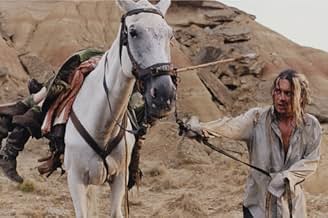
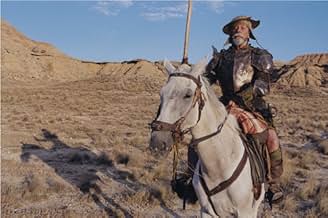
Gilliam's "The Fisher King" co-star Jeff Bridges narrates the doco which details pre-production through to its troubled shoot. "The Man Who Killed Don Quixote" was to be the most expensive independently produced film in Europe with an international cast including Johnny Depp. Filming only lasted about a week before the insurance company closed down production. The insurance company now own Gilliam and Tony Grisoni's screenplay plus the surviving footage from the shoot.
People believe that the story of "The Man Of LaMancha" is cursed and the documentary mentions in minor detail another troubled genius, Orson Welles, and his unfinished Don Quixote project.
There has been other documentaries of this type such as "Hearts Of Darkness: A Filmmaker's Apocalypse" about the lengthy production of Francis Ford Coppola's "Apocalypse Now" but in the case of this film there is no happy ending. No cultural masterpiece that rises from a problematic shoot. This film is the cinematic equivalent of a train wreak. You know things are going to get ugly but you can't take your eyes off it. You have to admire Gilliam for signing off on this doco. It's a constant reminder of a time in his life wasted with nothing to show for it. It's terribly depressing but the crew's sense of humor and commitment to the project shine through.
If you're a fan of Gilliam's or interested in film production then this entertaining documentary is for you.
Gilliam is no stranger to controversy. Books, made for dvd documentaries and now this feature have been produced about his troubles in the tv and film industry. He has been labeled as a director who goes over budget though in this case the weather, the noise of overhead fighter planes and an ailing lead actor all come together to halt filming.
Gilliam's "The Fisher King" co-star Jeff Bridges narrates the doco which details pre-production through to its troubled shoot. "The Man Who Killed Don Quixote" was to be the most expensive independently produced film in Europe with an international cast including Johnny Depp. Filming only lasted about a week before the insurance company closed down production. The insurance company now own Gilliam and Tony Grisoni's screenplay plus the surviving footage from the shoot.
People believe that the story of "The Man Of LaMancha" is cursed and the documentary mentions in minor detail another troubled genius, Orson Welles, and his unfinished Don Quixote project.
There has been other documentaries of this type such as "Hearts Of Darkness: A Filmmaker's Apocalypse" about the lengthy production of Francis Ford Coppola's "Apocalypse Now" but in the case of this film there is no happy ending. No cultural masterpiece that rises from a problematic shoot. This film is the cinematic equivalent of a train wreak. You know things are going to get ugly but you can't take your eyes off it. You have to admire Gilliam for signing off on this doco. It's a constant reminder of a time in his life wasted with nothing to show for it. It's terribly depressing but the crew's sense of humor and commitment to the project shine through.
If you're a fan of Gilliam's or interested in film production then this entertaining documentary is for you.
Important for anyone who's ever wanted to direct a film
Terry Gilliam's had a controversial career. His "Brazil" in 1985 upset Universal because it had a "sad" ending, so they cut it apart and replaced the finale with a "happier" version. Gilliam hated their hack job of his work, and illegally screened his original version for a critics' circle -- they voted it one of the best films of the year. Soon Gilliam got his way and the film was released as he had originally intended, and it's now considered a classic.
A few years later he released "The Adventures of Baron Manchusen," a fantasy flop that went some $20 million over budget and collapsed at the box office. He quit directing for a while and, when he returned, started work on "Twelve Monkeys." It wasn't the best of shoots and his perfectionism resulted in eccentric, intolerable shooting schedules.
In 1998 "Fear and Loathing in Las Vegas" was released and the MPAA hated it, threatening to give it an X rating for its drug content. Released alongside "Godzilla," it flopped, but to this day remains a cult classic.
So it's reasonable to say Gilliam is quite an eccentric personality and has had a tumultuous career.
"The Man Who Killed Don Quixote" was going to be his new film until it crashed. The production was halted because Gilliam couldn't find an actor to play Quixote, flash floods destroyed equipment and one of his shooting locations was in fact a NATO airfield which created quite a problem for the filmmakers.
Gilliam's film probably would have been a great twist on the classic tale and I'm sure his eccentric vision would have suited it well. He also had a cameo by Johnny Depp in the movie and it's quite funny as shown in this documentary detailing the events of the production.
Gilliam recently said he's going to start production on this again and finish it up. I hope so, it really does look like a promising film.
In terms of this documentary itself, it's very insightful and a must-see for any Gilliam fan or aspiring director -- it's entertaining and important, and a great guide on how NOT to make a movie.
A few years later he released "The Adventures of Baron Manchusen," a fantasy flop that went some $20 million over budget and collapsed at the box office. He quit directing for a while and, when he returned, started work on "Twelve Monkeys." It wasn't the best of shoots and his perfectionism resulted in eccentric, intolerable shooting schedules.
In 1998 "Fear and Loathing in Las Vegas" was released and the MPAA hated it, threatening to give it an X rating for its drug content. Released alongside "Godzilla," it flopped, but to this day remains a cult classic.
So it's reasonable to say Gilliam is quite an eccentric personality and has had a tumultuous career.
"The Man Who Killed Don Quixote" was going to be his new film until it crashed. The production was halted because Gilliam couldn't find an actor to play Quixote, flash floods destroyed equipment and one of his shooting locations was in fact a NATO airfield which created quite a problem for the filmmakers.
Gilliam's film probably would have been a great twist on the classic tale and I'm sure his eccentric vision would have suited it well. He also had a cameo by Johnny Depp in the movie and it's quite funny as shown in this documentary detailing the events of the production.
Gilliam recently said he's going to start production on this again and finish it up. I hope so, it really does look like a promising film.
In terms of this documentary itself, it's very insightful and a must-see for any Gilliam fan or aspiring director -- it's entertaining and important, and a great guide on how NOT to make a movie.
A good proof of Murphy's laws
Anything that can go wrong, will go wrong
But to start at the beginning. There was finally something in the cinemas from the background of movie-making, about how the movies are made and what are the costs. They were high in this case
It was really fascinating to see the project falling apart so quickly. I think it would have been a wonderful movie if made, proof of this are all former Gilliam's works. But I also think that there could have been more about the movie itself (not just the catastrophes) like storyboards, and definitely more about the plot. Because at least I would rather hear Gilliam talking about the plot than hear him saying f*** for the umpteenth time. I just think that little bit more details would have been fine. But maybe Gilliam didn't say more on purpose, maybe he still wants to make the movie so he keeps it secret yet. We'll see. But if he ever does make it, I'll make sure not to miss it.


Did you know
- TriviaFulton and Pepe intended to make a television documentary about the development and pre-production of Terry Gilliam's long-awaited passion project. They had no idea that the story would develop into its own quixotic tragedy. After the project failed, Fulton and Pepe were wary of finishing their film until Gilliam said "someone has to get a film out of this. I guess it's going to be you."
- Quotes
Terry Gilliam: I want to know when we're fucked in advance, not in the middle of a shoot.
- Crazy creditsAt the end of the credits we see the footage of the giants running menacingly towards the screen (which Gilliam admitted would make a great trailer). Just before it fades to black, the words "COMING SOON" are emblazoned across the screen. At the fadeout, we hear Gilliam's distinctive laugh.
- Alternate versionsAlthough the U.S. home video version has a listed running time of 93 minutes, the version on the tape runs only 89 minutes.
- ConnectionsFeatured in Zomergasten: Episode #18.2 (2005)
- How long is Lost in La Mancha?Powered by Alexa
Details
- Release date
- Countries of origin
- Languages
- Also known as
- 救命吶!唐吉訶德
- Filming locations
- Bardenas Reales, Navarra, Spain(shooting in the desert)
- Production companies
- See more company credits at IMDbPro
Box office
- Gross US & Canada
- $732,393
- Opening weekend US & Canada
- $63,303
- Feb 2, 2003
- Gross worldwide
- $1,407,019
Contribute to this page
Suggest an edit or add missing content