IMDb RATING
7.1/10
2.9K
YOUR RATING

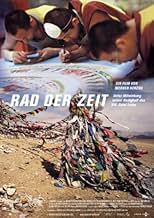
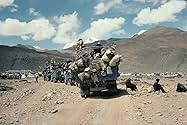
Wheel of Time is Werner Herzog's photographed look at the largest Buddhist ritual in Bodh Gaya, India.Wheel of Time is Werner Herzog's photographed look at the largest Buddhist ritual in Bodh Gaya, India.Wheel of Time is Werner Herzog's photographed look at the largest Buddhist ritual in Bodh Gaya, India.




- Director
- Writer
- All cast & crew
- Production, box office & more at IMDbPro
7.12.8K
1
2
3
4
5
6
7
8
9
10
Featured reviews
Herzog showing a culture, in mass, in inner-peace, led by the guy to know most
Wheel of Time is a curious documentary crucially because of someone from the West, like myself, being privy to traditional customs and ceremonial practices that seem like they could be coming from another world. But, as one soon learns, this curiosity is strong because it IS apart of this world, and maybe the truest moment of clarity from the Dalai Lama himself comes when he states how the universe is really not owned by one country or apart of one mountain or other, but is in how an individual conceives it- the universe, the center of it, is in you, or at least your projection of what it is, which is not something collective but ultimately is. It's a very wise statement that will keep me pondering it over for a long time. Likewise, the Kalachakra mandala becomes like a metaphor for this ideal, of hundreds of thousands of people coming together for the purpose of- aside from getting priceless words from the Dalai Lama- being at inner peace with oneself, hence the universe.
By the end of Wheel of Time I didn't know much more about Buddhism than I had going into it, which isn't any real fault on Herzog's end as a filmmaker; it doesn't illuminate and challenge the mind too much like other documentaries of the filmmaker, but it's also nevertheless unique in Herzog's cannon for what he does and doesn't take on with his subject(s). On the one hand, he's endlessly fascinated with ritual, with physical movements, of the masses of people who have gone on this pilgrimage from thousands of miles from all over the continent for this once-in-two-years event (this adds a dosage of climactic irony for what happens there- an 'illness'). It's anthropological to an extent, only it's not one of everyday culture so much as the unheeding devotion to a religion based around enlightenment, not suffering via a messiah or other. On the other hand, Herzog relies this time on just being a guy with a camera, moving around these swarms of people, and this time Herzog relents for the most part to "directing landscapes" as he usually does to just catching people's faces, their body language, and the instruments at their disposal (which are, usually, their own bodies, as in their bowing-type moves to attain a level, and crawling on ones hands and face across land for a purpose). It's actually, for Herzog, kind of conventional, bordering on being something one might expect for television.
But this little note shouldn't discourage one from seeing the film, and whether you're a Buddhist or not it holds its own aura that provides moments almost akin to what the Dalai Lama wants for his pupils and followers. One's even reminded of Woodstock in comparison of a documentary that goes out of its way to show more-so the nature of the people who gather together, and the power of a gathering, than the actual acts themselves. On top of this, Herzog does the occasional focus on an individual (albeit a little sidetracked as it is during the climax) with a political prisoner released from China and allowed to finally "see" the Dalai Lama in person. And for Herzog fans who are always on the prowl for his 'adequate images', there's still a good few to go around here, like when he captures the mountains that the Tibetans go to in masses, or the final images, including one that is as haunting as anything Herzog's shot. It's a peaceful, brisk journey; not a great work, but not an insignificant one either.
By the end of Wheel of Time I didn't know much more about Buddhism than I had going into it, which isn't any real fault on Herzog's end as a filmmaker; it doesn't illuminate and challenge the mind too much like other documentaries of the filmmaker, but it's also nevertheless unique in Herzog's cannon for what he does and doesn't take on with his subject(s). On the one hand, he's endlessly fascinated with ritual, with physical movements, of the masses of people who have gone on this pilgrimage from thousands of miles from all over the continent for this once-in-two-years event (this adds a dosage of climactic irony for what happens there- an 'illness'). It's anthropological to an extent, only it's not one of everyday culture so much as the unheeding devotion to a religion based around enlightenment, not suffering via a messiah or other. On the other hand, Herzog relies this time on just being a guy with a camera, moving around these swarms of people, and this time Herzog relents for the most part to "directing landscapes" as he usually does to just catching people's faces, their body language, and the instruments at their disposal (which are, usually, their own bodies, as in their bowing-type moves to attain a level, and crawling on ones hands and face across land for a purpose). It's actually, for Herzog, kind of conventional, bordering on being something one might expect for television.
But this little note shouldn't discourage one from seeing the film, and whether you're a Buddhist or not it holds its own aura that provides moments almost akin to what the Dalai Lama wants for his pupils and followers. One's even reminded of Woodstock in comparison of a documentary that goes out of its way to show more-so the nature of the people who gather together, and the power of a gathering, than the actual acts themselves. On top of this, Herzog does the occasional focus on an individual (albeit a little sidetracked as it is during the climax) with a political prisoner released from China and allowed to finally "see" the Dalai Lama in person. And for Herzog fans who are always on the prowl for his 'adequate images', there's still a good few to go around here, like when he captures the mountains that the Tibetans go to in masses, or the final images, including one that is as haunting as anything Herzog's shot. It's a peaceful, brisk journey; not a great work, but not an insignificant one either.
Werner Herzog does a walk around
It's interesting to read that Werner Herzog wasn't an expert on Buddhism when he filmed this. In a way, that's the charm of this film. Essentially we're given a backstage pass to a Buddhist festival. In Herzog fashion, he holds the camera longer than most, filming his subjects looking for any reaction. In a childlike way, it could be very compelling. Especially since this world is so strange to most westerners that the audience is like any tourists in a strange land. We stare a little too long.
My only complaint is he ended the movie in the wrong place. Just because The Dalai Lama couldn't finish the rituals doesn't mean the movie needs to go to another continent to find a happy ending.
My only complaint is he ended the movie in the wrong place. Just because The Dalai Lama couldn't finish the rituals doesn't mean the movie needs to go to another continent to find a happy ending.
More anthropological than spiritual.
This film is an exploration of several Tibetan Buddhist rituals, and centers around an initiation in India attended by hundreds of thousands of Himalayan devotees, many of whom arrive after punishing pilgrimages that, in one case, took up to three and a half years. As Cinema this film excels. Herzog places himself in the midst of the throng. The faces he captures tell a thousand stories. Yet the actual stories are few and far between. There is a cool detachment in this film that gives it an anthropological feel. Herzog admitted in a live discussion after the screening that he had little familiarization with Buddhism, and reluctantly took this assignment after several requests only after the Dalai Lama himself personally asked him to do it. There is little to be learned here about the ritual itself, as the film focuses mostly on the attendees. Herzog seems uninterested in the meaning behind the sometimes strange-seeming actions of the devoted monks, and focuses instead on observation. While this is a smart approach for a film-maker on one hand, since any attempt to explain this complicated philosophical system would undoubtably fall short, I was left wanting more. If I can make a somewhat strange metaphor: it was like seeing a documentary on the Superbowl, which focused on Americans traveling from all over the country, standing in long lines, paying large sums of money to get in, drinking beer, shouting and cheering at the field, or shouting at television screens, waving strange banners around, and possibly braving rain, snow or blizzard to see it--without ever really going into what football is. Long shots of haggard faces and people doing "the wave" would be compelling to watch, but wouldn't give a true picture of the event. If you're interested in seeing a fly-on-the-wall observation of a very interesting and different aspect of the human experience, this film succeeds. But if you are interested in understanding the Kalachakra ritual, or learning more about Buddhism, then, like me, you'll be left unsatisfied. Perhaps the film is mistitled. The title, "Wheel of Time", somehow promised something different to me. A more apt title would be something like, "Naked Devotion".
Mandala
In his film My Son, My Son, his protagonist taunts a student meditating on a rock facing a river, telling him to open his eyes, that reality is out there. I was cautious of this, Herzog's encounter not with a simple madness but with an ancient, complex, beautiful point of view, but cautiously optimistic, curious.
We know that Herzog seeks truths in the extremities of life, in the madness that inhabits them. He often guides these subjects to be what he wants them to be, which is his personal reflection that we may find a more eloquent, resilient truth in what deviates rather than what abides, but his visual meditations are tried and true. True enough that Malick, a trobadour himself, has taken from them.
But is he merely a tourist in this, the Kalachakra initiation, a Westerner with a camera strapped around his neck approaching sacred ground with idle curiosity, or does he come in earnest, perhaps to learn?
He shows us the pilgrims travelling the thousands of miles to Bodh Gaya on foot, stopping every couple of steps on this journey that takes as much as three years for one of them, to prostrate themselves on the ground. He says nothing of this but there's no doubt in my mind on why he handpicks them among the crowds. They have a good story of spiritual struggle to tell, perhaps itself a form of holy madness. Elsewhere his camera prowls through a crowd of monks, in the end selectively settling upon the most mysterious face he could find.
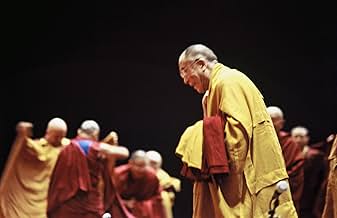
There's one moment however in his meeting with the H.H. the 14th Dalai Lama that brilliantly reveals the chasm between these two worlds. Asked about it, the Dalai Lama explains to him what he believes to be the center of the universe, inside of each one of us, doing this with the goodhearted laugh that characterizes him. Mistaking this radiance of equanimity and happiness for an attempt at humour, Herzog quips back that he shouldn't tell his wife about this. The moment follows an awkward pause of silence and a dumbfounded look by the DL.
The above incident, which may reflect badly on him from a formal point but still reflects something, he chose to keep on the film as both a way of undercutting a solemnity he perhaps sees as banal and of showing how far the two cultures are. Herzog may be a stranger here but he's still a talented filmmaker.
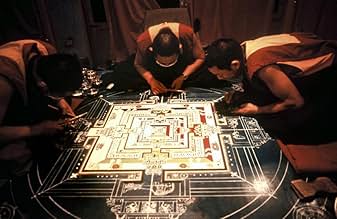
And more. The uproar of the pilgrims, how they prepare food and tea for the monks, how they crowd for a good view of the Dalai Lama, he contrasts with the booming silence inside the sanctum, punctured repetitively by the sounds of monks at work on the great sand mandala, the representation of the cosmos.
This is one of the beautiful contrasts of the film. How the superstition of the peasants, who clamor for a crumble of a sacred dumpling thought to be a blessing, with the complex philosophical discussions on concepts of emptiness held openly among the monks elsewhere.
What do the simple folks who came down for this from Nepal understand of shunyata? What do we, in turn, understand of the spiritual importance of performing 100,000 asanas, sun salutations? And what does the Dalai Lama understand of the superstitions he practices in the ceremony, of dropping sticks to see where they may land as pointing into a direction?
Nevertheless, even a man of his own ideas like Herzog leaves this with newfound wisdom, with the potential to enrich us in turn. We get three unforgettable images in the end, all meditatios I will keep inside of me.
How the great sand mandala upon which the Tibetan monks worked tirelessly day and night is eventually destroyed, a palpable reminder of how all things come to pass. The different colored sands brushed aside blend together into abstract shape without pattern or meaning now, to be poured then into the river where after a time they will perhaps wash out in some distant shore.
In Graz, Austria, a security man stands guard in an almost empty hall, guarding nothing from nothing. The self, a barrier to our awareness.
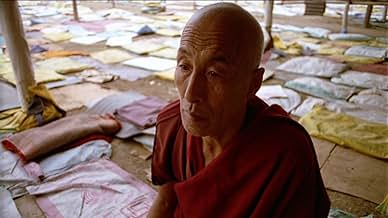
And back again in Bodh Gaya, the ceremony now over, we see the hundreds of thousands of empty pillows left over by the pilgrims lining the floor. In the middle of this emptiness kneels alone one last monk, lost in meditation.
We know that Herzog seeks truths in the extremities of life, in the madness that inhabits them. He often guides these subjects to be what he wants them to be, which is his personal reflection that we may find a more eloquent, resilient truth in what deviates rather than what abides, but his visual meditations are tried and true. True enough that Malick, a trobadour himself, has taken from them.
But is he merely a tourist in this, the Kalachakra initiation, a Westerner with a camera strapped around his neck approaching sacred ground with idle curiosity, or does he come in earnest, perhaps to learn?
He shows us the pilgrims travelling the thousands of miles to Bodh Gaya on foot, stopping every couple of steps on this journey that takes as much as three years for one of them, to prostrate themselves on the ground. He says nothing of this but there's no doubt in my mind on why he handpicks them among the crowds. They have a good story of spiritual struggle to tell, perhaps itself a form of holy madness. Elsewhere his camera prowls through a crowd of monks, in the end selectively settling upon the most mysterious face he could find.
There's one moment however in his meeting with the H.H. the 14th Dalai Lama that brilliantly reveals the chasm between these two worlds. Asked about it, the Dalai Lama explains to him what he believes to be the center of the universe, inside of each one of us, doing this with the goodhearted laugh that characterizes him. Mistaking this radiance of equanimity and happiness for an attempt at humour, Herzog quips back that he shouldn't tell his wife about this. The moment follows an awkward pause of silence and a dumbfounded look by the DL.
The above incident, which may reflect badly on him from a formal point but still reflects something, he chose to keep on the film as both a way of undercutting a solemnity he perhaps sees as banal and of showing how far the two cultures are. Herzog may be a stranger here but he's still a talented filmmaker.
And more. The uproar of the pilgrims, how they prepare food and tea for the monks, how they crowd for a good view of the Dalai Lama, he contrasts with the booming silence inside the sanctum, punctured repetitively by the sounds of monks at work on the great sand mandala, the representation of the cosmos.
This is one of the beautiful contrasts of the film. How the superstition of the peasants, who clamor for a crumble of a sacred dumpling thought to be a blessing, with the complex philosophical discussions on concepts of emptiness held openly among the monks elsewhere.
What do the simple folks who came down for this from Nepal understand of shunyata? What do we, in turn, understand of the spiritual importance of performing 100,000 asanas, sun salutations? And what does the Dalai Lama understand of the superstitions he practices in the ceremony, of dropping sticks to see where they may land as pointing into a direction?
Nevertheless, even a man of his own ideas like Herzog leaves this with newfound wisdom, with the potential to enrich us in turn. We get three unforgettable images in the end, all meditatios I will keep inside of me.
How the great sand mandala upon which the Tibetan monks worked tirelessly day and night is eventually destroyed, a palpable reminder of how all things come to pass. The different colored sands brushed aside blend together into abstract shape without pattern or meaning now, to be poured then into the river where after a time they will perhaps wash out in some distant shore.
In Graz, Austria, a security man stands guard in an almost empty hall, guarding nothing from nothing. The self, a barrier to our awareness.
And back again in Bodh Gaya, the ceremony now over, we see the hundreds of thousands of empty pillows left over by the pilgrims lining the floor. In the middle of this emptiness kneels alone one last monk, lost in meditation.
Excellent Herzog fare; surreal, stylistic, yet real
I just saw Wheel of Time yesterday at its premiere in Toronto, where Herzog was present. As usual, Herzog creates a compelling film: a portrait of a traditional Bhuddist initiation ceremony. Specifically, we are shown the pilgrimmage of hundreds of thousands of people to India and one year later, to a similar ceremony in Austria. On a purely documentary level, this winning film is a fascinating piece, giving insight into this ancient ceremony (including the pilgrimmage itself), as well as showing us the painstaking construction of a large "mandala" made out of colored sand, with a "wheel of time" intricately designed in its center. The interviews with the Dalai Lama were interesting and even humorous. On an artistic level, it is also a winner, as Herzog mixes stylistic poses and environmental landscapes within the structure of the documentary. Of course, Herzog's critics call this self-indulgence, but I strongly disagree. Herzog operates on a subconcious level in most of his films, including his narrative features, and actually succeeds where other "artsy" filmmakers fail miserably. Herzog has produced yet another fascinating masterpiece.


Did you know
- Quotes
The Dalai Lama: All religions carry same message. Message of love, compassion, forgiveness, tolerance, contentment, self-discipline. I think we need these qualities, irrespective of whether we are believer or non-believer, because these are the source of a happy life.
- SoundtracksHimal
Performed by Prem Rama Autari
- How long is Wheel of Time?Powered by Alexa
Details
Contribute to this page
Suggest an edit or add missing content