

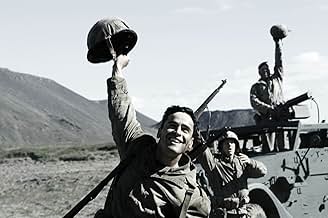
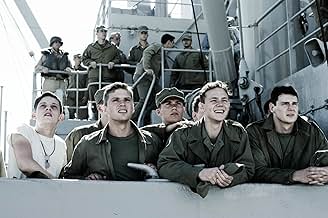
The life stories of the six men who raised the flag at the Battle of Iwo Jima, a turning point in World War II.The life stories of the six men who raised the flag at the Battle of Iwo Jima, a turning point in World War II.The life stories of the six men who raised the flag at the Battle of Iwo Jima, a turning point in World War II.
- Nominated for 2 Oscars
- 16 wins & 28 nominations total




Featured reviews
The story is realistic and very compelling by not glorifying war
(My Comment) The film was based on the book written by Doc's son, James Bradley. It wasn't until his father's death that he found out that Doc was one of the Iwo Jima flag raisers. Soldiers with real combat experiences usually keep their war stories to themselves. Clint Eastwood directed the film, and he didn't pull any punches in the battle scenes, even though the battle for Iwo Jima was considered one of the bloodiest against the Japanese in the Pacific. The only problem I had with the movie was that Eastwood used too many flashbacks that jumped around and made the movie hard to follow. The movie would have been better if Eastwood had gone in chronicle order with some flashbacks. During the battle scenes, you actually see the chaos that soldiers encounter on the battlefield. Overall, I found the story to be realistic and very compelling by not glorifying war. It is a long movie, but the time passes very fast. This film will receive many Oscar nominations. Some of the movie is graphically violent and shows the dark side of war, and the effects war has on our returning soldiers. (Warner Brothers Pictures, Run time 2:12, Rated R) (8/10)
Impressive depiction of war, less successful on an emotional level
I must admit, this one has elements of greatness in almost every department, but somehow these don't quite glue together as intended. The film seems to suffer from three evenly strong-handed approaches. The script by Paul Haggis eagerly wants to take us on an emotional roller-coaster in the second half, where the focus increasingly shifts to the story of Ira Hayes in the aftermath of the battle. There's obviously a strong hand of Steven Spielberg, who always wants to show us the human side of the story, which Clint obviously wants too, but he tends to do it in a different way. There seems to be a clash of wills, with these three major forces at work here. Ultimately, FLAGS OF OUR FATHERS is not about the war proceedings itself, but how the war affected the men who fought in it themselves, and how they refused to be seen as heroes.
It's hard to dislike any of Clint Eastwood's films and with this one, and the follow-up LETTERS FROM IWO JIMA, he made two films of epic proportions, that will undoubtedly compete for the Oscars. Both of the films that is, as they were released by different distributors, "Flags" is with Dreamworks and "Letters" with Warner Brothers.
We'll see, so far, so good. I wasn't blown away by this one, but certainly a film to respect. Difficult to judge this, before seeing the follow-up LETTERS FROM IWO JIMA, which shows the Japanese perspective of the story. I strongly suspect Clint saved the best for last and that "Letters" will be his ultimate showcase.
Camera Obscura --- 7/10
Flag Bearers.
An amazing accomplishment
The problem with war movies about real people is that you have to deal with complexities of character and plot that the genre simply doesn't lend itself easily to.
So when the story at hand aims to pose questions like "what does it mean to do the wrong things for the right reasons" and tries to debunk the popular myth of herodom, there's very little margin for error.
Enter Clint Eastwood. Never one to shy away from challenging stories, this is a much bigger effort than his usual understated character dramas. On the one hand, it doesn't "feel" like a Clint Eastwood movie, but on the other, it feels at home in his themes of used-up heroes -- the person behind the larger than life persona. These are complex characters in very difficult situations, and he presents them in a way that's straightforward and non-judgmental, so we're left to decide the answers to the film's central conflicts ourselves.
To a person, the cast is up to the challenge. It's hard not to admire Ryan Phillippe for a restrained and thoughtful performance, but the real kudos go to Adam Beach. Almost every aspect of Beach's character is cliché, with one minor exception - that's really the way Ira Hayes was. So the challenge was to portray Hayes as a real person despite the cliché, and the result is one of the most heartbreaking and troubling performances in the film. Here's a guy who is portrayed as a hero, who really has no answers at all.
There's a lot not to like about the film. It's not "entertaining" per se, in the same way that any war memorial in DC is not entertaining. Nor is it a particularly approachable film. What it lacks in popcorn-munching entertainment value, it replaces with gravitas. This is an important film, about an important time. It's status as a valuable history lesson is secondary to it's reflections on human nature and our society. As such, it deserves to be seen, and contemplated, and appreciated.
I can't wait for Letters From Iwo Jima (the companion piece, also from Clint Eastwood, told from the Japanese point of view.) Taken together, the scope of this project is breathtaking.
War vs Hollywood


Did you know
- TriviaThe story about the flag raising being posed was true. It was started, ironically, by Joe Rosenthal. He did not know he had taken the famous photograph until he returned to the States. He did, however, take a second photograph of the five Marines and one Navy Corpsman gathered around the flag. When people asked if he had posed the photograph, he, thinking they were referring to the second photograph said "Of course". It was only after seeing the first photograph that he realized they were referring to that photograph and not the second one.
- GoofsIn explaining the importance of a successful bond drive, the treasury representative says that the fuel dumps are empty and "our Arab friends only take bullion." At the time of World War II, America was essentially self sufficient in oil production and not dependent on Arab oil. While oil was discovered in some Arab countries before the war, it was not extensively developed until after the war.
- Quotes
[last lines]
James Bradley: I finally came to the conclusion that he maybe he was right. Maybe there's no such thing as heroes. Maybe there are just people like my dad. I finally came to understand why they were so uncomfortable being called heroes. Heroes are something we create, something we need. It's a way for us to understand what's almost incomprehensible, how people could sacrifice so much for us, but for my dad and these men, the risks they took, the wounds they suffered, they did that for their buddies. They may have fought for their country but they died for their friends. For the man in front, for the man beside him, and if we wish to truly honor these men we should remember them the way they really were, the way my dad remembered them.
- Crazy creditsThere is an additional short sequence after the credits have ended.
- SoundtracksKnock Knock
Written and Performed by Kyle Eastwood, Michael Stevens, Andrew McCormack and Graeme Flowers
Details
- Release date
- Country of origin
- Official sites
- Language
- Also known as
- La conquista del honor
- Filming locations
- Production companies
- See more company credits at IMDbPro
Box office
- Budget
- $90,000,000 (estimated)
- Gross US & Canada
- $33,602,376
- Opening weekend US & Canada
- $10,245,190
- Oct 22, 2006
- Gross worldwide
- $65,900,249
- Runtime
- 2h 15m(135 min)
- Color
- Sound mix
- Aspect ratio
- 2.39 : 1