IMDb RATING
6.6/10
2.3K
YOUR RATING

An emotionally cold man leaves the safety of his Alpine home to seek a heart transplant and an estranged son.An emotionally cold man leaves the safety of his Alpine home to seek a heart transplant and an estranged son.An emotionally cold man leaves the safety of his Alpine home to seek a heart transplant and an estranged son.
- Director
- Writers
- Stars
- Awards
- 4 nominations total


Yekaterina Golubeva
- La jeune femme russe
- (as Katia Golubeva)

Florence Loiret Caille
- Antoinette
- (as Florence Loiret-Caille)


- Director
- Writers
- All cast & crew
- Production, box office & more at IMDbPro
6.62.2K
1
2
3
4
5
6
7
8
9
10
Featured reviews
movies, dreams and dirt
Two things haunt you throughout L'intrus (The Intruder): who's the intruder and is it a movie or a dream you're watching? The ending is so shocking that for a while you're at a loss for an answer to either of those questions. The intruder pops up as different characters, different men in different circumstances who don't belong in the scene, so they're expelled from it, kindly or brutally, but often without emotional involvement. The main character, Louis, is a contemptible man. He's got rough ways, some mean job and no heart. He needs one and goes after it. He has a heart transplanted and afterwards decides to start a new life. Can this man succeed in his quest for redemption? A guy like that could cut your throat at the drop of a hat. You know it but Claire Denis doesn't encourage you to judge him. Occasionally, there's a young Russian woman -a beautiful girl who seems to inhabit someplace between heaven and earth - who does judge him. She may even punish him. But not Denis. There's the character played by Beatrice Dalle who wants no business with him: don't touch me, she says. But Denis lets this man be himself, films him in his self-absorbed quest. I don't know if what she films is the heart or the mind but it isn't the traditional plot basics. Whatever she films, you get it in the end. You know who's "the" intruder, you know why, more or less, and some scenes come back to your mind with their full meaning. But was it a movie or a dream?
Others in the fragile Self
First of all, I liked very much the central idea of locating the '' intruders'', Others in the fragile Self, on various levels - mainly subconscious but sometimes more allegorical. In fact the intruders are omnipresent throughout the film : in the Swiss-French border where the pretagonist leads secluded life; in the his recurring daydream and nightmare; inside his ailing body after heart transplantation.... In the last half of the film, he becomes intruder himself, returning in ancient french colony in the hope of atoning for the past.
The overall tone is bitter rather than pathetic, full of regrets and guilts, sense of failure being more or less dominant. This is a quite grim picture of an old age, ostensibly self-dependent but hopelessly void and lonely inside. The directer composes the images more to convey passing sensations of anxiety and desire than any explicit meanings. Some of them are mesmerizing, not devoid of humor though, kind of absurdist play only somnambulist can visualize.
The overall tone is bitter rather than pathetic, full of regrets and guilts, sense of failure being more or less dominant. This is a quite grim picture of an old age, ostensibly self-dependent but hopelessly void and lonely inside. The directer composes the images more to convey passing sensations of anxiety and desire than any explicit meanings. Some of them are mesmerizing, not devoid of humor though, kind of absurdist play only somnambulist can visualize.
Comfortably Comforting
My take on this, at our local festival where people would see me so often they thought me a better source than I may actually have been, began with a head shake: "Well, I can't summarize the plot, but it's a really superb character study of an extremely scary man." Then, slight embarrassment, I ran into someone who actually knew what had gone down, that is, from whom Trebor unwittingly gets his new heart. It'd been my last film in a long, long day halfway through the festival. Maybe I'd dozed. The better a film is the more likely it triggers daydreams that send me really dreaming. Don't know. Did know there was an O'Henry twist achingly just beyond my ken as things finished. And knew it had to do with the heart, hence the quietly hilarious talent search. My plot-loss remark had more to do with intricacies of Trebor's connections in France, his relation to the dog woman and so on, stuff I'd been wide awake for. Denis barely glances at details that might have anchored another director's treatment.
But I write these things too often from memory, especially festival films, films whose DVD I don't have at hand (Le Lait de la tendresse humaine is one of many examples.), and plot kinks fade much more quickly than broader impressions. Still, or already, L'Inrus in my memory is beyond all else a character study of a sort of dark-side superman, a super fiend not ensconced in genre or historical trappings but active and plausible, relatively soft-spoken, driven but patient, right among us. The scar, once he attains it, makes him, just visually I mean, in image, a sort of hybrid Frankenstein monster, mad doctor and creation all in one. The actual doctors are his tools. If he doesn't extract and install the heart himself, it's only because it's not possible. He's the force, always, the parasite consuming everyone he touches and finally himself. What else is he? To suggest that he's us, the First World versus the Third, seems too simple since he feeds no less on his fellow First Worlders, on all of us.
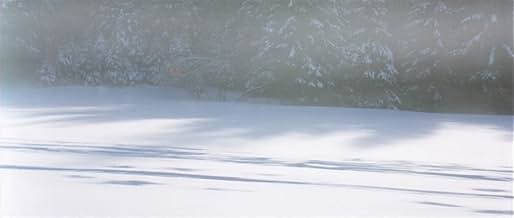
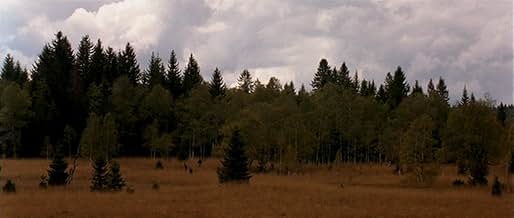
Denis's camera's eye - when it looks at things I know - goes usually where mine would, so I tend to trust her when she looks at things I don't know. Snow trekking, too-fast bicycling, and forest darkness I've known in small ways, but the South Seas not at all, so I made better entry into L'Intrus, both France and the crystalline isles of its finish, than into Beau Travail. L'Intrus is, for me, a very comfortable discomforting film. It's a sequence of places portrayed familiarly, with a intimacy that allows us to know them whether we've seen the reality or not. A single image, Trebor cycling, his massive weight on the thin racing frame, the sounds of violated air and shrieking tires, the asphalt ribbon, the dark-in-bright-sun evergreens, cued me that the film would be linear, a road trip, a single will-driven thrust.
Despite Trebor's personal power, he's a human failure. No matter who he's with, he's alone, though apparently he hasn't always been. His body aborts life twice, first to need the new heart, then despite it. L'Intrus is tragedy. Trebor is hubris.
I'm navigating perilously the thread of what I remember. Let's leave it at that.
But I write these things too often from memory, especially festival films, films whose DVD I don't have at hand (Le Lait de la tendresse humaine is one of many examples.), and plot kinks fade much more quickly than broader impressions. Still, or already, L'Inrus in my memory is beyond all else a character study of a sort of dark-side superman, a super fiend not ensconced in genre or historical trappings but active and plausible, relatively soft-spoken, driven but patient, right among us. The scar, once he attains it, makes him, just visually I mean, in image, a sort of hybrid Frankenstein monster, mad doctor and creation all in one. The actual doctors are his tools. If he doesn't extract and install the heart himself, it's only because it's not possible. He's the force, always, the parasite consuming everyone he touches and finally himself. What else is he? To suggest that he's us, the First World versus the Third, seems too simple since he feeds no less on his fellow First Worlders, on all of us.
Denis's camera's eye - when it looks at things I know - goes usually where mine would, so I tend to trust her when she looks at things I don't know. Snow trekking, too-fast bicycling, and forest darkness I've known in small ways, but the South Seas not at all, so I made better entry into L'Intrus, both France and the crystalline isles of its finish, than into Beau Travail. L'Intrus is, for me, a very comfortable discomforting film. It's a sequence of places portrayed familiarly, with a intimacy that allows us to know them whether we've seen the reality or not. A single image, Trebor cycling, his massive weight on the thin racing frame, the sounds of violated air and shrieking tires, the asphalt ribbon, the dark-in-bright-sun evergreens, cued me that the film would be linear, a road trip, a single will-driven thrust.
Despite Trebor's personal power, he's a human failure. No matter who he's with, he's alone, though apparently he hasn't always been. His body aborts life twice, first to need the new heart, then despite it. L'Intrus is tragedy. Trebor is hubris.
I'm navigating perilously the thread of what I remember. Let's leave it at that.
More than just visual
The film is not visually stunning in the conventional sense. It doesn't present a series of pretty pictures. Instead it is a visually interesting film. It forces the viewer to constantly process or perhaps imagine the context of the various shots. This sort of thing is easy to try but hard to succeed at. The film refuses to use the crutch of a genre to help the less than fully engaged viewer get what's going on. Instead the film touches on and moves through a number of different genres. The trick to loving the film is being able to enjoy this playfulness. I suspect 99% of North American viewers will just not get it. If you try to pin down the narrative of this film, or the philosophical message, or the symbolist structure, etc. you will waste your time. There are none of these. The film only feints towards these genres and others at times. The only unifying force in the film is Claire Denis's own sense of what fits together. There are so few feature length films that come close to satisfying Kant's description of what art is, namely the enjoyment of the power of judgment itself instead of simply subsuming experiences under concepts. Film usually takes the easy way out and opts for the simpler pleasure of understanding what's happening. Most film is not art. Most film doesn't come close to art. When a film does, as this one does, and is still enjoyable by a large range of viewers, it's something of a miracle. My on negative comment is that at times I find the film too simplistically buying in to the various narrative threads that run through it. The Tahiti father-son narrative, even though it's not exactly conventional, ends up making things a little to clear and simple. It dominates too much.
5cwx
A bit too far over most of our heads
Well shucks, I tried to like it, and at least I succeeded in not hating it and in getting something out of it (whereas several walked out of the theater during the "festival" screening that I attended). That said, filmmaker Claire Denis clearly wasn't willing to meet me halfway. This film is clearly inaccessible by design. Not only do you not quite know what things mean, you don't even know why things are happening or even what is happening. In fact, you're not even sure what thematic ballpark we're supposed to be in. Entire sequences and characters are introduced with no rhyme or reason. And while there are plenty of films I've seen lately that have similar obstacles to enjoyment, there is often enough beauty or artfulness that those concerns don't ruin the experience. Denis, however, prefers to assail the viewer with images that fail to even appeal to the viewer in any aesthetically comprehensible manner. I'm not saying it's crap. I'm just saying it's not for me, or for most people, and that there's nothing wrong with that.


Did you know
- TriviaArchival footage from Paul Gégauff's Le Reflux is used for the scenes with a younger Michel Stubor.
- ConnectionsEdited from Le reflux (1965)
- How long is The Intruder?Powered by Alexa
Details
Box office
- Gross US & Canada
- $40,853
- Opening weekend US & Canada
- $3,527
- Dec 25, 2005
- Gross worldwide
- $40,853
- Runtime
- 2h 10m(130 min)
- Color
- Sound mix
- Aspect ratio
- 2.35 : 1
Contribute to this page
Suggest an edit or add missing content