
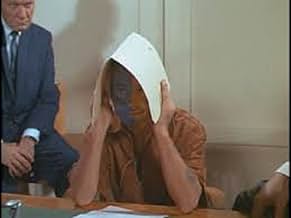
Friday and Gannon encounter Benjy "Blue Boy" Carver, an LSD user. Because of the then-lack of any laws against the use of LSD, they are unable to make a case against him, and Carver's parent... Read allFriday and Gannon encounter Benjy "Blue Boy" Carver, an LSD user. Because of the then-lack of any laws against the use of LSD, they are unable to make a case against him, and Carver's parents are of no help. Finally, legislation is passed against LSD use and sale, but by then it ... Read allFriday and Gannon encounter Benjy "Blue Boy" Carver, an LSD user. Because of the then-lack of any laws against the use of LSD, they are unable to make a case against him, and Carver's parents are of no help. Finally, legislation is passed against LSD use and sale, but by then it may be too late for "Blue Boy".


- Ray Murray
- (as Olan Soulé)


- Edna Mae Dixon
- (as Heather Menzies)

- Main Title Announcer
- (voice)
- (uncredited)
- Teddy Carstairs
- (uncredited)
- Landlady
- (uncredited)

- Ben Riddle
- (uncredited)

- Narrator
- (voice)
- (uncredited)

- Philip Jamison
- (uncredited)
- Director
- Writer
- All cast & crew
- Production, box office & more at IMDbPro
Featured reviews
"The LSD Story" was an effective initial ep of "Dragnet 1967"
Coming on Like a Full-Blown Acid Trip
Jack Webb was the impetus and guiding force for "Dragnet." Having had a bit part in the excellent 1948 film noir "He Walked by Night," based on a true story, Webb was inspired by the police procedures depicted in the movie to create a half-hour show, based on actual case files, that traced the investigation and solution of an array of both felonies and misdemeanors. Launched as a midseason replacement for the sitcom "The Hero" in January 1966, "Dragnet 1967" opened with a story truly ripped from the headlines, "The LSD Story."
A rock-ribbed conservative, Webb, who served as the series' producer, director, occasional writer, and star Sergeant Joe Friday, had long spotlighted illegal drug abuse on "Dragnet," and although the show's depictions--and Webb's diatribes--would soon become strident, "The LSD Story" is comparatively subdued.
Granted, Friday and his partner Officer Bill Gannon soon encounter teenage acid tripper Benjie "Blue Boy" Carver (Michael Burns) with his head buried in the dirt after having chewed bark off a tree (seemingly predating Euell Gibbons), but Webb's script makes it clear that the scourge of LSD, a powerful psychedelic drug derived from ergotamine, has taken the Los Angeles Police Department by surprise as it doesn't know much about the drug, which along with marijuana epitomized the Sixties counterculture.
Accordingly, Blue Boy, despite his erratic behavior, is able to beat the rap with help from his parents (Eve Brent, Robert Knapp). But when other youths, including a pair of teenage girls (Shari Lee Bernath, Heather Menzies), begin freaking out after hooking down "number five capsules" containing LSD, the trail leads quickly to Blue Boy.
Depictions of the big bust suggest Webb's unfamiliarity with the burgeoning psychedelic scene; the party Friday and Gannon crash seems more like heroin junkies nodding out than the kinetic kaleidoscopes soon to become pop-culture staples in portrayals of the acid culture; moreover, at the climax, LSD is not the drug to blame for the inevitable tragedy.
Decades later, we have the luxury of knowing a fascinating secret about LSD, which "Dragnet 1967" had seized upon as a public menace to inaugurate its return to television. Webb and the general public could not have known this at the time of production, but LSD had been the centerpiece of MK-ULTRA, an extensive mind-control program conducted by the Central Intelligence Agency in the 1950s--a decade before the 1960s counterculture discovered LSD--to find either a "truth serum" or a debilitating agent as a weapon in the Cold War. CIA agents who, wittingly or not, had been dosed with acid were known as "enlightened operatives."
Indeed, one such witting CIA operative was Al Hubbard, whose LSD experiences were so enlightening that he became the drug's earliest large-scale advocate, known as "the Johnny Appleseed of LSD." He made psychiatrists aware of the drug; in turn, they prescribed it as a therapeutic agent ("The LSD Story" notes that acid was still legal) to high-profile patients such as actor Cary Grant. One such doctor was Timothy Leary, soon to become a notorious LSD proselytizer.
The CIA also used agencies such as the Veterans Administration to solicit volunteers for LSD experimentation. One such volunteer was writer Ken Kesey, whose experiences working at a VA hospital informed his novel "One Flew Over the Cuckoo's Nest," and whose LSD experiences at the hospital inspired his own proselytizing: Kesey hosted a series of "acid tests"--"The LSD Story" uses his line, "Can you pass the acid test?"--that also featured a rock band called the Warlocks; they later became famous as the Grateful Dead, the archetypal exponent of acid rock.
Again, we have the benefit of hindsight into circumstances unknown to the then-contemporary public at large, although had Joe Friday known of them, he might note sardonically that it was "your tax dollars at work" as, irony of ironies, the CIA was indirectly but ultimately responsible for introducing LSD to the unwashed masses. But we do view these "Dragnet" episodes retrospectively, with a fuller context informing the environment in which they were produced, and "The LSD Story" remains fascinating for its cautious establishment reaction to a (counter-) cultural phenomenon about to come on like a full-blown acid trip.
REVIEWER'S NOTE: What makes a review "helpful"? Every reader of course decides that for themselves. For me, a review is helpful if it explains why the reviewer liked or disliked the work or why they thought it was good or not good. Whether I agree with the reviewer's conclusion is irrelevant. "Helpful" reviews tell me how and why the reviewer came to their conclusion, not what that conclusion may be. Differences of opinion are inevitable. I don't need "confirmation bias" for my own conclusions. Do you?
LS Delirious
Show was almost fun to watch, but it was soooo stupid. It's a shame that the public believed the silly drivel of non-facts told in this episode.
Characters in program are having fun listening to music etc...but you can't have any fun on Dragnet. If you are, it must be against the law.
It was badly dated and irrevocably ignorant, but that was what this entire show was about - most of the time. And it is told to us in such a serious tone, that I couldn't stop snickering at this comic misrepresentation of LSD.
A fun little trip
Sgt. Joe Friday is BACK -and he's gonna fix all those whacked-out 60's characters, starting with BLUE-BOY
And what a way to start!
This episode starts, with Joe and his newest partner Bill Gannon, respond to a call. And literally 'pick' Benjie'blue-boy' Carver's head (attached to his living body) out of the ground.
With a tight, single shot, 'blue-boy' gets right at it:
'Reality, man, reality! I can see the centre of the earth!'
And, with those immortal words (and more to follow) we're into the 60's man - tagging along with Sgt. Joe. And what a trip this will be.
This episode includes some of my - and, many others - favourite trippy moments, including the scene at the acid-eaters house; one girl's 'climbing' a stairs, another is snapping her fingers to that (invisible) bongo beat, and, the beatnik who has dialogue, is eating paint.
You cannot make this stuff up.
But, Jack can - and does he.
He trowels on the moralising, and, everything in Sgt. Joel's world IS black and white.
You're either a good upstanding citizen - meaning, a square, boring person, or, you're a freak, and will do anything to make him snarl. But, be certain of this: after Joe's given you his speeches, and his disgusted looks, he'll throw the book at you.
I love him. I miss him. And, he gave up Ms. Julie London for his jazz records.
Go figure.


Did you know
- TriviaAt the time this episode originally aired, 12 January 1967, LSD was not an illegal drug in the United States. Possession of LSD was made illegal in the United States on 24 October 1968, and it was listed as a Schedule I controlled substance by the United Nations in 1971.
- GoofsWhen Friday and Gannon go to Benji Carver's apartment and find that he has overdosed on LSD, Carver is supposed to be dead, but he blinks immediately after Friday leans down to take his pulse.---Incorrect: at no point is the kid seen blinking at all. In fact, he is barely seen partially, and for a split second, before Friday reaches (not leans down) for him.
- ConnectionsFeatured in TV Guide's 100 Greatest Episodes of All-Time (1997)
Details
- Runtime
- 30m
- Sound mix
- Aspect ratio
- 1.33 : 1