
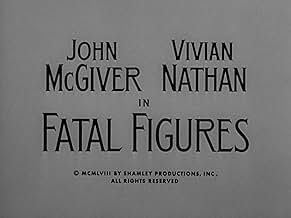
A meek bored man wants to feel important, so he commits increasingly serious crimes ranging from theft to eventual murder.A meek bored man wants to feel important, so he commits increasingly serious crimes ranging from theft to eventual murder.A meek bored man wants to feel important, so he commits increasingly serious crimes ranging from theft to eventual murder.
- Director
- Writers
- Stars


- Director
- Writers
- All cast & crew
- Production, box office & more at IMDbPro
7.0627
1
2
3
4
5
6
7
8
9
10
Featured reviews
The previous episode was a classic...."Fatal Figures", however, is far from a classic.
Familiar character actor John McGiver plays a most unusual guy. It seems his character has lived a very dull and ordered life so he decides he needs to leave a mark...a statistic of which he is a part. So he decides to murder someone just to make his mark....a rather strange and contrived reason to kill. In fact, he doesn't even care if he's caught and actually WANTS to be caught in order to make his mark....and when that doesn't happen, he decides to leave his statistical mark in another way.
This episode was just okay at best. Not terrible but harder than usual to believe nor care about one way or the other. A clear case where the writing disappointed.
This episode was just okay at best. Not terrible but harder than usual to believe nor care about one way or the other. A clear case where the writing disappointed.
Strange sense of humor?
From what I remember of John McGiver, he played parts where the character had a rather dry sense of humor. His line about the owner of the store who died being a friend of his, whom he had never talked to is one.
And Vivian Nathan's delivery of some of her lines, while meant to belittle John's character, were also done with a light tone.
A good fit for an Alfred Hitchcock episode.
It would also be interesting to look up the data for 1957.
Out of a population of 172 million, were there really 7124 murders and 16008 suicides?
One disturbing bit - that John's character wanted to murder to achieve fame - now in the time of mass shootings, not at all funny.
And Vivian Nathan's delivery of some of her lines, while meant to belittle John's character, were also done with a light tone.
A good fit for an Alfred Hitchcock episode.
It would also be interesting to look up the data for 1957.
Out of a population of 172 million, were there really 7124 murders and 16008 suicides?
One disturbing bit - that John's character wanted to murder to achieve fame - now in the time of mass shootings, not at all funny.
Deadly statistics
Don Taylor directed seven episodes of 'Alfred Hitchcock Presents', of varying quality. Of which "Fatal Figures" is the third, following the above average but unexceptional "The Deadly" and the excellent "The Right Kind of House". 'Alfred Hitchcock Presents' does have some light-hearted, droll humoured episodes, but the premise for "Fatal Figures" was one of those could have gone either way ones. With a real danger of being really daft if not done right.
"Fatal Figures" is watchable and fun enough and the acting saves it. It is a long way from a great episode though and does fall into the trap that the premise had unfortunately, after the absolutely wonderful previous episode "Lamb to the Slaughter" this was a disappointment. When it comes to Taylor's episodes, "Fatal Figures" is closer to "The Deadly" in quality rather than "The Right Kind of House" for similar reasons to each other. This reviewer does give it a small recommendation but doesn't consider it a must.
Quite a lot is good here. John McGiver is suitably droll and befuddled and Vivian Nathan is a very effective contrast and does sliminess unsettlingly. The chemistry between them is strong. Hitchcock's bookending is as ironic as ever and in an entertaining way that fits the light hearted tone of the story very well.
The production values are simple and have atmosphere and the theme music is appropriately macabre. Did enjoy the light hearted-ness of the script and there are intriguing moments in the story. Taylor directs more than competently.
However, "Fatal Figures" is rather flawed when it comes to the story. It has moments, but badly lacks suspense, feels over-stretched (making for some draggy run out of ideas like pacing in the second half) and goes too far on the silliness. Especially the ending, which is truly ludicrous.
Also felt that there could have been more tautness in the writing and the pacing plods. While McGiver does a good job in the lead role, not enough is done allowing one to care for him and he does act in a way that makes one feel frustrated by the decisions he makes.
Overall, above average and decent but not much here that is mind blowing. 6/10.
"Fatal Figures" is watchable and fun enough and the acting saves it. It is a long way from a great episode though and does fall into the trap that the premise had unfortunately, after the absolutely wonderful previous episode "Lamb to the Slaughter" this was a disappointment. When it comes to Taylor's episodes, "Fatal Figures" is closer to "The Deadly" in quality rather than "The Right Kind of House" for similar reasons to each other. This reviewer does give it a small recommendation but doesn't consider it a must.
Quite a lot is good here. John McGiver is suitably droll and befuddled and Vivian Nathan is a very effective contrast and does sliminess unsettlingly. The chemistry between them is strong. Hitchcock's bookending is as ironic as ever and in an entertaining way that fits the light hearted tone of the story very well.
The production values are simple and have atmosphere and the theme music is appropriately macabre. Did enjoy the light hearted-ness of the script and there are intriguing moments in the story. Taylor directs more than competently.
However, "Fatal Figures" is rather flawed when it comes to the story. It has moments, but badly lacks suspense, feels over-stretched (making for some draggy run out of ideas like pacing in the second half) and goes too far on the silliness. Especially the ending, which is truly ludicrous.
Also felt that there could have been more tautness in the writing and the pacing plods. While McGiver does a good job in the lead role, not enough is done allowing one to care for him and he does act in a way that makes one feel frustrated by the decisions he makes.
Overall, above average and decent but not much here that is mind blowing. 6/10.
I'm confused...
Wouldn't figures for 1957 be published in 1958? So his crimes would have been included on the 1958 totals (published 1959). Maybe I don't understand 1950's almanac....
Driven by Numbers
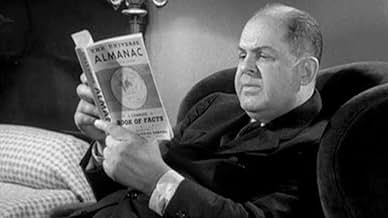
Of course, one could say that the whole thing is ludicrous. However, as John McGiver points out to us time after time, we are all nothing; we are just an unrecognizable piece of America. He uses an almanac to see just how insignificant he is. It becomes his purpose to put himself into the statistical records as a somebody. He does this by finding categories that have less people in them and then finding out a way to join that group. Unfortunately, the statistics he chooses are those that involve murder and other acts of violence. He lives with a virago of a sister who has cut off every chance of him being happy. She is about as slimy as any villain with a pencil thin mustache. She becomes furious when he tries to avoid their weekly Chinese Checkers game (a perfectly dull game for incredibly dull people). She harasses and belittles him. Had he wished to join a positive statistical group, things might have worked out better. But she has stolen any resolve he has had. Anyway, there is one page in the almanac and that is the driving force. McGiver is quite good in this. He literally carries on conversations with himself and goes about things in a most business-like way.


Did you know
- TriviaDuring the introduction, Mr. Hitchcock gives a supercomputer a simple problem to solve, and the machine responded with the answer "THINK." This word "THINK" was the slogan for IBM, already well known by the time of this airing.
- GoofsAfter Harald George Goames has stolen a car, he corrects the car theft statistics in his almanac with a ballpoint pen. However, in the next shot, the statistics page can be seen again with the page uncorrected.
- Quotes
Harold George Goames: Suicides... sixteen thousand and eight.
[loads gun as camera pans away]
Harold George Goames: Sixteen thousand and NINE!
[BANG]
- SoundtracksFuneral March of a Marionette
Written by Charles Gounod
Details
- Runtime
- 30m
- Color
- Aspect ratio
- 1.33 : 1
Contribute to this page
Suggest an edit or add missing content