
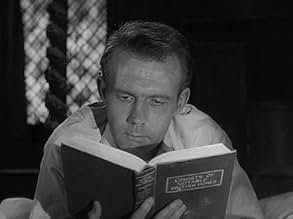
Rich American Howard Latimer visits London, and bets 1,000 pounds that he can spend the night in a room that is said to be haunted.Rich American Howard Latimer visits London, and bets 1,000 pounds that he can spend the night in a room that is said to be haunted.Rich American Howard Latimer visits London, and bets 1,000 pounds that he can spend the night in a room that is said to be haunted.
- Director
- Writers
- Stars




- Hanson
- (as Eric Snowdon)


- Club Patron
- (uncredited)

- Club Patron
- (uncredited)
- Director
- Writers
- All cast & crew
- Production, box office & more at IMDbPro
Featured reviews
bad choice
What i do notice as a dominant fact to much of the episodes is that we are always allowed to define the degree of human manipulation or super natural unexplained events that take place (or that is revealed to us). So, in this case, we suspect the American is being manipulated, but we also wonder whether we are being manipulated as well. The plot is predictable, but it leaves some shadows, which might be enough for us to wonder enough to feel in doubt. Is there a real ghost? Would the manipulators fall in their own trap and be caught in the middle of something they didn't understand? Would the American over top his deceivers and come out with something more clever? Well, apparently they chose the dullest solution. The American does exactly what is intended by the money chasers, everything is according to the book (not the one he reads, i wish it was according to that). We have a minor twist, of finding out what happened to the American after the night in the mansion, but instead of fun irony, they moralize. Bad choice, to me.
So it fails in the plot, and to me it fails in the building of the tension in the ghost house. That has to do with direction, but also probably due to the ghost itself, which is laughable by today's production standards, so it is badly dated.
My opinion: 1/5
http://www.7eyes.wordpress.com
Don't Bet On Ghosts
There is also a bit of information mentioned earlier about a nearby lunatic asylum, and I don't see this as a spoiler, as, while there is some foreshadowing of what shall happen later on in the tale, it's near impossible for a first time viewer to guess the signifacence of it. The prospect, in this story, of gambling, an early wartime setting, a young American abroad, and out of his element, a ghost, and madness, is a tantalizing one even as the first half of the episode is otherwise somewhat prosaic and unremarkable. Things turn, literally, darker, in the second half, yet there's also some confusion for even a seasoned Hitchcock show viewer, as the "set-up", or introduction (as it were) is quite complicated as to the terms of the wager, and how or whether a ghost would react to being shot at. Nor is it made wholly clear who is going to be staying in this large manor house to ensure that the American will stick to his part of the bargain, and if he doesn't, how they can know. The episode pays off in the end, though it could have been a whole lot better with some different players and a better script. Michael Arlen's short story was a good one, yet the epsode, while above average in most respects, feels a bit second tier for this particular television series.
Hitchcock ghost story
The haunted gentleman
"The Gentleman from America" could have been better than it was and could have done a good deal more with its concept. It is another 'Alfred Hitchcock Presents' episode that is not one of the best, it is not even one of the best of Season 1. It is also not quite one of the worst, but it is in the lesser half of the first season. Director Robert Stevens did do a lot better episodes before and since "The Gentleman from America", actually had a hard time believing it was directed by him.
Sure there are good things. It doesn't fare badly visually, with some suitable eeriness in the photography and lighting. The main theme is still haunting and an ingenious use of pre-existing piece of classical music that has been long associated with the series (very like the 'Die Fledermaus' Overture in popular culture has been associated for a long time with Tom and Jerry). The bookending is once again suitably droll, dryly delivered by Hitchcock himself.
Biff McGuire does a good job in the lead role and the episode works well enough as a psychological character study ('Alfred Hitchcock Presents' did psychological character studies well more than once). It starts off intriguingly and there are some moments of nice suspense.
Moments that are too far and between in the second half. The story generally is too thin, with too little to sustain the length. Meaning the pace drags in stretches. Also thought that it was very predictable, with familiar territory given little freshness, as well as lacking spookiness. Some of it borders on silly, especially in the final quarter.
Despite liking to loving a good number of Stevens' 'Alfred Hitchcock Presents' episodes, his work here is undistinguished at best and quite routine. Did think that it could have been any other director, as this didn't somehow feel like Stevens. The ghost is more unintentionally goofy than scary and ruined by the very fake look. The dialogue doesn't sound natural and can be goofy.
Overall, watchable one time watch but not much more. 5/10.
Erratic but Suspenseful
I like the way Clanton projects a slightly snobbish air that irks regular guy McGuire into taking up the wager. Without that extra dimension the wager would not be as plausible.
Unfortunately, the haunted bedroom scene doesn't work as well as the opening—McGuire's behavior is not all that believable. Still, we wonder what the payoff will be, which doesn't come until five years later. If at the end, you have trouble fitting the various parts together, so did I.
Good performances by the principals. McGuire was an early series favorite, probably for his ordinary looks. It's not superior Hitchcock, but there's enough offbeat interest to keep you entertained.


Did you know
- TriviaAt the end of the episode, there is a promo for Alfred Hitchcock's newest film The Trouble with Harry (1955).
- GoofsHurstwood hands a gun to Latimer and tells him, "You have seven shots, in all." However, Latimer fires the gun nine times - once into the fireplace and eight more times when he's alone in the room.
- Quotes
[first lines]
Himself - Host: [Hitchcock is sitting in a high chair with a lit candle, a small box, and a couple of books all on a narrow desk in front of a closed door with a hung sign marked "QUIET"] Good evening. Do you believe in ghosts?
[the lit candle disappears]
Himself - Host: Of course not. I knew you didn't.
[the entire desk with the box and books disappears]
Himself - Host: Noise is the mortal enemy of good motion picture making and television broadcasting. That is why I hired this particular house. It is deathly quiet-
[people start screaming off screen; Hitchcock turns to look with mild annoyance]
Himself - Host: Most of the time. And its reputation for being haunted keeps away the curious.
[Hitchcock's high chair disappears]
Himself - Host: The shifting of scenery also seems to be better here. The human element has been removed. So, if you would just lean back and relax, I'll tell you a little ghost story. Please don't hesitate to turn out your lights. I'm sure the warm glow from the picture tube will be sufficient to melt all your fears of the dark. But, before we view with alarm, allow us to point with pride.
- SoundtracksFuneral March of a Marionette
Written by Charles Gounod
Details
- Runtime
- 30m
- Color
- Aspect ratio
- 1.33 : 1