The Priory School
- Episode aired Jul 16, 1986
- TV-PG
- 52m
IMDb RATING
8.0/10
1.1K
YOUR RATING

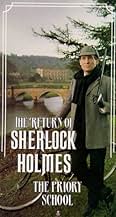
The headmaster of a prestigious prep school calls on Holmes for help when the ten year old only son of powerful but publicity-shy duke disappears.The headmaster of a prestigious prep school calls on Holmes for help when the ten year old only son of powerful but publicity-shy duke disappears.The headmaster of a prestigious prep school calls on Holmes for help when the ten year old only son of powerful but publicity-shy duke disappears.


Bryan Heeley
- Shepherd
- (uncredited)
- Director
- Writers
- All cast & crew
- Production, box office & more at IMDbPro
Featured reviews
Sherlock Holmes is hired by Dr. Huxtable, the headmaster of prestigious preparatory school Priory School. One of their students, the son of the Duke of Holdernesse, has disappeared but no ransom has been demanded. Also missing is Mr. Heidegger, the German master.
Great episode in the Sherlock Holmes series. Has the usual intrigue, delightfully Victorian settings and the wonderfully quirky and engaging performance by Jeremy Brett as Holmes.
Not among the best though. The plot feels a bit clumsy at times and from a point the perpetrators are reasonably obvious. Not a major problem but the episode doesn't quite have the tightness and gloss that most episodes have.
Great episode in the Sherlock Holmes series. Has the usual intrigue, delightfully Victorian settings and the wonderfully quirky and engaging performance by Jeremy Brett as Holmes.
Not among the best though. The plot feels a bit clumsy at times and from a point the perpetrators are reasonably obvious. Not a major problem but the episode doesn't quite have the tightness and gloss that most episodes have.
If you are interested in Holmes, or the way directors discover films, or both...
A walk through the Brett Holmes' adventures is, well an adventure. And there's every bit as much detective work involved. In these, you have three principles: Brett, who has some energy and an engaging notion of the character, a director and a screenwriter. As with all British mystery series, the game here is to have a different writer and director for each "episode." Perhaps there were production reasons for this.
Brett in this period was fat and dull from the drugs he was taking to control his condition, the very condition that made him and interesting Holmes. Internally exploding.
The writer is Bowen. I have encountered him many times before in various detective screenplays. each time I have been repelled by his decisions. Mostly, they are decisions to cut the viewer out of the discovery game. This is pernicious business, these decisions.
Film, even pedestrian TeeVee films, can be sharp, can help you butcher your demons, can start wildfires that cleanse. But only when the viewer is given power (and implicitly, respect). Often, this power comes free with the detective form, where we collaboratively weave narrative -- even what narrative means -- with the writer.
Bowen refuses us this, and I hate him for it because he actively scours it out, removes it.
So under normal circumstances, I'd be waving you off of this, especially since you likely will be seeing it on DVD and this is paired on a disk with a horrible episode, one of the worst experiences of all.
But here's the magic of film. Even a sleeping actor and a woefully mistaken writer cannot kill a project if the director (and his team) have vision. And this young director does. He would go from this to TeeVee detective projects with good writers, then on to some very competent movies indeed, a best picture Oscar.
So look at this and put yourself in the place of the director instead of the writer as you normally would do. And struggle with him around the barriers the world places in front of us, barriers that prevent a coherent narrative (in the form it would be called a "solution").
Its quite a miracle. There's one huge misstep, when the body is discovered. But look at how he lingers on a minor character, the innkeeper's wife. There's a whole story, a whole world in a few succinct moment with her.
Ted's Evaluation -- 3 of 3: Worth watching.
A walk through the Brett Holmes' adventures is, well an adventure. And there's every bit as much detective work involved. In these, you have three principles: Brett, who has some energy and an engaging notion of the character, a director and a screenwriter. As with all British mystery series, the game here is to have a different writer and director for each "episode." Perhaps there were production reasons for this.
Brett in this period was fat and dull from the drugs he was taking to control his condition, the very condition that made him and interesting Holmes. Internally exploding.
The writer is Bowen. I have encountered him many times before in various detective screenplays. each time I have been repelled by his decisions. Mostly, they are decisions to cut the viewer out of the discovery game. This is pernicious business, these decisions.
Film, even pedestrian TeeVee films, can be sharp, can help you butcher your demons, can start wildfires that cleanse. But only when the viewer is given power (and implicitly, respect). Often, this power comes free with the detective form, where we collaboratively weave narrative -- even what narrative means -- with the writer.
Bowen refuses us this, and I hate him for it because he actively scours it out, removes it.
So under normal circumstances, I'd be waving you off of this, especially since you likely will be seeing it on DVD and this is paired on a disk with a horrible episode, one of the worst experiences of all.
But here's the magic of film. Even a sleeping actor and a woefully mistaken writer cannot kill a project if the director (and his team) have vision. And this young director does. He would go from this to TeeVee detective projects with good writers, then on to some very competent movies indeed, a best picture Oscar.
So look at this and put yourself in the place of the director instead of the writer as you normally would do. And struggle with him around the barriers the world places in front of us, barriers that prevent a coherent narrative (in the form it would be called a "solution").
Its quite a miracle. There's one huge misstep, when the body is discovered. But look at how he lingers on a minor character, the innkeeper's wife. There's a whole story, a whole world in a few succinct moment with her.
Ted's Evaluation -- 3 of 3: Worth watching.
I'm not sure if Sir Arthur Conan Doyle might have gotten his idea for The Priory School from an American source, the kidnapping of Charlie Ross which happened about 20 years before he wrote this story. Child kidnappings were pretty rare and not well publicized for the most part until the Lindbergh baby case in 1932.
In any event the headmaster of The Priory School, Christopher Benjamin, calls in Sherlock Holmes because he's both concerned about the child and the attending bad publicity his school is going to receive. The child Nicholas Gecks is the ten year old son and heir to the Dukedom of Holdernesse. His dad and the current duke, Alan Howard, is a notoriously publicity shy individual, but his rather detached manner throughout the crisis is what's bothering Benjamin which is why he sends for Jeremy Brett and Edward Hardwicke.
There's of course more to the kidnapping than a simple snatch and ransom job. A German teacher has also gone missing from the school at the same time. How's it all connected and why is Alan Howard so cool towards the involvement of the greatest detective in the world in his son's case?
It all is revealed of course both the reason for the kidnapping and the Duke of Holdernesse's publicity shy ways. This is not a bad story from the Holmes case files. I do wonder where Conan Doyle might have gotten his inspiration.
In any event the headmaster of The Priory School, Christopher Benjamin, calls in Sherlock Holmes because he's both concerned about the child and the attending bad publicity his school is going to receive. The child Nicholas Gecks is the ten year old son and heir to the Dukedom of Holdernesse. His dad and the current duke, Alan Howard, is a notoriously publicity shy individual, but his rather detached manner throughout the crisis is what's bothering Benjamin which is why he sends for Jeremy Brett and Edward Hardwicke.
There's of course more to the kidnapping than a simple snatch and ransom job. A German teacher has also gone missing from the school at the same time. How's it all connected and why is Alan Howard so cool towards the involvement of the greatest detective in the world in his son's case?
It all is revealed of course both the reason for the kidnapping and the Duke of Holdernesse's publicity shy ways. This is not a bad story from the Holmes case files. I do wonder where Conan Doyle might have gotten his inspiration.
Holmes is brought in because of his ability to keep his cases from the public eye. Watson's portrayals occur well after the fact. In this one, a school boy at a private institution and his German teacher have disappeared. The trail proves one, requiring great patience and personal strength. The suspected perpetrator suddenly becomes a victim and the case gets rather ragged. At the center is the aristocratic father, whose world has become complicated. When one of Holmes' clients is as taciturn as this man, we know that the road will ultimately lead back to him in some way. The real joy of the episode is the use of several red herrings that need to be dismissed. The Victorian view of children born out of wedlock is certainly disturbing. It's interesting how such a "refined" culture needs to maintain its status through subterfuge and dishonesty. We still have some of this going on today. The unique thing about Holmes is that it is nearly always about the "case." While this episode plods on at times, it also teases us, and leads us astray. The clues are all there if you view it with knowledge of the conclusion. Good writing; good mystery.
This is a better than average episode which has good production values and which makes excellent use of the Westminster Abbey Choristers playing the part of pupils at the The Priory School. As ever Patrick Gowers is in overall charge of the music but credit is also given to Simon Preston as choirmaster .
But the burning question is: "What is the choral music that plays over the opening credits" It's hauntingly beautiful but I can't quite pin it down.


Did you know
- TriviaWatson points out that "cock fighting is illegal, and has been for fifty years." This refers to the Cruelty to Animals Act, 1835, and allows the events depicted to be dated to approximately 1885.
- Quotes
Sherlock Holmes: [Inquiring about the white pudding that Watson is eating in a run-down hostelry they are investigating] How is it, Watson?
Dr. John Watson: It is disgusting, Holmes.
- ConnectionsReferences The Hound of the Baskervilles (1983)
Details
Contribute to this page
Suggest an edit or add missing content