The Galileo Seven
- Episode aired Jan 5, 1967
- TV-PG
- 50m
IMDb RATING
7.6/10
4.8K
YOUR RATING

The Galileo, under Spock's command, crash-lands on a hostile planet. As the Enterprise races against time to find the shuttlecraft, Spock's strictly logical leadership clashes with the fear ... Read allThe Galileo, under Spock's command, crash-lands on a hostile planet. As the Enterprise races against time to find the shuttlecraft, Spock's strictly logical leadership clashes with the fear and resentment of his crew.The Galileo, under Spock's command, crash-lands on a hostile planet. As the Enterprise races against time to find the shuttlecraft, Spock's strictly logical leadership clashes with the fear and resentment of his crew.
- Director
- Writers
- Stars





Robert 'Big Buck' Maffei
- Creature
- (as Buck Maffei)

David L. Ross
- Transporter Chief
- (as David Ross)

Majel Barrett
- Enterprise Computer
- (voice)
- (uncredited)
Bill Blackburn
- Lieutenant Hadley
- (uncredited)
Frank da Vinci
- Lt. Brent
- (uncredited)

Eddie Paskey
- Lieutenant Leslie
- (uncredited)
- Director
- Writers
- All cast & crew
- Production, box office & more at IMDbPro
7.64.7K
1
2
3
4
5
6
7
8
9
10
Featured reviews
Spock vs. Everyone Else vs. Caveman Planet
When I was 8 years old on a family road trip, we popped in at a museum in Clovis, New Mexico. I remember nothing of the museum aside from their two giant spear props from this episode near an exhibit emphasizing the importance of the Folsom Point, which was an important discovery placing the earlier population of North America. It added a lot of weight to the viewing experience of this particularly creepy episode while home sick from school one day.
Years later at a restaurant I remember accidentally making eye contact with an elderly gentleman across the room. We nodded at each other and that was that. Then the next day at a nearby Chiller Theater convention I saw the man again sitting at a table with displays of all the movies he was in. Lo and behold, he was Don Marshall, who here was the largest thorn in Spock's side. We had a 15 minute conversation about the episode and he was as friendly as could be, saying that he had a blast working on Star Trek with nothing but good things to say about it, despite the rushed 6 day shooting schedule.
The first season of Star Trek served up a wonderfully uneven mishmash of tonal shifts and crazy ideas. A lot of these early episodes (along with THE MAN TRAP, THE CORBOMITE MANEUVER, NAKED TIME, etc.) felt more like a horror-show than a sci fi show, and the bombastic music certainly added to the chill factor. With this episode, a few crewmembers of the Enterprise get marooned in their most hostile planet yet, populated by mist and spear-wielding giant furry primates as one of Star Trek's most well-realized one-time threats. The atmosphere serves this episode well and I really wish they'd made more like it seasons 2-3.
The downside of this episode for me has to be the tiresome infighting between Spock and the others. Some of his decisions, like leaving the lone crewman to guard a valley, make little sense. The other crew's actions don't either, such as their need to bury dead comrades when under direct threat, or Kirk's decision at the start to send his chief engineer and ship's doctor to chart some random nebula. All in all this episode stands as a classic and for anyone interested in seeing the props from it, be sure to pop in the museum in Clovis.
Years later at a restaurant I remember accidentally making eye contact with an elderly gentleman across the room. We nodded at each other and that was that. Then the next day at a nearby Chiller Theater convention I saw the man again sitting at a table with displays of all the movies he was in. Lo and behold, he was Don Marshall, who here was the largest thorn in Spock's side. We had a 15 minute conversation about the episode and he was as friendly as could be, saying that he had a blast working on Star Trek with nothing but good things to say about it, despite the rushed 6 day shooting schedule.
The first season of Star Trek served up a wonderfully uneven mishmash of tonal shifts and crazy ideas. A lot of these early episodes (along with THE MAN TRAP, THE CORBOMITE MANEUVER, NAKED TIME, etc.) felt more like a horror-show than a sci fi show, and the bombastic music certainly added to the chill factor. With this episode, a few crewmembers of the Enterprise get marooned in their most hostile planet yet, populated by mist and spear-wielding giant furry primates as one of Star Trek's most well-realized one-time threats. The atmosphere serves this episode well and I really wish they'd made more like it seasons 2-3.
The downside of this episode for me has to be the tiresome infighting between Spock and the others. Some of his decisions, like leaving the lone crewman to guard a valley, make little sense. The other crew's actions don't either, such as their need to bury dead comrades when under direct threat, or Kirk's decision at the start to send his chief engineer and ship's doctor to chart some random nebula. All in all this episode stands as a classic and for anyone interested in seeing the props from it, be sure to pop in the museum in Clovis.
Galileo in distress
Leonard Nimoy gets command of an away team to explore a really desolated planet named Markus II which is always ravaged by ion storms. Because of that no one dares use the transporter on the Enterprise and so he gets a shuttlecraft for his mission.
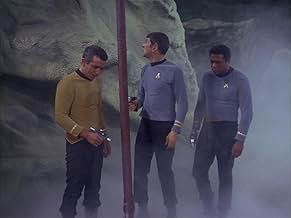
Once down Spock and the six crew members are stranded because those same ion storms make it difficult to return. The crew is also under attack by some savage ape like creatures which are the predominant life form. No appealing to their logic.
Spock's ever calm logical manner does grate on the nerves of Dr. McCoy more than usual as well as crewman Don Marshall. DeForest Kelley's scenes with Nimoy have even more bite than usual, not to mention an almost mutinous Marshall.
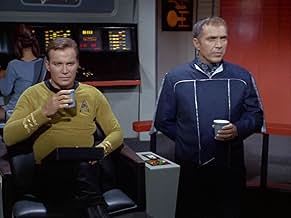
While all this is going William Shatner has to deal with a Federation commissioner who is ready to takeover the Enterprise as they are on a mission to take him to an outpost in distress.
Of course with all these series regulars on the mission you know that they're coming back, at least most of them. Enterprise crew members that are not regulars don't have that same protection. Still the writing and directing keep up the necessary suspense to make this a thoroughly enjoyable episode.
Once down Spock and the six crew members are stranded because those same ion storms make it difficult to return. The crew is also under attack by some savage ape like creatures which are the predominant life form. No appealing to their logic.
Spock's ever calm logical manner does grate on the nerves of Dr. McCoy more than usual as well as crewman Don Marshall. DeForest Kelley's scenes with Nimoy have even more bite than usual, not to mention an almost mutinous Marshall.
While all this is going William Shatner has to deal with a Federation commissioner who is ready to takeover the Enterprise as they are on a mission to take him to an outpost in distress.
Of course with all these series regulars on the mission you know that they're coming back, at least most of them. Enterprise crew members that are not regulars don't have that same protection. Still the writing and directing keep up the necessary suspense to make this a thoroughly enjoyable episode.
Like a Needle in some Space Haystack
This one will always be known as spotlighting one of the shuttlecrafts that the starship has at its disposal. The downside of exploration is showcased in this episode, a case study of survival techniques and examining the group dynamics among several crew members stuck on a hostile planet. Rare for a first season episode, this focuses on Spock rather than Kirk, who remained on the Enterprise this time around. Spock's in command of the 7-member landing party of the shuttlecraft, though this landing was unplanned. Besides needing to figure out a way to lift off without fuel, they're besieged by some 10-foot-tall natives who like to throw huge spears at starfleet officers. Some of these scenes were actually pretty scary to me as an 8-year-old viewer; all that planetary fog or mist and those lumbering beast-men made me re-think my plans to become an astronaut. Kirk, meanwhile, fends off an annoying bureaucrat, a 'high commissioner,' on his bridge while attempting to locate his missing crew members without the usual instrumentation (ion storms, you know).
Spock takes logic to faulty extremes during this crisis - all problems are addressed like a simple mathematical equation and this doesn't work with huge, hairy, unpredictable savages. Nor does his robotic attitude sit well with human beings who sometimes need words of encouragement and re-assurance in such times of great stress. He comes across as downright callous in some scenes - you'd think he'd know by now that you should at least give the appearance of giving a damn about a fallen comrade. I believe he overcompensates during this mission; despite his usual statements of not using emotion, he obviously feels the pressures of this command and his way of dealing with it is to go out of his way in alienating the rest of the party. Mostly, he sends the message that he's the smartest and half of them are expendable - not the best way to provide a positive spin on a mission gone wrong. McCoy & Scotty, along for this joyride, will back up Spock in the end even as they disagree with his methods, but a couple of the other crew members are pretty much insubordinate here. I'd be surprised if Spock didn't bring up charges back on the Enterprise - after he explained his lapse into illogic towards the end of the mission (cue: bridge crew laughing away all the built-up tension during this episode; above all, Starfleet needs happy bridge crews). McCoy does seem to win this round in his and Spock's ever-growing debate on the emotion over pure logic question.
Spock takes logic to faulty extremes during this crisis - all problems are addressed like a simple mathematical equation and this doesn't work with huge, hairy, unpredictable savages. Nor does his robotic attitude sit well with human beings who sometimes need words of encouragement and re-assurance in such times of great stress. He comes across as downright callous in some scenes - you'd think he'd know by now that you should at least give the appearance of giving a damn about a fallen comrade. I believe he overcompensates during this mission; despite his usual statements of not using emotion, he obviously feels the pressures of this command and his way of dealing with it is to go out of his way in alienating the rest of the party. Mostly, he sends the message that he's the smartest and half of them are expendable - not the best way to provide a positive spin on a mission gone wrong. McCoy & Scotty, along for this joyride, will back up Spock in the end even as they disagree with his methods, but a couple of the other crew members are pretty much insubordinate here. I'd be surprised if Spock didn't bring up charges back on the Enterprise - after he explained his lapse into illogic towards the end of the mission (cue: bridge crew laughing away all the built-up tension during this episode; above all, Starfleet needs happy bridge crews). McCoy does seem to win this round in his and Spock's ever-growing debate on the emotion over pure logic question.
Not a bad episode but wow was the crew disloyal towards poor 'ol Spock!
For the most part, all the episodes up until this one kept Spock in the background--allowing him no room to grow as a character or have all that much screen time. However, this is definitely his episode--as he is in command of a group aboard the shuttle craft (the Galileo). And I liked how the Vulcan logic, for once, was quite inadequate to handle a situation where logic was NOT the best approach to their dilemma. He tried using reason to predict the actions of a group of savage humanoids who were like giant cavemen--or so we think, as the folks at Paramount Studios/Desilu were too cheap to show them!! Instead, you saw bits and pieces and heard about them or saw shadows, but that was all!
The problem is that this episode, despite its emphasis on Spock, was incredibly confusing. It's supposed to be in a more enlightened future but the crew members on the shuttle sure don't behave that way. In particular, the crew members seemed awfully disloyal and were like a bunch of "armchair quarterbacks"--always second-guessing Spock. This tension seemed out of place and it just did nothing to help improve the overall image of the series.
The problem is that this episode, despite its emphasis on Spock, was incredibly confusing. It's supposed to be in a more enlightened future but the crew members on the shuttle sure don't behave that way. In particular, the crew members seemed awfully disloyal and were like a bunch of "armchair quarterbacks"--always second-guessing Spock. This tension seemed out of place and it just did nothing to help improve the overall image of the series.
Good Character Development
Star Trek was hitting its stride by the time of the "Galileo Seven". The title might actually be a variation of "Twelve Angry Men" another story of several interesting characters forced into a situation where important choices need to be made. The characters of Spock, McCoy and Scott in particular are advanced here as we learn more about each of them. Spock's strictly logical thinking proves to be both an advantage and a detriment as he is the ranking officer and responsible for the ultimate choices being made here. McCoy on the other hand acts as Spock's "human" conscience, figuratively sitting on his shoulder and pushing him not to rely so much on his non-emotive Vulcan side. Scott merely does what he does best by tirelessly testing theories using the resources he's provided to do his part in solving the problem at hand. In this case, the shuttlecraft "Galileo" is stranded on a hostile planet with large alien creatures determined to prevent their escape. The conclusion will surprise you and ultimately gives some great insight into the character of Spock.


Did you know
- TriviaAfter this episode was filmed, no new shots of the shuttlecraft miniature were taken. All shuttlecraft model shots used in the series were stock footage from this episode, sometimes matted into different backgrounds.
- GoofsSpock states they need to remove all possible weight to lift off. Much is jettisoned, but the seating remains, even the empty seats.
- Crazy creditsIn the closing credits of the show, the title for Script Supervisor, George A. Rutter, is misspelled "SCPIPT SUPERVISOR".
- Alternate versionsSpecial Enhanced version Digitally Remastered with new exterior shots and remade opening theme song
- ConnectionsEdited into Star Trek: Journey to Babel (1967)
- SoundtracksTheme From Star Trek
Written by and credited to Alexander Courage
Details
- Release date
- Country of origin
- Official sites
- Language
- Filming locations
- Production companies
- See more company credits at IMDbPro
Contribute to this page
Suggest an edit or add missing content