Retrospect
- Episode aired Feb 25, 1998
- TV-PG
- 45m
IMDb RATING
6.5/10
2.2K
YOUR RATING
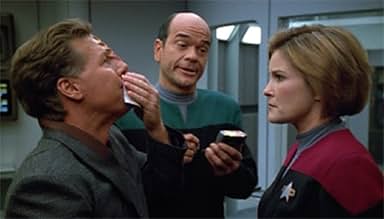
Seven of Nine claims to have been assaulted by the arms trader who just sold new technology to Voyager.Seven of Nine claims to have been assaulted by the arms trader who just sold new technology to Voyager.Seven of Nine claims to have been assaulted by the arms trader who just sold new technology to Voyager.
Ethan Phillips
- Neelix
- (credit only)
David Keith Anderson
- Ensign Ashmore
- (uncredited)
Patrick Barnitt
- Entharan Assistant
- (uncredited)
Tarik Ergin
- Lt. Ayala
- (uncredited)
Sylvester Foster
- Crewman Timothy Lang
- (uncredited)
Peter Scott Harmyk
- Crewman Thompson
- (uncredited)
Scott Pierce
- Entharan Test Subject
- (uncredited)
6.52.1K
1
2
3
4
5
6
7
8
9
10
Featured reviews
Negotiations with Kovin
Janeway should have thrown in a crate of self sealing stem bolts or perhaps Neelix' supply of Yamok sauce. Lol
The galaxy is a complicated place
...and try to examine this episode in terms of complexity.
While I understand the furor over the treatment of the (metaphorical) rape victim and the indications that it was an (unintentionally) false accusation, one of the most fascinating aspects of the evolution of Star Trek over its various incarnation and series is the way the underlying themes and plots grow both heavier and more complex. TOS was...well, it wasn't exactly the most profound and deep of series. It was groundbreaking, but still a product of its times, when there was far less freedom on TV to explore the more troubling aspects of the world. TNG gradually evolved from less-than-inspiring early seasons to become far more complex and insightful than TOS ever was (and that includes most of the early movies, Wrath excepted.) With DS9, they started pushing the envelope almost immediately, bringing in issues of society and religion, war crimes. slavery, genocide, terrorism, and...oh, all the usual things you'd expect from a station located on the precipice of continuous warfare. Voyager has continued the tradition of exploring issue in more depth, if unevenly so in the first 3 seasons. And then we have this episode...
The attempts from certain portions of society to minimize the suffering of rape, especially by blaming the victim or overreacting to anecdotes of false accusations make this episode a fraught one indeed. Despite saying, and believing, that the outcome here is a dangerous one, I actually think that the writers managed to make an intelligent choice. In TOS or at least 2/3rds of the run of TNG, the episode would have ended with the accused proven guilty, the accuser vindicated, and the world returned to its balance. It feels good, it feels right (unless you are one of those angry men who can't handle the fact that rape is a serious problem in this world and among our species) and nobody would have complained (except aforementioned men.)
But....the world, and the galaxy, apparently, is not a simple feel-good place. Humans are complex creatures. Due to her nature, Seven of Nine is more complex than most. She's dealing with a horrific past, a confusing present, and a future that promises to make dealing with her past even more horrific. And that's exactly what this episode is really about. Not the metaphorical rape that appeared to occur in this episode, but by the metaphorical *life-destroying* rape that absolutely did happen when she was a small child. It's not about a false accusation of rape, it's about a true accusation of rape. As she becomes more human, she has become more cognizant of the horror done to her. Just a few episodes ago, she considered being assimilated, and her life afterwards, to be the best thing that ever happened to her. But no human that thinks like a human would take that perspective. She's starting to think like a human, feel like a human, and that includes being appalled and angry at what was done to her, like any rape victim should and would.
This was a troubling episode, no question, with an apparently troubling moral. Beneath that apparent moral, I think, is a far more complex and meaningful one, though.
While I understand the furor over the treatment of the (metaphorical) rape victim and the indications that it was an (unintentionally) false accusation, one of the most fascinating aspects of the evolution of Star Trek over its various incarnation and series is the way the underlying themes and plots grow both heavier and more complex. TOS was...well, it wasn't exactly the most profound and deep of series. It was groundbreaking, but still a product of its times, when there was far less freedom on TV to explore the more troubling aspects of the world. TNG gradually evolved from less-than-inspiring early seasons to become far more complex and insightful than TOS ever was (and that includes most of the early movies, Wrath excepted.) With DS9, they started pushing the envelope almost immediately, bringing in issues of society and religion, war crimes. slavery, genocide, terrorism, and...oh, all the usual things you'd expect from a station located on the precipice of continuous warfare. Voyager has continued the tradition of exploring issue in more depth, if unevenly so in the first 3 seasons. And then we have this episode...
The attempts from certain portions of society to minimize the suffering of rape, especially by blaming the victim or overreacting to anecdotes of false accusations make this episode a fraught one indeed. Despite saying, and believing, that the outcome here is a dangerous one, I actually think that the writers managed to make an intelligent choice. In TOS or at least 2/3rds of the run of TNG, the episode would have ended with the accused proven guilty, the accuser vindicated, and the world returned to its balance. It feels good, it feels right (unless you are one of those angry men who can't handle the fact that rape is a serious problem in this world and among our species) and nobody would have complained (except aforementioned men.)
But....the world, and the galaxy, apparently, is not a simple feel-good place. Humans are complex creatures. Due to her nature, Seven of Nine is more complex than most. She's dealing with a horrific past, a confusing present, and a future that promises to make dealing with her past even more horrific. And that's exactly what this episode is really about. Not the metaphorical rape that appeared to occur in this episode, but by the metaphorical *life-destroying* rape that absolutely did happen when she was a small child. It's not about a false accusation of rape, it's about a true accusation of rape. As she becomes more human, she has become more cognizant of the horror done to her. Just a few episodes ago, she considered being assimilated, and her life afterwards, to be the best thing that ever happened to her. But no human that thinks like a human would take that perspective. She's starting to think like a human, feel like a human, and that includes being appalled and angry at what was done to her, like any rape victim should and would.
This was a troubling episode, no question, with an apparently troubling moral. Beneath that apparent moral, I think, is a far more complex and meaningful one, though.
I love everything about this episode
This episode explores the unintended consequences of overactivism and over enthusiasm in any cause, even a seemingly just one, where a person's actions in defense of a phantom "cause" have real social consequences for bystanders. As much as we want to sympathize with 7 of 9 in the beginning, we are given clues early on that something is amiss. I picked this up with Tuvok's comments in the briefing room. The doctor early on identified with a victim mentality in the patient and let that cloud his judgment until the end. The result was disastrous, with the loss of life and the stain of remorse upon both the doctor and 7 of 9.
In real life, the consequences may not be as dramatic. Someone could lose their reputation, their standing in the community, or their liberty, all over someone's vague memory recollection. This could be true of any case that comes before a court today.
We know that human memory is flawed, even eye-witness testimony can prove to be inaccurate, and this episode reminds us that no matter how much we want justice, or retribution, for a victim, we had better make plain sure that person is actually a victim before we destroy other lives in pursuit of that cause.
In real life, the consequences may not be as dramatic. Someone could lose their reputation, their standing in the community, or their liberty, all over someone's vague memory recollection. This could be true of any case that comes before a court today.
We know that human memory is flawed, even eye-witness testimony can prove to be inaccurate, and this episode reminds us that no matter how much we want justice, or retribution, for a victim, we had better make plain sure that person is actually a victim before we destroy other lives in pursuit of that cause.
You messed this one up, guys.
Did any female writers even have a voice when this was written? Shameful.
Female viewpoint
I agree that this episode has a weak handling of Seven's complaint of treatment by Kovin, it should be noted that she is taken seriously by the Doctor and the Captian. But that the idea of there being no female viewpoint in the story on the part of the writers, one should notice that both Jeri Taylor and Lisa Klink have writing credits on this episode.
Did you know
- TriviaThe interior cockpit of Kovin's ship was a reuse of the cockpit from the Timeship Aeon, which appears in Future's End (1996)/Future's End: Part II (1996).
- GoofsWhen Kovin said they reported the accident immediately, Captain Janeway doesn't look at the accident report nor do they attempt to have Seven identify the other assistant in the lab where she was "held."
- Quotes
The Doctor: I often find my own patience being tested by someone like Mr. Kovin. Of course I generally respond with a devastating quip rather than a left hook.
- ConnectionsReferenced in Treksperts Briefing Room: Retrospect w/ Bryan Fuller (2021)
Details
- Runtime
- 45m
- Color
- Sound mix
- Aspect ratio
- 1.33 : 1
- 4:3
Contribute to this page
Suggest an edit or add missing content