The Jet Set
- Episode aired Oct 12, 2008
- TV-14
- 1h

Don blows off the convention in Los Angeles when he meets a beautiful, exotic woman. Back at Sterling Cooper, a member of the creative staff comes out of the closet, and Duck falls off the w... Read allDon blows off the convention in Los Angeles when he meets a beautiful, exotic woman. Back at Sterling Cooper, a member of the creative staff comes out of the closet, and Duck falls off the wagon and initiates his power play.Don blows off the convention in Los Angeles when he meets a beautiful, exotic woman. Back at Sterling Cooper, a member of the creative staff comes out of the closet, and Duck falls off the wagon and initiates his power play.
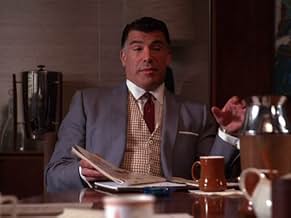


- Paul Kinsey
- (credit only)


- Director
- Writers
- All cast & crew
- Production, box office & more at IMDbPro
Featured reviews
Escaping reality
Don's journey to California and the experiences are nicely depicted. It makes sense that he would be interested by this type of lifestyle, given his history, but the filmmakers do a great job of visually portraying an impactful reality check moment. John Hamm leads the episode strongly, particularly when acting with facial expressions.
Other interesting aspects include the scenes involving Duck Phillips, which lay the foundations for nicely for some intriguing plot developments yet to come. I like how this links to Roger Sterling's escapist midlife crisis. John Slattery is very entertaining as ever, particularly as he delivers the trademark one liners.
The background of impending nuclear crisis fits in well with the character behaviour and attitudes. Plus the cultural changes of the '60s are well worked into various scenes.
The cinematography and period design is excellent as always.
"The Jet Set" thrusts Don Draper into a blindingly bright Los Angeles, only to expose him to a world that promises pure, consequence-free hedonism
Don Draper and Pete Campbell travel to Los Angeles for an aerospace convention, symbolizing the relentless forward march of American commerce and technology. However, while Pete immerses himself in the competitive schmoozing, Don almost immediately resists the prescribed corporate path. The move to California, frequently interpreted in Mad Men as a space for reinvention and optimism, becomes for Don an opportunity for pure escape. He collapses from heat exhaustion by the pool, a subtle but significant moment that signifies his current state of psychic depletion. Rescued and taken in by a clique of European aesthetes-the Jet Set-Don finds himself immersed in a world of inherited wealth, casual sex, and utter rootlessness. They are the ultimate embodiment of the consumer fantasy that advertising sells, yet they exist in a realm beyond the need for production or work. This is Don's deepest desire laid bare: to be adored, to consume, and never to be questioned about the ledger of his life.
Don's immersion into the Jet Set's world is a dangerous form of self-sabotage, yet it feels entirely earned given the domestic disaster he left in New York. The episode explores the concept of the "chameleon"-the ability to seamlessly blend into any social milieu. Don, the consummate self-inventor, proves he can perform the part of the sophisticated international playboy as easily as he plays the suburban husband. However, this effortless fit is what ultimately disquiets him. In this realm, the man he invented-Don Draper, the successful advertising executive-is just as dispensable as Dick Whitman, the orphan. The subtle cues from Joy's friends, who speculate he might be a spy before concluding he is "just" in advertising, highlight that even his celebrated career is rendered trivial. Don is on the precipice of choosing pure hedonism over humanity, tempted to shed all professional and familial obligations and join the perpetual motion machine of the elite.
The glamorous, consequence-free bubble of the Jet Set is brutally popped by a singular, crucial visual element: the sudden appearance of miserable, displaced children. Don witnesses a man, a member of the Jet Set's extended circle, dropping off his young, unhappy son and infant daughter-the consequence of an aristocratic divorce. This visceral image, completely lacking in the Jet Set's stylish detachment, acts as a moral and psychological circuit breaker. The misery of the boy, forced into the chaos of his parents' entitlement, immediately reminds Don of his own children and the chaos he has inflicted upon his family. The fantasy collapses instantly because Don realizes that the rootless life he desires is utterly incompatible with his deep, unshakeable need for the idealized family unit he desperately wants to provide, despite his inability to sustain it. He rejects Joy's invitation to join their world, choosing instead to find a genuine anchor: Anna Draper.
The decision to leave the Jet Set and travel to visit Anna Draper (the real Mrs. Don Draper) is the emotional payoff of the entire California detour. By choosing Anna, the only person alive who knows the truth of Dick Whitman, Don rejects the ephemeral freedom offered by Joy in favor of the difficult, profound acceptance offered by his "old friend." Anna represents the genuine, unconditional love and foundation that Don has spent his life running from. This journey from the aesthetic but empty freedom of the "Jet Set" to the emotional authenticity of the past is the single most important action Don takes this season, setting the stage for his eventual decision to try and salvage his marriage. It confirms that Don's ultimate desire is not to erase his history entirely, but to find a way to reconcile his past with his present, a reconciliation that only Anna can facilitate.
Back in New York, the concurrent subplots demonstrate the heavy toll that bourgeois desire exacts, sharply contrasting with the effortless freedom of the Jet Set. Roger Sterling, in his pursuit of Jane Siegel, is forced by his ex-wife Mona and her lawyer to pay a debilitating price. Roger's lawyer explicitly states that the cost will be "all the good things in life, and then cut them in half." This calculated financial penalty-the true cost of trading Mona for Jane-is the opposite of the Jet Set's financial immunity. Similarly, Duck Phillips' ambitious maneuvering to secure a deal with PPL and demand creative control under him reveals the bitter, transactional nature of power. Duck's actions are crass and desperate, highlighting the profound difference between the old-world elegance of the Jet Set and the grasping hunger of the American corporate climber.
Peggy Olson's subplot provides a crucial female counterpoint to Don's identity crisis. After asking Kurt out, she is gently informed that he is gay. Peggy's disappointment is profound, leading to the self-aware observation that she is "drinking sad" and continually choosing the "wrong boys." Unlike Don, who needs to travel thousands of miles to find his identity, Peggy finds hers in a decisive, self-directed act of transformation. She gets a new, mature, stylish haircut, a powerful symbol of her professional and personal evolution. This act of self-mastery is entirely disconnected from male approval; she is redefining herself for herself, shedding the vestiges of the naïve secretary. The scene is a quiet declaration of independence, showing that Peggy's path to freedom is through self-authorship, not escapism.
"The Jet Set" is a necessary detour that tests the limits of Don Draper's identity crisis. It posits that there are two forms of freedom available to him: the beautiful, hollow freedom of the international elite (a perpetual escape) and the difficult, honest freedom of self-knowledge (confronting Dick Whitman). By choosing to fly from the pool party to Anna Draper's home, Don makes a decisive, redemptive choice, rejecting the ultimate fantasy of anonymity in favor of a painful, yet necessary, acknowledgment of who he truly is.
This is a seminal episode that leverages stunning visuals and a sophisticated, non-linear plot to explore the deep American conflict between freedom and foundation. It leaves the viewer with the profound realization that true escape is impossible; the self is the one suitcase you can never check. "The Jet Set" is a beautifully realized, unsettling piece of philosophical television that sets the final, inevitable conflict of the season in motion.

Did you know
- TriviaAs Peggy and Kurt are seeing Bob Dylan at Carnegie Hall, this episode takes place on and around 22nd September 1962.
- GoofsThis series is set in 1962. The Mercedes Benz sports (body W113) that Don gets into with Joy wasn't released until mid 1963.
- Quotes
Pete Campbell: [Woman jumps in pool]
[turns to Don]
Pete Campbell: Come on.
Don Draper: You want to be on vacation, Pete? 'Cause I can make that happen.
- ConnectionsFeatured in The 61st Primetime Emmy Awards (2009)
- SoundtracksA Beautiful Mine
(uncredited)
Written by RJD2
Performed by RJD2
(opening credits)
Details
- Release date
- Country of origin
- Official sites
- Languages
- Filming locations
- Farralone Estate, 9361 Farralone Ave, Chatsworth, Los Angeles, California, USA(Palm Springs house)
- Production companies
- See more company credits at IMDbPro