Six Month Leave
- Episode aired Sep 28, 2008
- TV-14
- 48m
IMDb RATING
8.5/10
3.1K
YOUR RATING

Don checks in to a hotel after his separation from Betty. Back at the office, he is forced to get rid of Freddy against his will because of his drinking problem.Don checks in to a hotel after his separation from Betty. Back at the office, he is forced to get rid of Freddy against his will because of his drinking problem.Don checks in to a hotel after his separation from Betty. Back at the office, he is forced to get rid of Freddy against his will because of his drinking problem.





8.53.1K
1
2
3
4
5
6
7
8
9
10
Featured reviews
Finally! The Ad Men and Ad Women are showing their true colors
Mrs. Shullivan and I have waited almost the first two full seasons of Mad Men for these ad men and ad women to finally start showing who they truly are and for this drama series to start becoming much more interesting. There wasn't any particular focus on one character but rather, all the main charcters seemed to be undergoing some transformational change, either for better or for the worse.
Accounts are being won and lost, and the account execs are struggling to maintain a stranglehold on their own accounts. Peggy is assisting the new young parish priest Father John Gill (Colin Hanks) with some promotional material for the annual Youth Organization Dance but the ones who are dancing (circles around their feelings for one another) during this episode are Peggy and Father John Gill.
This episode is by far the most interesting in the series to date.
Accounts are being won and lost, and the account execs are struggling to maintain a stranglehold on their own accounts. Peggy is assisting the new young parish priest Father John Gill (Colin Hanks) with some promotional material for the annual Youth Organization Dance but the ones who are dancing (circles around their feelings for one another) during this episode are Peggy and Father John Gill.
This episode is by far the most interesting in the series to date.
The most underrated Mad Men episode and my favourite.
This is such an underrated episode that when I finished the series and was going over the episode ratings this episode being an 8.5 is crazy to me. I thought it would at least be a 9 or higher because it was in my top 3 and possibly my favourite of the series especially if you had watched the previous episodes of season 2 with Jimmy.
Anyway this episode was fantastic and really the whole of the series was fantastic. So thank you Matthew Weiner for giving us people who like the glamorous 60s and 70s.
And one thing I would like to add about the episode is the entire Freddy storyline since he had became one of my favourite characters, this was a really great episode to see him in.
Anyway this episode was fantastic and really the whole of the series was fantastic. So thank you Matthew Weiner for giving us people who like the glamorous 60s and 70s.
And one thing I would like to add about the episode is the entire Freddy storyline since he had became one of my favourite characters, this was a really great episode to see him in.
It is a story about the lies we tell to function: that a firing is a "leave," that a celebrity's life is perfect, that we are indispensable
"Six Month Leave," the ninth episode of the second season of Mad Men, directed by Michael Uppendahl and written by Andre Jacquemetton, Maria Jacquemetton, and Matthew Weiner, serves as a grim meditation on obsolescence and the fragility of the human facade. Set against the melancholic backdrop of August 5, 1962-the day Marilyn Monroe was found dead-the episode masterfully weaves a tapestry of public grief and private humiliation. The death of the world's most famous sex symbol acts as a tonal anchor, casting a pall over Sterling Cooper that forces the characters to confront their own dispensability. Weiner utilizes this historical tragedy not merely as a timestamp, but as a thematic mirror reflecting the episode's central conflict: the professional demise of Freddy Rumsen. Just as Monroe's carefully constructed image could not save her from her inner demons, the corporate armor of the "ad man" proves insufficient to protect Freddy from the biological reality of his alcoholism. The episode functions as a requiem, suggesting that in the high-stakes world of Madison Avenue, as in Hollywood, when an icon cracks, they are swiftly swept aside to maintain the illusion of perfection for the consumer.
The narrative impetus of the episode is sparked by a moment of grotesque realism that stands in stark contrast to the show's usually polished aesthetic. During a pitch for Samsonite luggage, Freddy Rumsen, the jovial, heavy-drinking senior copywriter, loses control of his bladder, wetting himself in front of clients and colleagues. Uppendahl directs this scene with excruciating patience; the camera lingers not on the act itself, which is obscured, but on the horrifying realization dawning on the faces of those present. The sound design is particularly effective here, amplifying the silence of the room to make the social transgression deafening. This moment is the antithesis of the "Mad Men" cool; it is the visceral, messy intrusion of the body into the sterile corporate space. It serves as a stark reminder that the liquid lunches and three-martini meetings that fuel their creativity are also poison. Freddy's accident is treated not as a medical issue but as a breach of the unspoken contract of masculinity and competence, triggering a chain reaction of political maneuvering that exposes the ruthless Darwinism lurking beneath the agency's collegial surface.
The fallout from Freddy's indiscretion allows the writers to dissect the generational and ethical divides within the agency. Pete Campbell, representing the hungry, unsentimental youth, immediately weaponizes the incident, reporting it to Duck Phillips. This act of betrayal highlights a recurring theme in the series: the Oedipal struggle where the "sons" must kill the "fathers" to ascend. Duck, a man who views the creative department as a wild animal that needs taming, sees this as an opportunity to assert dominance and trim the fat. The juxtaposition of Pete's cold opportunism with the older generation's code of silence is striking.
While Roger Sterling and Don Draper initially try to laugh it off or ignore it, adhering to a "gentlemen's agreement" of overlooking vices, the modern corporate structure represented by Duck demands efficiency over fraternity. This conflict illustrates the transition from the personality-driven business of the 1950s to the bottom-line obsession of the coming decades, positioning Pete as the harbinger of a colder, more calculated future.
Don Draper's reaction to Freddy's impending firing is one of the episode's most complex character studies. Don fights vehemently to save Freddy, arguing for a "six-month leave" rather than a termination. On the surface, this appears to be an act of loyalty, but a deeper reading reveals it as an act of self-preservation. Don sees himself in Freddy: a man who drinks too much, lives a life built on secrets, and is one slip-up away from losing everything. If the agency can discard Freddy for a moment of weakness, then Don, whose entire identity is a fabrication, is equally vulnerable. Jon Hamm plays these scenes with a simmering intensity, his anger directed not just at Duck or Roger, but at the mirror Freddy holds up to him. The "six-month leave" is a euphemism that Don desperately wants to believe in, because if there is no redemption for Freddy, there may be none for Don. It is a terrifying confrontation with the reality that talent does not grant immunity from the consequences of one's lifestyle.
The script brilliantly dichotomizes the reaction to Marilyn Monroe's death along gender lines, offering a scathing critique of the era's misogyny. For the men of Sterling Cooper, Marilyn is a punchline or a lost fantasy; they discuss her death with a callous detachment, focused on the tragedy of losing a sexual object rather than a human being. Conversely, for the women-particularly Joan and Betty-the loss is deeply personal. Joan, who usually wields her sexuality as armor, is found weeping in Don's office. She recognizes in Marilyn the exhaustion of constantly performing for the male gaze. It is a rare moment of vulnerability where Joan's facade cracks, revealing the fear that her value is tied solely to her physical appeal, which, like Marilyn's, has an expiration date. This subplot underscores the precarious position of women in 1962 society, suggesting that they identify with the "sad clown" aspect of Monroe because they too are forced to smile through their systemic oppression.
Amidst the mourning and the firing, Peggy Olson's trajectory continues its upward arc, but not without moral compromise. She is the beneficiary of Freddy's downfall, inheriting his office and his accounts. The cinematography emphasizes her isolation as she steps into this new space; the office is empty, a vacuum left by a man's destruction. Elisabeth Moss conveys a mixture of guilt and steely resolve. When Pete Campbell congratulates her, implying she should be grateful to him for removing the obstacle, Peggy's reaction is guarded. She realizes that her success is built on the ruins of her mentor. This narrative thread complicates Peggy's feminist journey; she is breaking the glass ceiling, but she is doing so by participating in a system that devours the weak. It challenges the viewer to question the cost of ambition-is Peggy becoming "one of the boys," or is she forging a new path that requires shedding her sentimentality?
The climax of the night out occurs when Don punches Jimmy Barrett in the face. While ostensibly provoked by Jimmy's crude remarks, the violence is clearly a displacement of Don's rage regarding his failing marriage and his own existential dread. Jimmy Barrett, the jester who speaks truth to power, had previously exposed Don's affair to Betty. By striking him, Don is physically attacking the embodiment of the truth he cannot face. The editing of the punch is sharp and brutal, shocking the viewer and the characters. It is a moment where Don's suave exterior completely disintegrates, revealing the brute beneath the suit. This act of violence does not solve anything; instead, it underscores Don's impotence. He cannot punch away his wife's coldness or his colleague's firing, so he lashes out at the nearest target, proving that his control is entirely illusory.
Parallel to the office drama, Betty Draper's storyline deals with her depression and her refusal to easily forgive Don. Following the events of the previous episode, Don is living in a hotel, and Betty is maintaining the house. Her reaction to Marilyn's death is quiet but profound; she sees the ultimate despair of the "perfect woman." Betty spends her time riding horses, an activity that grants her a sense of power and freedom absent in her domestic life. The costume design is crucial here; her riding habit is structured, masculine, and armor-like, contrasting with her usual soft, feminine dresses. When she confronts her friend regarding the gossip about her marriage, Betty refuses to play the victim. Her resistance to letting Don back into the house is a significant shift in the power dynamic. She is no longer the passive housewife; she is the gatekeeper, and for the first time, Don is on the outside looking in, realizing that his charm has lost its currency.
"Six Month Leave" is a pivotal episode that functions as a structural pivot for the second season. It is a story about the lies we tell to function: that a firing is a "leave," that a celebrity's life is perfect, that we are indispensable. By linking the micro-tragedy of Freddy Rumsen with the macro-tragedy of Marilyn Monroe, the creators Matthew Weiner and Michael Uppendahl elevate a workplace drama into an existential critique of the American Dream. The episode strips away the glamour of the advertising world to reveal the ruthless machinery beneath, leaving the viewer to question the durability of their own social and professional masks.
This episode stands as a testament to Mad Men's ability to blend historical atmosphere with deep character psychology. It is a melancholic masterpiece that forces a confrontation with mortality. The final takeaway is a haunting realization: in a world obsessed with the "new," everything-and everyone-eventually becomes inventory to be liquidated. The characters are left riding the elevator down, uncertain if they will ever truly rise again.
The narrative impetus of the episode is sparked by a moment of grotesque realism that stands in stark contrast to the show's usually polished aesthetic. During a pitch for Samsonite luggage, Freddy Rumsen, the jovial, heavy-drinking senior copywriter, loses control of his bladder, wetting himself in front of clients and colleagues. Uppendahl directs this scene with excruciating patience; the camera lingers not on the act itself, which is obscured, but on the horrifying realization dawning on the faces of those present. The sound design is particularly effective here, amplifying the silence of the room to make the social transgression deafening. This moment is the antithesis of the "Mad Men" cool; it is the visceral, messy intrusion of the body into the sterile corporate space. It serves as a stark reminder that the liquid lunches and three-martini meetings that fuel their creativity are also poison. Freddy's accident is treated not as a medical issue but as a breach of the unspoken contract of masculinity and competence, triggering a chain reaction of political maneuvering that exposes the ruthless Darwinism lurking beneath the agency's collegial surface.
The fallout from Freddy's indiscretion allows the writers to dissect the generational and ethical divides within the agency. Pete Campbell, representing the hungry, unsentimental youth, immediately weaponizes the incident, reporting it to Duck Phillips. This act of betrayal highlights a recurring theme in the series: the Oedipal struggle where the "sons" must kill the "fathers" to ascend. Duck, a man who views the creative department as a wild animal that needs taming, sees this as an opportunity to assert dominance and trim the fat. The juxtaposition of Pete's cold opportunism with the older generation's code of silence is striking.
While Roger Sterling and Don Draper initially try to laugh it off or ignore it, adhering to a "gentlemen's agreement" of overlooking vices, the modern corporate structure represented by Duck demands efficiency over fraternity. This conflict illustrates the transition from the personality-driven business of the 1950s to the bottom-line obsession of the coming decades, positioning Pete as the harbinger of a colder, more calculated future.
Don Draper's reaction to Freddy's impending firing is one of the episode's most complex character studies. Don fights vehemently to save Freddy, arguing for a "six-month leave" rather than a termination. On the surface, this appears to be an act of loyalty, but a deeper reading reveals it as an act of self-preservation. Don sees himself in Freddy: a man who drinks too much, lives a life built on secrets, and is one slip-up away from losing everything. If the agency can discard Freddy for a moment of weakness, then Don, whose entire identity is a fabrication, is equally vulnerable. Jon Hamm plays these scenes with a simmering intensity, his anger directed not just at Duck or Roger, but at the mirror Freddy holds up to him. The "six-month leave" is a euphemism that Don desperately wants to believe in, because if there is no redemption for Freddy, there may be none for Don. It is a terrifying confrontation with the reality that talent does not grant immunity from the consequences of one's lifestyle.
The script brilliantly dichotomizes the reaction to Marilyn Monroe's death along gender lines, offering a scathing critique of the era's misogyny. For the men of Sterling Cooper, Marilyn is a punchline or a lost fantasy; they discuss her death with a callous detachment, focused on the tragedy of losing a sexual object rather than a human being. Conversely, for the women-particularly Joan and Betty-the loss is deeply personal. Joan, who usually wields her sexuality as armor, is found weeping in Don's office. She recognizes in Marilyn the exhaustion of constantly performing for the male gaze. It is a rare moment of vulnerability where Joan's facade cracks, revealing the fear that her value is tied solely to her physical appeal, which, like Marilyn's, has an expiration date. This subplot underscores the precarious position of women in 1962 society, suggesting that they identify with the "sad clown" aspect of Monroe because they too are forced to smile through their systemic oppression.
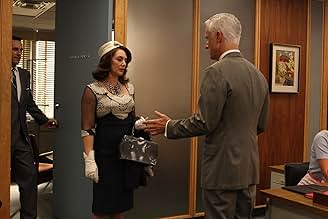
Amidst the mourning and the firing, Peggy Olson's trajectory continues its upward arc, but not without moral compromise. She is the beneficiary of Freddy's downfall, inheriting his office and his accounts. The cinematography emphasizes her isolation as she steps into this new space; the office is empty, a vacuum left by a man's destruction. Elisabeth Moss conveys a mixture of guilt and steely resolve. When Pete Campbell congratulates her, implying she should be grateful to him for removing the obstacle, Peggy's reaction is guarded. She realizes that her success is built on the ruins of her mentor. This narrative thread complicates Peggy's feminist journey; she is breaking the glass ceiling, but she is doing so by participating in a system that devours the weak. It challenges the viewer to question the cost of ambition-is Peggy becoming "one of the boys," or is she forging a new path that requires shedding her sentimentality?
The climax of the night out occurs when Don punches Jimmy Barrett in the face. While ostensibly provoked by Jimmy's crude remarks, the violence is clearly a displacement of Don's rage regarding his failing marriage and his own existential dread. Jimmy Barrett, the jester who speaks truth to power, had previously exposed Don's affair to Betty. By striking him, Don is physically attacking the embodiment of the truth he cannot face. The editing of the punch is sharp and brutal, shocking the viewer and the characters. It is a moment where Don's suave exterior completely disintegrates, revealing the brute beneath the suit. This act of violence does not solve anything; instead, it underscores Don's impotence. He cannot punch away his wife's coldness or his colleague's firing, so he lashes out at the nearest target, proving that his control is entirely illusory.
Parallel to the office drama, Betty Draper's storyline deals with her depression and her refusal to easily forgive Don. Following the events of the previous episode, Don is living in a hotel, and Betty is maintaining the house. Her reaction to Marilyn's death is quiet but profound; she sees the ultimate despair of the "perfect woman." Betty spends her time riding horses, an activity that grants her a sense of power and freedom absent in her domestic life. The costume design is crucial here; her riding habit is structured, masculine, and armor-like, contrasting with her usual soft, feminine dresses. When she confronts her friend regarding the gossip about her marriage, Betty refuses to play the victim. Her resistance to letting Don back into the house is a significant shift in the power dynamic. She is no longer the passive housewife; she is the gatekeeper, and for the first time, Don is on the outside looking in, realizing that his charm has lost its currency.
"Six Month Leave" is a pivotal episode that functions as a structural pivot for the second season. It is a story about the lies we tell to function: that a firing is a "leave," that a celebrity's life is perfect, that we are indispensable. By linking the micro-tragedy of Freddy Rumsen with the macro-tragedy of Marilyn Monroe, the creators Matthew Weiner and Michael Uppendahl elevate a workplace drama into an existential critique of the American Dream. The episode strips away the glamour of the advertising world to reveal the ruthless machinery beneath, leaving the viewer to question the durability of their own social and professional masks.
This episode stands as a testament to Mad Men's ability to blend historical atmosphere with deep character psychology. It is a melancholic masterpiece that forces a confrontation with mortality. The final takeaway is a haunting realization: in a world obsessed with the "new," everything-and everyone-eventually becomes inventory to be liquidated. The characters are left riding the elevator down, uncertain if they will ever truly rise again.
The Thing About Freddy
So Freddy drank too much, pees himself in the office in front of a few people, and everyone makes a big deal, including Roger, who not long before drank so much he projectile vomited on about ten men in the office... What's the deal?
The thing I always liked about Freddy is that... when you look at photos of ad men.... ACTUAL AD MEN from this era... they mostly look like Freddy... they're adults... average-looking adults...
Don't get me wrong, I love the characters on this show but many are far too young to be professional ad men... Sometimes it's more like, Mad Boys... (Of course Don is the right age, and he's a deliberate Rock Star Ad Man so his perfect looks fit)...
Herein, Don's best moment was telling his secretary, who is crying about Marilyn Monroe's death, if she wants to go home... That was great... He should have sent ALL those girls home... Roger had some great things to say about how Marilyn had everything... She really did have everything...
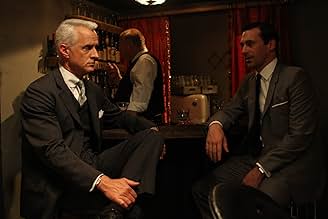
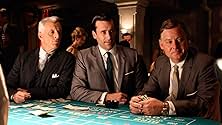
But the best scenes take place in the underground gambling hole, and after: the same night. Roger really is, truly is, the best character on the series. He's just perfect... Always so wise and funny...
It's weird when you think, John Flattery has been around since the 1980's and it took this long for him to become famous. But it just goes to show you... the perfect role needs the perfect actor or actress, or it's no longer perfect...
So far it's one of the best episodes, of both seasons.
The thing I always liked about Freddy is that... when you look at photos of ad men.... ACTUAL AD MEN from this era... they mostly look like Freddy... they're adults... average-looking adults...
Don't get me wrong, I love the characters on this show but many are far too young to be professional ad men... Sometimes it's more like, Mad Boys... (Of course Don is the right age, and he's a deliberate Rock Star Ad Man so his perfect looks fit)...
Herein, Don's best moment was telling his secretary, who is crying about Marilyn Monroe's death, if she wants to go home... That was great... He should have sent ALL those girls home... Roger had some great things to say about how Marilyn had everything... She really did have everything...
But the best scenes take place in the underground gambling hole, and after: the same night. Roger really is, truly is, the best character on the series. He's just perfect... Always so wise and funny...
It's weird when you think, John Flattery has been around since the 1980's and it took this long for him to become famous. But it just goes to show you... the perfect role needs the perfect actor or actress, or it's no longer perfect...
So far it's one of the best episodes, of both seasons.
Eventful episode
Six Month Leave is an important episode for some characters facing big changes in their professional and personal lives.
The writers focus on characters such as Don, Betty, Roger, Freddie, and Peggy. Each deals with situations that are portrayed very well by the actors and filmmakers. I particularly like the scenes involving Don, Roger, and Freddie, which include great interaction and dialogue exchanges.
The background event of Marilyn Monroe's death fits nicely into an episode where characters who seemingly have everything going for them are not doing so well privately.
Everything builds up to an unexpected ending that comes as a shock.
Don continues to be portrayed as a great, complex lead character. He has major psychological hangups, which come out in many negative ways (dishonesty and infidelity), but is also capable of great loyalty and does not suffer fools who take pleasure in the suffering of others.
As always, the actors are tremendous, with John Hamm, John Slattery, Elizabeth Moss, and January Jones standing out.
The writers focus on characters such as Don, Betty, Roger, Freddie, and Peggy. Each deals with situations that are portrayed very well by the actors and filmmakers. I particularly like the scenes involving Don, Roger, and Freddie, which include great interaction and dialogue exchanges.
The background event of Marilyn Monroe's death fits nicely into an episode where characters who seemingly have everything going for them are not doing so well privately.
Everything builds up to an unexpected ending that comes as a shock.
Don continues to be portrayed as a great, complex lead character. He has major psychological hangups, which come out in many negative ways (dishonesty and infidelity), but is also capable of great loyalty and does not suffer fools who take pleasure in the suffering of others.
As always, the actors are tremendous, with John Hamm, John Slattery, Elizabeth Moss, and January Jones standing out.

Did you know
- TriviaAction takes place on August 6, 1962, the day following Marilyn Monroe's death, and two days after.
- GoofsAs the pool secretaries react to the death of Marilyn Monroe, which happened the day before, Jane tells Draper that Sally called the office last night asking about him. Last night would have been Sunday, 5 August, when the office was closed.
- Quotes
Don Draper: It's your life. You don't know how long it's gonna last, but you know it doesn't end well. You've gotta move forward... as soon as you can figure out what that means.
- ConnectionsFeatured in The 61st Primetime Emmy Awards (2009)
- SoundtracksA Beautiful Mine
(uncredited)
Written by RJD2
Performed by RJD2
(opening credits)
Details
- Release date
- Country of origin
- Official sites
- Language
- Filming locations
- Production companies
- See more company credits at IMDbPro
Contribute to this page
Suggest an edit or add missing content