IMDb RATING
7.4/10
3.7K
YOUR RATING


Follows a jealous countess, a wealthy businessman, and a young orphaned boy across Portugal, France, Italy and Brazil where they connect with a variety of mysterious individuals.Follows a jealous countess, a wealthy businessman, and a young orphaned boy across Portugal, France, Italy and Brazil where they connect with a variety of mysterious individuals.Follows a jealous countess, a wealthy businessman, and a young orphaned boy across Portugal, France, Italy and Brazil where they connect with a variety of mysterious individuals.
Browse episodes



7.43.6K
1
2
3
4
5
6
7
8
9
10
Featured reviews
sweeping and epic -- it is more of a MASTERING of Lisbon
At four and one-half hours, this is the longest movie I have seen in quite some time. The length will most definitely detract many (as would the costumes and subtitles) from ever sitting down to view this; but I think those with patience and appreciation of "epic"/sweeping storytelling might like this one.
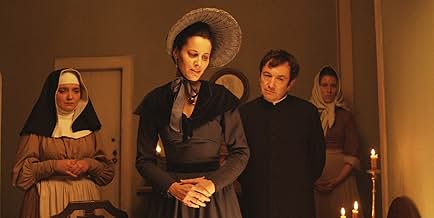
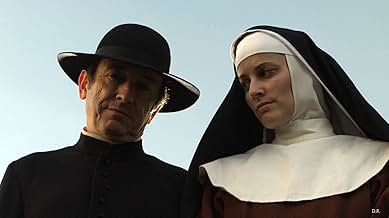
This is the story of Joao, a young orphaned boy (he discovers he's actually a bastard as the story unfolds) living in a Catholic orphanage under the watchful, caring eye of Father Denis. Joao learns of his parentage and where they came from and their circumstances ... and as those stories unfold we learn of different characters in THOSE stories as well.
The film spirals and sweeps and sways with several tangents and characters; but I found it all interesting and actually wanted to continue watching. That each of the stories intertwine and circle each other is part of the "mystery" of the title and parts of the film act and feel as if the entire production is a dream.
It is lovely to look at (gorgeous costumes and sets) and each of the characters has a revelation that continues the "mystery" and the intrigue and drama. The story travels from the streets of Lisbon to Venice to France to Tunis and to Brazil ... it is SWEEPING on a grand-scale as it also spans three decades.
Based on the late author, Camilo Castelo Branco's (who shot himself at the age of 70 b/c he was going blind) novel of the same name, Chilean director Raoul Ruiz has given us his final film (it is masterful) as he died shortly before the film began screening. That it is all so tragic and doomed and romantic is fitting ... as that is exactly what the movie gives its viewer.
I know none of my friends will give this one a shot ... it does require patience. But it is a beauty.
This is the story of Joao, a young orphaned boy (he discovers he's actually a bastard as the story unfolds) living in a Catholic orphanage under the watchful, caring eye of Father Denis. Joao learns of his parentage and where they came from and their circumstances ... and as those stories unfold we learn of different characters in THOSE stories as well.
The film spirals and sweeps and sways with several tangents and characters; but I found it all interesting and actually wanted to continue watching. That each of the stories intertwine and circle each other is part of the "mystery" of the title and parts of the film act and feel as if the entire production is a dream.
It is lovely to look at (gorgeous costumes and sets) and each of the characters has a revelation that continues the "mystery" and the intrigue and drama. The story travels from the streets of Lisbon to Venice to France to Tunis and to Brazil ... it is SWEEPING on a grand-scale as it also spans three decades.
Based on the late author, Camilo Castelo Branco's (who shot himself at the age of 70 b/c he was going blind) novel of the same name, Chilean director Raoul Ruiz has given us his final film (it is masterful) as he died shortly before the film began screening. That it is all so tragic and doomed and romantic is fitting ... as that is exactly what the movie gives its viewer.
I know none of my friends will give this one a shot ... it does require patience. But it is a beauty.
An intriguing, fascinating film
Mistérios de Lisboa is shown in the United States with the title Mysteries of Lisbon (2010). The film is directed by the extraordinary Chilean director, Raoul Ruiz. Ruiz, who died in 2011, had directed 115 films. (Not a typo--one hundred and fifteen.)
The film is based on a novel by the Portuguese author Camilo Castelo Branco. (Unfortunately, the novel isn't available in English translation.) It's also frustrating that the DVD available in the U.S. is a shortened version of the original miniseries. (266 minutes vs. 360 minutes. What was left out of the shorter version?)
The film is hard to describe because there are stories within stories within stories. The basic plot--more or less--revolves around a boy attending a Catholic school in early 19th Century Portugal. The boy doesn't know the identity of his mother and father. He doesn't even know his last name.
We eventually meet his mother, her husband, and--in flashback--his father. We also meet elegant women in sumptuous gowns, men for whom dueling is a way of life, and endless numbers of servants who are always watching and listening.
Some mysteries are never resolved. For example, there's a young woman who is the mistress of one of the nobles. When he dies, she refuses to accept any of his inheritance. She turns up again as the wife of an extremely wealthy, cruel man. Then she disappears from the plot. (Was her story edited out, or did she just disappear?)
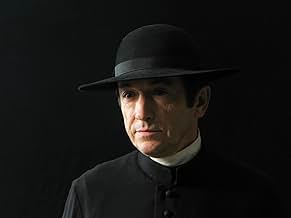
Ultimately, I think the key to the plot is the priest Padre Dinis, played extremely well by Adriano Luz. He--like almost all of the the characters--turns out to have a surprising past.
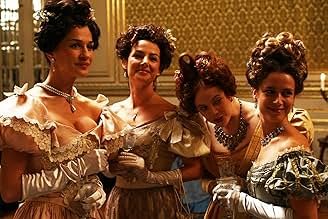
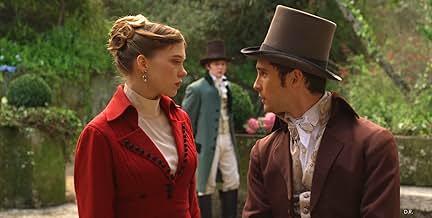
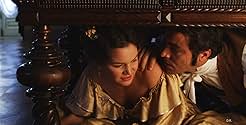
Other IMDb reviewers have commented on the costumes, which are incredibly attractive. Two main characters who appear in those costumes are Maria João Bastos as a Portuguese noblewoman and Clotilde Hesme as a French noblewoman. Both of them are extremely beautiful in a European, non-Hollywood way. They appear to have been born to wear those costumes.
At the very end of the movie the young man, now grown, encounters some beggars. One of them tells him, "With the nobility, it's all about their honor. We poor people know these things happen, and we take them as part of life." When I thought about it, those sentences encompasses Mysteries of Lisbon. Nobles fight duels and spend endless effort and resources to protect the honor of their family. One man goes so far as to order the killing of his grandchild, because the child is born out of wedlock. Huge events are taking place around them--the Napoleonic wars, the Portuguese civil war--but what really matters is their rigid code of honor.
We saw this movie on DVD, and it worked well enough. However, almost every frame of the film would be a beautiful still. Many scenes look like lush paintings--Baroque, rather than 19th Century. That's why I believe the film would work better on the large screen. However, if no screening is available, buy the DVD. It's not a movie you want to miss!
The film is based on a novel by the Portuguese author Camilo Castelo Branco. (Unfortunately, the novel isn't available in English translation.) It's also frustrating that the DVD available in the U.S. is a shortened version of the original miniseries. (266 minutes vs. 360 minutes. What was left out of the shorter version?)
The film is hard to describe because there are stories within stories within stories. The basic plot--more or less--revolves around a boy attending a Catholic school in early 19th Century Portugal. The boy doesn't know the identity of his mother and father. He doesn't even know his last name.
We eventually meet his mother, her husband, and--in flashback--his father. We also meet elegant women in sumptuous gowns, men for whom dueling is a way of life, and endless numbers of servants who are always watching and listening.
Some mysteries are never resolved. For example, there's a young woman who is the mistress of one of the nobles. When he dies, she refuses to accept any of his inheritance. She turns up again as the wife of an extremely wealthy, cruel man. Then she disappears from the plot. (Was her story edited out, or did she just disappear?)
Ultimately, I think the key to the plot is the priest Padre Dinis, played extremely well by Adriano Luz. He--like almost all of the the characters--turns out to have a surprising past.
Other IMDb reviewers have commented on the costumes, which are incredibly attractive. Two main characters who appear in those costumes are Maria João Bastos as a Portuguese noblewoman and Clotilde Hesme as a French noblewoman. Both of them are extremely beautiful in a European, non-Hollywood way. They appear to have been born to wear those costumes.
At the very end of the movie the young man, now grown, encounters some beggars. One of them tells him, "With the nobility, it's all about their honor. We poor people know these things happen, and we take them as part of life." When I thought about it, those sentences encompasses Mysteries of Lisbon. Nobles fight duels and spend endless effort and resources to protect the honor of their family. One man goes so far as to order the killing of his grandchild, because the child is born out of wedlock. Huge events are taking place around them--the Napoleonic wars, the Portuguese civil war--but what really matters is their rigid code of honor.
We saw this movie on DVD, and it worked well enough. However, almost every frame of the film would be a beautiful still. Many scenes look like lush paintings--Baroque, rather than 19th Century. That's why I believe the film would work better on the large screen. However, if no screening is available, buy the DVD. It's not a movie you want to miss!
10Fotodude
An experience not to be missed on the big screen
It's almost a miracle to find a film like this one in theaters nowadays. An exceptional rarity, something that reminds you that cinema like this can still be achieved. Being a period piece, and with almost 5 hours of runtime (the 15-minute intermission included), it defies almost every convention of commercial cinema. And it doesn't drag one bit; every minute of the film is required, and while it absorbs you and doesn't let go, you feel grateful for it
For those magical hours of hypnotic escapism.
"Mysteries of Lisbon" is en epic, mesmerizing adaptation of the homonym novel by Camilo Castelo Branco. It tells a series of interconnected stories set mostly in 19th century Lisbon, although the main plot is pretty much unique. In any case, the way each story leads to the other and how it all comes together towards the end is brilliant. The two main characters are Pedro da Silva and Padre Dinis; a priest and an orphan destined to form a close bond. But all characters are carefully fleshed out; apart from those two, Ângela de Lima (Pedro's mother) or Alberto de Magalhães, among others, stand out. It is the film's purpose to explore the enigmatic nature of most of these people, leaving them and coming back to them with deeply measured fluency, bringing forward through the set occasional details of their personality, frequently using voice-overs to convey their inner thoughts while staying faithful to the literary source material.
This last idea is also present in how much the act of observation matters in this film. In a great number of scenes, a lesser character is either listening to what is happening or watching that given scene from a distance, thus often adopting the viewer's external point of view. This objective is made clear through the miniaturist theater that Pedro receives as a present from his mother, a toy that Ruiz goes back to on several occasions to mark the transition between a scene and the next. It is a beautiful little trick and, in some way, it provides part of the film's complexity. This complexity is reinforced by a few ambiguous notes, some surrealist touches and of course the multiple layers of the plot.
Another remarkable aspect is the use of clear-cut sequence shots for the majority of scenes, each of those shots more impressive than the other. The film has therefore very few close-ups, something that would also contribute to create a certain distance with the viewer. Only in a couple of situations (usually of lesser significance) does Ruiz go back to a more orthodox way of shooting. But those delightfully crafted sequence shots give the film an extraordinary, almost intoxicating energy, especially when they are accompanied by the film's haunting score. That way, every shot is a wonder in terms of composition, but also as far as the lighting is concerned. Just a few marvelous examples would be the scene at the opera hall or when Alberto de Magalhães confronts another man while Padre Dinis is traveling in the calash. Indeed, this must be one of the most striking films I've had the chance to see on the big screen.
On the whole, this is a moving, tragic and awe-inspiring masterpiece. A feast for the senses, and an immediate entry in my top 50. *****
"Mysteries of Lisbon" is en epic, mesmerizing adaptation of the homonym novel by Camilo Castelo Branco. It tells a series of interconnected stories set mostly in 19th century Lisbon, although the main plot is pretty much unique. In any case, the way each story leads to the other and how it all comes together towards the end is brilliant. The two main characters are Pedro da Silva and Padre Dinis; a priest and an orphan destined to form a close bond. But all characters are carefully fleshed out; apart from those two, Ângela de Lima (Pedro's mother) or Alberto de Magalhães, among others, stand out. It is the film's purpose to explore the enigmatic nature of most of these people, leaving them and coming back to them with deeply measured fluency, bringing forward through the set occasional details of their personality, frequently using voice-overs to convey their inner thoughts while staying faithful to the literary source material.
This last idea is also present in how much the act of observation matters in this film. In a great number of scenes, a lesser character is either listening to what is happening or watching that given scene from a distance, thus often adopting the viewer's external point of view. This objective is made clear through the miniaturist theater that Pedro receives as a present from his mother, a toy that Ruiz goes back to on several occasions to mark the transition between a scene and the next. It is a beautiful little trick and, in some way, it provides part of the film's complexity. This complexity is reinforced by a few ambiguous notes, some surrealist touches and of course the multiple layers of the plot.
Another remarkable aspect is the use of clear-cut sequence shots for the majority of scenes, each of those shots more impressive than the other. The film has therefore very few close-ups, something that would also contribute to create a certain distance with the viewer. Only in a couple of situations (usually of lesser significance) does Ruiz go back to a more orthodox way of shooting. But those delightfully crafted sequence shots give the film an extraordinary, almost intoxicating energy, especially when they are accompanied by the film's haunting score. That way, every shot is a wonder in terms of composition, but also as far as the lighting is concerned. Just a few marvelous examples would be the scene at the opera hall or when Alberto de Magalhães confronts another man while Padre Dinis is traveling in the calash. Indeed, this must be one of the most striking films I've had the chance to see on the big screen.
On the whole, this is a moving, tragic and awe-inspiring masterpiece. A feast for the senses, and an immediate entry in my top 50. *****
Perfect match of director and material
When Raoul Ruiz adapts existing material, he tends to reconfigure the narrative in a playful way, often obliterating all coherence in the process. In his writings on film, specifically Poetics of Cinema, he is quite critical of what he calls central conflict theory. The idea behind this theory is that narrative, especially film narrative, must be built around a single conflict and that every aspect of the plot must build on this conflict one way or another. Ruiz noticed this phenomenon and gave it a name, but it was so common that popular screen writing guides used it as an incontrovertible rule. Poetics of Cinema is devoted almost entirely to explaining and criticizing central conflict theory. Ruiz was never content merely to criticize this simplistic yet ubiquitous narrative structure in writing, however; commentary on it is often embedded in the films he makes. Unsurprisingly, his films intentionally eschew anything resembling this structure but they tend to go even further and offer playful deconstructions of the concept.
Although I can't claim much familiarity with the novel Ruiz is adapting in Mysteries of Lisbon (it apparently hasn't been translated to English yet) it undoubtedly lends itself especially well to his ludic, subversive style. Rather than follow the conflict of a single continuous narrative, Mysteries of Lisbon explores several interrelated narrative strands that complement one another unusually well as they're full of cases of important coincidental relationships and frustrated love affairs. Thus, Ruiz has less to subvert and more to emphasize.
Ruiz's visual style has always been highly unusual. He favors the frequent use of Dutch angles and he often creates startling juxtapositions with his unusual framing techniques and occasional superimpositions. While these unusual techniques are always welcome, they can become somewhat exhausting when they occur frequently. Since Mysteries of Lisbon is unusually long (the version I watched was around 260 minutes) it's perhaps unsurprising that Ruiz manages to space these out carefully enough to draw attention to all the right places and break up the monotony of the more conventional period piece style he favors in this film. Even at its least inspired, however, Mysteries of Lisbon offers far more visual stimulation than the stuffy fidelity of a film by Merchant and Ivory or Oscar fodder such as The King's Speech. Unlike most directors working with similar material, Ruiz captures vast landscapes and baroque interiors with the same effortless mastery. Even the frequent long takes are made more interesting by carefully employed tracking shots.
Mysteries of Lisbon represents the rare combination of a director at the top of his game working with material perfectly suited for his unique sensibilities. Cinema doesn't get much better than this.
Although I can't claim much familiarity with the novel Ruiz is adapting in Mysteries of Lisbon (it apparently hasn't been translated to English yet) it undoubtedly lends itself especially well to his ludic, subversive style. Rather than follow the conflict of a single continuous narrative, Mysteries of Lisbon explores several interrelated narrative strands that complement one another unusually well as they're full of cases of important coincidental relationships and frustrated love affairs. Thus, Ruiz has less to subvert and more to emphasize.
Ruiz's visual style has always been highly unusual. He favors the frequent use of Dutch angles and he often creates startling juxtapositions with his unusual framing techniques and occasional superimpositions. While these unusual techniques are always welcome, they can become somewhat exhausting when they occur frequently. Since Mysteries of Lisbon is unusually long (the version I watched was around 260 minutes) it's perhaps unsurprising that Ruiz manages to space these out carefully enough to draw attention to all the right places and break up the monotony of the more conventional period piece style he favors in this film. Even at its least inspired, however, Mysteries of Lisbon offers far more visual stimulation than the stuffy fidelity of a film by Merchant and Ivory or Oscar fodder such as The King's Speech. Unlike most directors working with similar material, Ruiz captures vast landscapes and baroque interiors with the same effortless mastery. Even the frequent long takes are made more interesting by carefully employed tracking shots.
Mysteries of Lisbon represents the rare combination of a director at the top of his game working with material perfectly suited for his unique sensibilities. Cinema doesn't get much better than this.
Romantic, tasteful
This series of short stories set in a world long gone is of course a costume drama, that may therefore deter some. They would be mistaken. It is slow, considered, colorful and in my view a good introduction to the world of our ancestors, who held opinions different from ours, did things in a different way, and got upset about the same issues, yet in a different clothing. Love that is thwarted, wise padres, noble families with poor youngest children and all of that in a heavily draped world - sometimes a bit much. And yet I may recommend that you sit down, do not hurry, leave your perhaps preconceived ideas at the entrance, and enjoy these so many hours of romantic stories.


Did you know
- GoofsThe movie is set during the late 1700's to early 1800's. During the ballroom scene, several shots make it obvious that the gowns worn by the women have zippers in the back but the zipper wasn't invented until 1851.
- Alternate versionsAlso exists as a shorter (by about an hour), theatrically released, feature film version, Mysteries of Lisbon (2010).
- ConnectionsEdited from Mysteries of Lisbon (2010)
- How many seasons does Mysteries of Lisbon have?Powered by Alexa
Details
- Release date
- Countries of origin
- Official sites
- Languages
- Also known as
- Лісабонські таємниці
- Filming locations
- Production companies
- See more company credits at IMDbPro
Contribute to this page
Suggest an edit or add missing content